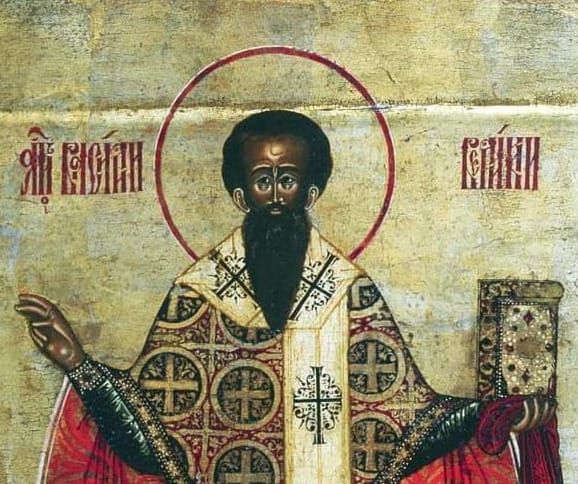
St. Basil of Caesarea (c. 330-379) is one of the most important Church Fathers and founders of monasticism.
He came from an upper-class and devout Christian family of Pontus. After higher studies at Constantinople and Athens, he had a conversion and abandoned the career of rhetor for a life of Christian asceticism and was baptised.
In 362, he was ordained a presbyter in Caesarea, formed a community of ascetics, but left for Pontus after falling out with the bishop.
Three years later, he returned to Caesarea, reconciled with Eusebius, and, amid a controversial election, succeeded him as bishop of Caesarea in 370.
The year before becoming bishop, he organised a remarkable relief effort during a famine.
During his episcopacy, he defended the Council of Nicaea but also courted controversy and opposition with his interventions in ecclesiastical politics.
A doctor of the Church, with St. John Chrysostom and St. Gregory of Nazianzen, he is venerated in the Eastern Churches as one of the Three Holy Hierarchs.
In this interview, Stephen M. Hildebrand discusses the life and work of St. Basil the Great
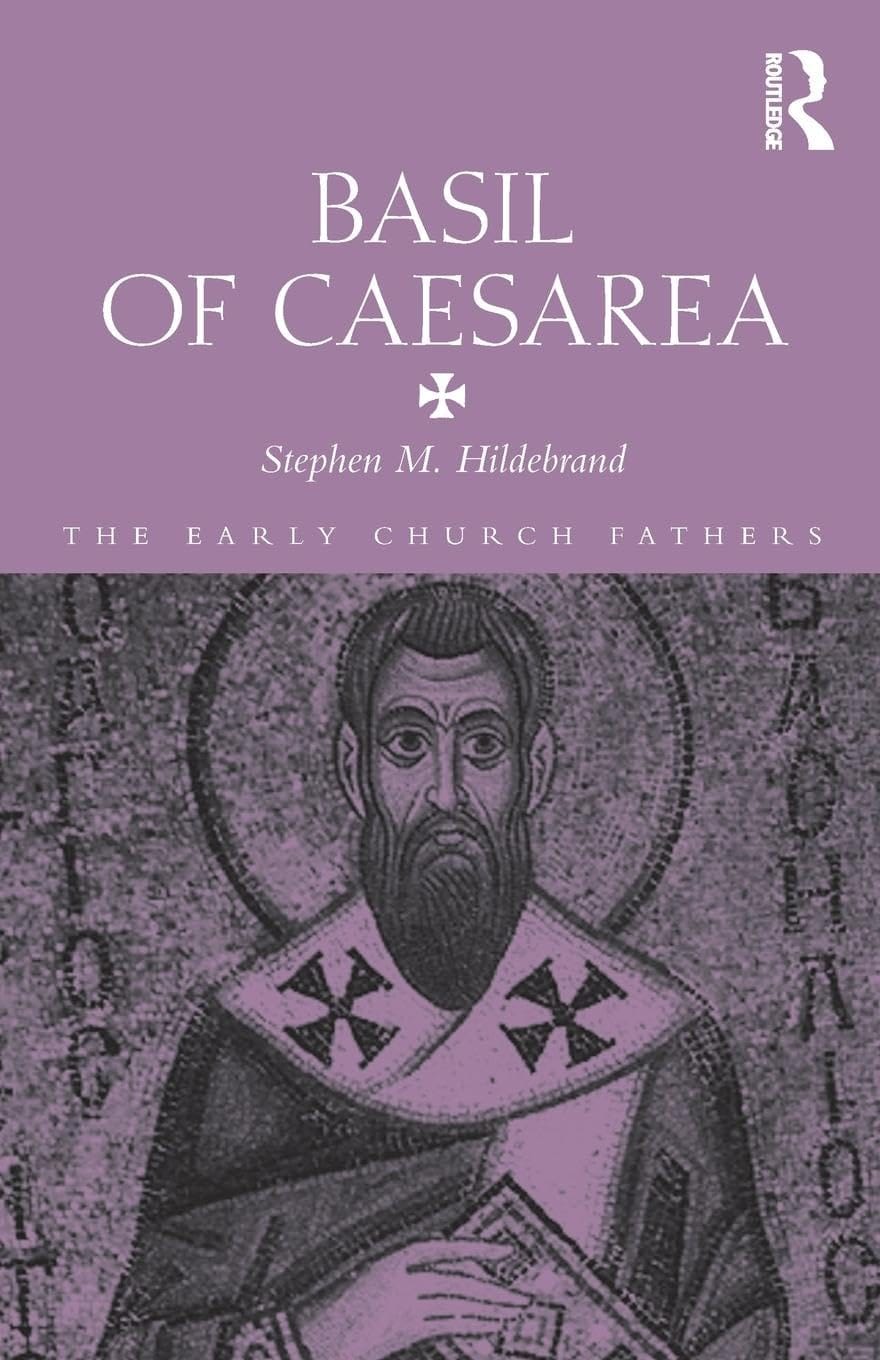
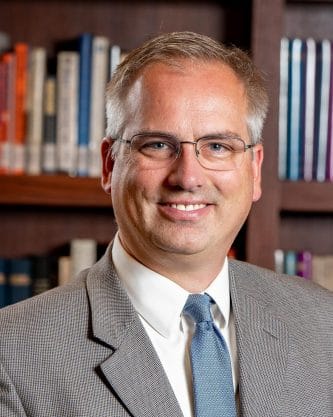
Stephen M. Hildebrand is Professor of Theology and Vice President for Academic Affairs at the Franciscan University of Steubenville. He is the author of The Trinitarian Theology of Basil of Caesarea: A Synthesis of Greek Thought and Biblical Truth (CUA Press), Basil of Caesarea (Routledge), Basil of Caesarea: Foundations of Theological Exegesis and Christian Spirituality (Baker Academic) editor of the Popular Patristics Series edition of St. Basil’s On the Holy Spirit.
- On the Holy Spirit
by St. Basil - Homilies on the Six Days of Creation [Hexameron]
by St. Basil - On Christian Ethics (alternative edition)
by St. Basil - The Long Rules
by St. Basil - Letters (vol. 1) (vol. 2)
by St. Basil
What are the main events of St. Basil’s life?
I would start just before he was born. In 325, there was the Council of Nicaea. This ecclesial event loomed very large in Basil's life.
So did the Great Persecution, which occurred little earlier still. His maternal and paternal grandparents suffered in that persecution. They were confessors: Christians who stayed faithful in a time of persecution. That persecution marked his parents and his whole family profoundly.
A key moment in his life was his return from school in Athens. We are not quite sure what happened. Anna Silvas speculates that he came home on account of the tragic death of his younger brother, Naucratius. In any event, an exchange with his wonderful sister, Macrina, converted him to the ascetic life. Instead of becoming a secular teacher of rhetoric, he was baptized, and embarked upon the ascetic life.
His ordination was another key event. He never planned to be a bishop. Entering the doctrinal life of the Church and disputes of the times was a profound decision for him. He debated whether to live his ascetic life in the countryside or in the city. He tried both and but settled on the latter. This was a very important decision for him, indeed for the life of the Church and the future of asceticism.
Finally, his meeting with Gregory and the unfolding of that relationship were profoundly important in St. Basil's life.
During the famine of 369, Basil built a complex—later called the Basileiados— which acted as centre for a monastic community and works of corporal mercy. Was he simply following an existing precedent or pioneering a new kind of institution?
There were some precedents but Basil took these activities to a new level. That is where he is original.
For example, he decided to practice asceticism in the city, first as a priest and then as a bishop, and put that ascetic activity at the service of the Church. Basil's mentor, Eustathius, had set some precedent for that. However, Basil took all that to a whole new level.
Moreover, nobody had ever built such a complex. Gregory of Nazianzus called it a new city, the Basileiados. Though there were some precedents for it, it is original in both its scope and intensity.
"The saints need to get into the mess of ecclesial politics."
Like St. Cyril of Alexandria, Basil engaged in some questionable politicking as bishop. To preserve his influence in the region, he made his brother bishop of Nyssa and manipulated Gregory of Nazianen into becoming, against his will, bishop of Sasima. Perhaps his uncle, who opposed his election as bishop of Caesarea, was aware of this side of Basil. What should we make of this less saintly side of his personality?
Basil made mistakes. There is no question about that. Gregory thought so and that Basil had risked his friendship. However, the saints need to get into the mess of ecclesial politics.
Take the way Basil made Gregory of Nazianzus and then Gregory of Nyssa bishops. His diocese had been cut in half by the emperor. The dioceses were being divided according to the imperial provinces. In a shrewd move, the Arian emperor Valens divided Basil's province in half. This severely diminished the number of bishops that Basil had under him as metropolitan. In making new bishops, Basil was responding to that move.
What would have been the saintly thing to do? Simply to let Valens have his way? That would have left the Arianizing bishops the dominant force. I am sympathetic to Basil, maybe because I am administrator and think of academic politics. That side of the Church and universities is unavoidable. You need to handle it the best you can, with honesty and charity.
It was important for Basil to respond shrewdly to Valens, who was trying to diminish the influence of the pro-Nicene bishops. I do not fault Basil for multiplying bishoprics. That was the smart thing to do and probably even the holy thing to do. However, he should not have duped Gregory into coming to his own ordination. Basil did not navigate these matters perfectly. Nor did St. Cyril of Alexandria.
 Five Books for Catholics
What was the reason for St. Basil’s disagreement with St. Athanasius?
At the time, Athanasius, Basil, and many others were working out the best way to speak about the Trinity. They knew that they agreed in truth and had the same faith. However, they disagreed over what was the best way to speak of the Trinity. how best to talk about it. So when this became very concrete,
At one point, the See of Antioch had four bishops: an Arian, an Apollinarian, and two Nicene bishops, the one in communion with Athanasius, the other with Basil. The frustrating thing is that in this instance Basil and Athanasius were making the same mistake. They invested too much in words.
In 362, Athanasius wrote a very important Letter to the Antiochians (Tomus ad Antiochenos), where he allows for some flexibility of language. St. Basil never quite allowed for the same flexibility. He wanted Christians to confess that there are three hypostases. He uses hypostasis for person, where Athanasius used it for the one God and professed that Father and Son are of the same hypostasis. Basil wanted to use ‘hypostasis’ to refute modalism, whereas Athanasius had his own way of refuting it. That was their basic disagreement.
Basil wrote Athanasius six letters to persuade him to adopt his solution to the problem— which eventually the Church did adopt—but Athanasius never responded.
"Basil, therefore, acknowledged that we sometimes need to use technical terms but sees this as unfortunate."
St. Gregory of Nyssa was Basil’s brother. St. Gregory Nazianzen was his friend. These three Church Fathers are known as the Cappadocians because they share many common doctrines. How does the teaching of St. Basil differ from that of the other two Cappadocians?
As you said, the most important things they share in common.
For example, they had a common way of thinking of God and his relation to creation. This was a huge question for the Church at the time. It may sound crazy to us but some Church Fathers, influenced by the Greek tradition, thought of God as a ranked divinity: the Father is at the top, the Son a little below Him, and the Spirit a little bit below them both. Athanasius and the Cappadocians realized that this subordinationism does not make sense and is inconsistent with the Gospel. Hence, they make a radical division between God and creation. This is one thing the Cappadocians have in common.
However, they differ on a couple of things.
One is the question of the Holy Spirit. In his fifth Theological Oration, Gregory of Nazianzus asserts that the Spirit is God and that he is consubstantial with the Father. Basil was reluctant to make those assertions, not because he did not believe them, but because he was reticent to do so. This reticence is called the Basilian reserve or economy.
He was reticent to use expressions that did not appear in Scripture. He accepted that the Council of Nicaea has used the term ‘consubstantial’ (homoousios) even though it does not appear in Scripture. He accepted that and tolerated it.
However, he preferred not to use words that did not appear explicitly in Scripture. The clause on the Holy Spirit in the Constantinopolitan Creed is very Basilian. That Creed does not call the Holy Spirit God or consubstantial with the Father. It calls him “the Lord, the giver of life.” This clause is based in Scripture and so is very Basilian. However, it is not very Gregorian. Both Gregory of Nazianzus and Gregory of Nyssa would have preferred to confess—and did freely confess—that the Holy Spirit is God is consubstantial with the Father and the Son. Gregory of Nazianzus and Basil even exchanged letters on this point. In his letter, Gregory criticised Basil for not making this profession. In a couple of texts, Basil comes close to doing so. In one text, Basil speaks of a consubstantial Trinity. For the most part, however, he never directly addresses the Holy Spirit as God or talk of him as being consubstantial, even though he obviously believes and argues that he is. That is a theological difference.
On the ascetic side, Gregory of Nazianzus never embraced the organized ascetic life in the way that Basil did. Although he led a very ascetic life, his was more of a hermitic asceticism. He would withdraw from society and retire into the countryside. He was pulled back to his family and away from the ascetic life in a way that Basil was not.
Early on in their lives, right after their schooling in Athens, Gregory went to Alexandria. Basil wanted him to come to his country estate in Pontus, near the Black Sea so that they could live the ascetic life together, withdrawn from society. Gregory did so for a time but then left. So, their asceticism is different. Basil is the founder of a wonderful ascetic tradition. Gregory of Nazianzus and Gregory of Nyssa, who seems to have been married, were not. There are similarities between Basil's ascetic vision and theirs, but the way in which he lived it out is very different from theirs.
 Five Books for Catholics
Was Basil entirely consistent on the first point you mentioned? If he was reluctant to call the Holy Spirit consubstantial with the Father because Scripture never uses the term ‘consubstantial’, why did he insist on calling the three divine persons hypostaseis, another term which Scripture does not use for them.
That is a great question. Hebrews 1:3 uses hypostasis but this is a very enigmatic verse and cannot be used as a clear proof text for Basil.
If I could speak for Basil, basically he would say that we use technical non-Scriptural words when we need to.
The Council Fathers at Nicaea felt they needed to. They were right. If you limit yourself to the words of Scripture, it is very difficult to refute Arianism. If you tried to, Arius would assent to every Scriptural text proposed but interpret it according to his mind rather than that of the Church.
Basil, therefore, acknowledged that we sometimes need to use technical terms but sees this as unfortunate. He blames the heretics for this unfortunate turn of events. He believes that it is necessary to use ‘hypostasis’, but not to apply ‘consubstantial’ to the Holy Spirit. Nevertheless, the Creed of Constantinople does refute modalism without using hypostasis. One of the differences between the Nicene Creed and the Constantinopolitan Creed is that the latter adds a clause with a quotation from Scripture: “and of his kingdom, there will be no end” (Luke 1:33). That clause is designed specifically to refute the modalism of Marcellus of Ancyra, who believed that the Son would cease to exist when he handed the Kingdom over to the Father (Later, he repented of his modalism). Hence, whenever we confess with the Creed of Constantinople that “his kingdom will have no end,” we are confessing that his person will have no end. This is an anti-modalist confession.
Basil died a couple of years before the Council of Constantinople, he would have liked its Creed very much, even though it proves, contrary to what he insisted, that you can have an anti-modalist creed without using hypostasis.
However, he was right about the clause on the Holy Spirit. There is no doubt in anybody's mind that the Holy Spirit is divine. It does not matter that we do not call him God.
Is St. Basil the author of the Divine Liturgy that is attributed to him?Yes, basically he is. This is one aspect of St. Basil I have not studied all that much. As with other questions regarding St. Basil, it is very complicated.
These liturgies have a very complicated textual history but definitely resemble St. Basil’s thought and language.
In this regard, they remind me of the textual issues surrounding Basil’s Hexameron. These nine sermons on creation do not reach the creation of man. However, there are two sermons on the creation of man that are attributed to St. Basil. The textual tradition by which they have come down to us is less clean. Consequently, scholars debate their authorship. Philip Rousseau, who has done some wonderful research on them, concludes that, even if Basil didn't write them, he might as well have. They come from in his circle or school. They are inspired by his thinking.
Although this is not my area of expertise, my guess is that something similar happened with the Liturgy of St. Basil. He did not sit down and write it out in a single go, onto a manuscript that was then preserved and copied for centuries, without any addition, subtraction, or revision. More likely, the text originated with him, was revised by him, and then developed organically as a living liturgical text. It is still true to say that it comes from him.
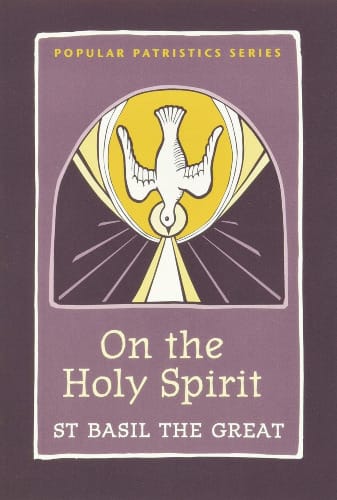
1.
First up, is St. Basil’s treatise On the Holy Spirit. It was written to settle the dispute over the divinity of the Holy Spirit. That dispute was settled subsequently at the First Council of Constantinople (381). Why is Basil’s treatise still worth reading?
For one thing, the Council of Constantinople did not settle the controversy entirely. All these controversies continued to brew. It was really Theodosius's laws against heresies that finally put a lid on them.
However, the Creed does not give an argument. St. Basil’s On the Holy Spirit
does and engages the opponents of Nicaea. In the process, all kinds of wonderful things come up: the way that the Scriptures speak of both the Father and the Holy Spirit, along with questions about Tradition and doctrinal development.
On the Holy Spirit is a classic text on the relation between Scripture and tradition. It is almost as if Basil’s opponents hold to sola Scriptura. They want to limit themselves to the Scriptures and leave no space for Tradition or doctrinal developments. Basil is opposed to that view.
On the Holy Spirit, therefore, is a window into a whole range of theological arguments and issues, even though it addresses a question that has since been settled.
This is true of many theological questions. The Lord has left so much undone and so much for the Church to figure out. This attests to the dignity with which he has created us and the way he has saved us. We participate in the ever deeper unfolding of the truth revealed in Christ. There is a wonderful dignity to this. However, once progress has been made, we do not leave it behind.
It is good for us to kind of relive these developments with the Fathers of the Church and participate in them. It is beneficial for our own souls and minds. Contrast that with technological developments. Nobody goes back to use the technology of first-generation smartphones. There is no point in that. It does not help us. Similarly, a farmer with a tractor will not bother to learn how to use a horse-drawn plough. With the faith, it is different. There is a tremendous benefit in going back and getting inside the mind of St. Basil, St. Athanasius, and their opponents. We relive and retrace their steps in this development of doctrine. This is very fulfilling spiritually and intellectually. The Lord has made us for this sort of thing.
Basil’s Against Eunomius is his other systematic treatise against Arianism. Why have you recommended On the Holy Spirit over it?
On the Holy Spirit is better known and more accessible. It is also a mature work. Basil wrote Against Eunomius when he was quite young.
Against Eunomius addresses a similar set of questions but is focussed on the Son rather than the Spirit. The question of God’s relation to creation comes up in both works. Is there a ranking in the divinity and so a soft distinction between God and the world or is there a radical break and distinction between the two?
Nevertheless, Against Eunomius is a little more esoteric and a less mature work. It was written about ten years before On the Holy Spirit, which Basil wrote as a bishop in the 370s.
What made St. Basil shift from the homoiousian to the homoousian party: from professing that the Son is similar in essence to the Father (homoiousios) to professing that he is consubstantial with the Father (homoousios)?
Basically, he recognised that homoiousios opened the door to a certain kind of. This was a startling recognition for him. It ended his relationship with his mentor, Eustathius of Sebaste.
He realized that you could hold an Arian position while confessing homoiousios, but not if you confessed homoousios. This is the question that we dealt with earlier. What are the best words for expressing the true faith?
In many texts, Basil expresses the faith without technical language. However, he acknowledges that technical language is unavoidable in certain contexts. Over the years, he came to this realization.
None of the technical words is free of problems. Hence, he had issues with homoousios and for a time preferred homoiousios. Later, he realized that, on balance, the issues with homoiousios are more severe than those with homoousios.
The same reasoning drives him to insist upon hypostasis. He thought that it was the best word for avoiding theological mistakes.
Nowadays, there are similar debates. It may sound a bit dated, there was the theological debate around whether we should use transubstantiation, transfiguration, or transignification to describe what takes place in the Eucharist.
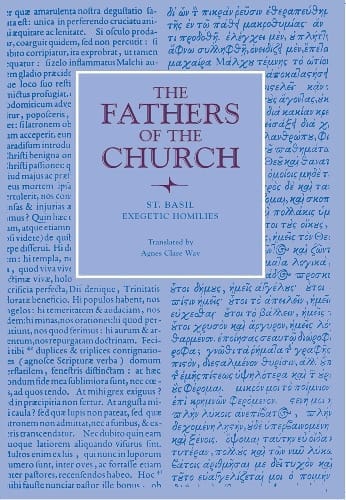
2.
St. Basil’s nine homilies on the six days of creation (Hexameron) were widely admired by other Church Fathers, such as St. Gregory of Nazianzen, St. Gregory of Nyssa, St. Ambrose, and St. Jerome. M odern exegetes might be less impressed and find them outdated. Does St. Basil’s Hexameron provide insights and perspectives that modern commentaries lack?
That is a great question. You are right. Modern Scripture scholars have a hard time with the Fathers in general and do not tend to see them as useful, particularly when it comes to their interpretation of Genesis.
However, we can learn from their respective interpretations of Genesis.
 Five Books for Catholics
For example, in his Hexameron, it is obvious that Basil believes in the divine authorship of the biblical text. Most modern scholars do not. Instead, they think of the early chapters of Genesis as a set of texts by different authors or schools (Jahwist, Elohist, Deuteronomist, Priestly source). The modern approach can be very fruitful. However, it has the real danger of atomizing the text and taking it out of a religious context. It reduces the text to mere human history. That human history is important for understanding the text, but St. Basil and the Fathers remind us that this text is divinely inspired and so has a unity.
Early in the Hexameron, Basil claims that God is teaching us theology when he says, “Let us make man in our image”. Genesis then goes on to say, “God created man in his own image.” Genesis alternates between the plural and the singular. Basil sees this as a reference to the Trinity; there is one God but three persons. Hence, the Lord is teaching us ‘theology.’ For us, theology is very general. For Basil, it is very focused. It is the understanding of God himself: the triune God.
Modern biblical scholarship needs to learn from Basil and the Fathers about the larger questions about Scripture, its nature, and its relation to the Church. The moderns tend to answer these questions differently. Some interpretations of the Fathers are not very helpful. However, modern exegetes can learn a lot from their general approach to the Scriptures.
"To live out the Gospel, you draw out and privilege certain texts that help you understand what God is asking of you."
3.
The Morals is a three-part work. It is prefaced with two short treatises: On the Judgment of God and On Faith. The Morals itself consist of rules on the spiritual and moral life drawn from Scripture. Why have you selected this work?
In the textual tradition, the Morals has come down to us with those two prefaces on faith and on judgment, although it was written before them.
This work gives us an insight into Basil's early development as a theologian, but above all as a Christian.
He wrote it shortly after his conversion at the hands of Macrina and his baptism. He had withdrawn from society to his country estate and was living a simple, rustic life with his friend, Gregory of Nazianzus.
They were striving to live an evangelical life and drew from the New Testament the texts that for them were the key to the living out the Gospel. To live out the Gospel, you draw out and privilege certain texts that help you understand what God is asking of you. Think of the texts that guide the Franciscan life or inspired St. Anthony.
So, Basil and Gregory were making their rule of life. Every Christian can benefit from doing this. Every family needs to do it.
Of course, there are the Ten Commandments, but every family needs to develop rules, patterns of behaviour, and concrete precepts that guide its life. By doing this, Basil and Gregory give us some insights into this basic dynamic of Christian life. They pick the texts from the New Testament that they consider to be the keys for their ascetic life.
"Basil's rule has been dominant in the East up to the present."
4.
The “Asketikon” is divided into two parts: the Longer Rules (Regulae fusius tractatae) and Short Rules (Regulae brevius tractatae). What is their relation to the Asketikon?
The Asketikon is the whole work.
The Great Asketikon is the Longer Rules and the Shorter Rules taken together. Those are the Greek text.
The Small Asketikon is the Regula Basilii. It is Rufinus of Aquileia’s Latin translation of an early version of the Great Asketikon. He bequeathed this wonderful gift to the Western Church. It is the text that St. Benedict, in his Rule, recommends that the monks study.
The textual relationship among those works is complex. This is due the origin of the work. Basil did not sit down at his desk and write these works in a single sitting or set of sittings.
They were all the result of what one scholar calls monastic conferences. This is apparent from their structure.
In Caesarea, maybe at the Basileiados, Basil would hold retreats with the monks and his following. During those retreats, there would be conferences in which the monks asked Basil all sorts of questions. “What do you think of the words ‘consubstantial’ and ‘hypostasis’?” Against Eunomius is the fruit of a monastic conference in which the monks discussed the faith and such theological questions.
However, they also discussed ascetic matters, such as how to conquer certain sins or deal with distraction in prayer.
As the monastic communities grew, their leader would ask Basil for advice. “How do you discipline your monks when they do such and such? How do you help them deal with such and such a difficulty?” The work reveals the historical context in which these ascetic rules arose.
It makes perfect sense there are different versions of the Rules: longer and shorter forms. Basil edited the text over and over.
In the Longer Rules, he could give some order and structure to these questions and ad hoc conferences. He deals with questions of admission before those on prayer. He adds a long preface which outlines the ascetic life. There is a beautiful text in which he argues for life in common as opposed to the hermetic life.
In this wonderful text, Basel outlines his vision for the ascetic life, the monk’s daily life, the issues he faced, and how the community would grow over time.
"He does not distinguish, as some in the Church do, between the ascetics and non-ascetics, between the real Christians and the hopeless clods of flesh."
What influence did St. Basil exert on Eastern and Western monasticism?
A tremendous influence. Prior to Basil, the only great Eastern rule of cenobitic life—ascetic life in common—was that of St. Pachomius, from the third century. Thereafter, Basil's rule has been dominant in the East up to the present.
In the West, the Regula Basilli has influenced the Benedictines and all those that they in turn have influenced.
In both the East and the West, Basil has been a huge figure in the history of monasticism.
Are the Longer Rules useful not just for monks but for the laity too?
For sure. I love to think about St. Basil’s vision of the laity and his universalism. He believes everyone should keep the commandments. He does not distinguish, as some in the Church do, between the ascetics and non-ascetics, between the real Christians and the hopeless clods of flesh.
The Church speaks of how families are the domestic church. This is a beautiful image. However, there is another good image, one which resonates with St. Basil: the family is a domestic monastery. Every family needs to pray together. It needs to have a rule: a way of dealing with spiritual problems, rules for worship and liturgy, silence and recreation. There is a rule of life for the laity.
In its life, a family can draw on St. Basil on how it will live the gospel. He is a great resource. This ties in with what I was saying about the Morals. Every Christian need to articulate his way of living the Gospel. So does every family.
The Longer Rules and Shorter Rules are concrete and deal with very specific issues. What are we going to eat together? What is your family going to do for Lent? What are your penances going to be? What shall you give up as a family? When will pray together as a family? When will go to Mass together? Will you attend Mass daily or do something else? Which works of charity will you perform as a family?
Every monastic community needs to address such issues and so does every family. The Rules of St. Basil, indeed any of his monastic works, are of great help in answering those questions.
5.
One translator of St. Basil’s 368 extant letters, Sister Agnes Clare Way, described them as “the most vivid and personal portion of his works.” Why are the letters worth reading?
The letters give more insight into his into his personality than the other works.
Sister Agnes Clare is right. There is a literary quality to the letters. However, I do not read them for that reason but for the insights they can give.
For example, he wrote a letter about the dissolution of his friendship with Eustathius. He lays bare his heart. He tells you about his formation as a child, what Eustatius meant to him, and how, when Eustatius betrayed him, he was so upset that he could not even talk about the matter for a couple of years.
The letters also give an insight into his pastoral care and a sense of the issues he dealt with as a bishop, his heart, and his mind.
For example, in one letter he asks a Roman governor for a tax break for a Christian widow.
There are also his letters to his fellow bishops. Earlier, we talked about his relationship with Athanasius. The letters are the only reason we know about it. In them, he gives a sense of his theological programme and his frustrations with Athanasius.
Summing up, they give deep insights into his person, theological mind, and the historical context in which he's operating.
He wrote letters to all the major theological players of the time. The letters tell us the reason for his decisions and positions. They tell us who his opponents were. They are very illuminating.
Do any of letters stand out? What are the main letters that are worth reading?
A few sets do, though they are not organized sequentially this way in the corpus.
There is a very interesting set of letters on ascetic matters. Some describe his own ascetic journey. Others are letters to fellow ascetics, where he lays down some rules.
Another is the set of theological letters. For example, there are letters to Amphilochius in which he argues against the Eunomians and their basic vision of God. There are also letters about what which words, such as homoousios and hypostasis, we should use to describe God.
There are the three canonical letters to Amphilochius, who was then a young bishop. These basically contain his canon law. Amphilochius would write to him with questions about penances: do you give a different penance for murder and manslaughter?
In his replies, Basil provides canons that detail which penances should be given for certain sins. These letters provide a wonderful insight into how the sacrament of penance was administered at that time.
The letters of patronage are another group. In Basil's time, a bishop became the patron of every member of his flock. So, people requested the bishop for all sorts of help, oftentimes with governors or civic leaders.
Finally, there are the letters of consolation, such as the ones he wrote to a woman on the death of her child or to a widow upon the death of her husband. They are beautiful.
I remember the one that I had to translate when I was a young student: the Address to Young Men on Greek Literature.
I should have mentioned it too. It is also good. Some of the letters of the Church Fathers become works of their own. This lengthy letter is an example. It is a little treatise.