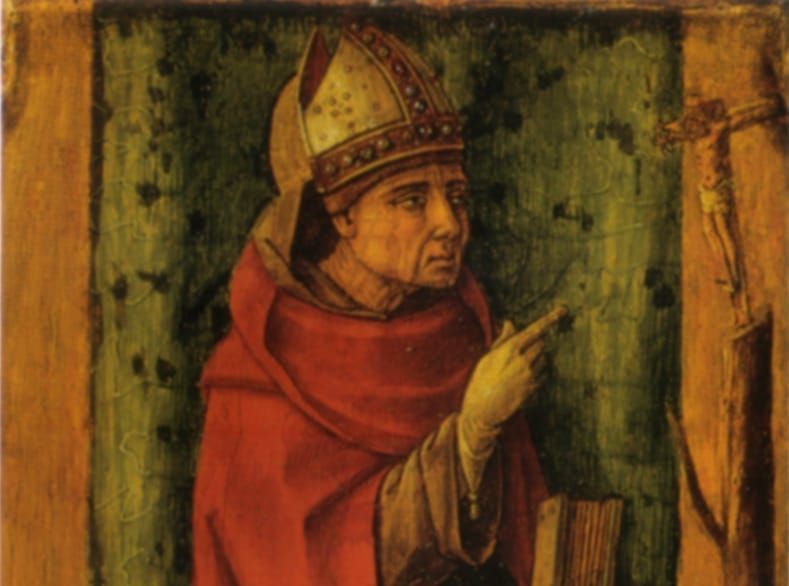
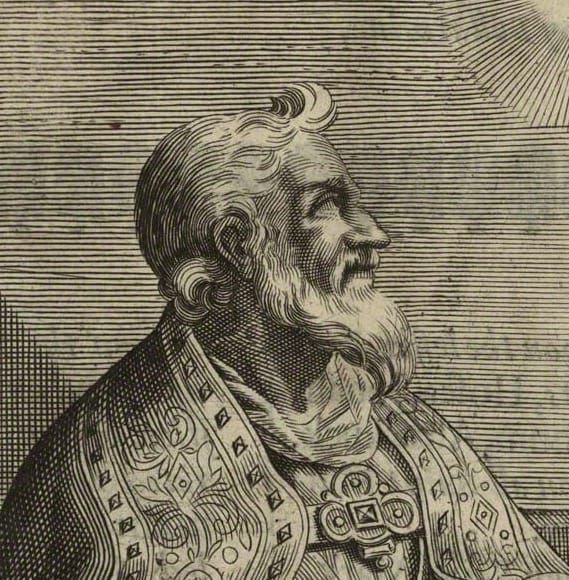
St. Anselm (c. 1033/4-1109) was a Benedictine monk, abbot, writer, and Archbishop of Canterbury (1093-1109).
He was born at Aosta, Upper Burgundy. In 1060 he entered the monastery of Bec, Normandy, helped make it a leading institute of learning, and was elected abbot after eighteen years.
Following the Norman Conquest, Anselm was obliged to visit the estates in England that had been donated to Bec and was eventually made Archbishop of Canterbury. His episcopacy was not a peaceful one. He clashed with the crown in the Investiture Controversy and was exiled twice.
However, Anselm is remembered today mainly for his writings which, pioneered and developed the nascent medieval scholasticism. Philosophers continue to ponder the argument for God’s existence that he proposes in his Proslogion: if God is that than which nothing greater can be thought, then God must exist. Theologians continue to discuss his explanation of the motives for Christ’s Incarnation and death on the cross.
He was declared a Doctor of the Church in 1720.
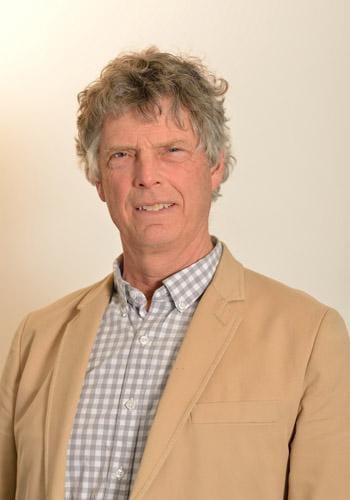
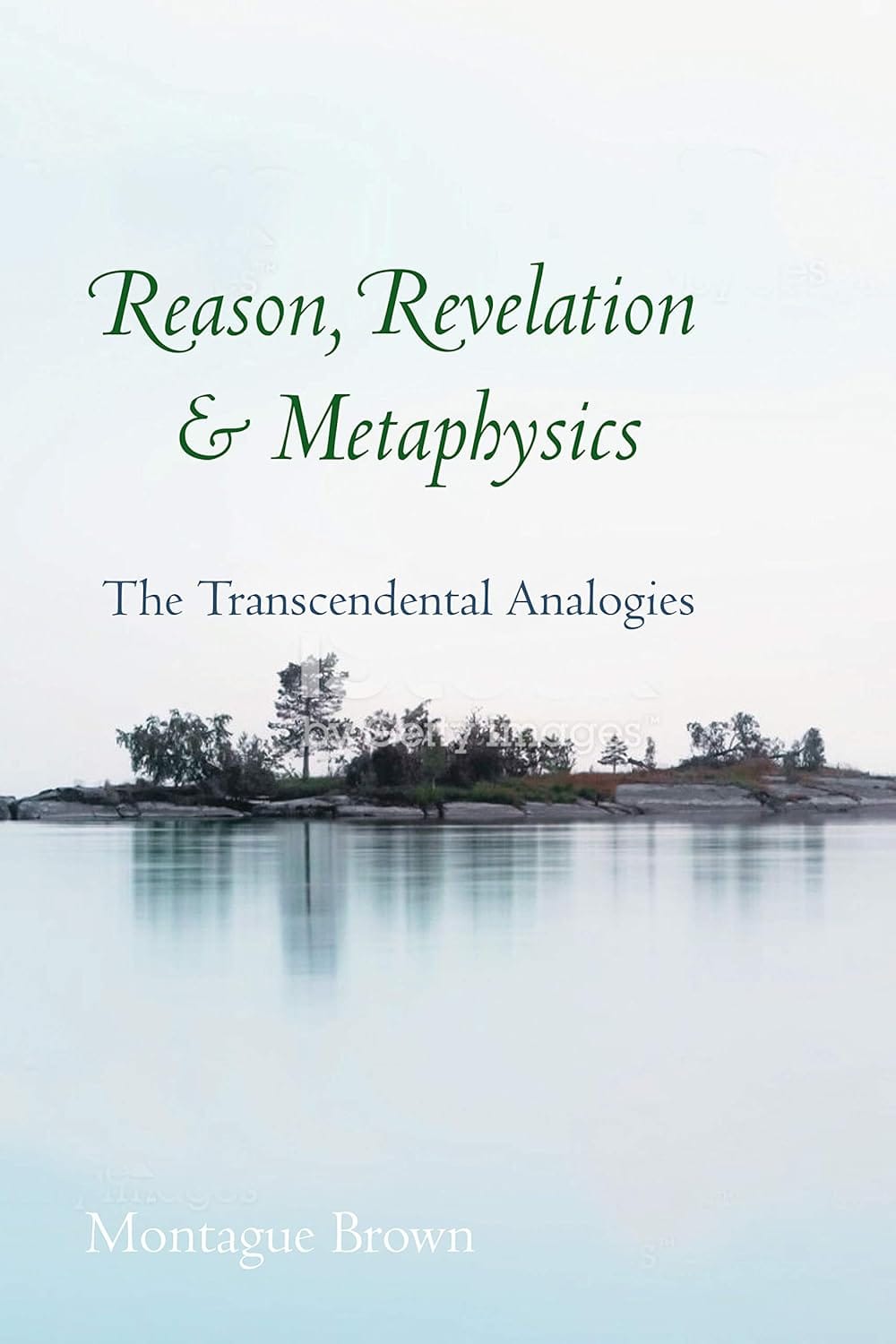
Montague Brown is Professor of Philosophy at St. Anselm College. His areas of interest are medieval philosophy (mainly Augustine, Anselm, and Aquinas), metaphysics, ethics, philosophy of mind, and the relation between faith and reason. He is the author of The Quest for Moral Foundations: An Introduction to Ethics (Georgetown University Press); The One Minute Philosopher (Sophia Institute Press); The Romance of Reason: An Adventure in the Thought of Thomas Aquinas (St. Bede's Press); Half-Truths: What's Right (And What's Wrong) With the Cliches You and I Live by (Sophia Institute Press); Restoration of Reason: The Eclipse and Recovery of Truth, Goodness, and Beauty (Baker Academic); Freedom, Philosophy, and Faith: The Transformative Role of Judeo-Christian Freedom in Western Thought (Lexington Books); and Reason, Revelation, and Metaphysics: The Transcendental Analogies (CUA Press).
- Monologion
by St. Anselm - Proslogion
by St. Anselm - Cur Deus homo (Why Did God Become Man?)
by St. Anselm - De veritate (On Truth)
by St. Anselm - De concordia (The Compatibility of God's Foreknowledge, Predestination, and Grace with Human Freedom)
by St. Anselm
What is most striking about St. Anselm as a monk and bishop?
He is a very interesting figure because he has so many features. While Prior, he wrote works for his monks. He continued to write when abbot and even as Archbishop of Canterbury. He was a good philosopher and a great theologian. He was very involved in both monastic life and the life of the Church. He also had to deal with headaches and difficulties with the kings of England.
What is most striking about St. Anselm as a theologian?
In many cases, he tries to explain as much as he can through philosophy alone. For example, in the Monologion, he claims that he will not talk about Christ himself. Moreover, he uses ‘God’ only in the first and last chapters. Otherwise, he speaks of the supreme essence. He claims to be doing the same sort of thing in Cur Deus homo: he attempts to answer a question through reason rather than through faith.
But of course, the Proslogion is all about faith seeking understanding. It is very much dedicated to the faith. His shorter works, On Free Choice of the Will and On the Truth draw on Scripture.
However, in De concordia (The Harmony of the Foreknowledge, the Predestination, and the Grace of God with Free Choice) he concludes that in the end all is grace. He wants to open up the world to God’s free creation by basing himself not just on metaphysical arguments, but on God’s love for humanity.
Although St. Anselm distinguishes faith from reason, he probably would never have considered himself a philosopher or writer of philosophical works. Nevertheless, he is widely studied by philosophers, both believers and non-believers. Is it appropriate or reductive to read him from a purely philosophical standpoint?
You are right. It is reductive to read him in that way. Even if you read the Monologion, around Chapter 28 he talks about the Trinity as Father, Son, and Holy Spirit. Those are personal names. You cannot deal with the Trinity just in terms of understanding, memory, and love, as Augustine sometimes does. It is too narrow to read Anselm as just a philosopher. He certainly has other interests.
"In his prayers and meditations, such as the opening prayer of the Proslogion, Anselm is not at all scholastic, but is concerned with loving Christ and the existential problem of how to get back home."
Who were the main influences on St. Anselm’s thought?
St. Augustine is his favourite thinker and main influence. At the beginning of the Monologion, he contends that if he makes too many claims from reason about the Trinity, then we should take a look at Augustine's On the Trinity. Of course, at the end of On the Trinity, Augustine points out that nothing can really explain the Trinity, no matter how much we try to provide answers based on examples from our life. That is Augustine's position. By the end of Anselm's life, it is his, too. Thomas Aquinas, who claims that there are not any philosophical reasons per se for the Incarnation or the Trinity, is also in that tradition. So is Boethius to some degree.
In explaining eternity, Anselm uses some language that harkens back to Boethius. However, Boethius’ On the Consolation of Philosophy is mostly a philosophical work, whereas Anselm goes way beyond philosophical theology.
St. Anselm stands at the bridge between monastic theology from the Middle Ages and the nascent scholastic movement. Did he lay the groundwork for medieval scholasticism?
He did. In his Monologion, he recognises that it is quite hard to follow his long drawn-out arguments, of which there are also quite a lot in Cur Deus homo, and keep them all in mind. There are so many of these arguments piled upon each other. This analytic style aims at showing how each point makes sense and then leads to another one. So, yes, he lays the groundwork for medieval scholasticism.
He is of two minds to this approach, just as Augustine may have been, as well. Augustine’s On Free Choice of the Will and On the Trinity are more philosophical and analytic, but his Confessions is much more existential and phenomenological. In his prayers and meditations, such as the opening prayer of the Proslogion, Anselm is not at all scholastic, but is concerned with loving Christ and the existential problem of how to get back home. So, Anselm is really on the cusp of the two movements, monasticism and scholasticism. He never gives up the deep spiritual love of God that guides him in the Proslogion.
Are there any good monographs on Anselm's life or which give an overview of his thought?
I have not followed those books that deeply but have focussed more on his philosophical theology. Katherin Rogers has written helpful works on his On Free Choice of the Will, while Eileen Sweeney also wrote a book on the love that drives his work.
"For I do not seek to understand in order to believe, but I believe in order to understand. For I believe even this: that unless I believe, I shall not understand."
St. Anselm, Proslogion
What drew you to study St. Anselm?
Many things. I wrote my dissertation on Thomas Aquinas but had read Anselm in graduate school. Much of my writing has been on Aquinas and Augustine. However, when I came to St. Anselm College, Anselm seemed an important element to add to my life. Then I was asked to be Director of the Institute for St. Anselm Studies.
I have written a number of papers on Anselm but never a whole book.
Anselm is a brilliant mind for his combination of analytic depth, love, and commitment.
He is very clear at making his points. However, sometimes he finds it hard to hold the whole argument together because it is strung out. That is why he wanted to find a simpler argument with the Proslogion.
1-2
That brings us to the first book on your list Anselm’s Monologion. He opens with various arguments for God’s existence. From the results of those arguments, he proceeds to work out and justify the various divine attributes. What are Anselm’s main contributions in this work?
The opening two arguments are standard Platonic ones.
The first holds that if there are many different things in the world that are good, they all share something in common, and so there must be a transcendent good.
The second argument is that, if things are good to a greater or lesser degree, then there must be a standard of goodness to which they all refer. Thomas Aquinas picks up this second argument.
Following from these arguments, Anselm considers what a free creation would be like. It is creation from nothing. This does not mean ‘not from anything’ nor ‘from something that is called nothing’ but with no priority. Creation is free. If creation is the source of all truth, then truth is also free. Anselm gets into this in De veritate.
Anselm was not entirely satisfied with the Monologion, as you mentioned, and sought a single argument from which he could work out and justify God’s various attributes. His demonstration was later called the ontological argument, though the fittingness of that name is dubious. What is the Proslogion’s argument for God’s existence and does it work?
He starts off with faith and states, “We believe that you are that than which nothing greater can be conceived.” Some take this as a first premise. However, if you leave belief out for a second, which is not what Anselm is doing, then the second premise is, “It is greater to exist in reality and the mind than just in the mind.” Therefore, God exists in reality.
In many ways, this is very strong as a logical argument. Thomas Aquinas disagrees with it. In his view, it contains four terms rather than three. It starts with the idea of God rather than with experience of the world and inferring God’s existence from that experience of the world. Hence, it can only yield conclusions about the idea of God.
Anselm justifies his main argument in his Reply to Gaunilo in a way that I believe would probably satisfy Thomas Aquinas. His basic argument is based on the same insight as the arguments from the Monologion. It is based on the idea of good. Our search for the good means that whenever we recognise that something is missing in a thing or our account of it, then we have not reached God. God is that than which nothing greater can be conceived. If we recognize that we do not have the whole truth or that we are not perfectly happy, then there is always something more that is calling us forth as we try to understand God.
Anselm’s contemporary, Gaunilo of Marmoutiers wrote a critique of the Proslogion’s argument for the existence of God. The gist of his objection is that thinking of the most perfect kind of island does not necessitate the existence of such an island. Similarly, the concept of ‘that than which no greater thing can be conceived’ does not necessarily entail the actual existence of that thing. Does Gaunilo debunk the argument of the Proslogion?
In the end he does not, or at least Anselm has a good reply to his objections.
Regarding the example of the perfect island, Anselm insists that his argument works only for that than which nothing greater can be conceived. It only works for God. The best island does not have every perfection but only the perfections of an island. The only being that could have all perfections is God, the transcendent source of all things.
Gaunilo’s other objection is that you cannot come to a conception of that than which nothing greater can be conceived. Going back to the foundations of his Monologion, Anselm argues that we can come to such a conclusion from our experience of how some things in the world are greater or lesser in their goodness than others.
I do not know whether St. Thomas was aware of this reply, but it hearkens back to something with which he would agree. In demonstrating God’s existence, we start with things, not with a mere idea.
Subsequently, Anselm’s argument in the Proslogion was called the ontological argument. Is that an appropriate name for his argument?No. It is not meant to be an a priori argument. First, it is not just a philosophical argument. Anselm starts off by stating, “We believe…” He is committed to the faith. Second, his argument is really an argument toward the good and the greatest good. It is not just about a logical conviction that something abstract exists. It is about how our whole lives are dedicated to reaching out toward that which is most perfect. We know that we have not attained it because we understand that we are unhappy. If you know that you are unhappy, you know something about happiness. Anselm’s argument is about our ongoing search for God rather than being, as in Descartes’ argument, a convenient summary of the existence of God as an abstract reality.
One of the intended addressees of Anselm’s arguments for God’s existence is the person described in Psalm 14:1: “The fool says in his heart, ‘There is no God.’” We tend to imagine that there were not many actual atheists in Anselm’s day. Are Anselm’s arguments meant to shake people out of indifference and practical atheism, or to confirm believers in their faith?
In the Proslogion, he certainly claims that his intention is to confirm us in our faith. However, in both the Monologion and Cur Deus homo, he makes an effort to provide arguments based on reason so as to reach out to unbelievers and show them that it is reasonable to believe.
As he explains at the beginning of Cur Deus homo, unbelievers think that it is irrational and unfitting for God to suffer. Anselm wants to turn that objection around and show that there are the reasons why this is the only way in which we can be saved and attain the happiness that all of us, even the pagans, desire.
3-5
Along with the Proslogion, Anselm’s most celebrated work is Cur Deus homo? In it, he explains why it was fitting for Christ to become man and redeem us through his death on the cross. For Anselm, what was the motive for Christ’s Incarnation and death on the cross? Did Jesus need to ransom us? Did he need to vanquish the devil and his hold over us? Did he need to satisfy God’s wrath by suffering in our stead? Was he accomplishing some other work?
In the end, the motive is God’s ongoing love for us.
In the first book, he shows that we cannot really pay back the honour we owe to God both because we owe everything to him to begin with and because we have sinned. So, only a human being should pay that honour back, and only God can pay it back. That puts us in the situation where the Incarnation seems necessary.
The second book has a very powerful beginning. In its first chapter, Anselm argues that that we have been created rational, not just for the exercise of theoretical reason, but to discern between good and evil and to choose the good.
His second premise is that God does nothing in vain (that argument harkens back to Aristotle’s assertion that nature does nothing in vain, even though Anselm probably did not get it from Aristotle). Hence, God will accomplish his purpose, or at least there is nothing in God that makes it impossible for us to accomplish it. We cannot be saved without our will, as Anselm explains in
De concordia. There needs to be both grace and the will, not just the one or the other. At any rate, there is no reason to believe that God does not continue to hold his loving plan to accomplish our salvation. God's continuing love for us is eternal in a very important way: it his purpose.
Coming back to the previous question, there are various models for explaining soteriology. There is the ransom theory and the theory of vicarious satisfaction, and so on. Does Anselm's proposal fall into any of these theories or is it something completely distinct?
Well, it's certainly related to the satisfaction theory. In saying that God needs to be satisfied, Anselm is appealing to our own sense of justice. Think about yourself and how you have sinned. If you are honest with yourself, you will acknowledge that you should be punished: in other words, that you do not deserve to be saved.
Does God, therefore, demand the suffering of Jesus to bring our salvation to fruition? That is a very harsh view of what Anselm is saying. Nor is it an accurate view. What God wants is our salvation. In Christ, God freely chooses to lay down his life for us. That action does help save us. However, it does not save us against our will. We still need to make a choice throughout our life. We see this in Augustine. He turns away from God and back toward God, who always wants us to turn toward him.
In Cur Deus homo? does Anselm, as some have alleged, argue that Christ’s Incarnation and death on the cross were necessary for our redemption as opposed to fitting?
In many cases, his argument for necessity is one of fittingness. The reasoning he makes use of in Cur Deus homo is often practical, moral, and aesthetic. Part of his argument is that the faith is fitting and harmonious. Such reasoning is based on aesthetics. Then there is the moral argument that we are made for happiness and that our happiness cannot be fulfilled until we attain our end.
In Chapter 10 of Book One, he introduces two rules. First, we should say nothing unfitting about God. That applies to both a philosophical and a theological understanding of God. Second, the least reason, if not overpowered by another one, counts as necessity. This is how a human being goes about understanding something. Unless you take the reasons you first think are right to be meaningful, then you cannot raise questions about them or progress.
Anselm, however, rejects the idea that God loves us out of coercive necessity. Rather, God loves us in such a way that he never turns his back on us. The necessity of Christ's freedom is that of human freedom. To be a human being is to be free. So, it is necessary that Christ be free and not under coercive necessity. The necessity of which Anselm speaks, then, is not that of coercion. It is the necessity that is characteristic of human moral life in the world and of the aesthetic. It is better, therefore, to understand Anselm's argument in terms of fittingness rather than absolute necessity because we cannot be saved against our will. There can be no necessary salvation without our participation.
How influential has Anselm’s Cur Deus homo been?
It has been quite influential in reflecting on why the Incarnation happened and involves both the human and the divine nature. The Incarnation needs to be covenantal.
People disagree about Anselm. Some believe that his view of the Incarnation is a super-analytical, necessitarian position that takes away freedom. However, it is a kind of free truth: rectitude of the will. He examines this notion of truth in De veritate. Rectitude of the will consists in a free kind of choice from the outset.
Fr. Donald Keefe, S.J. has dealt with the question of a free truth rather than that of a determinant necessary truth. He has been quite influenced, I believe, by Anselm’s fundamental positions on faith seeking understanding and how, as Anselm explains in De veritate, God, not a statement, is the prime analogate in the analogy of truth.
So, Anselm has been influential in establishing that creation is free and that there no coercive element on God’s part or the Son’s in saving us.
"Anselm’s conception of truth is not just abstract, metaphysical, epistemological. There is a very strong element of the moral to it."
That brings us into the next book on the list: St. Anselm’s treatise On Truth. We might assume that this a work of epistemology and discusses the nature of knowledge. However, Anselm defines truth as rectitude and construes it more broadly than modern authors. It also has a metaphysical and a moral valence. Have you recommended this work because it underlies some of Anselm’s other treatises, such as On Free Choice (De libertate arbitrii) and On the Fall of the Devil (De casu diaboli)?
Yes, it is very important that we understand Anselm’s idea of truth. He is trying to understand the truth in the light of Scripture’s statement that God is truth.
This hearkens back to the end of Monologion. There, he says that it is important for us not just to know the truth but to be in the truth. To be in the truth denotes rectitude and rectitude always goes back to will. You cannot have rectitude without a will.
So truth is free, all the way from the free creation to all the analogates of rectitude: the rectitude of statements, opinions, the senses, the mind, and the will’s choices of rectitude for its own sake. To choose rectitude for its own sake is to participate in God, who is truth. Hence, Anselm’s conception of truth is not just abstract, metaphysical, epistemological. There is a very strong element of the moral to it.
Finally, there is Anselm’s De concordia (The Compatibility of God's Foreknowledge, Predestination, and Grace with Human Freedom). Does Anselm make a major contribution in solving this thorny theological problem?
He does. Again, how does he do it? The third part of the work, where he talks about grace and freedom is the most telling and helpful.
In Scripture, Jesus tell us, “Without me, you can do nothing” (John 15:15), and “No one can come to me unless the Father who sent me draws him” (John 6:44). Grace is foundational, as Augustine recognised.
However, in Scripture the Lord also tells us, “Knock and the door shall be opened to you” (Matthew 7:7), and “Behold, I stand at the door and knock; if any one hears my voice and opens the door, I will come in” (Revelation 3:20). Freedom is essential to our salvation. Knock and you can enter, or I stand at the door and knock and if you open up to me I'll come in. So the fact that freedom and providence, predestination, or grace are compatible is essential to our salvation. You cannot be saved without the grace of God but you can't be saved without free will. This is self-evidently true.
In many ways, Anselm ends up where Augustine does, but he does not spend as much time as Augustine arguing for this position philosophically: on the obviousness of freedom, Augustine argues that you cannot be my friend or ask me a real question unless you are free. Instead, Anselm points to Scripture, which recognises both grace and freedom. Whenever Scripture emphasises grace, it is not referring to something that is not freedom. Whenever Scripture emphasizes freedom, it is not referring to something that is not grace. Our salvation needs to be the work of God, but it also requires our assent.