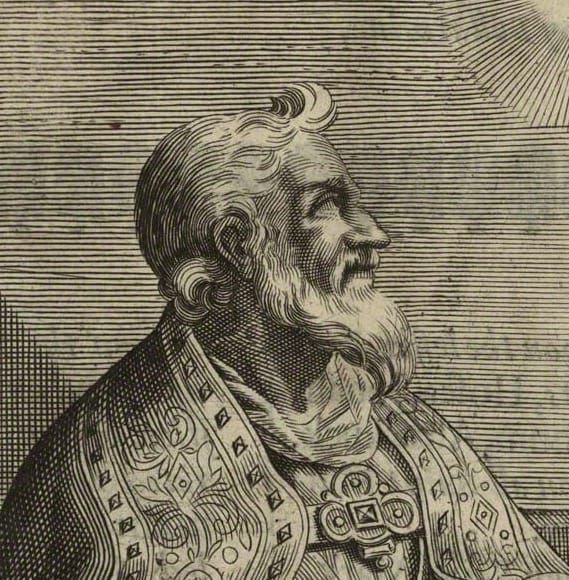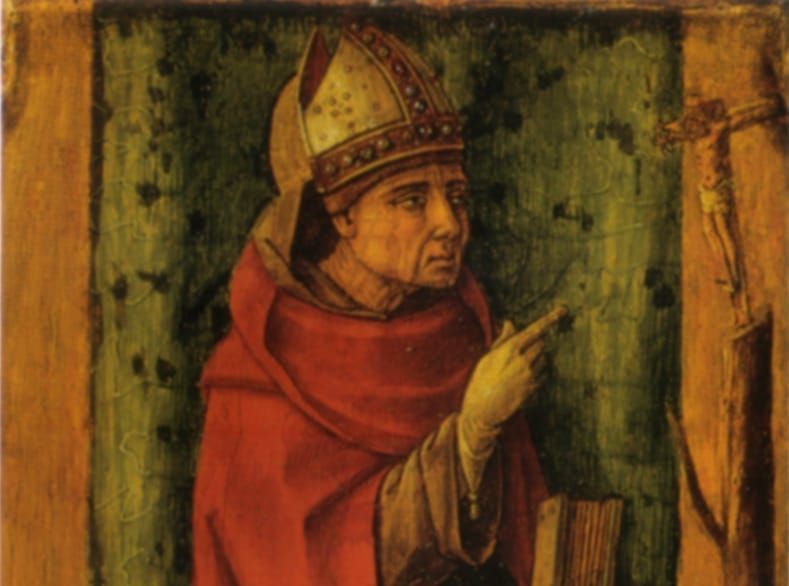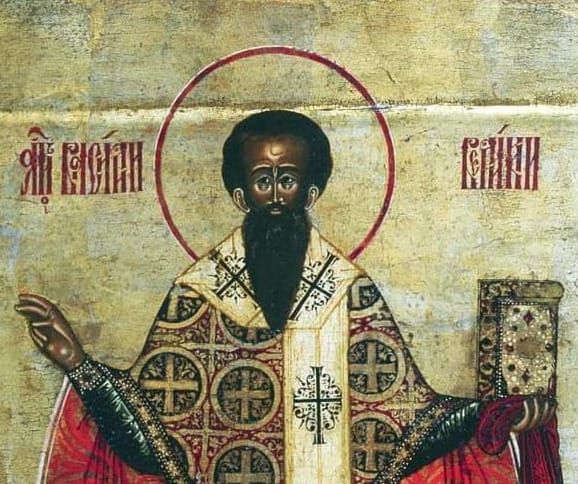
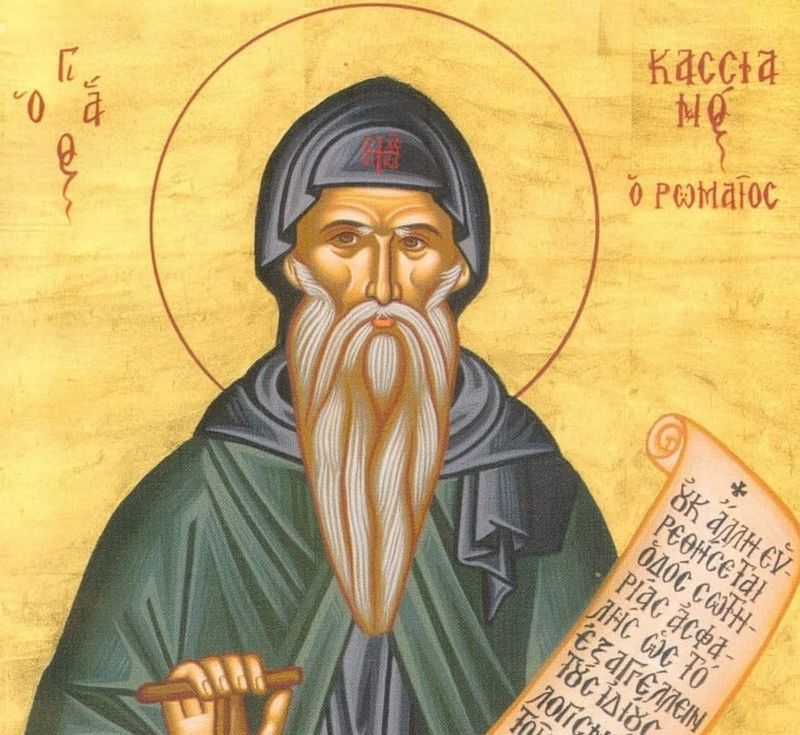
St. John Cassian (c. 360- c. 435) was a monk who, through his writings, spread the principles and practices of ancient Christian monasticism. While a young man, he travelled with his friend Germanus to Palestine. Besides becoming monks, the two also visited the monasteries situated in the desert of Scete in Egypt. During the second Origenist controversy, they travelled to Constantinople to seek the protection of its patriarch, St. John Chrysostom. From there, he was sent to Rome to represent Chrysostom before Innocent I. At Rome, Cassian accepted the invitation to found a monastery in Southern Gaul. There he recorded and codified the principles and practices of Eastern monasticism in his Institutes of the Coenobia (De institutis coenobiorum) and Conferences of the Desert Fathers (Collationes patrum in scythica eremo). These books exerted an immense influence in the subsequent development of both Western and Eastern monasticism.
In this interview, Dr. Thomas Humphries discusses St. John Cassian and his writings.
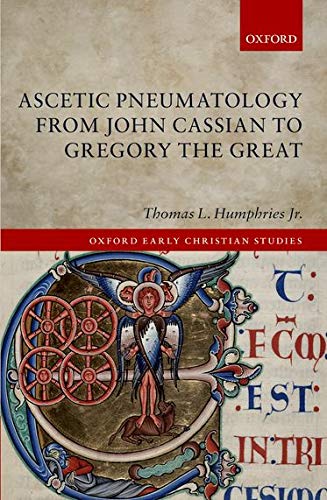
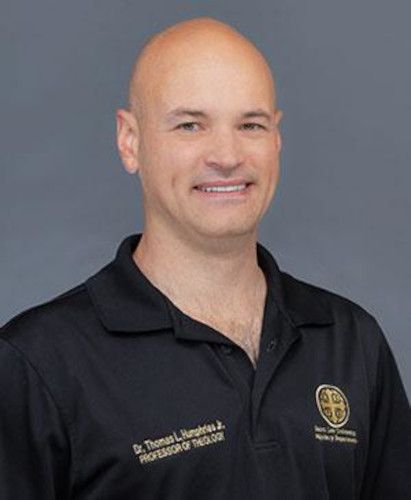
Dr. Thomas Humphries is Professor in the College of Arts and Science at Saint Leo University, Florida. A native of Arkansas and a life-long Roman Catholic, he holds a mandatum from the diocese of St. Petersburg and enjoys giving regular theological reflections outside of the classroom with student faith communities, parishes, and monasteries. He also volunteers with the local fire department as Chaplain and holds the rank of District Chief. He is a licensed Florida EMT and NREMT. He is the author of Ascetic Pneumatology from John Cassian to Gregory the Great (Oxford University Press) and Who is Chosen? (Wipf and Stock).
- The Institutes
by St. John Cassian - The Conferences
by St. John Cassian - On the Incarnation of Christ: Against the Heretic Nestorius (online)
by St. John Cassian - Cassian the Monk
by Columba Stewart - John Cassian
by Owen Chadwick
Who was St. John Cassian?
We know very little about him. Most of what we know about him is really as he shows up later in the tradition. Essentially, he is the the monk of monks. He systematizes the previous monastic tradition. This systematization is very useful for the subsequent monastic tradition. In that regard, he is the perfect instrument of Tradition, handing on what has been handed down to him.
It is fairly certain that he was born in or around what is currently Romania. He belonged to a well-off family, had a sister, and was educated.
Relatively young, he moved to Bethlehem to profess monastic life there. He travelled from Bethlehem to Egypt, where the great Desert Fathers lived, and spent about a decade there. He may have made two trips between Bethlehem and Egypt.
Subsequently, he ended up in Constantinople, Rome, and maybe even Antioch.
Eventually, he settled in Marseilles. There, he founded two monasteries: one for men and one for women. Sometime in the 420s, when he was probably in his sixties, he began his career as a writer. He did so at the request of several important bishops, including the future St. Leo the Great. Hence, he must have been a very impressive person. Wherever he went, he became well-connected. Nevertheless, he says remarkably little about his own life.
You mentioned that he moved to Constantinople. Historians believe that he did so along with other Egyptian monks on account of the Origenist crisis. Why had Origen's teachings stirred up so much controversy at the time?
There are several reasons, some good, others not so much. At the time, there were various movements or waves of Anti-Origenism. It was a volatile and ever-changing issue.
Origen had been dead for several generations when these concerns about some of his teachings popped up. One of the principal concerns was over the philosophical language that he uses in many of his exegetical and theological arguments. Philosophical language can be interpreted in different ways or take on new technical meanings. The Arians were among those who used the same philosophical language as Origen. Anti-Arians, therefore, were wary of using that language to talk about the Trinity.
Another issue was Origen’s speculation on the depths of God's mercy. In particular, he wonders whether anyone can be beyond the mercy of God, who is infinite and all good. This is a deep question.
Consider Psalm 139:7-8. “Whither shall I go from thy Spirit? Or whither shall I flee from thy presence? If I ascend to heaven, thou art there! If I make my bed in Sheol, thou art there!” Origen wonders if this applies to humans in hell and maybe even to demons. Those after Origen found that highly problematic. You cannot assert that Satan will be redeemed.
In Cassian's time, people found two issues particularly difficult to unravel.
One regarded the appropriateness of forming a picture of the immaterial God in our mind? This is often called the Anthropomorphite controversy.
Genesis 1 teaches that we are made in the image of God. We should not make it the other way round. We often depict God the Father as an old man with a white beard. Envisioning him in this way is problematic. It suggests something about God the Father that is not true. Of course, since the Word became incarnate, it is appropriate to make images of the Incarnate Christ.
Origen discussed this difficult theological issue. He had argued that, as all Catholics believe, God is immaterial. Hence, we need to think immaterially of God in speaking of him with philosophical language. Cassian and other monks agreed with Origen’s dense theological position. However, other monks did not.
We still find this problem today. Many have a certain picture of God. Do we pray to the picture we have of God, or do we let God reveal himself to us?
The second question regarded the attainability of moral perfection this life. What constitutes moral perfection? Never committing a mistake? Never sinning mortally? Never sinning venially? Under these questions fall many others. For example, is it a sin to get angry, even if you do not act upon your anger? This leads writers to distinguish between having an impulse, entertaining thoughts, and then acting upon them. We can choose to think about acting upon an impulse and we can choose to act upon it.
Many believed the Origenist monks were teaching that you could attain perfection in this life. The Catholic response is that we can only attain full perfection with the resurrection. On that score, Cassian does not side with the Origenist monks. He teaches clearly that we cannot attain complete perfection in this life.
This dense set of conversations revolved mainly around these two issues: moral perfection and the nature of God.
Amid the controversy, the Patriarchal Archbishop of Alexandria, Theophilus, issued some letters. He changed his mind back and forth. It was not clear whether he was in support of the Origenism of the Alexandrian monks. Hence, Cassian left Alexandria definitively. He may have moved back to Palestine or gone directly to Constantinople. By the second wave of the Origenist crisis, he had moved to Constantinople.
St. John Chrysostom, the bishop of Constantinople, was sympathetic to this theology, much of which was later unquestionably determined to be orthodox. Cassian befriended Chrysostom and may have been ordained a deacon by him.
When John Chrysostom fell out of favour with the court at Constantinople, attempts were made to exile him and even proclaim him a heretic. Cassian was among the clergy sent to plead his case before Pope Innocent in Rome. In his day, Chrysostom seemed to be on the out and outs. History has proved him to be a saint and wonderful teacher of the Church. Similarly, Cassian seems to have been pushed out of Constantinople by political forces but, in the end, his theology was proven to be correct.
" Cassian clearly read Origen for himself. Hence, it is difficult to know what Cassian, the son, learnt directly from Evagrius, the father, or Origen, the grandfather."
Origen was one influence. Was Cassian also influenced by Evagrius Ponticus?
Yes. It is very difficult to separate the two because Evagrius was more of a classical fourth-century Origenist monk than Cassian ever was. On certain points of doctrine, Evagrius sides with Origenistic speculation whereas Cassian argues against it or refuses to engage in it.
Nevertheless, most scholars believe that Evagrius was Cassian's primary theological mentor. It was probably Evagrius who taught Cassian and encouraged him to read Origen. Still, Cassian clearly read Origen for himself. Hence, it is difficult to know what Cassian, the son, learnt directly from Evagrius, the father, or Origen, the grandfather.
At many points, Cassian subtly uses those parts of Evagrius which are unquestionably true and helpful, but not the problematic technical terms that would have raised a red flag or which he deemed unfitting.
For example, Cassian firmly teaches that there is a hell, where the wicked receive an everlasting punishment. That is a big difference between his reading of Origen and that of certain monks who were taking Origen’s speculations even further.
However, Cassian never declares himself to be opposed to Origen or Evagrius. Instead, he wraps his disagreements up in a neat package, mentions them, and moves on.
One term over which there had been a great debate was apatheia: the state of being without either suffering or passion. It is difficult to determine whether every passion is good, or whether some are good and others bad. Take anger. Some believe that there is a justifiable anger and that we should be angry at the sins that surround us. Others object that Christ told us not be angry and that anger is akin to murder. Which is it?
As the term ‘apatheia’ was under scrutiny, Cassian never uses it. However, he does retain the content of Evagrius’s teaching on it. Cassian insists that we should be focussed on God so single-mindedly that nothing other than God should ever affect us. We should not be moved by the superficial things around us. Cassian calls this purity of heart. Purity of heart consists in giving yourself fully and completely to God through the life of virtue. It involves something akin to apatheia. It consists in being unmoved by that which is not God.
Evagrius was a key mentor for Cassian. They probably knew each other as they were in Palestine and Alexandria at the same time. Evagrius probably died before the migrations of the Origenist monks. If he were still alive at the time, he would have been one of the monks forced to move.
"Every saint who has left important teachings on the spiritual life has read Cassian in one way or another."
You have written on Cassian in your study on ascetic pneumatology. What is ascetic pneumatology and what is Cassian’s take on it?
I invented the phrase for my dissertation. Pneumatology belongs to Trinitarian theology and has been widely studied. It considers the Holy Spirit and his relation to the Father and the Son.
By the fourth century, the Councils of Nicaea and Constantinople had determined that the Holy Spirit was in no way less than the Father or the Son.
But what about the fifth century theologians? Did they simply restate more adamantly or in new ways what the fourth-century theologians had said? They did not. Rather, they applied Nicene pneumatology by pondering what it meant for Christian life. They argued that Christian asceticism consists in training of our body and our soul to be perfectly permeable to the Holy Spirit.
This is an ascetic pneumatology. It was developed in the fifth century by authors such as Cassian, who were interested in what the full divinity of the Holy Spirit means for my life and my ascetic discipline. However, Cassian’s pneumatology went unnoticed. No one had stopped to inquire into what he said about the Holy Spirit in the life of the monk.
He argues that the Spirit is the monk’s partner and co-worker. He uses the Latin term index. We still use this word. We speak of our index finger. For Cassian, therefore, the Holy Spirit is the divine person who always points to the deeper truth of God's existence and how we should live in conformity with him. The Holy Spirit provides the grace—what Cassian calls the protection and the motivation—to follow that path rather than others.
With this picture in hand, it becomes easier for the historical theologian to consider whether other writers of the period were addressing the same questions and developing an ascetic pneumatology. I argue that there were several who did so. They were interested not only in the doctrinal controversies of the Councils of Nicaea and Connstantinople, but also in those about grace, free will, and full commitment to the ascetic life.
For example, what does embarking on Lent mean for me today? Is God involved in the discipline that I choose for Lent? Yes, he is. The Holy Spirit in particular accompanies, strengthens, and protects me.
"More than any other Church Father, he masters the dialogue."
Cassian systematized the principles and practices of ancient monasticism. How extensive was his influence on the subsequent development of monasticism?
So great that we cannot really measure it. I have been studying Cassian for quite a while. I am constantly surprised at how many saints drew on him. Dominic used him. So did Thomas Aquinas and Phillip Neri used him. Every saint who has left important teachings on the spiritual life has read Cassian in one way or another.
At the end of his Rule, St. Benedict lists three works which monks ought to read for a more advanced spirituality. He lists Basil’s Rule for monks and then Cassian’s Institutes and Conferences. So, Cassian wrote two of the books that Benedict believes all monks should read.
Moreover, the monks took Benedict’s Rule seriously and have been reading Cassian ever since. The Rule of the Master (Regula magistri), which is closely related to Benedict's Rule, also uses Cassian. There were other rules for a monastic foundation that were written shortly before them. Virtually every one of them engaged the same theology that Cassian provided.
Prior to Cassian’s systematization, most of the literature on the monastic life is a set of hero stories. That literature is very helpful but also has its limits. Take St. Athanasius’s Life of Anthony. It contains a tonne of stories. Anthony hears the Gospel preached at Mass, sells everything straightaway, and goes into the desert to lead an ascetic life. Fully committed, he visits every other monk that he can find and learns how to practice virtue from each one. He lives in tombs. He goes further into the desert. He does battle with demons.
The question, though, is how can I do all that? Do I have to wander out into the desert? Should the monk’s formation be as extraordinary as Anthony’s?
Alternatively, take the other kind of monastic literature that was formalized around the same time as Cassian: The Sayings of the Desert Fathers. They are wonderful, but sometimes they sound like zen sayings. You do not know how to take them or when the piece of advice applies.
For example, fasting is always good and something we should always do. However, I also need to be hospitable toward my neighbour. What if someone shows up on my doorstep on a day of fasting? Do I stop fasting and feast with this person who needs to eat, or do I prepare her a meal and let her eat alone? Do I tell her that today we fast but tomorrow we can eat? Cassian wraps his mind around delicate questions of this kind.
He argues that all these ascetic practices are tools that are meant to be used for an end. Moreover, he applies an architecture—the distinction between our proximate and our final goal—to monasticism and Chrisitianity. This is one of his gifts to the tradition.
Our final goal is to reach heaven, but that will not necessarily happen tomorrow. We do not know when we shall die or how our resurrection will go. In the meantime, we need to pursue purity of heart and virtue. That is the sure path to heaven.
Hence, there are three levels in his system. Like every other Christian, I want to get to heaven. I can do so only through purity of heart: by relying on grace and exerting myself in the life of virtue. But how do I attain purity of heart? This is where all the stories and examples that Cassian gives come in. They show me which tools I should use. Moreover, embedded within them are the rules for determining which tool is appropriate.
Fasting is always necessary, as is attending to my neighbour. Whenever the two are in conflict, I do not ask which is the greater. I consider which one leads me to purity of heart given the circumstance. For sure, discernment is needed in these cases. However, Cassian provides a certain system for working out what I should do right now to attain purity of heart. If purity of heart requires that I set aside my fast and eat with someone else, then I should do so without any worries. In the end, fasting is only a tool for attaining purity of heart.
St. Phillip Neri would read Cassian to the laity to whom he ministered. To what extent are his teachings relevant to the laity if Cassian was addressing monks, a very different audience?
Many saints have endorsed Cassian and recommended that we read him with passion and think his teachings through.
Cassian is not just important but also accessible. More than any other Church Father, he masters the dialogue. Think of Plato’s dialogues. They exemplify a great intellectual tradition for which the real way to do intellectual work was not just to set out the argument for some thesis, but to go through the back and forth of a conversation.
Each of Cassian's twenty-four conferences is a dialogue between Cassian and his friend Germanus, on the one side, and, on the other, a virtuous senior monk, an Abba. Often, Germanus asks a question and the Abba answers it. Germanus follows up by saying, “Wait a minute!. Do you mean this, or have I misunderstood you?” That is an incredible way to learn.
Moreover, Cassian’s dialogues often cover the very questions we have. Not only does he pose them, but he also receives deep answers to them that appeal to the fulness of Scripture and Tradition.
He seldom enters into long, dense theological controversies, but whenever he does, he engages in them intelligently. He does not bog the reader down with technical terms or a lot of history. He gives the layman a helpful introduction to many of these controversies.
1.
First up is Cassian’s Institutes. This work describes the rules of monastic garb and canonical prayer, along with and the remedies for eight principal vices. What should the reader look out for in this work?There are twelve chapters or books. The first four start with the monk’s garb and then work their way through each of the canonical hours. The fourth gives an overview of how to join the monastery and the first year of training. It ends with a beautiful homily from a guest abbot, who describes how asceticism and renunciation consist in taking up the cross and following after Christ along the way of death to oneself.
The first four books, therefore, talk about the externals of monastic life and outline the outward shape of a Christian life.
The last eight are meant to describe the interior shape of Christian life. In this regard, Cassian follows the sacramental principle. There are both external and internal dimensions to being human: the body and the soul. With great care, Cassian starts with the outer aspects of our life. He advises us to give a consistent shape to them. That in turn will influence our interior life. There is a pattern of communication between the body and soul, the external and the internal. Whatever I do in the one will affect the other. If I change my thoughts, that will change my external behaviour. Similarly, changing my external situation—hanging out with different people, for example—will influence my interior life. These are phenomenal principles of the spiritual and moral life.
Though incredibly powerful, the former of these two principles is a little more delicate. It becomes more obvious when Cassian writes about the eight principal vices (or principal thoughts or the eight principal demons that tempt us).
Everyone knows of the seven deadly sins. Gregory the Great classifies them by condensing Cassian’s list of eight principal vices into seven deadly sins. This is an exegetical move. Gregory is contrasting them to the seven gifts of the Spirit that Isaiah lists in the passage from the scroll that Jesus reads in the synagogue. However, there is a danger in construing them simply as seven deadly sins. Strictly speaking, a sin is a single offence or event. However, in his teaching on the eight principal vices, Cassian makes it clear that each sin is rooted in a series of previous going-ons. Maybe the sin I committed on Friday was the culmination of two or three struggles that began on Monday. In Cassian’s parlance, two or three demons were tempting us. They realized that if they came straight at us with a temptation, we would recognise it as a demonic suggestion and resist it. So, instead of a direct frontal attack, they come at us from the side. On Monday, they put us slightly off our game with one thing, and then on Tuesday with something else. On Friday, we succumb. In other words, there is a narrative, chronology, system, or series of interrelated habits. The ultimate outcome might be one of the seven deadly sins. However, we need to think about what led up to it. In this regard, Cassian speaks like an ancient monk and very differently from many modern theologians. He is not afraid to engage a conversation with your demons.
According to the tradition, you should manifest all your thoughts and actions to an elder who has discernment and genuinely cares for you because you are far more complicated than you acknowledge. There is far more to us than a checklist of our sins can reveal. Cassian, therefore, moves us away from considering sins as isolated events to thinking in terms of habits, vices, and categorical temptations that might even belong to agents more powerful than us. There might be a specific demon tempting me, say, away from communion with God and my community in the Eucharist and the liturgy. Moreover, what the demon sees in the young monk, or a Christian is a good which can be perverted.
Take gluttony, the first principal vice that Cassian treats. It is good to eat. You must take care of your body, a good that God has created for a particular purpose, and you should not despise it. However, you should not make it the end by which you judge all things. Well, demons will tempt you to make your body more important or less so than it really is. They will tempt you to lose all balance.
As soon as you recognize that a demon is tempting you to gluttony, you recognize the prior goodness of your body and food. Through a sophisticated conversation with your demons, you can come to recognize the deeper gifts that constitute your personality.
This where the psychological insight and the spirituality of the Institutes are so profound. A basic Catholic principle is that any evil is a perversion of some good. Whenever you review your conscience, you need to uncover the good which has been perverted rather than simply focussing on the perversion itself.
2.
On a side note, Cassian's main work, the Conferences (Collationes) has made a big influence one everyday life in Italy. It is the source of the Italian word for breakfast (prima colazione) or meal (colazione). The Benedictines would read Cassian’s Collationes at the evening meal. Hence, the title of the work passed into Italian to designate a meal and, more specifically, breakfast.
That is fantastic. The word conlatio or collatio means to stand side by side and hence came to signify a conversation. How wonderful that breakfast is the first conversation that you have: the first sharing in community, side by side.
Cassian’s legacy shows up everywhere, without you realising it. I have come to judge the conferences that I attend by whether they approximate one of Cassian’s conferences. Was it just a few meetings or did I sit at the feet of a master and have my questions answered in a holy, edifying way?
These days all the Conferences are published together. They are one of the longest writings from the first millennium.
However, Cassian issued them in three separate books. The first ten came out shortly after the Institutes. Hence, many scholars see them and the Institute as companion pieces.
Moreover, it is helpful to read the first ten as a set, then the second volume (Conferences 11-17) as another set, and the third volume (Conferences 18-24) as another, rather than read them all cover to cover.
Cassian makes connections and crescendos between the conferences of a given set that you might otherwise miss. For example, 1-10 culminate in a discussion of the nature of prayer.
Each of the Conferences is slightly longer than the books of the Institutes. The former are about thirty pages long apiece; the latter about twelve. Often, I recommend the relevant Institute to a student or friend who is struggling deeply with an issue that Cassian discusses in depth, such as sadness, anger, gluttony, or fornication. They also remark that it has helped them with its psychological depth.
Though the Conferences are topical, they are also longer and pull in some other related issues. There is more than one thing going on in each of them.
The Conferences is divided into three sections. The first set record conversations held at Skete; the second, those at Thennesus; the third, those at Dioclos. Does Cassian arrange the conferences according to any other principles?
Yes. Many very intelligent people have noticed patterns that run through them. Some patterns are more obvious and are helpful for reading the Conferences. Others might not be less helpful, if at all.
For instance, in odd-numbered conference he tends to discuss the theoretical end of topic, and in the even-numbered one that follows discusses the practical problems. You need to balance the two ends of the spectrum. As Aristotle argues, virtue is the mean between two vices. You can either eat too much or you can eat too little. For Cassian, each is a form of gluttony. Hence, he will start with a conversation about food and the role of fasting in the spiritual life. Then there is a second round of conversations about the practical implications of temperate eating and the two contrasting extremes. In that regard, it is worth reading one and two, three and four, or five and six together.
Most scholars believe that Cassian published the Conferences in reverse chronological order. Conference 1-10 are probably the last conversations Cassian had as a young monk during his travels in Egypt, whereas the last set he published reflect the first conversations he had.
At any rate, there is a thematic progression in each set. The first ten begin with the goal and purpose of a monk. They talk about discernment (discretio) and work through various issues. The last two—9 and 10—are on prayer. It is at the ultimate heights of prayer, combined with a life of ascesis, that you attain purity of heart. Hence, it is helpful to read 1-10 as guiding you through certain stages of the spiritual life.
It is also helpful to read 1, 11, and 18 together. Each is the first of its respective series and lays out a major theoretical paradigm. They you might what to read 10, 17, and 24 together, as they conclude each of those respective series.
Others have noticed that there might be a connection between the conference that are ten apart: between 1 and 11 and 21; 2 and 12 and 22; 3 and 13, and 23. This many not be helpful for a reading strategy, but it indicates that they are not loosely connected occasional pieces. Rather, Cassian arranges them in a logical order.
In the 24 conferences, fifteen Abbas speak. Most speak more than once. Hence, it is a mistake to read a conference in isolation from the others given by the same Abba.
Cassian and Germanus go to a monk known for certain virtues and ask him for advice on their struggles. The conference records the conversation they had during a single day and ends when they retire to eat, pray, or rest. If they came back the next morning to ask deeper questions on what he had said, there is another Conference. If you do not notice the connection between the two conversations, you may make misassumptions.
For example, Cassian discusses chastity, grace, and free will together. To get to the depths of his thought, you need to understand what he says about all these topics. We tend to these as totally different theological concepts. Chastity figures in a class on the moral virtues, as a variety of moderation. However, chastity is also a virtue of integration by which I give myself in love. In that case, is it a cardinal virtue or a theological virtue? This question makes for a great set of classes or conversations. In Cassian's mind, we can only answer it by working out the problems surrounding grace and free will. Do I ever act alone, under God’s influence, or are the circumstances in which God is acting alone in me. If we handle all these issues as discrete topics, we miss Cassian’s much deeper and broader sensibilities.
"Cassian’s legacy shows up everywhere, without you realising it."
To what extent is Cassian simply reporting conversations he had or elaborating upon them to push his own ideas? For example, Conference 13 appears to criticise Augustine’s views on grace’s role in conversion, but the conversation reported would have taken place before the Bishop of Hippo had spelt out his views on the matter.
The simple answer to your question is that it is always a mix of both. Sometimes Cassian writes about a specific figure that others wrote on. His report almost always aligns with other texts and is consonant with them. So, there is no evidence that Cassian was restyling an ancient monastic hero or trying to change people’s opinion about him. His report always seems to be genuine.
He is the sole witness to certain aspects of these figures and tells us things we would not know otherwise. There is no reason to suppose that he is making things up.
On the flip side, he states explicitly he is writing about these conversations decades after they took place. There is no way that he is transcribing them verbatim. He did not write them down in a notebook that he published thirty years later. It would be naïve to imagine that this is what he is doing. In two regards, he is doing something more careful.
First, he is conveying how conversations are the way in which we can really get to the depths of a matter.
You might ask me a question to which there is a simple theological answer. I can give you the answer straight out of the manual or the catechism. I can tell you what the most recent papal teaching on it is. The yes or no answer is quite simple. However, you might be asking the question on account of some deep controversy in your own life. You might pose it because you are trying to discern how you should act and how this issue will affect your pursuit of holiness. In that case, we need to talk about the extremes, the middle ground, and the various stages of development. Such a conversation needs to take place as an actual conversation.
Another way of answering the young person's question is to tell a story. That story needs to include exemplars: both heroes who have got things right and persons who have got them wrong. Stories of the latter kind are every bit as important as the former. They too illustrate the theological principle that needs to be applied. All these stories put flesh on the bones of that conversation. That is one reason why everyone loves Cassian.
The other thing Cassian does is provide a great lesson in humility. He does not tell stories of his own successes and failures, but those of others. He only ever hands on the tradition of the ancients who preceded him. Some accuse him of playing a power-game because he is the only one who gets to tell these stories. Fair enough. On the other hand, in our conversations with others we are often so proud of having grasped some truth that we forget the people from whom we learned it. Instead, Cassian reminds us that the theologian’s role is to hand on the tradition. He takes a question and tells us that he had the same one, asked an elder about, consulted the tradition, and transmits the wisdom of the tradition.
This is both one of the deepest blessings to be gained from reading Cassian and a key to reading him better. This explains why the conferences are so long and in- depth. To do theology well you need the complete package: the whole context of a discussion, the narrative, the passages from Scripture that are quoted, along with guidance on how to read the Scriptures, examples of those in the community who have got things either right or wrong, and a summary statement.
Some of the examples of obedience or other virtues that Cassian cites will strike many readers as strained and liable to set dangerous precedents. Are there certain regards in which Cassian is no longer a valid guide?
That is a fair question, but first I would like to say a little more about Conference 13 (On God's Protection).
It parses out grace and free will. Supposedly, Cassian had this conversation when Augustine was still a young man and not yet Catholic. However, it addresses the same issues that Augustine will later on, when Cassian publishes the Conferences.
There are many scholarly debates about the dating of these writings. However, most scholars agree that Cassian is not responding directly to Augustine. Rather, he is responding to other people in Gaul, who are repeating Augustine. He is not attacking the Bishop of Hippo but their misunderstanding of Augustine. That is part of what is going on in Conference 13.
Nor need we read Augustine and Cassian as disagreeing with one another. In fact, when some of those in Gaul wrote to Augustine and asked him to censure Cassian and his theology, Augustine replied cautiously that Cassian’s doctrine is not that bad. Augustine explains that Cassian and the priests they are concerned about are Catholic and in agreement with him on these important issues.
Similarly, Cassian’s response to those who are trying to start a fight between him and Augustine is to tell the story of how he had the same questions many years earlier. Rather than pick a fight with a person of virtue, he offers a slightly better or more congenial interpretation of the disputed Scriptural verses, so that everyone can come out a winner. That is what is going on in Conference 13. Cassian is correcting those who have misread Augustine.
Though I am in the minority of scholars on this point, I am not far off the mark. Most acknowledge that Cassian is responding to his critics that they have misunderstood the whole tradition. He is arguing that there is no fight between him and Augustine, despite their minor differences.
Now, are there regards in which Cassian might not be a helpful guide?
Cassian writes as a monk for monks. He assumes that his reader has been baptized and confirmed, receives Holy Communion regularly, has renounced the world and moved into a monastery. However, I have not professed a life of renunciation but am a married man. I am never going to renounce the world in that sense and join a monastery. So, how much of Cassian is relevant to me and how much is not.
There is also question of authority. Cassian is a saint; I am not. I am in awkward position if I start vetoing parts of his teaching (e.g. decide not to follow his rule about fasting) yet still claim to be pursuing holiness in the way that he indicates.
However, some of Cassian’s principles can be applied fairly easily by anyone with a well-formed conscience. These rules are very helpful.
My final goal is to reach heaven, as Cassian teaches. The only way to reach it is to lead a life of virtue, premised on grace, as Cassian teaches. Moreover, there are various tools, as Cassian teaches in Conference 1. For example, vigils are one tool that the monk needs. He gets up in the middle of the night and recites the Psalms. That is not an appropriate tool for me. However, there are moments when I do have vigils. My child might wake up in the middle of the night. I should not respond to that situation grumpily, but treat is as a blessing and make it a prayer.
As a husband, I am not under obedience to an abbot, who tells me when to pray and what to pray. However, I do live in community with my wife and my daughter. Perhaps I do need the same kind of obedience toward them. In other words, we can make charitable interpretations of Cassian and apply them to our situation.
Moreover, he almost always labels the cases that require careful discernment and warns that such acts are not for everyone.
We should not get hung up on the extreme examples that, in the narrow sense, do not seem right. If we set them aside, Cassian’s principles are certainly helpful.
I am not a fan of the way some people read those cases and suppose that Cassian did not really mean what he was writing about. He is serious when he claims that some monks just ate one piece of bread a day. I may have neither the call nor the constitution to do so. However, I am not a fan of excising things from Cassian’s writings. It is not a good reading practice to ignore someone who has a fairly comprehensive system.
Rather, we need to take his principles and tools and apply them with discernment to reach our intermediate and final goals.
Is Cassian a helpful guide? Maybe not. He is writing for monks, and I am not a monk. Nor does he address the technology that is currently available. None of this changes the fact that we need to find someone with discernment who can direct us and that we need to live an honest life in community. These are timeless principles and get us out of many of our problems.
3.
Does Cassian’s treatise On the Incarnation of Christ Against Nestorius add anything substantial to previous anti-Nestorian writings, such as those of St. Cyril of Alexandria?
Yes, it does, though many commentators would say that it does not. They consider it an embarrassing work because they find the language imprecise or believe that Cassian wrote it for political motives. I disagree on both scores.
To see what it adds, we need to put it in its historical context.
At the time, there was a controversy between Nestorius, the Patriarchal Archbishop of Constantinople, and Cyril, the Patriarchal Archbishop of Alexandria, over calling Mary the Mother of God (theotokos).
Nestorius argued that we can only call Mary the mother of the man, Jesus, because God does not have a mother. To claim that God did have a mother, we would have to hold that there is a fourth person in the Trinity. We would thereby end up like the pagans, who believe in mother gods and father gods.
Cyril responded that if we separate the Christ’s humanity from his divinity, we rob the Church of its Saviour. Our saviour needs to be fully human and fully divine at the same time. By calling Mary the Mother of God, we acknowledge that, in the Incarnation, the Word really did become a particular human being. His divinity and humanity coexist in a single person.
Cyril also had difficulty with expressing himself with precision. However, this conversation took place in Greek, between Constantinople and Alexandria. Both parties wrote to Rome and asked it to be the arbiter. However, the Church of Rome spoke Latin. If it was going to weigh in on a controversy over technical terms in Greek, it needed a theologian who was fluent in both Latin and Greek. Moreover, if it was going to weigh in on a controversy between two patriarchal archbishops, each of whom was claiming to be the second most important bishop in the world after Rome, and each of whom was an ascetic or monk of sorts (Nestorius had been a monk at Antioch), you needed a theologian who was also known for his asceticism. Cassian was perhaps the only person at the time who fitted that entire bill.
He could understand a controversy that was being played out in Greek and convey it to a Latin audience. His life of travelling around the Mediterranean had prepared him for this sophisticated challenge. Moreover, he was a friend of many bishops and deeply involved in the episcopal networks. At the time, many bishops in the Latin world had been monks. In particular, the monasteries in Gaul were effectively seminaries for the episcopacy.
Deacon Leo, the future Pope Leo, was commissioned by Pope Celestine to figure out what was going on. Leo chose Cassian over the other Latin theologians to be Celestine’s advisor. Cassian, therefore, was the first to articulate a comprehensive position on the other side of the Mediterranean.
Cyril had commissioned a Latin translation of his text. However, in Cassian’s treatise a single mind puts the views of both Nestorius and Cyril into Latin. He also wedded some of their conversation to issues that were not known in the Greek world: the Christological controversies of Gaul and Africa.
Cassian argues that Nestorius’s position was not entirely new: ten years earlier a priest had taught something very similar, and Rome had already resolved the issue. Hence, he proposed that, since the West had already thought this through, it could apply the same theological solution to this cas
He made an unfamiliar controversy familiar for the Latin speaking world.
Celestine probably used part of On the Incarnation Against Nestorius in the synod of Rome (430) in which he deposed Nestorius. It is tricky to figure out exactly when the work was completed in its current form. Nevertheless, the whole purpose of the work was to brief Celestine on the issue. Hence, it is a very important text.
4.
You have recommended two monographs on Cassian, one by Columba Stewart and the other by Owen Chadwick. How can each of these books guide the reader through Cassian’s writings?
Chadwick's is the older of the two and dates back to the 1950s. It is a detailed study that reads Cassian’s works closely and places a particular text in its context. It puzzles through question of both literary criticism and historical theology. Not only is it a fantastic introduction to Cassian. It also shows how scholars went about recovering patristic theology in the 1950s.
5.
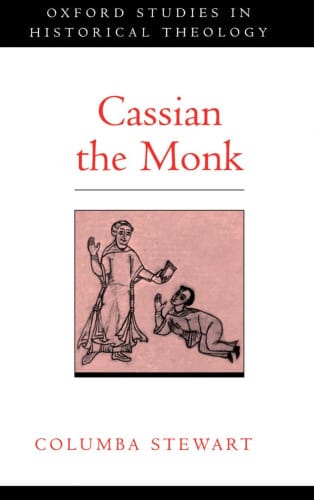
However, you should read Columbus Stewart first if you are looking for secondary literature on Cassian. He is incredibly well-read in various languages and provides immaculate footnotes that are very helpful for those doing further research.
In the main conversation, he spells out quite plainly what he considers helpful or unhelpful in Cassian. As he states in his prologue, he reads Cassian as a monk and writes about him for other monks. Hence, he has the first-hand knowledge of the matters that Cassian is discussing that comes only from having lived a monastic life that is shaped largely by Cassian's conception of monasticism. It is incredibly helpful to speak with a contemporary monk about an ancient monk.
Both works offer insight into the various ways of approaching Cassian. They help the reader tie together everything in a systematic way. You miss many things on the first reading of Cassian. Moreover, Columba Stewart has such a full command of Cassian's writings that he explains everything that Cassian says on a subject in all his works.