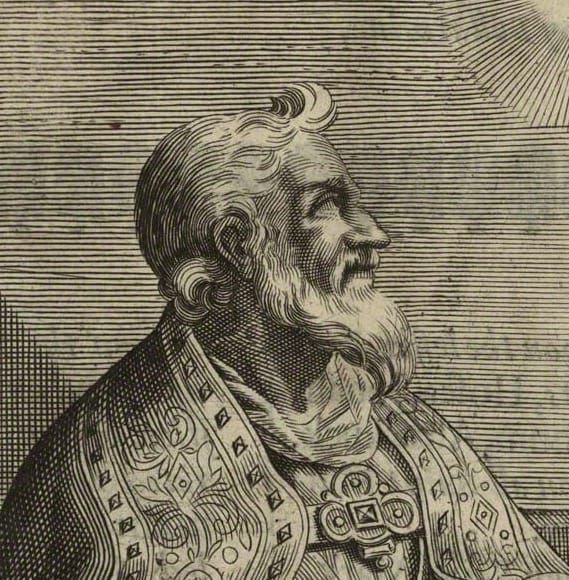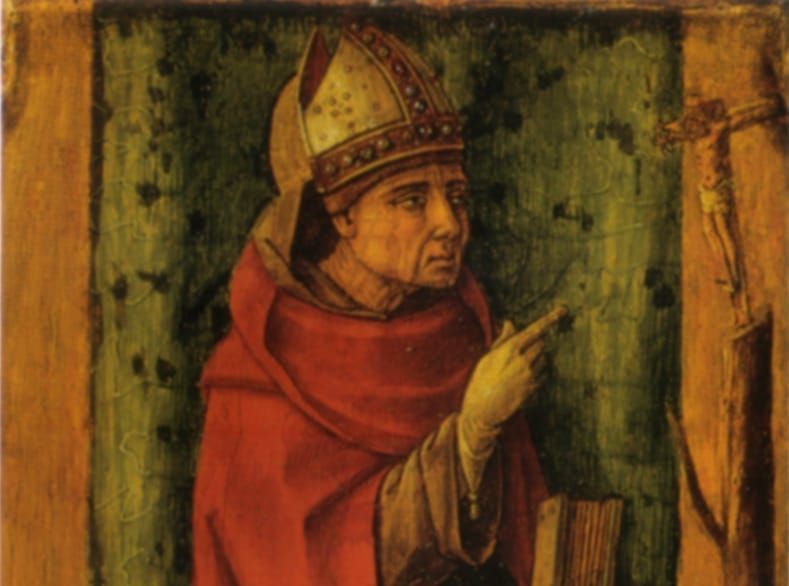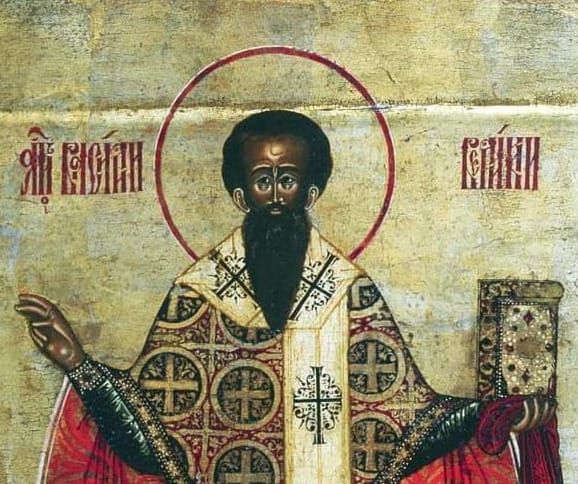
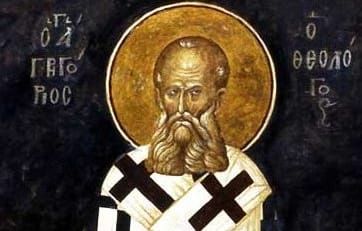
St. Gregory of Nazianzus (c. 329-c. 390) is a Father and Doctor of the Church. Along with St Basil the Great and St. Gregory of Nyssa, he is known as one of the Cappadocian Fathers and Three Holy Hierarchs. Born at Nazianzus (Nenizi, Turkey) into a wealthy family the same year that his father was made bishop of his hometown, Gregory was given a first-class education and in 350 he was sent to perfect his studies in Athens. There he befriended Basil of Caesarea. In 357, he was summoned back home and, in 361, his father ordained him to the priesthood. In preparation for his ordination, he studied with Basil at the latter’s estate in Pontus. There, they may have prepared an anthology of texts, the Philokalia, from the writings of Origen. Preferring a life of prayer and study to the demands of the priestly ministry, he fled Nazianus for a period. Basil became bishop of Caesarea in 370. To shore up his influence following an imperial redrawing of the boundaries of civil and ecclesiastical governance in Cappadocia, he ordained Gregory bishop of Sasima in 372. Threated by supporters of the neighbouring metropolitan, Gregory did not take up the post. Following his father’s death in 374, he withdrew to Seleucia to pursue a life of prayer and study. In 378, he transferred to Constantinople to support the Pro-Nicene Christians and set up the Church of the Anastasia. There he preached in defence of the orthodox view of the Trinity and the Incarnation. Theodosius made him Bishop of Constantinople and for a while he presided the Council of Constantinople (381). However, his opponents forced his resignation and retirement on a technicality. He was still bishop of Sasima and so, by holding another episcopal see, in breach of a decree of the Council of Nicaea. Gregory dedicated his final years to revising his writings. The author that the Byzantines cited most often after the Bible, he is known in the Easter Churches as St Gregory the Theologian on account of his teaching on the Trinity. During the middle ages his remains were transferred to Rome and are venerated in the Basilica of St. Peter.
In this interview, Fr. Andrew Hofer OP will discuss St. Gregory Nazianzen and five of the best books for discovering his teaching.
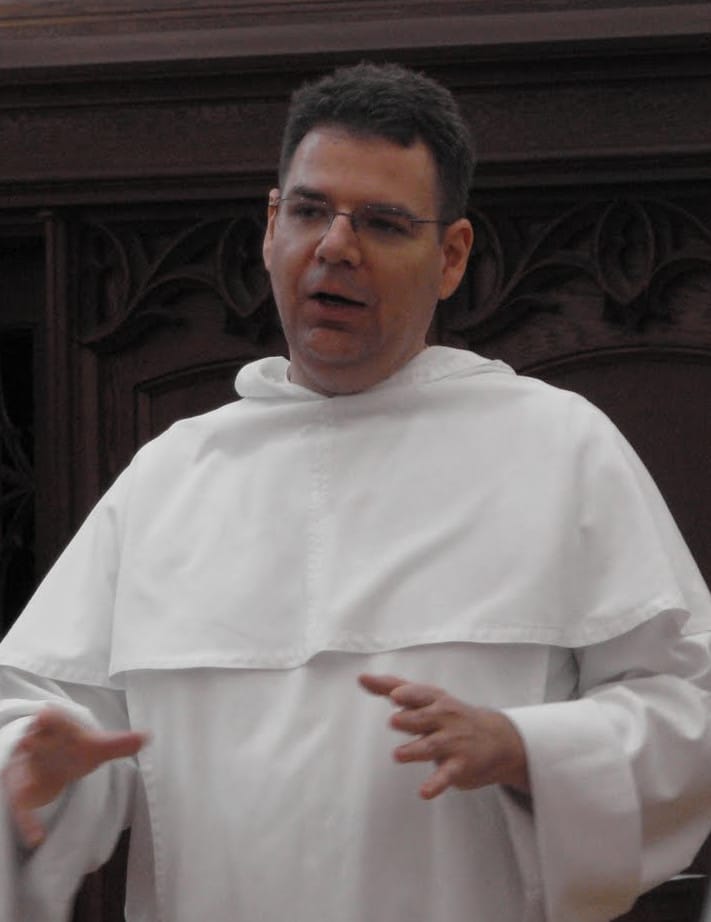
Fr. Andrew Hofer, O.P. is a formator at the Dominican House of Studies, a member of the Pontifical Faculty of the Immaculate Conception, and a formator at St. Dominic Priory in Washington DC. Since the fall of 2021, he has been the editor of the journal The Thomist, for which he previously was book review editor. He is the author of The Power of Patristic Preaching: The Word in Our Flesh and Christ in the Life and Teaching of Gregory of Nazianzus, and the co-author of A Living Sacrifice: Guidance for Men Discerning Religious Life. He is also the co-editor of The Pastoral Theology of the Early Church, The Cambridge Companion to Augustine’s Sermons, The Oxford Handbook of Deification, Thomas Aquinas as Spiritual Teacher, Thomas Aquinas and the Crisis of Christology, Thomas Aquinas and the Greek Fathers, and Divinization: Becoming Icons of Christ through the Liturgy.
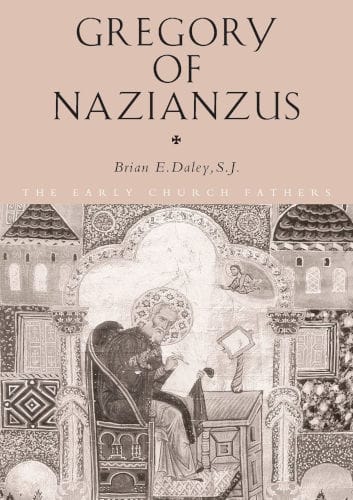
- Gregory of Nazianzus
by Brian E. Daley SJ - On God and Christ: The Five Theological Orations and Two Letters to Cledonius
by St. Gregory Nazianzus - Festal Orations
by St. Gregory Nazianzus - On God and Man: The Theological Poetry of St Gregory of Nazianzus
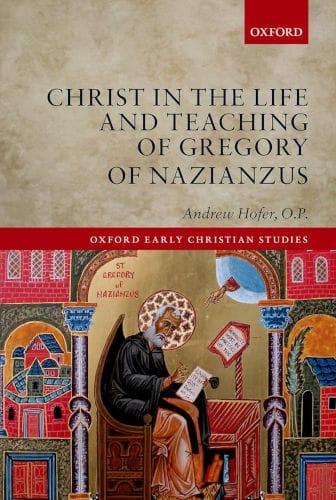
by St. Gregory Nazianzus - Christ in the Life and Teaching of Gregory of Nazianzus
by Andrew Hofer OP
Could you give a brief survey of the life of Saint Gregory Nazianzen?
Yes. St. Gregory of Nazianzus or St. Gregory Nanzianzen is one of the Cappadocian Fathers. Cappadocia is a region in present day Turkey. He lived in the fourth century. Two of his friends were the blood-brothers St. Basil the Great and St. Gregory of Nyssa. Today, people sometimes call these three the Cappadocian Fathers
His father was St. Gregory the Elder of Nazianzus and his mother was St. Nona. He had an older sister, St. Gorgonia, and a younger brother, St. Caesarius. The family was very interested in Gregory's education and so he moved around quite a bit to study, first within Cappadocia Cesarea, then Palestinian Caesaria, then Alexandria in Egypt, and finally Athens.
In Athens, his college roommate, so to speak, was St. Basil the Great. Gregory looked very fondly on their time together in Athens. The Church commemorates their friendship by celebrating St Basil the Great and St. Gregory of Nazianzus with a joint feast on 2 January. In the Office of Reading, Basil is said to have been one with Gregory in their friendship.
Julian, the future apostate emperor, was also in Athens at the time.
Following his studies in Athens, he returned to Cappadocia. He wanted to lead an ascetical life and was with Basil. However, Gregory the Elder Gregory was bishop of Nazianzus and ordained his son a priest. That started Gregory's ministry. He went away for a time, then came back and helped his father.
Gregory was very active as a priest. He used his philosophical and rhetorical skills at the service of a Pro-Nicene theology. At the time, there were all sorts of strange Trinitarian theology. Gregory wanted to ensure that people were holding the Catholic, orthodox faith.
When his father died, Basil had already become the great archbishop of Caesarea and wanted his friend, Gregory, to be a bishop. So, he ordained him bishop of Sasima. Gregory was not particularly happy about that. He tells us a lot about his unhappiness, frustrations, and anger. He wrote and talked a lot.
When he transferred to Constantinople, the Emperor Theodosius recognised him as the bishop of Constantinople. Then, Theodosius wanted what we call the second ecumenical council: the First Council of Constantinople. The first presider, Meletius of Antioch, died, and Gregory became its president. However, the bishops did not like him. They thought it was not legal for him to be the bishop of Constantinople. He had been consecrated bishop of Sasima and the Council of Nicaea had issued a decree against the transfer of clergy. Gregory, therefore, left the Council of Constantinople and returned to Cappadocia, where he continued to write.
Today, we know him on account of his three sets of writings: his orations, poetry, and letters.
He has become preeminent within Church history for several reasons. In the Eastern tradition, he is known, along with Basil the Great and John Chrysostom, as one of the Three Holy Hierarchs. Within the Western tradition, he is known as one of the first four Greek Fathers who are Doctors of the Church. The others are St. Athanasius of Alexandria, St. Basil the Great, and St. John Chrysostom. Gregory has been nicknamed the Theologian because he has such an important way of speaking about God. Moreover, his life is just tremendous. Some believe that he was a failure in his ministry because he would get upset, go away on these retreats, or simply leave. The thing is that he is extremely influential precisely on the subject of priestly ministry. Oration 2, the De fuga (On His Flight) is the first treatise on the Christian ministerial priesthood. He exercises a great and perduring influence through his writing.
"Once, I was talking with a man who was very devoted to Gregory. He said that he especially loved Gregory's humility. For certain scholars, this is ridiculous. In their view, Gregory postures himself against others. However, as this devotee of Gregory said, 'I really love Gregory's humility. He tells us about his faults.' "
What drew you to study and write on St. Gregory Nazianzen?
I was at the University of Notre Dame for my doctoral programme and was studying mainly under Fr. Brian Daley S.J., one of the world’s premier patrologists. He had done a lot of work on Gregory Nazianzus. Moreover, he had a great influence on my appreciation of Gregory. He told me that if you had to select one Greek Father comparable to Augustine in influence, it would be Gregory of Nazianzus. I had never heard that before. From what Fr. Daley taught and then from my own readings, I realised that he was right. Within Byzantine literature, Gregory Nazianzen is cited more than any other source apart from Scripture. Usually, St. John of Damascus does not cite his sources in his An Exact Exposition of the Orthodox Faith. Occasionally, he does and Gregory of Nazianzus is cited far more than any of the other Greek Fathers.
I am particularly interested in Christology. The churches that opposed each other over Christological doctrine during the fifth century all claimed Gregory Nazianzen as an authority. I wanted to know what he really said. Why did everybody want him as an authority and why were there different interpretations of him? For me, this was remarkably interesting. So, I wrote my doctoral dissertation on Gregory Nazianzen and have continued to teach and write on him.
"Just as St. Gregory Nazianzen is the Eastern Father most comparable to Augustine in doctrinal authority, so too is he the one most comparable to Augustine in self-revelation."
As you mentioned, he could get upset very easily. Quite a few scholars look at Gregory’s extensive biographical writings and conclude that he was not the easiest person to work or get along with. He was very touchy. This might surprise us, as the Church celebrates him for his sanctity. How can we venerate him as a saint if the literature, including his own, manifests so many of his faults?
Once, I was talking with a man who was very devoted to Gregory. He said that he especially loved Gregory's humility. For certain scholars, this is ridiculous. In their view, Gregory postures himself against others. However, as this devotee of Gregory said, “I really love Gregory's humility. He tells us about his faults.”
There is something very relatable about him. You can read the five books that I have selected and see what Gregory says. Maybe you will think, “Oh! I thought that too,” or “There is something appealing about that.”
Just as St. Gregory Nazianzen is the Eastern Father most comparable to Augustine in doctrinal authority, so too is he the one most comparable to Augustine in self-revelation. St. Augustine’s Confessions is probably the most popular of all the works of the Church Fathers. There, Augustine tells us about his life prior to his baptism. He reveals his various faults, foibles, and resistances to God.
St. Gregory of Nazianzus is the one most comparable to Augustine in this way. He too is an autobiographical Father. He wants people to know something of how Christ is in his life. Some love Gregory; others just detest him.
I want people to know Gregory of Nazianzus better, particularly because Gregory of Nyssa has become much more popular over the past sixty years. I like Gregory of Nyssa too. However, it has never been traditional, neither in the East nor the West, for Gregory of Nyssa to have the same standing as Gregory of Nazianzus. For example, St. Gregory of Nyssa appears in the Roman Martyrology but not on the Roman Calendar. Nor is he a Doctor of the Church. Gregory of Nazianzus, on the other hand, is paired in the Roman Calendar with the one he claimed was his best friend, St. Basil, and is called the Theologian because he has a unique authority.
Along with St. Basil the Great, St. Gregory of Nyssa, and St. Gregory Nazianzen are known as the Cappadocian Fathers. Besides being close associates from the same region, do they have a distinct, common theology?
That is a great question. Do these three have a distinct common theology? People often speak of a Cappadocian theology. Indeed, there are some distinctive common traits to these three. At the same time, they should not be confused with one another. There has been a long-standing trend within the scholarship to uniting these three. Distinguishing them from one another is a more recent trend.
First, what unites them? Well, they are all considered to be not only Fathers of the Church, but also great, influential theologians. All three took the Greek heritage and put it at the service of the Christian faith. All three were extremely well educated, great scholars of literature, and supported the Council of Nicaea in various ways.
The fourth century is an extremely important period in Church history for the articulation of Christian doctrine. There were all sorts of ways of getting around the Council of Nicaea. The Cappadocians presented what we now call a Pro-Nicene approach. When Augustine writes his De Trinitate, and wants to state the Christian doctrine of the Trinity in shorthand, he goes back to a Greek formula and says that there is one nature or substance of God and three persons (hypostaseis in Greek). Each of the Cappadocians has such a similar way of talking about the Trinity that Augustine can summarise it and call it the Greek approach. We should not take this for granted. On Sundays and solemnities, we profess the Nicene-Constantinopolitan Creed (381). It does not say, “God is one in substance or nature,” nor, “There are three persons or hypostases.” Interestingly, though, each of the Cappadocians contributes in a different way to this summation of the fundamental mystery of the faith.
Now, there are also differences between them. Gregory of Nazianzus was upset with Basil the Great. He believed that Basil did not go far enough in describing the divinity of the Holy Spirit in his great and extremely influential work, On the Holy Spirit. However, the Nicene-Constantinopolitan Creed of 381 never says, “The Holy Spirit is consubstantial (homoousion) with the Father and the Son.” It does not even say that the Holy Spirit is God. Rather, it says that he is “the Lord and giver of life.” Gregory, on the other hand, wanted to teach people that the Holy Spirit is consubstantial (homoousion) with the Father and the Son: that he is God. Basil had said things very much like that. However, people would sometimes question whether he went that far. Gregory claim that Basil did but, due to the pressures of the time, did not state it as clearly as he himself did.
There are, then, these differences between the Cappadocians. Each of them has a particular theology. They should not be squished together, as if there were just this one Cappadocian approach.
 Five Books for Catholics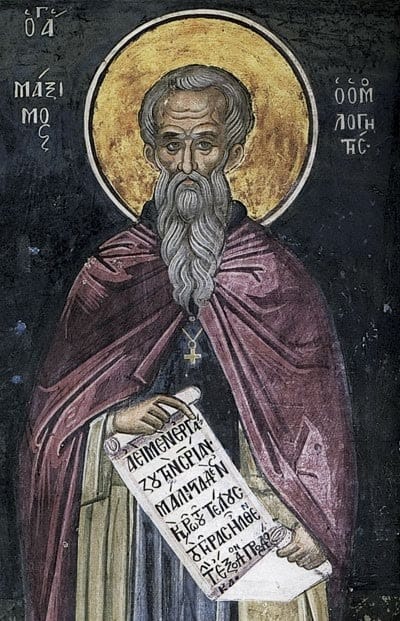
The eleventh-century scholar Michael Psellos echoed a common opinion of the Byzantines when he asserted that Gregory “in ideas surpasses Demosthenes, in quality of prose Plato, and so is superior to both of them, and bears first prize against all comers.” Is the literary brilliance of Gregory lost not only in translation but also with the passage of time. Our culture is no longer informed by the ancient Greek humanism that constituted the background to Gregory’s oratory. Do his writings still touch many of the same notes in modern readers as they did in their original setting?
Michael Psellos asserted that Gregory of Nazianzus was, in various ways, better than Plato and Demosthenes, two of the greatest pre-Christian Greeks. He believed that Gregory not only expressed the best of Greek culture, but did so as a faithful Christian.
In English, we cannot capture all the different nuances of Gregory's Greek. Something is always lost in translation. Take the word ‘rhetoric¡. Today, it a flat term. We may call someone or something ‘rhetorical.’ A rhetorical question is, basically, not a real one. However, questions can be expressed in all sorts of ways within rhetoric. Rhetoric was a way of being, an education, and a way of interacting in social relationships. This has been lost. So, we can miss things both because we are not reading Gregory in the original Greek, but also because we do not have the same appreciation for what the Greeks called paideia, their system of education. This just does not matter to lots of people.
Within Gregorian studies, there are two tracks. There is the track of the classicist, who can appreciate how Gregory imitated and surpassed his various literary predecessors. Then there is the track of the of theologian. Some theologians have absolutely no interest in the classics, and some classicists, have absolutely no interest in the Christian faith. There is a summation of the two within Gregory. Today, however, there is not much appreciation for those who have both these things together.
Why has there never been a complete English translation of Gregory’s works?
Yes, this is a great question. Various Fathers of the Church have written a lot, but we do not have a complete English translation of their works. A complete translation of the works of St. Augustine is coming out from New City Press. However, that is rare. John Chrysostom has left many but we do not have a translation of them all in in one series. The nineteenth-century Nicene and Post-Nicene Fathers series held up Augustine and Chrysostom as special and dedicated volumes to much of their writings. However, it was not a complete translation of their works. How many of Gregory's poems entered the Nicene and Post-Nicene Fathers? Zero, even though he left around 17,000 lines of poetry. He was not recognised as one of the great poets of early Christianity. Like other Fathers, his works have been translated in a piecemeal manner. Some of his works are here, some are there. You need to go to different kinds of books and studies for the translations. Moreover, before you can have a good translation, you need a good Greek edition, but though there have been various projects, none is available yet.
1.
The first recommended book is Fr. Brian E. Daley SJ’s collection of some of Gregory’s orations, poems, and letters, and which opens with an introductory essay. What makes this a good place to start?
It is part of Routledge’s The Early Church Fathers series. It is a wonderful book to start with. It has an introduction, about sixty pages long, with sections on ‘Gregory the Man’, ‘Gregory the Humanist’, ‘Gregory the Philosopher’, ‘Gregory the Theologian’, ‘Gregory the Priest,’ and it introduces him under these various lenses.
Then there are various excerpts, translated by Fr. Daley, from the three genres in which Gregory wrote: orations, poetry, and letters.
Gregory wrote 45 orations (44, technically). This book contains his funeral oration for his sister, Gorgonia (Oration 8), and his orations on love of the poor (Oration 14),on theology and the appointment of bishops (Oration 20), about himself on his return from the country (Oration 26), on the theophany (Oration 28), on the Holy Light (Oration 39), of his farewell address (Oration 42), and for ‘New Sunday’ (Oration 44).
Take Oration 14, On Love for the Poor, for example.
All three Cappadocians left great homilies on loving the poor. In various ways, they wanted Christians to be moved by compassion and to care for the poor and sick. Basil the Great even created a little city that was dedicated to the poor and the sick and has a place within the history of the institution of the hospital.
This is how St. Gregory Nazianzus begins Oration 14.
“Brothers and sisters, poor with me—for all of us are beggars and needy of divine grace, even if one of us may seem to have more than others when measured on a small scale—accept my words on love of the poor, not in a mean spirit but generously, that you may be rich in God’s Kingdom; and pray that we may bestow these words on you richly, and nourish your souls with our discourse, breaking spiritual bread for the poor. Perhaps we may make nourishment rain from heaven, as Moses did in ancient times, lavishing on you the bread of angels; or perhaps we may feed many thousands in the desert with a few loaves, and leave them satisfied, as Jesus later did, who is the true bread and the source of true life.”
Gregory appeals to his people insofar as they are poor. In one way or another, we are all poor and beggars before God. He motivates them, with the Word of God, to give to the poor and to love them. Sometimes, people are interested in the Fathers of the Church for their doctrines but do not see how they are connected to the moral life. For the Church Fathers, it is all of apiece: someone who is orthodox and holds the Catholic faith is moved by the love of God and gives to the poor. That is just what right thinking people do.
The next section of the book is on poems. One of the poems translated by Fr. Daley is ‘A Prayer to Christ.’
“Where’s the injustice? I was born human—well and good!
But why am I so battered by life’s tidal waves?
I’ll speak my mind—harshly perhaps, yet still I’ll speak:
Were I not yours, my Christ, this life would be a crime!
We’re born, we age, we reach the measure of our days;
I sleep, I rest, I wake again, I go my way
With health and sickness, joys and struggles as my fare,
Sharing the seasons of the sun, the fruits of earth,
And death, and then corruption—just like any beast,
Whose life, though lowly, still is innocent of sin!
What more do I have? Nothing more, except for God!
Were I not yours, my Christ, this life would be a crime!”
Brian Daley’s translation communicates something of Gregory's poetry and its particular cadence, as in
“Were I not yours, my Christ, this life would be a crime!”
This line appears twice in this little prayer to Christ. For Gregory, life would be meaningless without Christ.
As an example of his letters, take Letter 58: To Basil. St. Gregory chides Basil for not teaching loudly and openly enough about the Holy Spirit.
“I have considered you, from the beginning, my life’s guide, my teacher of doctrine, and every other kind of good influence—and I consider you so now. If anyone sings your praises, he either does it with me or in my tracks. That is how much I defer to your piety, and how completely I am on your side! And no wonder: the more people live together, the more they know each other first-hand, and when that first-hand experience is abundant, the testimony one bears is all the more complete. If there is any benefit for me in living, it is your friendship and companionship. That is the way I feel about these things, and may I always feel this way! So what I now write, I write unwillingly—yet nevertheless I write it. Please do not be angry with me—I shall be very angry with myself, if I cannot make you believe that I say and write this to you out of good will.”
In a sense, this is a literary buttering-up. Gregory, then says that there was a dinner in which the conversation turned to Basil and Gregory, and someone was very upset because Basil was not teaching sufficiently about the Holy Spirit while Gregory was protecting him. So, Gregroy asks Basil to say more about the Holy Spirit publicly because he has been protecting him.
2.
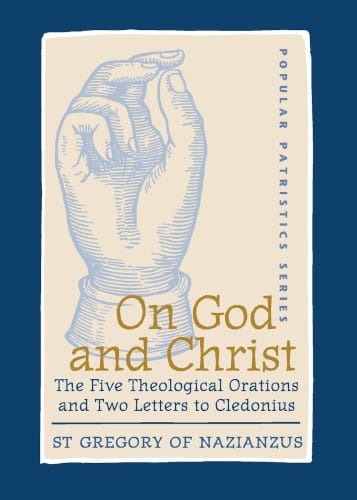
The second recommended books is a translation of what are arguably Gregory’s most celebrated writings: the so-called Theological Orations (Orations 27-31) and his Two Letters to Cledonius. In the former, he outlines the mystery of the Trinity in opposition to the Anomoeans or Eunomians; in the latter he addresses the Christological errors of Apollinarism. Let us start with the Theological Orations. Which doctrinal errors about the Trinity is Gregory addressing?
The Eunomians were extreme Arians and are also called heteroousians. They believed that the Son has a different substance from the Father: that the Son is so different from the Father that the two do not have the same nature or substance. Gregoy opposes the doctrine of the Eunomians but also their theological method. Eunomius of Cizicus, it was said, thought that he knew God just as God knows God. He was very confident in what he said about God but did not observe the proper rules for talking about him. So, the very first of these five theological orations (Oration 27) is on theological method.
One of the key things is to have a purified life—to be either purified or in the process of purification—so that our minds can think well about God. So, remembering God is more important than breathing, Gregory says. Some might think that this is an exaggeration. Well, at the end of your life, which is more important: to have God in your in your soul or to breathe? We are all going to stop breathing. Gregory wants us to always have God in our soul, but we just do not talk about God like we do about sports. People were treating God in an unfitting way.
That is the first of the Theological Orations. They have been collected in On God and Christ, a volume in the Popular Patristic Series of St. Vladimir’s Seminary Press, though Gregory did not give these orations that title. Oration 28 is on the doctrine of God; Orations 29 and 30, on the Son; Oration 31, on the Holy Spirit.
The two Epistles to Cledonius were written to a priest and friend who looked out for Nazianzus while Gregory was away. They are two of the three Theological Epistles and, in the manuscripts, were separated from the other epistles. Apollinarianism is the main threat that Gregory addresses. However, while he is treating it, he also considers the opposite threat and, as I argue, desirous to protect the Orthodox faith, provides a summation of errors about Christ.
This is a wonderful collection of the most popular of all Gregory’s writings. If you are going to read Gregory in a seminary or university, usually you will read the Theological Orations and Epistle 101: To Caledonius.
What contributions to the Church's teaching on the Trinity does Gregory make in his theological orations.
There are several important contributions. First, he distinguishes the Son as Son of God from the Son as Son of man. Gregory says that Jesus is one by a blending or a mixture. These words—‘mixture’ or ‘blending’—came to be disreputable technical terms. Gregory, however, emphasises the oneness of the mixture or blending: Jesus really is the God who became man. He articulates this against Apollinarianism, which said that, in the Incarnation, the Word became flesh but did not take upon himself the rational soul of man. Gregory’s doctrine on the mixture or blending goes against this doctrine. It also goes against the opposite heresy: the claim that that Jesus is two Sons.
Some might say that this is about Christology, not the Trinity. However, Lutheran scholastics were the first to use the word ‘Christology.’ All of this is about the Son, the eternal Word of God who became man.
The last of the five Theological Orations is on the Holy Spirit (Oration 31). There, St. Gregory sets out a very robust Pneumatology (again, this is a modern word). He teaches that the Holy Spirit really is God and is consubstantial with the Father and the Son.
These are his greatest contributions. He also explains how the Trinity is not one thing among all the others. The Trinity is God. God permeates our whole existence. The Trinity is not just simply a topic withing the Christian faith. Rather, all things are permeated by our faith in God: the Father, Son, and Holy Spirit. These are some of the chief aspects of St. Gregory's Trinitarian thinking.
Did Gregory have any real influence on the Council of Constantinople in 381?
He presided over it and then the bishops turned on him, so he left in a huff. Some say that he was not satisfied with the Creed.
Fr John McGuckin, one of the great experts on him, says that Gregory would be very pleased that his theology trumped an ecumenical council. Christians commonly will say that the Trinity is one in essence or nature and three in persons or hypotheses. That formula comes from Gregory's theology and is not summarised in the Creed. That is why Fr. McGuckin closes his book on the intellectual biography of Gregory of Nazianzus by saying that, in some sense, his theology is more influential than the Creed. This turns the question around. It is not that his theology influenced the Creed. Rather, his theology is more influential on the Christian profession of faith in the Trinity than the Creed that is recited on Sundays and solemnities.
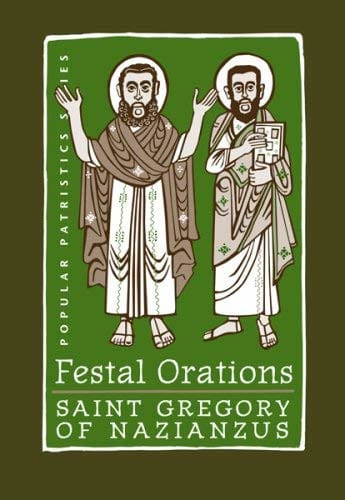
3.
The next book is a translation of Gregory’s orations for major liturgical feasts such as Easter, Christmas, Pentecost, and the Baptism of the Lord. Have you recommended these orations as windows into the history of the liturgy, as models of Patristic preaching, or as explanations of the mysteries celebrated in these feasts?
All three. These orations were translated by Nonna Verna Harrison, who passed away a couple years ago, and gathered together in Festal Orations.
There is an appendix on how each of these orations features in the Byzantine liturgical year. Oration 1, On Pascha is read at Easter: Oration 45, On Pascha, on Monday of Bright Week: Oration 44, On New Sunday, on the First Sunday after Pascha: Oration 43, On Pentecost, at Pentecost; Oration 15, On the Maccabees, on their feast, 1 August; Oration 24, On Cyprian, on his feast, 2 October; Oration 38, On the Nativity, on 25 December; Oration 43, On the Great Basil, on his feast, 1 January; Oration 39, On the Theophany, on 6 January; Oration 40, On Baptism, on 7 January, Feast of St. John the Baptist; Oration 11, To Gregory of Nyssa, on his feast, 10 January; Oration 21; On the Great Athantasius, on his feast, 18 January; Oration 42, The Farewell Address, on Gregory’s own feast, 25 January. It goes on and on.
To celebrate Christmas, Eastern Christians says, “Christ is born, glorify him.” Where does this greeting come from? The beginning of Gregory’s oration on the Nativity of Christ. Moreover, this is the first extant sermon from an Eastern celebration of Christmas on December 25th. It is important for the history of the liturgy. It is still being prayed in different ways today. It can nourish people’s spirituality. So, I highly recommend these Festal Orations.
"Often in this poetry, he brings up Jesus or addresses him directly. He addresses basic human questions at a fundamental level."
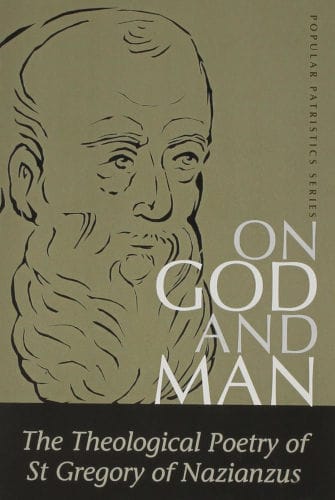
4.
As you mentioned, Gregory wrote about 17,000 lines of poetry, much of it autobiographical. The next book, On God and Man, is a translation of some of his poetry. Why is Gregory’s poetry worth reading today?
Gregory's poetry can be disarming. It is piercing. Some might read it, think of twentieth-century existentialism, and wonder how a Father of the Church could say such things. Some of his poetry speaks about various deep questions. Listen to the beginning of his ‘On Human Nature’ (Poem 1.2.14), in the translation of Peter Gilbert, a great scholar of Gregory Nazianzus.
“Yesterday, worn out with anxieties, away from others
I was in a shady grove, my soul consumed.
For how I do so love this drug for sufferings,
to speak in quiet, me with my own soul.
And the breezes whispered while the birds sang,
granting from the branches a sound slumber,
though for a soul quite weary. While, from the trees,
deep chanting, clear-toned, lovers of the sun,
whirring locusts made the whole wood to resound.
Nearby flowed cold water by one’s feet,
gently coursing through the cool grove. But as for me,
the strong sorrow I had had, I had it still.
Therefore I didn’t care about these things, since a mind
cloaked round with sorrows doesn’t want to sing back happily.
But privately, my mind in a whirlpool spinning,
I had this sort of battling round of words:
Who was I? Who am I? What shall I be? I don’t know clearly.”
From a shady grove, where we experience nature, Gregory goes back into his own soul and opens up the most basic questions of human life. Frequently, he connects all these questions to Christ. So, often in this poetry, he brings up Jesus or addresses him directly. He addresses basic human questions at a fundamental level. Moreover, his personality comes through. Some scholars do not like his personality or will say that he is just making things up. I find that he has a great consistency in presenting certain problems and connecting the reader to Jesus.
5.
Gregory was not the only ancient Christian author who wrote a lot of poetry. In the Latin world, there was Prudentius. Literary critics might acknowledge that Prudentius’s poetry is very edifying but do not rate it very highly as poetry. What is the consensus among classicists about the quality of Gregory's poetry?
It is mixed. He imitated all different kinds of Greek metre and style. The consensus is that he is more successful in some poems than in others.
His poem on writing poetry, and the reasons he gives for it, is very popular among classicists because it is on metre and how poetry itself is a kind of measuring.
Gregory understands poetry as a Christian and adapts various classical forms of poetry into a Christian register. Some find that clever and even like it. He is the first to write an epistolary letter in verse in Greek. Like his great nephew, Nicobulos, classicists realise that he is not just imitating others but inventing different forms. Some like this, others may not. So, there is a mixture of reactions.
The bad thing in Gregorian scholarship is that there is the classicist’s way of looking at him and the theologian’s. Generally, the two have not come together.
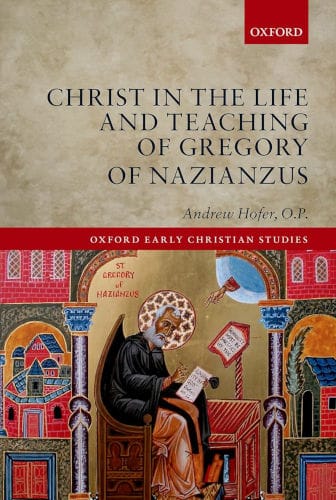
In your book Christ in the Life and Teaching of Gregory of Nazianzus, you explore both his Christology and the Christological import of his autobiographical writings. On the one hand, Gregory is first called the Theologian at the Council of Chalcedon (451) and cited for his explanation of the mystery of the Incarnate Word. On the other hand, of all the early Greek Church Fathers, he is the one who writes most about himself. In what way are his biographical writings connected to his preaching of the mysteries of Christ?
I turned my dissertation into Christ in the Life and Teaching of Gregory of Nazianzus, published by Oxford University Press in 2013.
Gregory is a pastor. He puts his literary prowess at the service of Christ, to connect people to Christ. To understand Gregory, you need to go back to the Psalms and to St. Paul.
How much does St. Paul talk about himself? Quite a bit. Moreover, there was a great surge in interest in Paul interest in the late fourth century. Various people went back to Paul in an intense way. Gregory Nazianzus does so with his rhetorical skills. He exposes something of his life to show Jesus. Paul says, “Be imitators of me, as I am of Christ” (1 Corinthians 11:1). That is a bold statement. Gregory’s imitation of Jesus allows us to see something of Christ at work in his life.
Furthermore, the psalmist gives us the Psalms and we then pray them. Similarly, as we enter into Gregory's world, we can identify with him.
Think of St. Augustine's Confessions. When we read it, we are not just reading about Augustine. In a sense, we are probing something of our own inner life and use his words to talk to God. However, I find that Gregory of Nazianzus is more Christocentric than Augustine. The Confessions is addressed to God the Father, whereas Gregory of Nazianzus is more about showing us Jesus and making us more and more focused on Christ.
Moreover, he wants us to see a holistic picture. His favourite title for Jesus is logos, the Greek for ‘word.’ However, it is also the Greek word for ‘oration.’ Moreover, we are rational animals (logikoi) and so belong to the Logos. Gregory of Nazianzus draws out the connection between all these things and Jesus, the eternal Logos of God made flesh. He shows the combinations of logos and bios. In Jesus, word and life exist together perfectly. Moreover, we really can be one with him, because he came to be one with us.
In my book, I go through this and attend to the Greek words mixis (mixture) and krasis (blend).
In a sense, Adam is the first mixture of heaven and earth, spirit and matter. Christ, the new or second Adam, is the new, second mixture. As Word made flesh, he enables us to be purified, and united to him, so as to be saved. That is the argument of my book. In this way, Gregory breaks down certain barriers that we have set up in modernity regarding one’s permeation with the life of Christ.