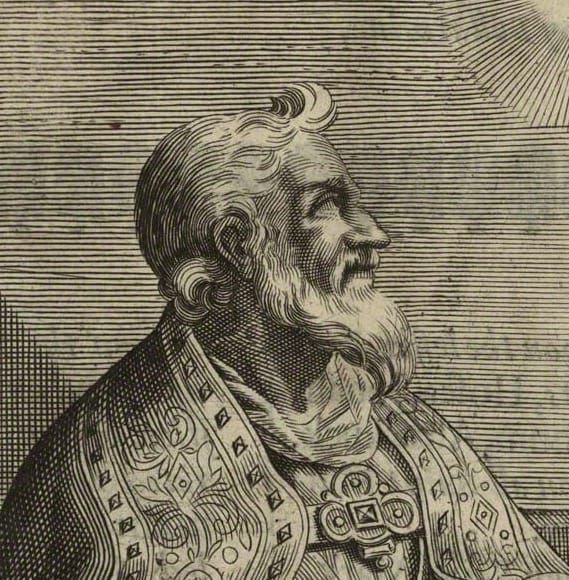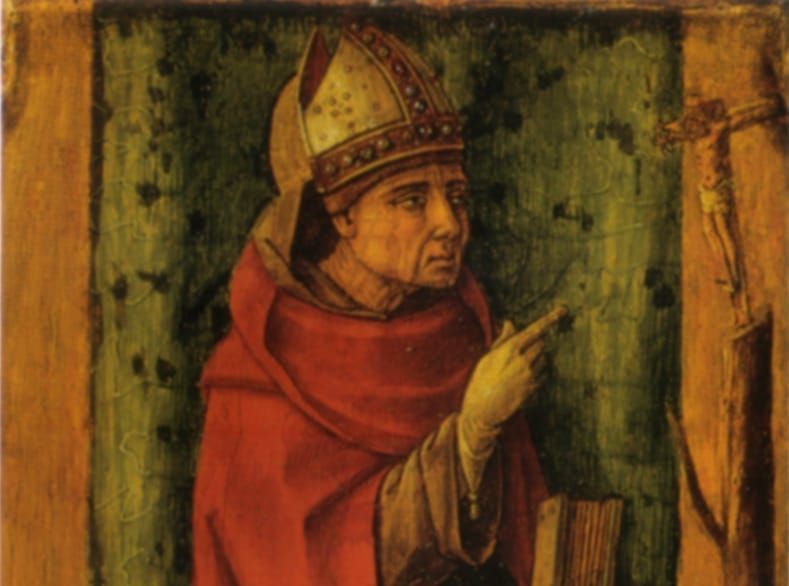
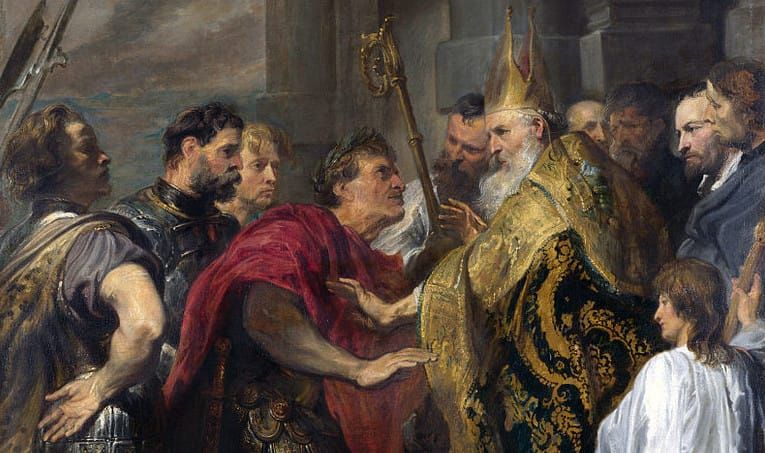
St. Ambrose of Milan (c. 339-397) is a Father and doctor of the Church. He was born in Augusta Treverorum (Trier) to a Roman Christian family. Following his father’s death, Ambrose’s family moved to Rome, where he was educated. Like his father, he served as a public official in the Roman administration and rose up the ranks. Around 372, he was appointed governor of the province of Aemilia et Romana, whose see was Milan. There, he became a leading figure at the court of Emperor Valentinian I. As governor, he worked to settle disputes between Arians and Catholics and earned the respect of each group. When Auxentius, the bishop of Milan and an Arian, died in 374, Ambrose attended the episcopal election to quell any dangers to the public order. By popular acclamation, he was elected as the new bishop. During his episcopacy, he countered Arianism with his teachings and resisted political pressure to make concessions to its adherents. He also reminded Christian leaders of their duties, most famously when he denied communion to Theodosius until the emperor made public penance for the Massacre of Thessolonica. His preaching contributed to the conversion of St. Augustine, whom he baptized. His hymns continue to be recited in the liturgy.
In this interview, Fr. Brian Dunkle SJ discusses Ambrose’s life, writings, and recommends some books by him and on him.
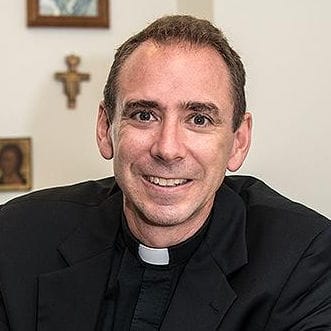
Fr. Brian Dunkle SJ is Associate Professor of Historical Theology at the Gloria L. and Charles I. Clough School of Theology and Ministry at Boston College. He regularly offers philosophy courses at the St. Joseph Scholastic in Vietnam and offers pastoral assistance at local parishes and the correctional institutes of Concord, MA. He has translated St. Ambrose’s Treatises on Noah and David and is the author of Enchantment and Creed in the Hymns of Ambrose of Milan (Oxford University Press).
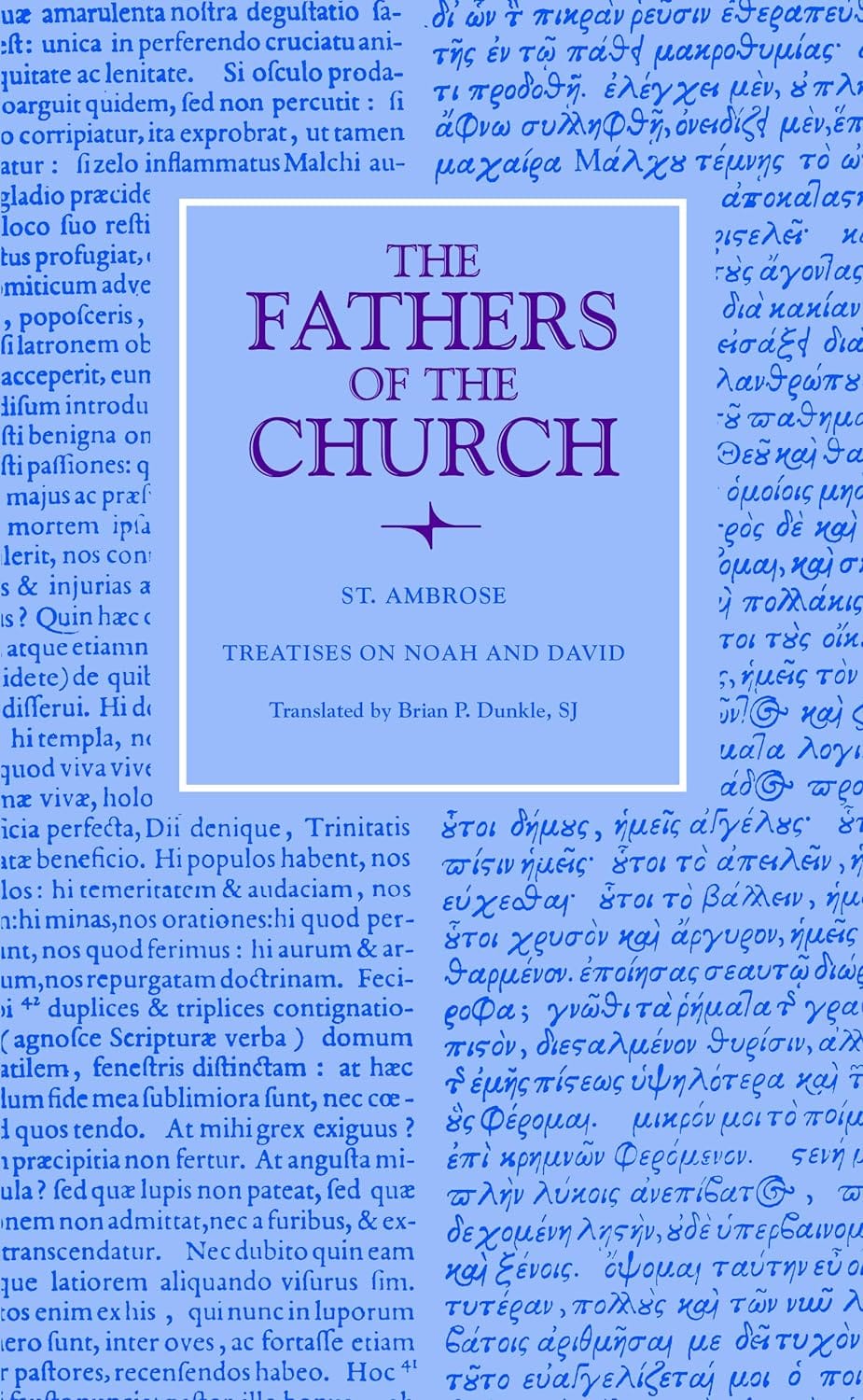
- Theological and Dogmatic Works
by St. Ambrose - Enchantment and Creed in the Hymns of Ambrose of Milan
by Brian Dunkle SJ - Ambrose of Milan: Deeds and Thought of A Bishop
by Caesare Pasini - Ambrose
by Boniface Ramsay OP - The Spirit of Early Christian Thought: Seeking the Face of God
by Robert Louis Wilken
What are the main events of Saint Ambrose's life?
The main event was his rapid ascendancy to prominence in the church in Milan, beginning with his election in 373/74. He went from being the governor of a major region of Northern Italy, Aemilia Romana, to becoming bishop of Milan, the main see of Italy at the time and, therefore, prominent in the Western Church.
This turn of events was quite dramatic. According to various accounts, he was a catechumen, if that. So, he was not especially involved in the life of the Church. However, by popular acclamation, he was elected bishop. He was baptized and ordained bishop the following November or December 7 instead of April 4, the date of his birth to eternal life. Often, Easter overrides the latter date. The Church, therefore, has decided to commemorate the beginning of his ecclesiastical career.
Through distant sources, we know about certain events of his childhood.
He was brought up in a prominent family of the empire. He was probably the son of a governor. He was born in Trier and trained in Rome and embarked upon a career in politics.
His active career started in the 370s, but we know very little about its beginnings.
From there on, we have a pretty good account of the other major events of his life.
He trained hard to become a learned bishop rather than just an administrator. In the late 370s he began to write his works, such as On Virgins, and those related to the various doctrinal disputes of the day, including his great work On the Christian Faith (De fide) and The Sacrament of the Incarnation of the Lord.
At the same time, he became a prominent figure in what we would now call Church-State relations: the relation between ecclesiastical and political affairs.
Given his background in politics and his former career as a governor, he had a special insight into the workings of imperial affairs and the way in which the Church would need to function in relation to the Imperial court.
So, beginning around 380, he assumed a very prominent role in negotiating and dealing with the threats from the Arians against the Nicene Church of Milan. The Arians were both prominent in northern Italy and Gaul, as well as in Rome. They were attempting to gain some control of the Church in Milan.
Throughout the 380s, the controversies in which he was engaged often involved the Emperor or his representatives in the West.
Prominent among these was his dispute over the Altar of Victory in Rome. This became a hot-button issue around 384. Certain pagan senators hoped to reinstitute an ancient practice of giving reverence to this altar, which depicted the winged Victory. Ambrose, and those in his party, argued that the moment had passed and this kind of devotion no longer had a place in a Christian empire.
The next major events of his life centered on the role of the Church vis-à-vis the empire. These culminated in 386, when the Church of Milan was threatened by Arians who wanted to use one of the city’s basilicas for their worship. Ambrose and his people led a resistance movement. He used his hymns and songs to rally the faithful to his cause and promote the orthodoxy of Nicaea against these outside forces.
Toward the end of his career, he focused primarily on writing. During the 390s he was writing and revising some of his commentaries and preaching to catechumens.
All this comes to an end with his death in 397.
As governor of Aemilia et Romana and bishop of Milan, Ambrose came into close contact with various emperors. Why was the emperor based in Milan at the time rather than Rome?
Over the third and fourth centuries, the political center of the Empire tended to gravitate eastward. The most dramatic case was Constantine's founding of the new Rome, Constantinople, in 325.
This manifested itself in another way: the gravitation of political activity toward the borders, where the threats were.
Rome remained the traditional, cultural, symbolic head of the empire. However, the politics, negotiations, meetings with ambassadors, and all the various other ways in which government runs, were centered more and more in the North. There it was possible to interact with rival forces. There you could have armies ready where they were needed.
Little by little, especially by the end of the fourth century, this led to a flow from Rome to Milan.
This changed dramatically in the fifth century, when forces from the north overran the Italian peninsula, all the way into North Africa.
What drew you to study St. Ambrose from among the Church Fathers?
That's interesting. I had a long-standing interest in the imaginative literature of the Early Church, which includes its poetry and hymns.
As much as I was taken by doctrinal issues, or the philosophical and biblical background of patristic thought, I believed that there was also much to be found in the verse and popular life of the faithful.
To my mind, no one exemplified that more than Ambrose, even though he was quite learned by the end of his career.
He had read widely in Greek theology and was the conduit for so much theology to the Church of the West.
Nevertheless, he probably expressed himself most enduringly and foundationally in his hymns.
As a personality, he seemed to have so many different parts. This intrigued me and I believed that he captured and pulled together many of those parts in his hymns, which were passed on and were deeply influential on all Western and Latin hymnody.
Initially, I approached him through his songs. Little by little, I grew to know him as a political, theological, and ecclesiastical figure. I find each of these parts infinitely intriguing because of what they show us about the life of the Church and the mind of this genius.
"He had no pretense of being an original thinker in the way we might conceive of one. In fact, he would have thought originality was precisely an enemy of good theology."
You have mentioned how St. Ambrose was the conduit for much of the Greek patristic thought and theology into the West. On which Greek Fathers did he draw mainly?
Early in his career, he seems to have drawn very heavily on the thought of a non-Christian, Philo the Jew.
Five of his works are often identified as Philonian because of how heavily they are influenced by the thought of this first-century exegete. In some cases, he is just translating directly from Philo.
Of course, Philo had a huge influence on many of the earlier Christian thinkers, both the Latins, but primarily the Greeks, including Origen of Alexandria. This was mainly because of his allegorical, spiritual reading of the Old Testament.
Initially, Ambrose relied heavily on Philo. At the same time, he read Origen very closely, names him once or twice in his writings, and drew heavily on his thought. At times, he is simply translating passages from Origen, adding a few minor tweaks, and bringing them into circulation in Latin.
Third, there is the thought of Basil of Caesarea. Fourth, there is Didymus the Blind.
They were near contemporaries of Ambrose. They were very influential on developments in the theology of the Holy Spirit.
Ambrose's own work The Holy Spirit draws very heavily on them. Sometimes this work is dismissed as derivative or even a plagiary, a charge that goes back as far as the fourth century, to Jerome, sometimes a friend of Ambrose’s, sometimes an enemy.
My understanding and reading of it is different. Ambrose is translating and rendering accessible thought that he recognized as authoritative. He saw this doctrine as a treasure and wanted to make it available to his people. He had no pretense of being an original thinker in the way we might conceive of one. In fact, he would have thought originality was precisely an enemy of good theology. He wanted to be loyal to Tradition.
Even so, Ambrose may be original in any way without necessarily intending to be. Is Ambrose’s teaching as a Church Father original or merely derivative?
Absolutely. The originality or novelty often occurs whenever he translates thought that he has received and supplements it for his context.
His readings of Philo are a clear example of this. Ambrose consistently introduces the figure of Christ, not just in terms of the parables or events of the New Testament, but Christ as proclaimed by the creeds, the Creed of Nicaea in particular.
Ambrose regarded Philo’s exegesis of Moses and Abraham as reliable. At the same time, he always stresses how these figures point to their fulfillment in Christ, the Word who assumed a human nature. So, he takes an exegetical insight and then renders it according to the orthodoxy of the period. He thereby creates something that is quite original in its own right.
While he draws on heavily on Philo and the Greek Fathers, does he also exemplify certain characteristics typical of the Latin Church Fathers and early Western Christianity?
Yes, in many ways he was at the headwaters of this synthetic Latin theology that was coming together at the end of the fourth century.
There were major figures before him, such as Tertullian in North Africa and his near contemporary Hilary of Poitiers.
However, Ambrose had a special genius for understanding and incorporating the Roman philosophical tradition into his thought. He thereby became deeply influential.
He was a student of Roman Stoicism. As to the philosophical tradition of ancient Rome, he clearly knew Seneca but above all Cicero.
Much of his project is to Christianize that Roman philosophy and to baptize Cicero's instructions on good, virtuous behavior.
He does this most prominently in a work from the mid-380s: On Duties (De officiis ministrorum). In that work, he at times paraphrases and translates Cicero’s guide for his own son, On Duties, and renders it into a guide to the duties of ministers.
However, he consistently substitutes Cicero's use of pagan models, such as the great heroes of Rome’s past, with figures from Scripture. No longer do we have Scipio or some other Roman luminary, but David for instance.
Again and again, Christ is at the heart of the work. For Ambrose, Christ is the model of virtuous behavior in a way that he certainly would not have been for the ancient Roman tradition.
This is a distinctively Western, Latin work and it becomes deeply influential on subsequent Latin theology.
"I always suggest that people first encounter Ambrose through his works on the mystagogies: The Mysteries and The Sacraments."
1.
The first book you have selected is entitled Theological and Dogmatic Works. It contains translations of The Mysteries (De mysteriis), The Sacraments (De sacramentis), The Holy Spirit (De Spiritu Sancto), The Sacrament of the Incarnation of the Lord (De Incarnationis Dominicae Sacramento). Are these Ambrose’s most important works or simply the ones it is worth starting with?
They are his most important works, although with Ambrose it is quite difficult to single out one work in the way you can with other Fathers.
It is safe to say that Augustine's most important work is the Confessions. With Gregory Nazianzus, Ambrose’s near contemporary, there are the five Theological Orations.
With Ambrose, it is more of a challenge to single one book out because his each of his works treats different areas. The later tradition does not attribute to any of his works the sort of authority that it does to the works that I have just mentioned.
I always suggest that people first encounter Ambrose through his works on the mystagogies: The Mysteries and The Sacraments. Many do. In these works, Ambrose is at his most accessible and imaginative. He is guiding neophytes, the newly baptized, into the experience of baptism and the mysteries of the Church. He is pointing to the mysteries at the heart of Christianity: mysteries both in terms of how Christians read Scripture and the sacraments themselves. The terms ‘mystery’ and ‘sacrament’ are virtually indistinguishable in Ambrose. They refer to baptism, the eucharist, and initiation broadly speaking.
These works are very accessible to modern readers. They are a good place to start, before moving on to his more dogmatic works.
Are any other of St. Ambrose’s works especially suited for those looking for spiritual reading?
I would recommend some of his earlier preaching. On Virgins is often seen as an expression of his praise for asceticism and prayer.
His exegesis, while not always to our taste, often has creative readings that can stretch our modern imaginations. It has real nuggets.
In addition to the mystagogies, I would include his book on creation itself, the Hexameron, among his valuable spiritual works.
It too draws heavily on Basil of Caesarea. It invites us to appreciate the natural world, God's creation of it in a sequential order, and the creation of humanity in the image and likeness of God. It does this in a way that still speaks to us.
"In many ways the hymns are where his genius comes out most."
2.
In Enchantment and Creed in the Hymns of Ambrose of Milan, you look at how St. Ambrose wrote liturgical hymns to counter Homoians and their connection to his mystagogical preaching. What is the theological and pastoral significance of Ambrose’s hymns?
They are at the center of his pastoral vision. My argument, while technical at times, is that we rarely study as closely as we should the language of the hymns, their construction, and their depth. If you do so with Ambrose's hymnody, we find a subtle interplay between what he calls enchantment. In a sense, he defends his hymns almost as if they were magic spells. Now, this is partly to defend them against the charge that he is seducing people over to his side. However, as he says, that is what music does in a sense. Yet there is no greater spell, he says, than praising the Trinity. Directly and indirectly, his hymns are about drawing people affectively and intellectually into a common praise of God—Father, Son, and Spirit—in light of the creeds that were being determined and settled during the fourth century.
In his hymns, I find an exquisite balance between emotional and imaginative appeal, on the one hand, and intellectual and sophisticated theological density on the other.
They might be his greatest accomplishment. While I tend to recommend treatises or academic writings, in many ways the hymns are where his genius comes out most.
At the end of the book, there is the Latin text and English translation of eighteen hymns attributed to Ambrose. Many of them—such as Aeterne rerum conditor, Splendor paternae gloriae, Iam surgit hora tertia, Deus creator omnium, Intende qui regis Israel—are still used in the Liturgy of the Hours. How many are authentic?
This is a point of dispute in the scholarship and has not been resolved entirely. Within Ambrose's lifetime, his hymns were being annotated all around the empire. In the subsequent generations, there was a profusion of hymns.
My argument is that, given shared criteria, we can confirm thirteen to be from him or close enough to be virtually from him. Textual critics and historians of manuscripts will disagree on this point. However, the ones you mentioned—in addition to a few more for the saints and the hours of the day—really stand out as coming from his pen.
From my undergraduate theology studies, I recall that the Arians would also compose hymns to try and propagate their ideas. Did St. Ambrose write hymns to counter their strategy and beat them at their own game?
Absolutely. One of the fascinating points about the history of song is that, with some exceptions, the earliest surviving non-Scriptural hymn from the Christian tradition is Arius’s so-called Thalia, the wedding song that he composed early in the fourth century. It was a subject of mockery for his opponents. However, it is clear that the rival parties in fourth-century doctrinal controversies drew on music, almost in the way that we might use rallying songs. The different music and language helped distinguish one party from another.
Ambrose never refers explicitly to how his songs are meant to combat others. However, the circumstantial evidence, as well as his own reference to his hymnody as a kind of magic spell, indicates that he was part of this controversy. Other Fathers of the period, such as Hillary and Augustine, engaged in a similar sort of gamesmanship. They too composed hymns to spread orthodoxy and counter their rivals.
The Church in Milan celebrates the Ambrosian rite, a variant of the Roman Rite. In what sense can this rite be attributed to St. Ambrose?
I have pondered this question, though I am not an expert on the Ambrosian rite. However, there are certain elements that, with some certainty, reflect Ambrose’s own understanding of the liturgy and, in one form or another, have survived to the present day.
The Ambrosian rite has undergone many periods of revision and reform. At certain times, it has been more thoroughly Romanized than at others. There have been recent attempts to return it to its authenticity. The general, safe estimation is that Ambrose’s version of the rite was probably closer to the Eastern rites than that of Rome.
Ambrose talks about the ritual of the washing of the feet, which seems to have been particularly prominent in the Milanese liturgy. He makes some reference to differences between what they do in Milan and what they do in Rome.
However, I am not confident enough to make a strong historical claim about the relationship between the liturgy, as presented in The Mysteries and The Sacraments, and that of the present day to answer your question adequately.
"Soon after Ambrose began composing his hymns, Latin poets in the West started to see him as a classic."
How important are Ambrose’s hymns for the development of Latin liturgical poetry?
They are indispensable. They really are at the headwaters of hymnody. To such an extent, that, in the sixth century, when Benedict specifies in his rule the hymns that the monks are to sing, says, “And then we sing Ambrosian hymns.” This was the broad term for all hymns.
He was also influential on poetry in a very interesting way.
Poets always see earlier authors as classics. They always have models that they are trying to imitate, rival, outdo, or honour.
For Latin poets, the obvious classic was always Virgil and his Aeneid. He was the great model of epic poetry.
Soon after Ambrose began composing his hymns, Latin poets in the West started to see him as a classic: to see his verse as so authoritative and beautiful that it merited imitation, honour, and should be absorbed into the tradition.
A poet like Prudentius took Ambrose's hymns for the hours of the day as the model for his own poems, just as he might have used Virgil or Horace.
"Ambrose understood that the Church is necessarily involved in the political order."
3.
The next book is Cesare Pasini’s, Ambrose of Milan: Deeds and Thought of A Bishop. As the subtitle indicates, this biography focuses on Ambrose’s stature as a bishop rather than his impact om the politics of the day. Which characteristics of a saintly bishop come through?
There is a tradition within the scholarship— it begins in the early twentieth century— of treating Ambrose as a Church politician, as in a famous biography from the 1930s: Ambrosius von Mailand als Kirchenpolitiker.
This approach tends to take a rather cynical view of his theology, writings, and interventions into political affairs.
There are episodes in Ambrose's life that lend themselves to such a reading. He issued a rather aggressive statement against the rebuilding of a synagogue that had been destroyed in Callinicum, a town in the Near East.
Pasini does a great job of sort of refocusing biographical accounts of Ambrose away from the purely political to the episcopal: to how he acts and writes pastorally. In this regard, it is a good corrective.
Some might say that it is too sympathetic and overlooks the uglier aspects of Ambrose’s interventions in politics.
Nevertheless, Pasini gets something right, something that we Christian readers need to appreciate. Ambrose understood that the Church is necessarily involved in the political order. The political order is neither immune from nor beyond the guidance and instruction of the Church, especially when those leading the empire claim to be Christians.
It was Ambrose who was calling different emperors, but especially Theodosius, to remember their Christian identity and that they were Catholics. In one sense, they may have possessed something approaching limitless power. However, as members of Christ's body, they had a duty to obey the bishop in certain matters. Ambrose conceptualised in an enduring manner the relationship between Church and state. This had a pastoral impulse rather than a political one.
Are there any other lessons that we can draw from Ambrose for pastoral ministry in the Church today?
His versatility is a characteristic that pastors can continue to draw from. His corpus, as I said, does not have a single magnum opus, but shows a range of approaches. He shows that a pastor needs to, as we say, try everything and see what sticks. Some things are more successful than others. Some of his exegesis can be a little wooden and too allegorical for our taste. That does not undermine his effort to be an exegete.
For instance, he wrote two books On The Christian Faith (De fide), and then realized that he was not doing a very good job. So, he went back and tried to improve it. He added a few more books. This shows that he was ever eager to try new things and improve what he was doing.
That is why he took up hymn-writing. Early in his career, he gave no inclination of becoming a poet. However, music was needed amid the difficult controversies to rally and enliven his flock and to instruct them. So, he turned to writing hymns.
Similarly, he wrote letter after letter to try and influence people.
He was willing to try anything for the service of God and the good of the Church.
4.
Fr. Boniface Ramsay’s Ambrose contains an introduction to his works, a selection of his writings, and the biography written an St. Augustine’s request by Ambrose’s notary, Paulinus of Milan. Why have you chosen this introduction in particular?
As I mentioned, one of the challenges with Ambrose identifying a single representative work of his.
Ramsay’s collection gives the reader access to a range of writings and reflects Ambrose’s versatility.
I like how it includes the hymns, not only in translation, but also in their original Latin. This gives you a sense of Ambrose's style.
Ramsay also includes snippets from the range of Ambrose's career. We get a sense of Ambrose in politics, Ambrose the pastor, and Ambrose the mystagogue.
The introduction gives a solid overview of Ambrose’s life.
Ramsay includes Paulinus’s wonderful, brief biography of Ambrose. This biography includes all these colorful events whose authenticity is perhaps questionable. There is the famous episode of bees coming to rest on Ambrose's mouth, signaling the honeyed speech that would be the basis of so much of his career. It is good that Ramsay includes this very influential, ancient biography. It presents Ambrose’s sainthood.
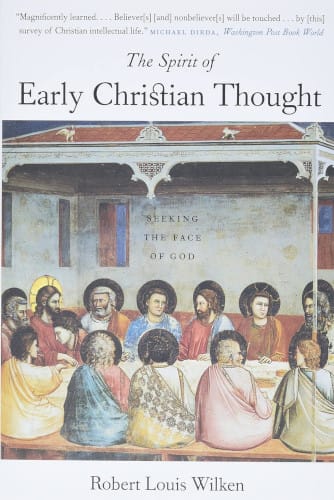
5.
The final book you have chosen is not about Ambrose but the whole sweep of early Christian thought and how it was geared towards evangelization. Have you recommended Robert Louis Wilken’s Spirit of Early Christian Thought: Seeking the Face of God to give readers a better sense of the broader Christian cultural setting of Ambrose’s works?
Exactly. Had I not listed these books in alphabetical order, I might have put this one first. It provides the general context and background to Ambrose’s work.
In teaching Introduction to Patristic Theology, or in recommending works to people who are not familiar with this period at all, I have found that Wilken’s monograph is incomparable. It just strikes so many people so deeply.
I have met so many people who were inspired to study Patristics by reading The Spirit of Early Christian Thought. It captures the historical, cultural, and theological milieu of the period.
In addition to Ambrose’s works, I wanted to recommend a book that would provide some context to him.
Ambrose does not feature heavily in Wilken’s study. However, he does appear now and again and Wilken does a good job of integrating him into the broader context.