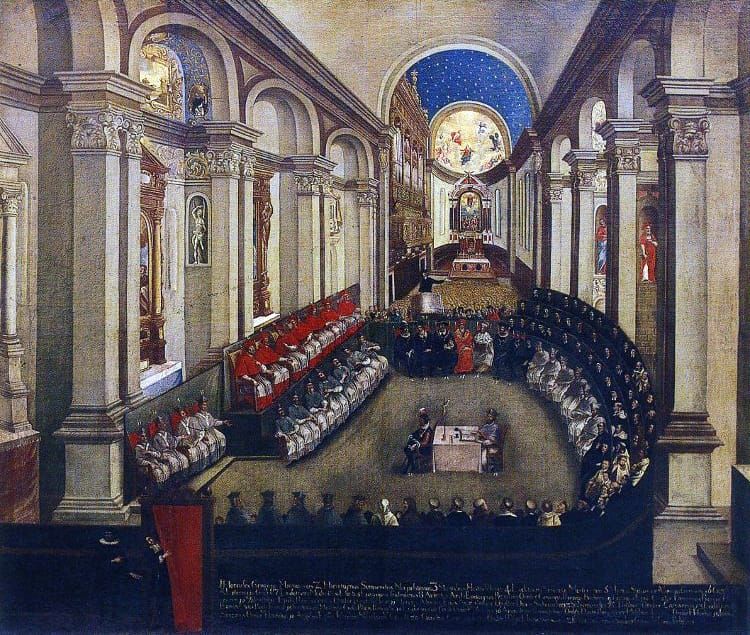
The Council of Trent (1545-1563) is the nineteenth of the twenty-one ecumenical councils and one of the most influential ones. It was convoked by Paul III (Sessions 1-8, 1545-1547) and continued under Julius III (Sessions 12-16, 1551-1552) and Pius IV (Sessions 17-25, 1562-1563). It addressed Protestant doctrines and prescribed a series of important ecclesial reforms. In its doctrinal decrees, it specified the canon of Scripture and clarified the nature of original sin, justification, and the sacraments.
In this interview, Nelson H. Minnich discusses the Council of Trent.
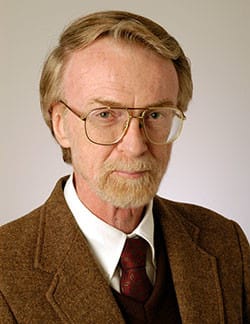
Nelson H. Minnich is Ordinary Professor of Church History at the Catholic University of America, where he has taught Renaissance, Reformation, and Counter-Reformation history since 1977. Since 2005 he has been editor of the Catholic Historical Review. He is the author of The Catholic Reformation: Council, Churchmen, Controversies (Variorum), Councils of the Catholic Reformation: Pisa I (1409) to Trent (1545-63) (Ashgate), The Decrees of the Fifth Lateran Council (1512–17): Their Legitimacy, Origins, Contents, and Implementation (Routledge); editor of Journeys in Church History (CUA Press), The Cambridge Companion to the Council of Trent (Cambridge University Press); and co-editor of The Cambridge History of Reformation Era Theology (Cambridge University Press), and Martin Luther and the Shaping of the Catholic Tradition (CUA Press).
- History of the Council of Trent (vol. 1) (vol. 2) (German Edition)
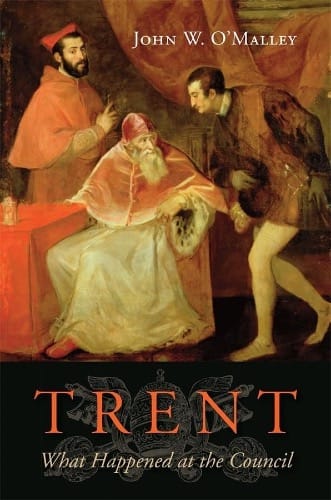
by Hubert Jedin - Trent: What Happened at the Council
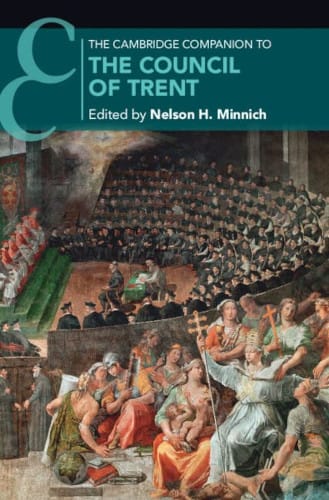
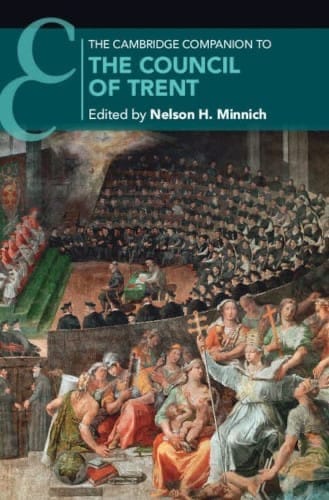
by John W. O’Malley SJ - The Cambridge Companion to the Council of Trent
edited by Nelson H. Mincing - Decrees of the Ecumenical Councils: Volume II
edited by Norman Tanner SJ
…and for readers of Italian or French... - Le Concile de Trente
by Alain Tallon - Il Concilio di Trento (1545-1563)
by Franco Buzzi - Il Concilio di Trento: una introduzione storica
by Adriano Prosperi
The Council of Trent began less than thirty years after the close of the Fifth Lateran Council (1512-1517), which decreed various measures of ecclesial reform. Why was another council needed so soon after Lateran V?
There are a number of reasons. Not only were the issues raised at Trent different from those of Lateran V, but the implementation of Lateran V’s decrees of reform had been delayed.
Lateran V ended in 1517. However, it was only in 1520 that its decrees were printed and sent out to the metropolitans to be distributed throughout Christendom. The enforcement of the decrees was left to the local ordinaries.
By 1520, new issues had arisen. In 1517, Martin Luther had posted his 95 Theses. Now justification by faith alone was the hot topic. However, it was not clear what the Catholic teaching on justification was.
Ultimately, therefore, a new council was needed to resolve these questions.
Were the Catholic princes of Europe keen to have the council, indifferent to the prospect, or hostile to it?
There was a lot of politics involved in the convocation of the Council of Trent. In Germany, several princes sided with Luther against both Rome and the young reigning emperor, Charles V.
Many feared Charles V. He seemed to have too much power and to pose a threat to the other kingdoms.
The elector princes of the German lands did not want the centralisation of authority that was going on in Spain, France, and England. They wanted to keep their own power. So, it was to their advantage that the emperor had difficulty imposing Catholicism.
The king of France especially feared Charles V and felt surrounded by him. To his west was Spain, where Charles was king. To his east were what we call the Netherlands, where Charles was the Duke of Burgundy. Charles V also controlled the Kingdom of Naples, which was claimed by both the king of Spain and the king of France. He was the overlord of Milan, which the king of France also claimed. So, the king of France was eager to diminish Charles’s power. A council that would resolve the conflicts in Germany was not to his advantage. He wanted Charles V to be weighed down with all the problems in Germany.
Hence, it was a strange situation. Various rulers were hostile to the Council of Trent. The king of France was hostile to it. In England, the schismatic Henry VIII did not want the Council of Trent to resolve doctrinal issues. The Scandinavians, who had gone Lutheran, did not want it.
Only Charles V of Spain, and his ally Portugal, wanted it.
Interestingly, even one of his allies, the papacy, was not keen on calling a council. If a council succeeded, it would increase the power of Charles V. The popes were afraid to death that, should Charles V dominate Italy, they would simply become his chaplain. They too opposed the Council of Trent.
In addition, the previous council, Lateran V, had been a bad experience for them. That council had been held in Rome, where, supposedly, the pope was in full control. Everything should have gone smoothly. That was not the case. Even in Rome, the bishops were rebellious. They had demanded that papal power be cut back, and their jurisdictional authority restored. It was extremely difficult for Leo X to control Lateran V. He was only able to close it by a difference of three votes. The popes, therefore, saw councils as very dangerous affairs that always seemed intent upon cutting back papal power. They were not eager to call a council.
Why was the council held not at Rome but in the Tyrolese town of Trent, then part of the Holy Roman Empire?
The location of the council was a very difficult and much debated issue.
Rome wanted a council that it could control. Hence, it preferred that it be held in Italy.
The Germans objected that the Protestants would not get a fair hearing because a council held in Italy would be under the control of the Pope. Luther and the German diets wanted what they called a free Christian council in German lands. The theory was that the solution should be found in the lands where the problem arose. But where in German lands?
The emperor and the popes played the following game. They tried to hold the council in an Italian city that was in imperial lands. In 1538, Paul III tried to call the council to meet in the imperial fiefdom of Mantua. He could claim that, though an Italian city, it was German. It was within the Holy Roman Empire. That plan fell through. The Marquis of Mantua could not provide security and the pope had to move the council.
They decided to hold it in Vicenza, in neutral Venetian territory. Only five bishops showed up. That was a disaster and would not work. So, they needed to find a place in German lands. Moreover, the French wanted an easily accessible location. For that reason, many suggested holding the council in a city on the Rhine. However, the popes were not in favour of that idea, after their bad experience at Basel, which was on the Rhine.
Trent was the solution they came up with. It was an unusual location. It was in Italy. However, it was only eighty miles south of the Imperial residence in Innsbruck, across the Brenner Pass.
It was also a bilingual city. Most residents spoke Italian, but a good portion were German speakers. Five miles to the north, everyone spoke German.
Furthermore, it was within the Holy Roman Empire. The ruler was a prince bishop. He was the both the temporal and spiritual ruler. He was also a member of the German Diet.
At the same time, Trent was in Italy. The pope could expect that many Italian bishops would attend.
Trent, therefore, seemed to be the location that would satisfy everyone. It was the compromise they came up with.
Did the council start out with a clear agenda or did it work it out along the way?
Traditionally, councils deal with three elements. They try to define the faith, remove abuses, and encourage peace among Christian princes or defend Christendom with a crusade. Those three objectives were stated in the decree of the convocation.
However, once the council met, the cardinal legates decided that achieving peace was not an objective that the council should address. It would waste too much time. They left that to the pope. Hence, the council agenda came down to two items: faith and reform.
Now, the papacy was very keen to define the Catholic faith so that the faithful would know where the Protestants had gone wrong. The emperor, however, was not keen on that at all. He felt that it would close the door to any reconciliation with the Protestants. Rather, he was in favour of reform, thinking that, once the Church had been reformed, the Protestant anger at it would diminish. The council had to decide how to resolve this tension between the papal and the imperial agendas; between decrees of doctrine and those of reform.
The compromise they reached was to handle both simultaneously. Whenever they defined a doctrine, at the same time they would reform any related abuses. Hence, in each session there is a doctrinal decree followed by a corresponding decree of reform.
“The Holy Spirit must have ensured that the council succeeded because there was always some crisis going on."
During the council, were there any crises that threatened to derail it?
It was a series of crises that never seemed to stop. It was The Perils of Pauline. Arthur Dickens claimed that it was a miracle that the council ever succeeded. At every turn, it was on a verge of collapsing. The Holy Spirit must have ensured that the council succeeded because there was always some crisis going on.
For example, as soon as the council first assembled, there was the question of how the various issues would be discussed. The bishops wanted to discuss it by themselves. However, they had brought advisors, periti, to the council and the pope sent his own experts. The bishops wanted to exclude the periti from the any discussions.
The cardinals who were there, including the two cardinal legates, convinced them that this would not work and was unbecoming (indecens). They pointed out that, unlike the periti, most of the bishops were not experts in theology or canon law. Without the assistance of the periti, they argued, the bishops would be unable to discuss the issues adequately and come up with good solutions to them. The legates decided, therefore, that the theologians and the canonists would participate in the discussions.
They started off by dividing the bishops—at the beginning of the council only thirty-five bishops were present—into three groups, with a cardinal in charge of each one. Each group met to discuss the issues. However, as the cardinal legates wrote back to Rome, this procedure proved to be a disaster. The bishops hated it. You can imagine what happened. A theological discussion came up. The bishops gave their opinion. However, they were not experts in theology. Whenever the theologian chimed in and pointed out how wrong their views were, the bishops were disgruntled. This was turning into a disaster. The cardinal legates had to come up with a solution.
The solution they came up with was a teach-in. They separated the bishops from the experts in theology and canon law. Whenever an issue came up, they had “particular congregations.” They brought the issue before the theologians and the canonists, who would discuss it among themselves. The bishops sat in and listened as the periti debated the issue. This was a teach-in. This was how they brought the bishops up to speed on these theological issues. Whenever the bishops felt they understood all the matters involved and were prepared to discuss it themselves, they dismissed the theologians and canonists.
That was the first crisis and its resolution. There followed a whole series of other problems.
Some bishops wanted the council to decree that it represented the universal Church. This formula had been used in the councils of the previous century as a way of declaring that the council is supreme, receives its authority directly from God, and that everyone, including the pope, must obey it. As you can imagine, the papal legates were not at all happy with this formula and did not want to include it in the decrees. They wanted the decrees to be issued with the apostolic legates presiding, thereby signifying that the agenda of the council is in the hands of the papal representatives. Ultimately, the authority of the council comes from the pope, not directly from God. This was another crisis that the legates confronted.
Another still regarded the question of justification. To achieve reconciliation with the Protestants, some theologians proposed the theory of double justification. They thought that it could bring together the traditional Catholic conception and the Lutheran view of imputed justice. According to this theory, we receive sanctifying grace (inherent justice) and are then covered over with the merits of Christ (imputed justice).
When this theory was brought up for discussion, various theologians denounced it. They argued that it does not make any sense. The Christian who has been justified with the reception of sanctifying grace, already shares in divine life. There is no need for that person’s sins to be covered over with the merits of Christ.
The Augustinians favoured double justification, while the more Thomistic group objected that the theory was unnecessary and confusing. They battled out this issue among themselves. It was resolved, of course, in favour of the Thomistic position.
Another crisis arose with the Italians. They did not like being in Trent. It was cold in the winter. The winds and snow came down from the Alps. As Trent was in the Adige Valley, it was also an unpleasantly hot and close during the summer. Moreover, there was the constant fear that the Lutheran armies could come through the Bremner Pass and attack the council. For these reasons, the Italians were eager to move the council out of Trent and always looking for an occasion to do so. Moreover, the Papal Legates were on their side.
The occasion arose when there was a suspected outbreak of typhus. The cardinal legates used this as a reason for moving the council to Bologna, in the Papal States, but not in German lands. The Imperial representatives objected that the council needed to be in German lands.
As a result, the move to Bologna created a schism. The imperial and Spanish bishops stayed in Trent, while the Italians moved down to Bologna. In a sense, two councils were going on, one in Trent and the other in Bologna. This created a huge crisis. The pope was afraid that, in addition to the schism between Catholics and Lutherans, there would be a schism within the Catholic fold between the imperials and the Italians.
The pope, therefore, told those assembled in Bologna that they could discuss the theological issues but not issue any decrees.
Eventually, the pope resolved this crisis by closing the council in Bologna. When the council re-adjourned in Trent under Julius III, the emperor had defeated the Lutheran princes at the Battle of Mühlberg (1547). Part of the surrender agreement was that the Lutherans would attend the council. This created the great hope that the council could finally resolve the disputes with the Lutherans.
Julius III had been one of the presidents at Trent and re-convoked the council to meet again in Trent. Everyone was expecting the Lutherans to show up. The emperor put a lot of pressure on them to do so. The pope, however, demanded that they could only come to the council if they were incorporated into it by taking an oath to submit to its authority and accept its decisions.
The Lutherans would not agree to that and set out their own terms. They would not accept the proceedings of the first period of the council, which included the Decree on Justification. They wanted to put aside all those decrees and start the council over again. Moreover, they wanted the council, not the pope, to be supreme, with the bishops freed of any oath of loyalty to the pope. They also demanded that they have a vote.
As you can suspect, the papal legates could not agree to their demands.
Of the various Lutheran delegations that showed up—from Brandenburg, Saxony, Wüttemberg, and the Imperial cities—only the one from Brandenburg accepted the terms.
Finally, the council had managed to get the Protestants to show up but could not move ahead. Ultimately, it had to move on without them.
During the third period of the council, there was a crisis regarding bishops, their authority, and their obligations.
There was a widespread feeling that bishops were taking the money and running. Often, those appointed as bishop of a diocese did not reside in it but moved to the court to become government officials or to Rome to become curial officials. They took the money that was given to them as bishops but were not doing their job. They were not providing pastoral care.
This occurred because the popes were granting them dispensations. The reformers were determined to put a stop to this. A bishop is the shepherd of his flock. He has an obligation to be in his diocese and provide pastoral care.
However, Rome objected that passing a decree to that effect implied that there is a divine law (ius divinum) requiring a bishop to be in his diocese and provide pastoral care. That would also imply that the papacy had been violating divine law by dispensing bishops from this duty. That was unacceptable to Rome.
This issue had come up during the first period of the council, which had passed a decree requiring bishops to reside in their diocese. However, most bishops did not observe it. The matter came to a crisis during the third period. The bishops were demanding that such a decree be passed, but Rome insisted they should not issue it.
The legates, Ercole Gonzaga and Girolamo Seripando, allowed the bishops to put the matter to a vote. The voting was extremely close, almost divided fifty fifty between those in favour, and those against. Rome was furious when it found out that the cardinal legates had allowed the vote. It was ready to yank them out of Trent.
A solution to this huge crisis was found only when a new legate, Cardinal Giovanni Morone, was sent up. His solution was to change the wording of the decree from ‘divine law’ (ius divinum) to ‘divine command’ (preceptum divinum). This was just a difference of semantics, but it was acceptable to Rome.
Another big crisis was created by the memorials—lists of grievances and issues that council should address—that each delegation drew up. There were Spanish, Imperial, and Portuguese memorials, and so on.
During the third period, Giovanni Morone came up with an interesting solution. He decided to create a committee comprising the notables—the wheeler-dealers or power people—of each delegation. This committee would go over the memorials, pick out the matters the council should address, and then each notable would go back to his delegation and get it on board. That solved the memorial crisis.
There were still other crises. For example, there was one on matrimony.
Clandestine marriages, where the couple married privately, were a big problem in the medieval Church.
Marriage was a contract between a man and a woman. It was contracted verbally between them—"I agree to marry you and you agree to marry me”—and then sealed by intercourse. There did not need to be a priest or a church service. Often, it was done privately. However, this created all kinds of problems. As there were no witnesses, a spouse who wanted to get out of the marriage could claim to have never married the other in the first place. Clandestine marriages created a real mess theologically and canonically. Everybody, especially the rulers, wanted to get rid of them.
The question came before the council, which debated whether it could get rid of clandestine marriages. There was a big fight over this matter. The Church had taught consistently that the sacrament of marriage consists basically of a contract, that is then consummated, between a man and a woman. The council could not claim that the Church has been wrong over the centuries. Eventually, it came up with a solution: put conditions on the contract. It stipulated that a man and woman could not enter the contract unless these conditions are present. They had to be of the right age. Five-year-olds and a four-year-old cannot be contracting a marriage. Trent did not make parental permission necessary, although the Protestants insisted on it. Interestingly, however, it added a new condition: that there must be witnesses present. One needed to be the priest, the representative of the parish. The contract could not be made without the presence of the priest and the witnesses. It needed to be done in the sight of the Church (in facie Ecclesiae). It did not have to be made at a nuptial Mass, but it did have to be conducted inside or at the church (e.g. on the doorsteps or at the side of the church).
The vote on Tametsi was very tight. Several bishops were not happy with it.
There was also a crisis over the nature of the Mass. There are three elements in the Mass: the Last Supper, the Sacrifice of Calvary, and the Mass itself. How are they related?
At the Last Supper, Christ says, “Do this in commemoration of me.” Hence, he commands us to have a celebration in commemoration of him. “This is the chalice of my blood, poured out for the remission of sin.” There is an expiatory component to this celebration. Was the Last Supper a sacrifice or simply the promise of a sacrifice that will be poured out for us with his death on the cross? Is the Mass itself a sacrifice? If so, what kind of sacrifice is it? A sacrifice of thanksgiving and praise, a Eucharist, or also a sacrifice of expiation?
These were hotly debated topics. The Council Fathers could not agree entirely on how you put these three components together and so the wording on the decree is somewhat evasive.
 Five Books for Catholics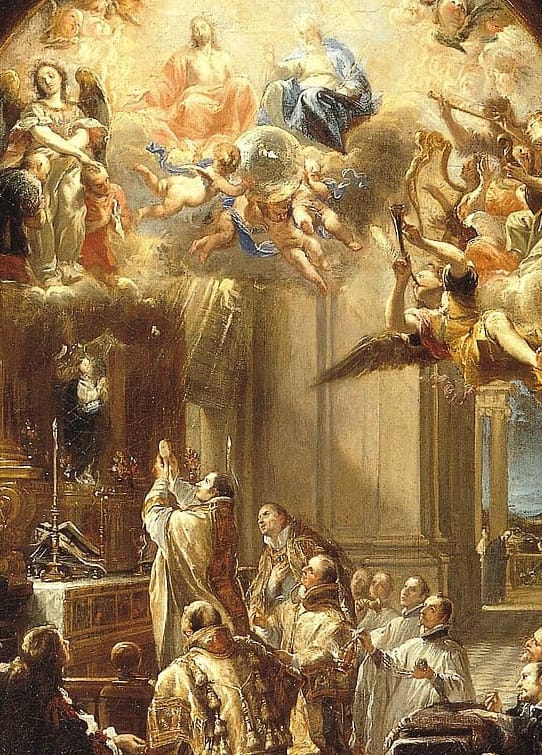
The final crisis came at the very end of the council.
Word came up that the pope was dying and that the council needed to close fast. Rome did not want it sitting when there was sede vacante. Morone wanted to declare it over. However, the French delegation refused and insisted that they were under instructions to obtain decrees on issues such as sacred images, purgatory, and indulgences.
At the end of the council, therefore, there was a mad scramble to rush these decrees through. They managed to get them through and close the council.
Normally a council’s decrees are shaped decisively by a handful of churchmen, princes, and theologians. Did this occur at Trent, even though it covered a wide range of subjects?
Well, various schools of theology were represented at the Council of Trent, mostly by the periti, the expert theologians, that the generals of the various religious orders sent up.
As you can imagine, the Dominican general sent up Thomists; the Franciscan, Scotists; the Augustinian, Augustinians. Those schools of theology debated the issues.
 Five Books for Catholics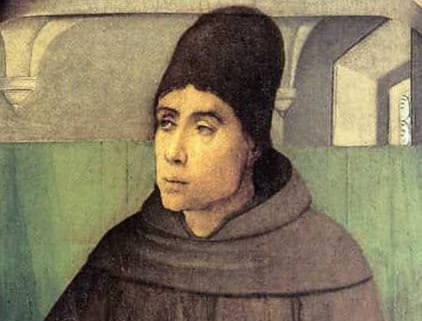
The Council of Trent was very careful though. Rome instructed that the decrees should avoid the scholastic jargon that most people did not understand. The only time scholastic terminology was really used was in the Decree on Justification’s teaching on the various causes of justification. Other than that, they avoided using it.
Rome also decided that the Council of Trent was not meant to settle disputes between the various schools of theology. Its purpose was to clarify Catholic teaching against the Protestants, not to resolve any conflicts between the Scotists and the Thomists. Hence, the Council Fathers reached compromises between the theological schools.
Who were the major theologians at the Council of Trent? The big gun representing the Augustinians was Girolamo Seripando. He went on to become a cardinal, indeed one of the cardinal presidents of the council. He was the one who pushed for the theory of double justification.
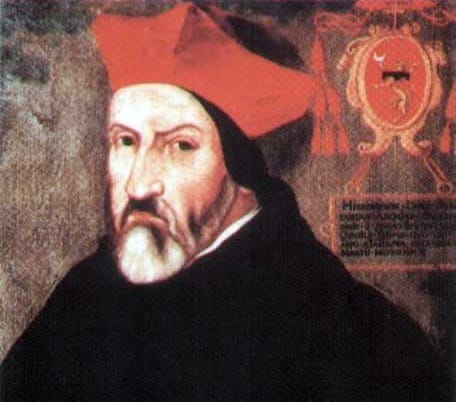
The pope sent up his private theologians. As his representatives, they were given the opportunity to debate the issues first and set the tone for it. Some of the pope’s theologians were Jesuits, such as Diego Laynez and Alfonso Salmerón. Both were distinguished theologians who had been trained at Paris.
The rule was they could speak for one hour. However, they did not always observe it and would sometime speak for several hours. The bishops did not complain. Laynez and Salmerón were very eloquent and the bishops felt that they learnt a lot from them.
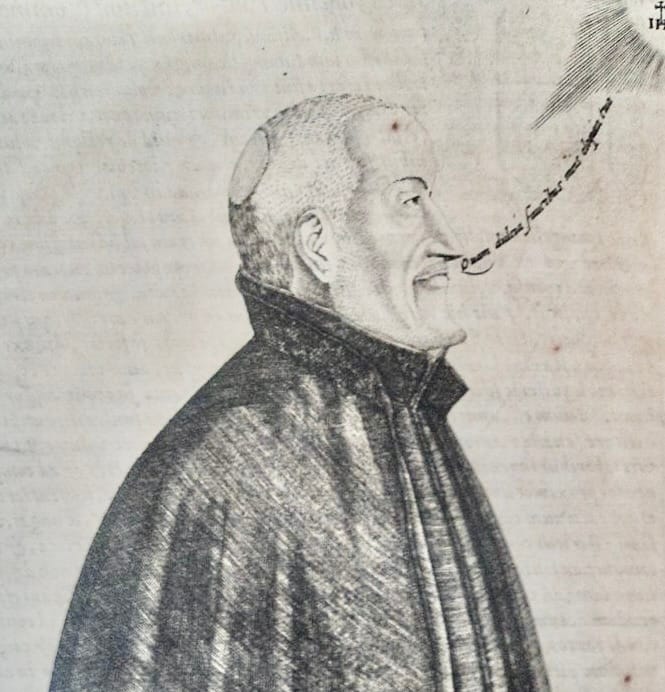
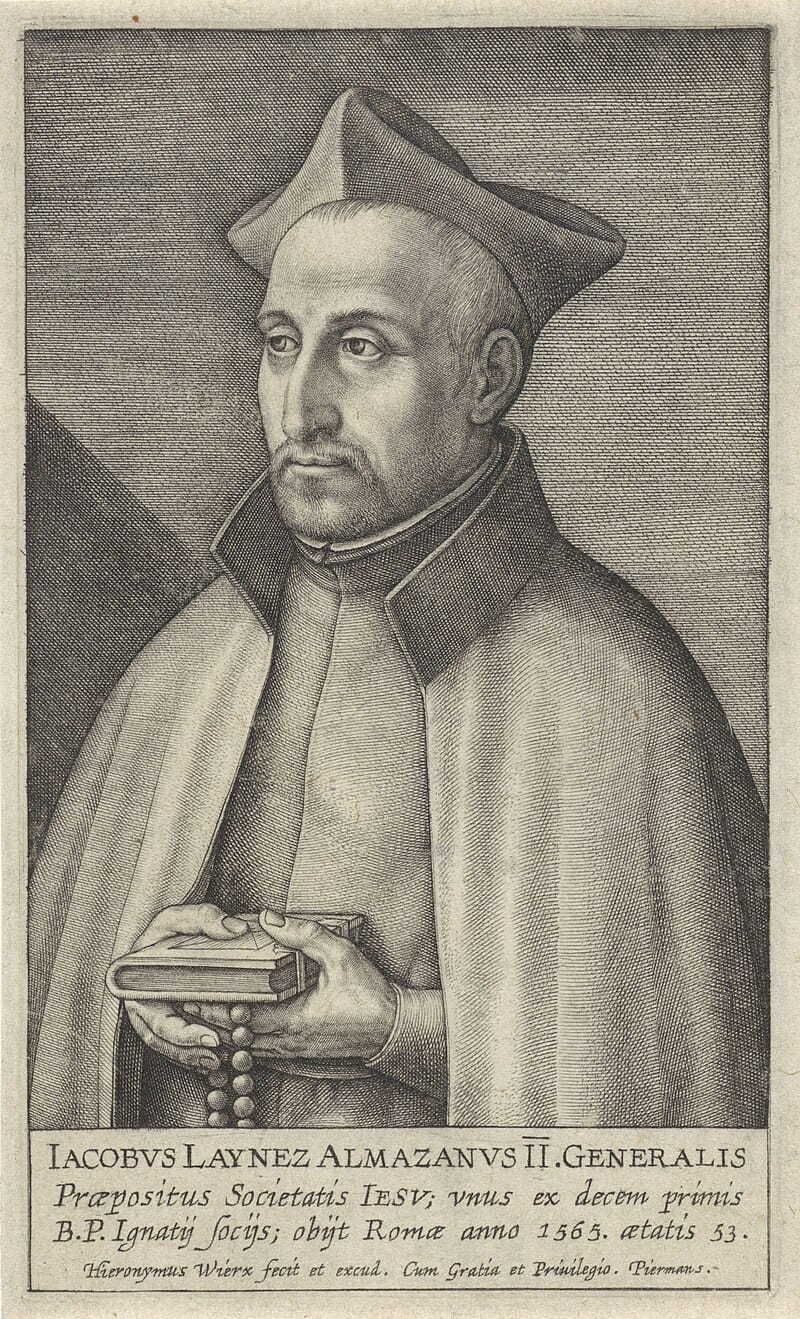
Alfonso Salemràon and Diego Laynez SJ
The Dominicans were represented by theologians such as Domingo de Soto and Ambrogio Catarino Politi.
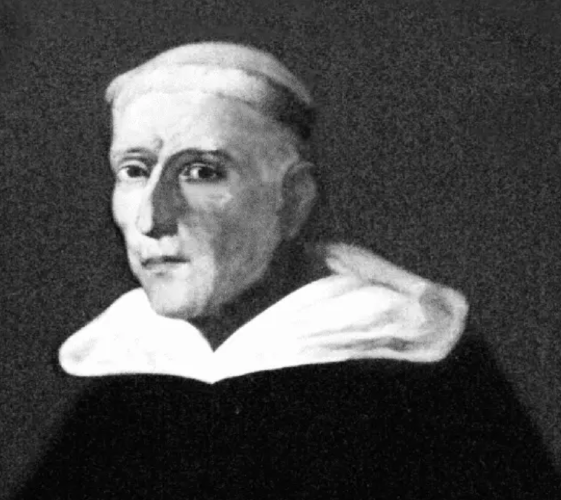
All these rather famous theologians debated the various issues at Trent.
The Dogmatic Constitution on the Church, Lumen gentium, is arguably the central document of the Second Vatican Council. Are any of the decrees of the Council of Trent the central ones around which the others revolve?
The most important one is the Decree on Justification because that was the issue that Luther stood on: that we are justified by faith alone.
The Council of Trent rejected that view. It taught that we are justified by faith, but by a living faith that is shown in works. In teaching this, it is not referring to the baptized infant who dies and goes straight to heaven without works. It is referring to adults, who need to manifest their living faith in works.
The Decree on Justification was very important because, in a sense, it closed the door to reconciliation with the Protestants.
After it, the most important decrees were those on the sacraments. The council affirmed that there are seven sacraments, not two, as the Calvinists would say (baptism, the Lord’s Supper), or three, as Luther might say (baptism, the Lord’s Supper, confession).
Spread through many decrees is the Council of Trent’s reaffirmation of episcopal authority. It restores it after various papal incursions into it. It makes the bishop the pastor in his diocese and, within the diocese, the parish the centre of religious life. It stipulated that the faithful should no longer go to their confraternity church, to the Dominicans, or to the Franciscans for their religious services, but make their local parish the centre of their religious practice. This comes up in several decrees.
“The decree on original sin was welcomed by the Protestants. Even John Calvin cheered it on because it was a very clearly rejected Pelagianism."
Did the Council Fathers of Trent have an accurate understanding of the various Protestant doctrines, or did they misconstrue any?
Good question. As I mentioned earlier, most of the bishops were not experts in theology. On top of that, very few of them knew German or French, whereas many of the Protestant writings were in German or French. Hence, they had not really read the writings of the Protestants.
How did they handle this? Well, the periti read these writings, went through them, and pulled out quotations—what you might call zingers—in which the Protestants stated their various beliefs in very clear terms.
Whenever a new topic came up, they had a list of suspect Protestant statements. However, those statements were excerpts that had been pulled out of context. To interpret them properly, you really needed to understand, for example, Luther’s whole theology and the context in which he made a certain statement. At Trent, these statements were debated one after the other.
The great majority of the bishops had never read the Protestant writings. What the bishops had on their desk were compilations drafted by some of Luther’s opponents, such as Cochlaeus or Eck. Sometimes the statements they considered were no longer valid. Luther changed his position over time, but they might have condemned a position from 1520 that he rejected later. It is fair to say that the bishops at Trent were never up to date on what the Protestants were actually saying.
At the time, were any of the council’s decrees welcomed by Protestant theologians and pastors?
Yes, the decree on original sin was welcomed by the Protestants. Even John Calvin cheered it on because it was a very clearly rejected Pelagianism. Various reform decrees were also acceptable to Protestants.
 Five Books for Catholics
However, there was also the four-volume Examination of the Council of Trent by the famous Protestant theologian, Martin Chemnitz. It was a very polemical work. Chemnitz was out to denounce the Council of Trent. He put a negative spin on its decrees and launched straw-man attacks.
In general, therefore, the Protestants were not eager to accept that the Council of Trent was positive. They saw it as a tool of the papacy to keep in power and to continue abuses. They were not great fans of its decrees.
“This might sound unusual to us but, to get the Council of Trent implemented, the bishops needed the secular authorities to be on board and accept its decrees."
Which liturgical reforms did Trent decree?
Yes, they had decrees on liturgical reform. In taking up the topic of the Mass, they issued, as I mentioned, both a doctrinal decree and decrees of reform. The doctrinal debate was on the relationship between the Mass, the Last Supper, the sacrifice of the Cross, and the status of the Mass as an expiatory sacrifice.
However, there were also liturgical questions and abuses surrounding the celebration of the Mass. For example, there was the question of how many candles should be placed on the altar. There were many strange little practices around. Twelve candles were placed for the Mass of an apostle. On the other hand, the Council Fathers did not like some of the music that was being used at Mass. They complained that it much of it was confusing, distracting, or if it contained secular melodies, improper.
They decided, therefore, to come up with a standard way of celebrating the Mass. They urged that the pope come up with what we call the Roman Missal.
What is fascinating is how people misunderstand this decree.
The decree calls for a standardised edition of the Roman Missal, but allowed any diocese that had been celebrating the Mass in a different way for at least 200 years, to retain its rite. Trent did not impose the Roman Missal on all Catholics. There was the Sarum Use or Salisbury Rite in England, the Ambrosian Rite in Milan, the Mozarabic Rite in Spain, and the Gallican Rite in France. For Trent, they were all legitimate.
Following the Council of Trent, however, many dioceses gave up their own way of celebrating the Mass and adopted the reformed Roman Missal instead.
“Trent did not impose the Roman Missal on all Catholics."
The success of a council depends largely upon how it is subsequently received and implemented. Was the Council of Trent implemented successfully and received effectively?
This might sound unusual to us but, to get the Council of Trent implemented, the bishops needed the secular authorities to be on board and accept its decrees. So, after the council had ended, the pope sent nuncios to the various rulers and asked them to accept the decrees of the Council of Trent as the law of their land.
Spain and Portugal accepted the decrees of the Council of Trent very quickly. So did Poland, Lithuania, and various rulers in Italy.
The big problem was with France and the Holy Roman Empire.
The French kings were frequently willing to accept the decrees of the Council of Trent. However, the Estates General refused to. They felt that the decrees were in violation of Gallican liberties and would curtail the fees that lawyers received by arguing these cases in secular tribunals. So, France never adopted the decrees of the Council of Trent officially.
The French bishops were very upset at this. In 1614, they met without the rest of the Estates and accepted the decrees on their own. However, there was never any civil acceptance of them.
In the Holy Roman Empire, the big problem was that much of the Peace of Augsburg (1555) depended upon how the council resolved these issues. Now that the council had come to a close and resolved these issues, its decrees could not be imposed within the Holy Roman Empire. The Protestant representatives were not willing to accept them and come back into the Catholic Church. When they met in Diet in 1565, the pope had hoped that the Emperor and the Diet would accept them. However, the Jesuits up there warned him that forcing such an acceptance then would trigger a civil war in Germany. By this point, the Catholics were weak. Rather than force the issue, the pope could only require the Catholic estates of the Holy Roman Empire to accept the decrees.
1.
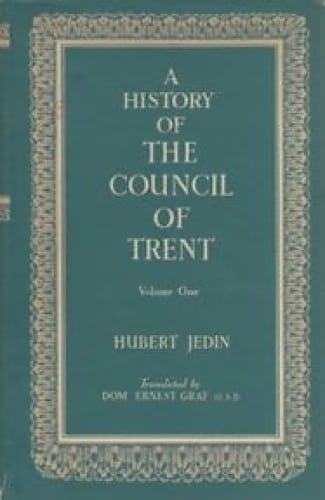
Hubert Jedin’s A History of the Council of Trent is a classic study of the event. Is it the best single study on Trent or has it been superseded by subsequent scholarship?
Hubert Jedin is the great master on the Council of Trent. He basically spent his life working on critical editions of the Decrees of the Trent and then his four-volume History of the Council of Trent (German Edition). In my opinion, nobody has superseded it. Most of those who have written on the Council of Trent have either summarised or vulgarised his work.
However, there are always new dimensions of the Council of Trent that can be taken up.
One example is Franco Buzzi’s Il Concilio di Trento (1545-1563). It is on the first period of the council. Buzzi goes through in detail the decrees of the first period on justification, Sacred Scripture, and the sacraments. It is a popularised history of the first period from a theological perspective. If you read Italian and are interested in theology, Buzzi’s is a good book on Trent.
The French scholar Alain Tallon is very good on its social history. He puts the decrees of the Council of Trent into their social context and examines how they were subsequently implemented.
Jedin wrote four volumes on the Council of Trent. He was planning a fifth, but died before he could complete it. The fifth volume was going to be on the implementation of the Council of Trent. This is an area which Jedin did not cover and where a lot of work is being done.
Adriano Prosperi has published a brief history of the Council of Trent. It does not go much beyond Jedin but popularises him. It was published in the Piccola Bibioteca Einaudi, a series that is used in Italian high-schools and universities.
2.
Then there is John O'Malley SJ’s Trent: What Happened at the Council. O’Malley is an excellent writer and he makes the council come alive. He is very good at writing cameo portraits of the participants. He makes them come alive. You do not get bored with O'Malley, who keeps the story moving. It is a very readable and up-to-date summary of the council.
3.
If you are interested in the decrees of the council and the theological debates rather than its history or the political going-ons, you can consult the The Cambridge Companion to the Council of Trent. It contains various chapters that take you through the decrees, and how they were debated and finally formulated. Frequently, the actual formulation of the decrees was a compromise. Hence, you need to be very careful not to assume that you understand what the decree is stating. You need to know why it was written the way it was. This compendium is very useful for understanding them.
4.
What is the best available English edition of the Tridentine decrees?
The most popular one is the Jesuit Norman Tanner’s. At the time of Vatican II, there was no compilation of the decrees of ecumenical councils. So, Giuseppe Alberigo and his crew in Bologna prepared a one volume-edition of all the decrees of the various ecumenical councils in the original languages (Latin, Greek, Syriac, and so on). It has gone through various editions, but a good English translation was needed. So, Tanner sought out and hired a whole team of Latinists to translate the decrees into readable English.
In general, they did a good job. However, you need to be careful when reading it. Sometimes they do not get the translation right. The good thing about Norman Tanner’s Decrees of the Ecumenical Councils is that the original Latin or Greek is on one side, and the English translation on the other. If you question this translation, it is easy to check the original Latin or Greek.