Desiderius Erasmus of Rotterdam (1466/9–1536) was the foremost scholar of the Northern Renaissance and, in his own lifetime, the most widely read author in Europe.
The illegitimate son of a priest, he was educated at Deventer by the Brethren of the Common Life, whose devotio moderna shaped his lifelong emphasis authentic piety. Both his parents died during an outbreak of the plague while he was still young. His guardians pressured him into entering the monastery of the Augustinian Canons Regular at Steyn, near Gouda.
In 1492, he was ordained to the priesthood. Later, he later obtained dispensation to live outside the monastery and made writing and scholarship his main pastoral activities. In addition to his better known works–– the Adages (1500), the Handbook of the Christian Soldier (1503), In Praise of Folly (1509) ––he wrote many works of exegesis, spirituality, catechesis, and pastoral guidance. He also produced editions of works of various Church Fathers, such as Irenaeus, Origen, Cyprian, Athanasius, Basil, Augustine, Jerome, and Chrysostom, including Latin translations of the Greek texts. However, his most influential work was his edition of the New Testament (Novum instrumentum omne), of which 300,000 copies were printed during his lifetime.
Erasmus was a candid critic of abuses in the Church and early Protestants were quick to claim him as an ally. However, he rejected the gibe that he had "laid the egg that Luther hatched" because he always sought reform from within the Catholic Church. Indeed, in 1524 he wrote On Free Will (De libero arbitrio) against Luther.
In July 1536, he died at Basel and the Protestant city honoured him with burial in its former cathedral.
In this interview, Thomas P. Scheck recommends some of Erasmus’ writings and explains why Catholics should read rather than overlook them.
Dr. Thomas P. Scheck (PhD, University of Iowa), taught for sixteen years at Ave Maria University as Associate Professor of Classics and Theology. He currently teaches Latin at Naples Classical Academy, Naples, Florida. He is a translator of many works of the Church Fathers, including Origen, St. Jerome, St. Chromatius, and of Renaissance scholars such as Erasmus and St. John Fisher.
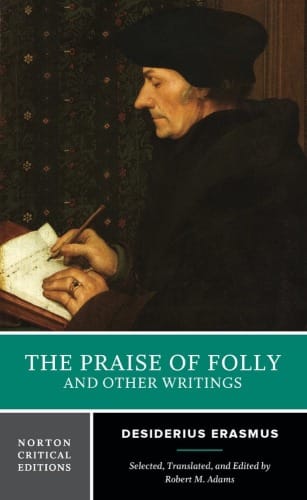
- The Praise of Folly and Other Writings
by Desiderius Erasmus, edited by Robert M. Adams - The Essential Erasmus
edited by John P. Dolan - New Testament Scholarship: Paraphrases on Romans and Galatians
by Desiderius Erasmus, edited by Robert D. Sider - Spiritualia and Pastoralia: A Short Debate concerning the Distress, Alarm, and Sorrow of Jesus; A Sermon on the Immense Mercy of God; On Praying to God; An Explanation of the Apostles’ Creed; Preparing for Death
by Desiderius Erasmus, edited by John W. O'Malley - Erasmus’s Life of Origen: A New Annotated Translation of the Prefaces to Erasmus of Rotterdam’s Edition of Origen’s Writings (1536)
edited by Thomas P. Scheck - Erasmus: A Critical Biography
by Leon Halkin
Who was Desiderius Erasmus?
He was born at Rotterdam, Holland, in 1466 and died in 1536. When he was in his teens, both of his parents died of the plague, and he was placed into a monastery.
He tells the story of how this happened in a letter to the pope. It is very heartbreaking to read, because he was an orphan and was about 16 years old. He says that he did not want to enter the monastery but to go to the university to study. He was on fire for theological and literary studies, not for cloistered monastic life. He tried to present arguments to his guardians, but they would not listen to him. He ended up bursting into tears.
So Erasmus went unwillingly and without a monastic vocation as a teenager into the monastery, but he loved studies and was drawn to classical literature. He used his time there to learn Latin, ancient literature, and as many of the Latin Fathers as he could. A few years later he was summoned out of the monastery by Bishop Hendrik van Bergen on account of his recognizable gifts as a Latinist and became secretary to the bishop. During that period, he obtained permission to study theology at the University of Paris. He was ordained to the priesthood in 1492 at the age of about 26. He did have a priestly vocation but as I said he never felt a vocation to cloistered monastic life.
At Paris in the 1490s, the theology curriculum was dominated by Duns Scotus and nominalism. Erasmus did not really appreciate the scholastic approach to theology and even mocked it, with its extreme emphasis on Aristotelian philosophy and complex and abstruse questions. He wanted to see theology more rooted in Scripture, the study of languages, and in the deep and direct study of the Church Fathers.
He tutored while he was studying in Paris and some English students were among the acquaintances he made. Thirty-two years later, in the year 1528, Erasmus received a letter from one of his fellow students from Paris named Hector Boece, who went on to help found the University of Aberdeen in Scotland. Hector wrote the following:
“When I was with you in Paris thirty-two years ago at the religious college of Montaigu, where you interpreted certain sacred texts, an admiration of your learning and your exceptional modesty of soul took hold of me, which has remained with me and increased day by day as the renown of your name grew. For, besides your outstanding command of the Greek and Latin languages, how much philosophy and theology you know! I understood that you were devoted from the beginning to this most sacred discipline. Then there is such fervor in your teaching, such lucidity in your writing, such zeal for the defense of true piety, that you seem to be some divine being dwelling among men! I do not think there is any place in the world accessible to human habitation that is ignorant of this. You are an object of admiration to all the learned world; you find favor with all those who profess the Christian religion. Your piety is so consonant with your learning that one can see from your writings that all your joy, all your care, all your leisure and hours of work seem to be devoted to the cultivation of sacred letters. Since you are regarded and are the most learned of the learned, your spirit is, in the judgment of all, worthy to enjoy the most honorable tranquility in this life and, after you have fulfilled your earthly mission, the immortal reward that God has reserved for those who love him.”
This letter of 1528 gives a glimpse of Erasmus’s humble character and reputation for learning as a young scholar in Paris. As a result, he received an invitation to visit England and went there in 1499, where he got to know the young Thomas More, John Colet, John Fisher, and many other well-known English scholars who were working to reform the Church. They too were rather critical of the Medieval scholastic approach to theology and were part of the Renaissance movement, which emphasised, for instance, the importance of Greek for theological formation as well as Scripture and patristic studies. He and Thomas More would later translate a number of works of the Greek writer Lucian into Latin.
During his visit to England, Erasmus was invited to debate with John Colet over the question of why Christ was distressed in the Garden of Gethsemane. Colet was bowled over by an interpretation from St. Jerome, who argued that Christ was distressed not because he was afraid and dreading his own imminent suffering and death himself; but he was distressed and grieved for others: for the Jews, who were going to be judged by God as a result of his Crucifixion. Erasmus, on the contrary, argued that Scripture made it clear that Christ was distressed for his own sake, because he was being made to drink the cup of suffering and was about to face a horrible torture and death. And as a true human being, he shrank back from that and suffered agony over it.
Upon his return to the continent, Erasmus transcribed the debate and published it. It was one of his first published writings and is the first essay in Volume 70 of the Collected Works of Erasmus, the volume that I have recommended. When I read it for the first time, I was astonished that a 30- or 32-year-old priest could have possessed such intricate knowledge of the Church Fathers. He also treated John Colet, his opponent and close friend, very well. The debate was not caustic or bitter. Erasmus tried to present Colet’s side as fairly as he could, even though he strongly disagreed with him.
It is a very beautiful meditation on Christ in the Garden of Gethsemane and his sufferings there for our sake. Thirty years later, during his imprisonment, St. Thomas More wrote a work called The Sadness of Christ, a meditation on why Christ was distressed in the Garden of Gethsemane. He essentially adopts Erasmus’s position: that Christ wanted to identify with us in his sufferings and went through distress himself in order to deepen our love for Him. Both Erasmus and Thomas More felt that theological writing needed to engage the emotions of the human being and not merely the intellect.
Erasmus’s A Short Debate Concerning the Distress, Alarm and Sorrow of Jesus made a deep impact on me when I read it for the first time. It gives us a window into Erasmus’s soul and his approach to theology. He emphasizes the humanity of Christ (without denying the divinity), and he stresses how Christ’s humanity gives us hope and inspiration.
In this work, Erasmus displays his fluency with the Latin Church Fathers but also his knowledge of the scholastics. Several times, he cites Thomas Aquinas, whom he felt was the best and clearest of the scholastic theologians. On the other hand, he did not care for Scotus, whose thought he felt was just too abstract and detached.
Eventually, Erasmus received his doctorate at the University of Turin. He travelled to Rome in the early sixteenth century and devoted himself to scholarship.
His friendship with the devout and holy priest John Colet, the confessor of St. Thomas More and the Dean of St. Paul’s Cathedral, was very important as we have just discussed. St. Thomas More said that England had not seen a man like John Colet in three hundred years. Colet founded St. Paul’s School for Boys in 1509 and asked Erasmus to provide material for use in the curriculum. So, Erasmus wrote several catechetical works, homilies, and educational writings that he dedicated to John Colet and used in the education at this school in London.
In England, Erasmus also became acquainted with St. John Fisher.
 Five Books for Catholics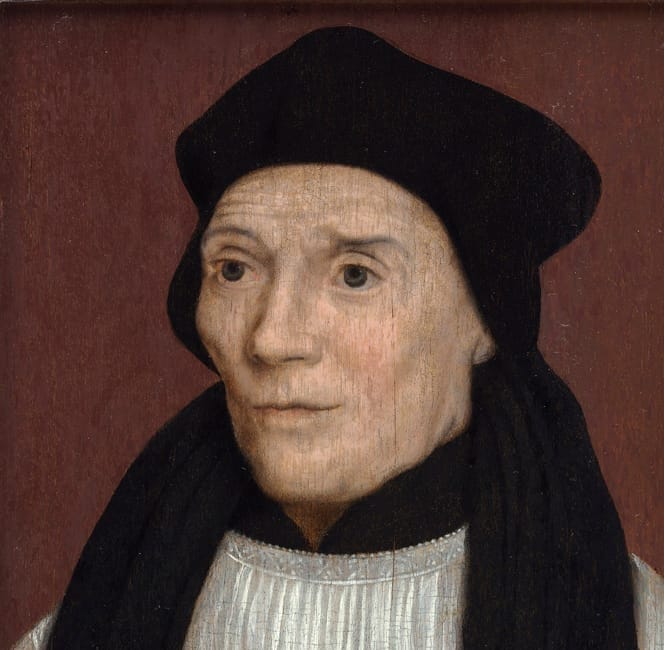
One of his great patrons in England was William Warham, the last Catholic Archbishop of Canterbury before England revolted against the Catholic Church. Warham provided Erasmus with an ecclesiastical income for over thirty years.
Erasmus returned to the continent and made Louvain and then Basel, Switzerland, his home. When Basel became Protestant, he moved to Freiburg, in southwestern Germany, and resided there for the rest of life.
About a year before he died, he returned to Basel to supervise the publication of one of his largest works, Ecclesiastes, a massive book on preaching. It was supposed to be dedicated to John Fisher. However, Fisher had been executed in 1535, so Erasmus had to change the dedication.
He died in Basel in July 1536 and is buried in the cathedral.
One of the great achievements was his Greek edition, replete with detailed philological annotations, and new Latin translation of the New Testament. In his amazing and very helpful annotations, he records what the Church Fathers—such as Hilary, Jerome, John Chrysostum, or Theophylact, had said about a verse of the New Testament. This great work of Catholic scholarship is worth our attention.
In many ways Erasmus resembles St. Jerome, the great translator and scholar of the Bible.
The other major strand of Erasmus’s theology lay in producing editions of the Church Fathers, both Greek and Latin. He completed twelve such editions. The first, in 1516, was a massive eight-volume edition of the writings of St. Jerome. Erasmus focused on annotating and explaining Jerome’s epistles because he was so familiar with ancient literature and could provide a commentary on Jerome’s many allusions to it. Jerome is a difficult author, and it is not easy to read him without such a commentary.
When St. John Fisher quotes Jerome’s interpretation of various Old Testament books in his response to Luther, he uses Erasmus’s edition of Jerome. That edition was very useful for scholars. The final patristic edition he produced was of Origen’s writings and which was published posthumously. He was a great admirer of Origen, especially for his interpretation of Paul and Matthew.
Erasmus believed that Origen’s explanations of Romans were very insightful and luminous in comparison with Augustine’s, and Origen’s Old Testament homilies were very edifying for Catholics to read. I notice that in his catechesis on Origen, Pope Benedict XVI recommended that Catholics read Origen’s homilies as he is a great spiritual writer.
This is what attracts me to Erasmus: his scholarship on the New Testament and the Church Fathers, and his close friendship with two of the great saints of that period, Thomas More and John Fisher, each of whom loved and defended him. Thomas More in particular wrote lengthy works in defence of Erasmus. Volume 15 of the Collected Works of Thomas More it devoted in its entirety to these works.
On that note, you mentioned that Erasmus, in several of his works, criticised faults that were widespread in the Church of his day and, like many others at the time, proposed certain reforms. However, some have claimed that he inadvertently laid the groundwork for the Protestant Reformation and may have influenced the Protestant Reformers. Is that a tenable claim or charge?
He published a new translation of the New Testament. The edition was bilingual and dedicated to Pope Leo X. The Greek text is on one page, and his new Latin translation on the page facing it, with philological annotations at the bottom. The pope approved the work and provided a letter of commendation that appeared as a foreword. So, Erasmus carried out his scholarly work under the auspices of the pope and as a man of the Church.
Protestants, such as Martin Luther and William Tyndale, took his edition of the New Testament, translated it into the vernacular, and added their own prefaces to the books of the New Testament. Those prefaces are filled with Protestant critiques of Catholicism and attacks on the Church. So yes, they made use of a work Erasmus had produced, but it was not his intention, in producing it, for them to use it against the Catholic Church in this way.
He always disassociated himself from Protestants who claimed to be perpetuating his critique of the Catholic Church and wrote works of Catholic apologetics.
There is some truth in what you suggested. The Protestants were influenced by Erasmus’s works and used them to initiate and perpetuate their schisms from the Church, but that was not his intention and he did not give them permission to do this.
He did see much that was wrong in the Church of his day and was very scandalised by what he saw in Rome. For instance he witnessed Pope Julius leading on horseback a triumphal procession in celebration of a military victory over Venice and was very scandalized to see the pope acting as if he were Julius Caesar. That led him, upon his return from Rome to England, to write perhaps his most famous work, In Praise of Folly. Many also attribute to Erasmus the comical dialogue, Pope Julius Excluded from Heaven.
 Five Books for Catholics
Praise of Folly is a satire and criticises abuses that existed in the Church. It was written at the home of Thomas More and at his instigation. Once More started reading the first few pages, he essentially said to Erasmus, “You have to finish this work and bring it to completion. It is going to become a classic.” Moreover, I would point out that the Greek word for folly (moria) which appears in the title (Moriae encomium) resembles More’s surname and is a pun. It could mean both In Praise of Folly and In Praise of More. The work represents the best of Catholicism, namely, the folly of the gospel of the cross of Christ (cf. 1 Corinthians 1:18); while the folly of wealth, superstition, and corruption represents the worst of it.
1.
In Praise of Folly was criticized at the time of its publication, because some felt that Erasmus’s reliance on satire to criticize ecclesial and social waywardness could also foster cynicism and a lack of reverence for the hierarchy of the church and religious life. More recently, Hubert Jedin, the great historian of the Council of Trent, concluded that the Counter-Reformation did not take Erasmus as its guide because—here I am quoting Jedin—“behind his satire one seems to detect the grin of a skeptic.” Why should Catholics read a work that might inadvertently lead them astray, if these criticisms are correct?
I believe that the real cynics were those who wished to see the corruption of the church go unchecked. I have great respect for Jedin’s scholarship, especially his multi-volume study of the Council of Trent, but for some reason Hubert Jedin did not have the patience to make an effort to read and understand Erasmus. He was dismissive of and hostile toward Erasmus. In response to Jedin’s damning sneer, I would point out that St. Thomas More does not share Jedin’s slander but wrote an entire work in defence of In Praise of Folly. I will match up a martyr and a saint (Thomas More) against a 20thcentury Catholic historian (Hubert Jedin). Moreover, I do not believe that Jedin himself was at all familiar with Erasmus’s writings, even though he knew just about everything else out there from the 16th century. My question is: Why would Erasmus have written The Distress of Jesus in the Garden of Gethsemane, catechetical works, the Paraphrases on the New Testament, the Annotations, his editions of the Church Fathers, if he were cynical about the Church’s hierarchy or skeptical about religion in general?
Furthermore, I would ask how those who criticise Erasmus and his satirical writings feel about St. Jerome, who also wrote satires? Jerome’s Epistle 22 to Eustochium, for instance, criticises many of the religious he had met in Rome for being worldly, luxurious, dainty, and very concerned about their clothing. Jerome’s satire on what he had seen was criticized by others and made him many enemies. Erasmus was the scholar who rediscovered Jerome in the 16th century. Should we not forgive him (if he needs forgiveness!) for imitating some of Jerome’s satirical writings?
Furthermore, I would emphasise that Erasmus wrote In Praise of Folly in 1509, when the Church was not experiencing the Protestant schisms but was in a relative state of tranquility and peace. The Protestant Reformation really began around 1517. He did not foresee what was going to happen. Many times he admits that he would have written his early works differently or not at all had he foreseen the emergence of Protestantism. We should be lenient on Erasmus and interpret him in his context as bravely challenging ecclesiastical corruption and not cynically aiming to undermine the Church’s authority. Basically, that is the approach that St. Thomas More pleaded for in his published defences of Erasmus which I strongly urge everyone to read (volume 15 of the Yale edition of The Works of Thomas More.
“I believe that the Second Vatican Council corresponds very closely to Erasmus’s ideals in many of the areas where his views did not prevail at Trent. To me this shows his deep Catholicity."
Scholasticism is one of Erasmus’s targets in Praise of Folly. You have already explained that he was not necessarily opposed to all scholastic theologians, but mainly those of his own day or the Scotist school. If Erasmus was broadly anti-scholastic, how would you classify his own scholarly project and ideals?
He certainly gave precedence to the Church Fathers over the Scholastics when he articulated the best method for educating future priests and theologians. His classic articulation of this method is called the Ratio verae theologiae, The System of True Theology, which is available in an inexpensive paperback entitled: Erasmus on Literature , edited by Mark Vessey, translated by Robert Sider (University of Toronto Press). He felt that the Church Fathers should be upheld as the primary teachers of the Church. But that is not the same thing as saying with Protestants that the Holy Spirit abandoned the church during the age of scholasticism when the philosophy of Aristotle became the mainstay and foundation of theological training. No, for Erasmus the Holy Spirit has always been with the Church throughout the centuries. However, Erasmus felt scholasticism had become too far removed from Scripture and too enmeshed in Aristotelian philosophy so that it needed reform and purification. He said his scholarly work was not intended to bring an end to scholastic discussions of doctrine, but to see it purified and made more scriptural and patristic based, so that it embraced the study of biblical languages and focused on the most essential points of the faith and did not get distracted with unimportant investigations.
What kind of educational reforms did Erasmus endorse? Basically, Catholic humanists who endeavoured to integrate Renaissance humanism were strongly supported by Erasmus. St. John Fisher is one who comes to mind. He was the chancellor of Cambridge University, and he initiated major reforms of the theological curriculum that gave much greater emphasis to the Church Fathers and to the study of Greek, Hebrew and Latin. That emphasis on biblical languages and the study of the Church Fathers scarcely existed before the Erasmian theological Renaissance.
In some ways Erasmus reminds me of Hans Urs von Balthasar, who also devoted much of his scholarly effort to the Greek Church Fathers but also possessed a fine knowledge of scholastic and medieval theology. The theological styles of St. John Henry Newman and Pope Benedict XVI remind me of him too. Did not Newman say that the Church Fathers were the ladder by which he entered the Church, and that he could not kick away that ladder? Is it not said that the works of St John of the Cross remained unopened on Newman’s desk? Did not Cardinal Ratzinger say that when he was a young theologian, he was drawn to the Fathers and not to Thomas Aquinas?
Let me add this as well: The Catholic Church at the Second Vatican Council, in its Decree on Priestly Training Optatum Totius gave the following instruction on how theology should be taught in seminaries. After receiving a careful training in Holy Scripture:
"Dogmatic theology should be so arranged that these biblical themes are proposed first of all. Next there should be opened up to the students what the Fathers of the Eastern and Western Church have contributed to the faithful transmission and development of the individual truths of revelation. The further history of dogma should also be presented, account being taken of its relation to the general history of the Church. Next, in order that they may illumine the mysteries of salvation as completely as possible, the students should learn to penetrate them more deeply with the help of speculation, under the guidance of St. Thomas, and to perceive their interconnections. They should be taught to recognize these same mysteries as present and working in liturgical actions and in the entire life of the Church. They should learn to seek the solutions to human problems under the light of revelation, to apply the eternal truths of revelation to the changeable conditions of human affairs and to communicate them in a way suited to men of our day."
Notice the ordering of Scripture, Fathers, history of doctrine, and then deeper penetration under the guidance of St. Thomas. Aristotelian philosophy is not given priority. I find that this articulation of priestly formation approximates Erasmus’s own educational ideals.
 Five Books for Catholics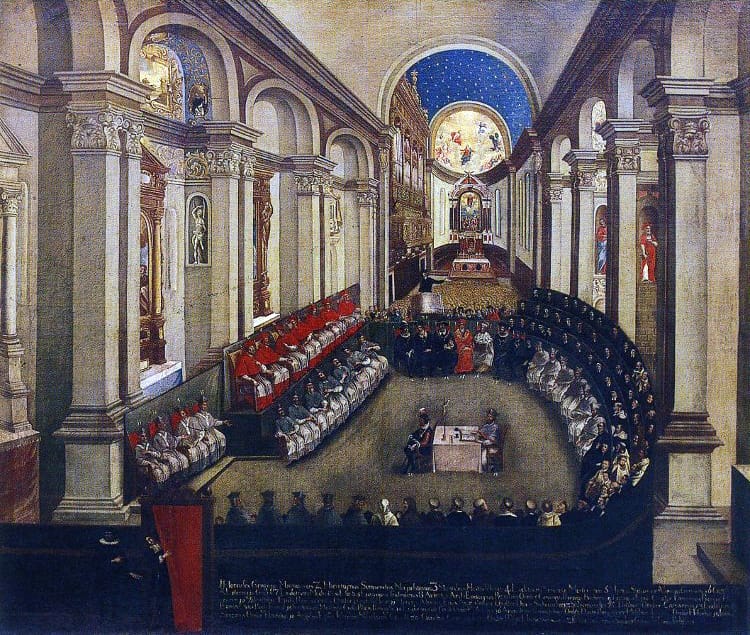
Perhaps one of the reasons for a certain wariness of Erasmus is that several of his positions were criticised during the Council of Trent—for example, his opposition to the use of coercive penalties against adults who refused to reaffirm their baptism as children, or his belief that Christ did not explicitly institute the sacrament of marriage. These were positions Erasmus had held, and they were condemned at Trent. Would that not be one of the reasons there is a certain wariness about Erasmus among historians of the Reformation or the Council of Trent?I believe you are correct, that Canon 14 of the 7th Session of the Council of Trent anathematised an inquiry Erasmus made in a preface to his Paraphrase on Matthew when he proposed – he used the word “perhaps” – that adults be given an opportunity to publicly reaffirm their baptismal vows in a new ceremony that would ratify the vows. The canon did not name Erasmus but condemned his opinion. Erasmus had clarified that this proposed new ceremony would not be a repetition of baptism, but a public ratification of it like crossing ourselves with holy water when we enter a church. His goal was to see Catholic adults personally appropriate the faith and content of their baptismal confession which their godparents had made on their behalf as infants.
Then, in a hypothetical discussion of this new proposal of his, he advised against the use of coercion against adults who refused to reaffirm their baptismal vows. The entire discussion was framed hypothetically, since the proposed ceremony was never implemented in any church. This original discussion of Erasmus was censured by a theologian at the University of Paris named Noël Béda who accused him of blasphemy and impiety. Erasmus wrote a defence of his good intentions in making this proposal, but out of respect he deleted the discussion from future editions of his Paraphrase on Matthew in order not to give offence. This controversy occurred several decades before the Council of Trent.
I am not sure why the bishops at Trent thought it important to resurrect the issue in this canon with its anathema, since Erasmus had removed the suggestion decades earlier. In any case, this was an opinion about discipline, not dogma.
Moreover, there may be some distance between Erasmus’s interpretations of the seven sacraments in their historical development and Scriptural basis and the dogmatic definitions that emerged from the Council of Trent. I believe, for example, that Erasmus recommended that the laity should be allowed to receive both the body and the blood at Mass. This opinion too was fiercely rejected at the Council of Trent and was only mitigated after Vatican II.
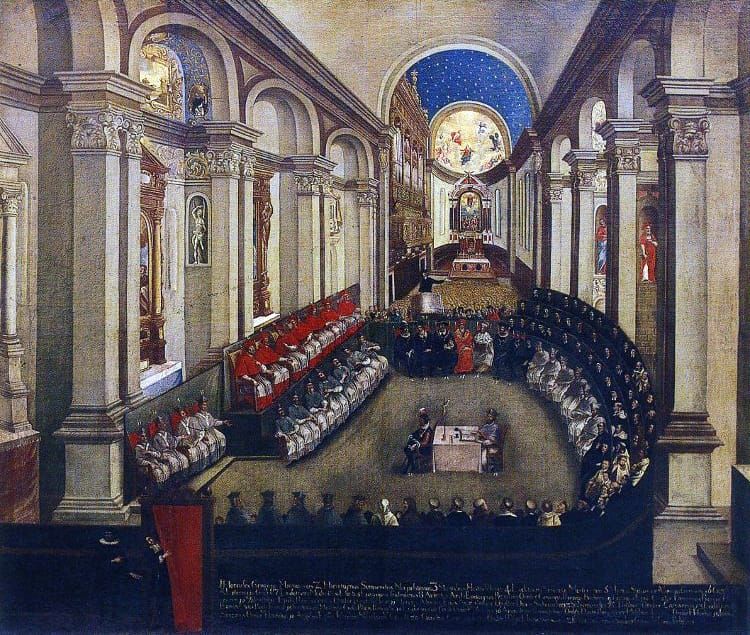
There is one more view I will mention from the Council of Trent. Erasmus believed that Jesus Christ wanted his mysteries that were recorded in the Gospels published in all languages. He advocated that translations into the vernacular languages should be made and used, not indiscriminately, but under the authority of the Church. He published these views in his New Testament of 1516. The Council of Trent did not universally support the promotion of translations of Scripture into the vernacular languages among Catholics. It debated the issue and while some bishops vigorously pleaded for the use of vernacular translations in the spirit of Erasmus, in the end the Council voted to disapprove such translations in the belief that they would do more harm than good. Some bishops even blamed the success of Protestantism in Germany and England on use of vernacular translations in those countries. Erasmus was not alive to witness that debate at the Council of Trent over this issue, but in a sense we could say that he lost it and those who disapproved of vernacular translations won the day. This approach held sway for many centuries.
So, you are right. Erasmus was the first to raise some of the points debated at the Council of Trent and the bishops sided with his opponents on several of these issues. However, that does not necessarily undermine his reliability as a Catholic theologian, since many other debates of the council were influenced positively by Erasmus. For example, the document on seminary formation was influenced heavily by his writings. Certain bishops at the council even believed that some of Erasmus’s writings should be required reading for all future priests. Jedin himself documents this. The reception of Erasmus at the Council of Trent is a complex issue. Moreover, in some areas, such as the use of vernacular translations of the Bible and the reception of the body and the blood by the laity, the modern Church has changed its approach at the Second Vatican Council. On these matters, the Catholic Church today sounds very Erasmian!
And consider who summoned the Council of Trent in 1535: it was Pope Paul III. He had wanted to make Erasmus a cardinal so that he might assist him at the forthcoming council. Erasmus died before he could be elevated to the cardinalate. I discuss the sixteenth-century reception of Erasmus in the appendix to my book on his Life of Origen.
So you are right. The post-Tridentine Church did not side with Erasmus on every single theological or exegetical issue. However, I believe that the Second Vatican Council corresponds very closely to Erasmus’s ideals in many of the areas where his views did not prevail at Trent. To me this shows his deep Catholicity.
2.
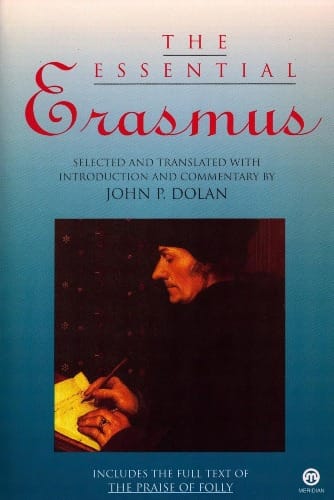
The next book is John P. Dolan’s The Essential Erasmus. This anthology contains a representative range of his writings. Have you recommended it for any work in particular, such as the Handbook of the Christian Soldier(Enchiridion militis christiani)?
Yes, that book is a little collection of some of Erasmus’s writings. It is very accessible, easy to find and inexpensive. It is a “Mentor Classic” and so it must have been issued in thousands of copies because I find it in almost every used bookstore I walk into. John Dolan was a very significant Catholic historian. He was the editor of the English translation of the 10-volume History of the Church, edited by Hubert Jedin.
In the introductory essay, Dolan defends Erasmus. I should also mention that Henri de Lubac, the French theologian whose canonization process has just been initiated by the bishops of France, also wrote an essay in defence of Erasmus; as did Louis Bouyer who wrote a wonderful book on him called Erasmus and his Times.
The Enchiridion, the Handbook of the Christian Soldier, is a wonderful little guide to living out the Christian life. It is full of classical allusions and depicts our Christian life as a spiritual warfare in which the cross is central and we must always be on guard and fight against the devil and his demons. The crucified Christ is our source of inspiration to continue the fight and resist the vices.
Erasmus runs through a number of admirable rules or principles, such as making Christ the central focus of your life. One rule is on the importance of forgiving others and not retaining anger against those who have hurt us. This little work has impacted me for the benefit of my soul.
There are also some of Erasmus’s Colloquies in the volume.
With regard to the Enchiridion, one of the central concepts of that work is the philosophy of Christ (philosophia Christi), a term with a patristic provenance. St. Justin speaks in those terms. But some criticize it because they think it is redolent of the neo-Platonism of Giovanni Pico della Mirandola. Is that accurate, and why does Erasmus choose that term to describe the Christian life or Christian spirituality?I believe that he was indeed influenced by Pico. One of Pico’s writings contains rules that seem to anticipate those that Erasmus gives for the Christian life. But I do not believe that Erasmus was aiming for neo-Platonism rather than Christianity, even if he did very highly esteem Plato’s philosophy.
“Philosophy,” in antiquity, referred to one’s way of life, the way in which we live our moral life. We should model everything after Christ. He should be our model, and we should follow his philosophy and teachings. This is not something abstract but affects every aspect of our lives.
The term “philosophy of Christ” is found in the Catechism of the Council of Trent. Previously, I taught a course on the foundations of catechesis. In it, we read through the and compared the Catechism of the Council of Trent with the modern Catechism, to see the similarities and dissimilarities, the continuity and discontinuity between the two. In the sixteenth-century Roman Catechism I found many passages that echo things that Erasmus had said. I suspect that many of its editors had been formed by Erasmus’s spirituality.
My main point is that the “philosophy of Christ” need not be a suspect term. It is used by the Church Fathers, and the Catechism of the Council of Trent, a work which nobody would suspect being neo-Platonist.
Louis Bouyer, Henri de Lubac, and Georges Chantraine have wonderful discussions of what Erasmus meant by the philosophy of Christ. I would refer to their works.
“Erasmus invented this new genre of literary commentary, the paraphrase, in which he expressed Paul’s meaning, or Matthew’s, in his own flowing words and by adopting the persona of the biblical writer."
3.
We have already commented on Erasmus’s importance as a biblical scholar. He wrote commentaries of a peculiar kind on all the books of the New Testament except Revelation. What are the characteristics of his paraphrases on the New Testament?
For each book on which he prepared to write a Paraphrase—Matthew, Mark, Luke, John, Romans, etc.—he first looked carefully into the church’s exegetical tradition and studied the most important commentaries on it, both Greek and Latin. He certainly did not try to reduce Catholic exegesis to the views of Augustine alone or Aquinas alone as was the practice of many scholastics. After thoroughly assimilating the thinking of the most ancient Church Fathers—how they interpreted, say, Romans—he wrote paraphrases in which he adopted the persona of the author (Paul, Matthew, Luke, etc.) and rephrased and clarified the meaning of the text.
His Paraphrases on Romans and Galatians are beautifully written and theologically penetrating. They read and flow so well. However, they are a different kind of commentary and do not follow the traditional, standard format explaining a lemma, such as Romans 1:1 with commentary below the lemma. Erasmus invented this new genre of literary commentary, the paraphrase, in which he expressed Paul’s meaning, or Matthew’s, etc., in his own flowing words and by adopting the persona of the biblical writer.
I would add that the only person able to fully appreciate the depth and insight of these paraphrases is someone familiar with the sources Erasmus used to reformulate Paul’s or Matthew’s message. That is why I recommended Volume 42 of the Collected Works of Erasmus, his Paraphrases on Romans and Galatians. The editor, Robert Sider, is very familiar with Erasmus’s sources. The endnotes indicate where Erasmus draws his interpretations from. He is not making them up out of his own head. He is drawing on Origen, John Chrysostom, Hilary, Ambrose, Theophylact, and so many other sources. That is why some of Erasmus’s contemporaries said his greatest gift was expounding Scripture. I agree.
Erasmus encapsulated the mind of the church in his paraphrases on the New Testament. By “mind of the church,” I mean the exegesis of the Church Fathers, because that is what the Church recommends to us. Erasmus’s paraphrases are spiritually edifying to read.
You just claimed that his paraphrases encapsulate the mind of the Church. However, some might object that his annotations and paraphrases on Scripture were placed on the Index of Prohibited Books? To clarify, reading unexpurgated editions of his annotations and paraphrases was prohibited. That would seem to suggest his paraphrases were objectionable on some points and do not encapsulate the mind of the Church. How would you address that objection?
You are referring presumably to the action of Pope Paul IV, who in 1559 placed all of Erasmus’s writings on the Index of Prohibited Books. A few years later the Council of Trent undid Paul IV’s action and permitted Erasmus’s writings but required censors to purge them of supposedly objectionable passages. I tried to discuss the Index of Prohibited Books in the Appendix to my book, Erasmus’s Life of Origen. One thing I will say is that Erasmus was not the only authentically Catholic theologian who fell victim to this post-mortem inquisition. In any case, in my judgment the action of a single pope does not negate the high esteem in which Erasmus was held by Paul’s IV’s four immediate papal predecessors (Paul III, Clement VII, Adrian VI, Leo X, not to mention Sts. Thomas More and John Fisher. It is inconceivable that these predecessors would have approved such an action. Pope Paul IV was also hostile to Reginald Pole and Philip Neri. The Index of Prohibited Books is not a happy topic and even Dante Alighieri’s name appeared in it.
The reason for the objections to Erasmus’s New Testament Paraphrases and Annotations is that Erasmus commented on so many verses of the New Testament that, in some of his discussions, if he favoured a certain interpretation, he would encounter a theologian who did not approve of it. So controversy was generated. Anybody who has written on Scripture encounters this kind of problem. St. Jerome, in his commentaries, refers all the time to people who objected to his interpretations and made accusations against him. The very first letter Augustine ever wrote to Jerome was a critique of Jerome’s entire interpretation of the book of Galatians. He also vigorously opposed Jerome’s new translation of the Old Testament based on the Hebrew. So there has always been debate and controversy over the meaning of Scripture, and some of Erasmus’s interpretations were controversial.
At the time of Pope Paul IV, the Catholic Church had high-ranking theologians who believed that the Church Fathers could not provide the Church any guidance for interpreting Holy Scripture. For it was believed that only the Aristotelian Scholastic theologians had the competence to guide theological studies. The Church Fathers were considered dangerous material. Moreover, some of these obscurantist theologians claimed that the only legitimate and divinely inspired text of Scripture was the Latin Vulgate. All other translations were considered pernicious and had to be condemned. These were the views of Noël Béda and Peter Sutor of Paris, for instance, and such men left a lasting legacy on the Catholic Church. One can hear echoes of their views in the debates at the Council of Trent.
In defending himself against the attacks of such theologians, what Erasmus would often do is reveal the sources he had used for his controversial translations and interpretations. In these defences (called “Apologies”), Erasmus displayed a far deeper knowledge of the tradition than his opponents. But my point in saying he “encapsulated the mind of the church” is that the church recommends the Church Fathers—the Catholic Church, the Magisterium, commends the Church Fathers for their interpretation of Scripture—and Erasmus was promoting and representing them in his work. Now, it is true that certain interpretations became controversial, and some of his translations of the New Testament did not agree with St. Jerome’s, with the Latin Vulgate, and so they too became controversial. But anyone who practices translation is aware that a translation is not going to please all readers. You would have to go case by case—which points were controverted, and why. It gets very complex to enter into that. But you are right: because he wrote so much, he also became controversial in his writings.
“Erasmus was trying to do everything in his power to help educate the members of Holy Mother Church."
4.
Next is a collection of Erasmus’s writings on spiritual and pastoral matters. Have you recommended this collection for any particular work, other than the one you discussed earlier on Christ’s suffering in the Garden of Gethsemane?
Everything found in this volume is precious. There is a sermon on divine mercy in this collection. When I taught theology courses, I assigned it as a reading and the students said that it reminded them of St. John Paul II’s encyclical on divine mercy.
There is also a work on praying to God. There, Erasmus reviews the entire Bible and records everything it says about prayer and how to pray. He also addresses the first Protestant objections to the Catholic practice of praying to the saints and defends its validity. So, he is one of the first Catholic apologists to defend the practices of the Church against the criticisms of Martin Luther and other Protestant theologians who denied the intercession of the saints.
Then there his beautiful work of catechesis on the Apostles’ Creed. It is virtually unknown today, but it is a full-blown catechism with detailed discussions of every point of our faith. It helped prepare the ground for the Roman Catechism and compares well with the modern Catechism.
Those who are critical of Erasmus and claim that he was a religious “skeptic” should ask themselves why he wrote a catechism? Is that something a religious skeptic would do? Clearly Erasmus was trying to do everything in his power to help educate the members of Holy Mother Church.
In fact, this catechism helped bring me back into the fold of the Catholic Church. I first read it as a Protestant. Briefly, I had grown up Catholic, then converted to being a Baptist in college, and I was away from the Catholic Church for seventeen years. During those years, I learned about Erasmus because Martin Luther and other Protestant Reformers were a big part of my Protestant education. I read a large portion of Luther’s writings but eventually became alienated from him because there was so much anger in them. I turned to John Calvin butagain became alienated from his doctrines. Then I learned about Erasmus and felt drawn to his style and his writings.
It is a dialogical catechism. The catechist converses with his student about doctrine. One of the questions posed by the pupil is, “Would a person be a heretic if he denied that Mary remained a virgin?” The catechist responds, “Not only a heretic, but a blasphemer.” That line woke me up to the utmost importance and gravity of the teachings of the Catholic Church. I asked myself, Who was I to stand outside and critique the defined teachings of Catholic Church. At the time I was in Protestant churches that were convinced Mary had other children after Jesus. Gradually I learned that the Church Fathers were unanimous in denying that—they taught uniformly that she was always a virgin and did not have other children. When I read Erasmus describing the denial of Mary’s perpetual virginity as not only heresy but a blasphemy, it hit me right in the chest. I was convicted in my conscience and realized I had to go back to my Mother. Erasmus is the one who punched me in the nose, so to speak and roused me out of my slumber.
I am therefore personally indebted to him. He woke me up to the seriousness of Catholic doctrine. My plea on his behalf reflects my own pilgrimage but hopefully people will become receptive to reading his writings firsthand. He is not an abstruse author but very easy to read.
The final work in the volume is On Preparing for Death. In my opinion, it is the most beautiful and profound essay on this topic ever written. Back in 2017, I lost a 22-year-old son to a drug overdose. My wife and I were grieving over this for weeks and weeks. We would take walks every evening and pray together, and we read aloud Erasmus’s essay On Preparing for Death many times. It really helped us. He emphasizes that God is a God of mercy and that the remedy for the fear of death is to embrace the faith of the Catholic Church and the teachings of Jesus. This work is a treasure waiting to be discovered in Catholics.
Let me tell one further story. When I taught at Ave Maria University, one summer session I taught an intensive Latin course using Wheelock’s Latin. I had a student named Travis, who loved learning Latin from me. During the class, I would talk about Erasmus now and then. The following year, he went to Rome to study canon law. There, he told one of his professors that he had had a teacher at Ave Maria who felt Erasmus deserves to be a saint and a doctor of the church. His professor passed a message to me through Travis and said: “Tell your professor from Ave Maria that Newman’s canonization will help Erasmus.” I believe he said this because Newman and Erasmus were so similar in that they both possessed an intense devotion to the Church Fathers and preferred Scripture and the Fathers to the Scholastic theologians and Aristotle.
5.
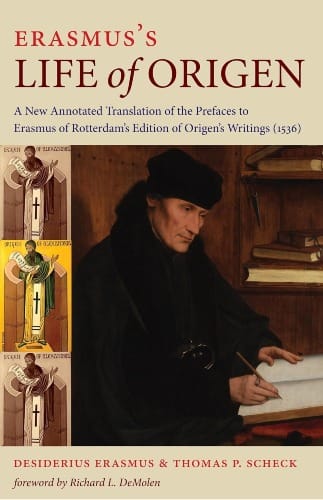
Erasmus produced editions of works by several of the most important Church Fathers—Irenaeus, Cyprian, Hilary, Basil, Ambrose, Jerome, Augustine, and Chrysostom. Why have you selected the prefaces from his edition of the works of Origen to represent his patristic scholarship?
That choice came when I was asked by an editor at the University of Toronto Press to translate those prefaces. Originally my work on this was intended to become part of one of the volumes of the Collected Works of Erasmus. I took the project on hesitatingly at the request of a Canadian scholar. When I completed it, I sent it to him, and he edited it and accepted my work. Years went by, and he resigned as the volume editor. I was left in the lurch. The new editor they appointed decided he wanted to do his own translation of those prefaces. So there I was, stuck with a finished manuscript that needed of a publisher. I sent it to the Catholic University of America Press and thankfully they accepted it for publication.
I would love to work on some of Erasmus’s other editions, but I have been bogged down with other projects recently and do not know how much of his works on the Church Fathers is still to be translated. Fortunately, I was able to work on his prefaces to Origen. From my own translations of Origen, I knew his writings well enough to annotate and explain Erasmus’s comments on Origen’s writing or preaching.
6.
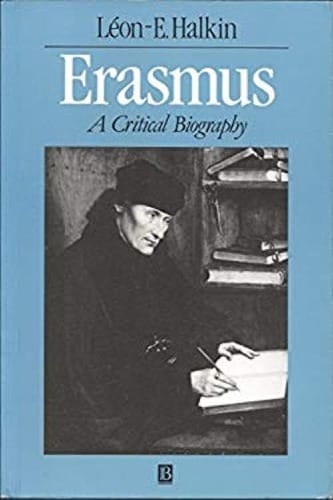
Why have you singled out Leon Halkin’s Erasmus: A Critical Biography from among the other biographies?
The work is so thorough and carefully written, it reminds me of J.N.D. Kelly’s famous biography of St. Jerome. To write it, Kelly studied every single one of Jerome’s works in Latin and mastered all the relevant secondary literature. Halkin was that type of scholar. He had a total mastery of Erasmus’s Latin works and could work his way through the secondary literature as well. As a post-Vatican II Catholic scholar, he had great sympathy for Erasmus’s theological and literary mission. He understood what Erasmus was aiming at and its connection to Thomas More. He was just a very good scholar.
The only weakness I would point out is that Halkin does not seem to be very familiar with the Church Fathers and the importance of patristics in the scholarly mission of Erasmus. In assessing Erasmus’s achievements, he underestimates the importance of the Church Fathers. He is more interested in Erasmus’s abilities as a writer and an educator, and his knowledge of the classics. There is less focus on the Church Fathers, who are central to Erasmus’s theological mission. Erasmus was working on Origen at his death. Even so, it a very reliable biography. De Lubac said Halkin’s Erasmus is the real Erasmus. I would agree.