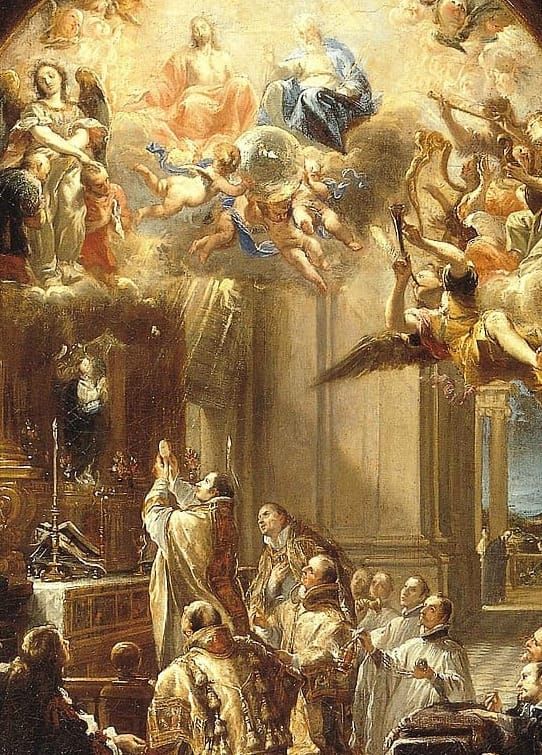
“When the Church celebrates the Eucharist, she commemorates Christ's Passover, and it is made present: the sacrifice Christ offered once for all on the cross remains ever present (Hebrews 7:25-27) ‘As often as the sacrifice of the Cross by which 'Christ our Pasch has been sacrificed' is celebrated on the altar, the work of our redemption is carried out.’ (Lumen gentium 3; cf. 1 Corinthians 5:7)
Because it is the memorial of Christ's Passover, the Eucharist is also a sacrifice. The sacrificial character of the Eucharist is manifested in the very words of institution: ‘This is my body which is given for you’ and ‘This cup which is poured out for you is the New Covenant in my blood.’ (Luke 22:19-20) In the Eucharist Christ gives us the very body which he gave up for us on the cross, the very blood which he ‘poured out for many for the forgiveness of sins.’ (Matthew 26:28.)
The sacrifice of Christ and the sacrifice of the Eucharist are one single sacrifice: ‘The victim is one and the same: the same now offers through the ministry of priests, who then offered himself on the cross; only the manner of offering is different.’ ‘In this divine sacrifice which is celebrated in the Mass, the same Christ who offered himself once in a bloody manner on the altar of the cross is contained and is offered in an unbloody manner.’ (Council of Trent (1562): DS 1743; cf. Hebrews 9:14, 27).”
Catechism of the Catholic Church 1364-1367.
In this interview, Fr. Reginald Lynch OP discusses the Sacrifice of the Mass and some of the best literature on it.
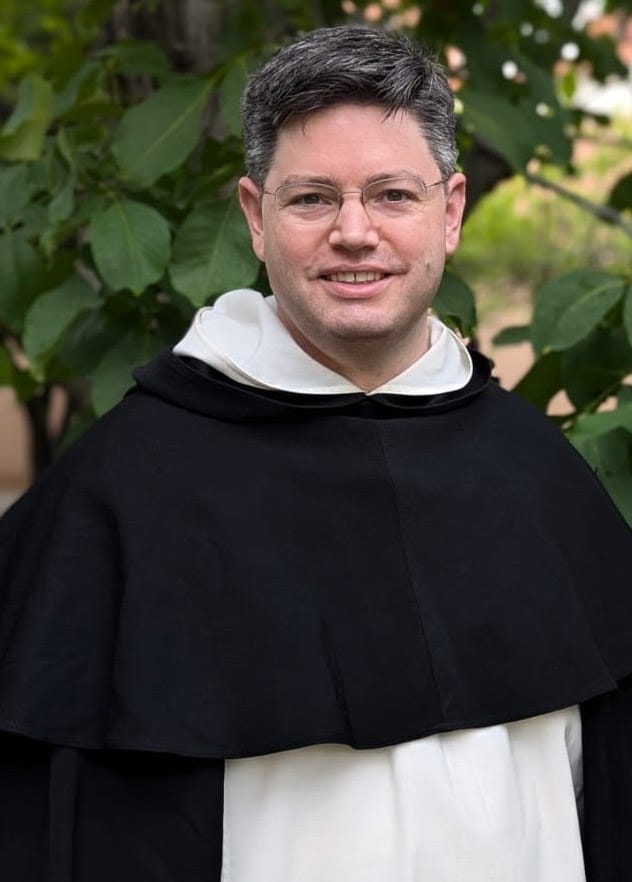
Fr. Reginald Lynch OP is a Dominican priest of the Province of St. Joseph and assistant professor of dogmatic theology and historical theology at the Dominican House of Studies in Washington, DC (USA). His research focuses on medieval and early modern theology. He is the author of The Cleansing of the Heart: The Sacraments as Instrumental Causes in the Thomistic Tradition (CUA Press, 2017) and Aquinas’s Summa Theologiae and Eucharistic Sacrifice in the Early Modern Period (Oxford University Press, 2023).
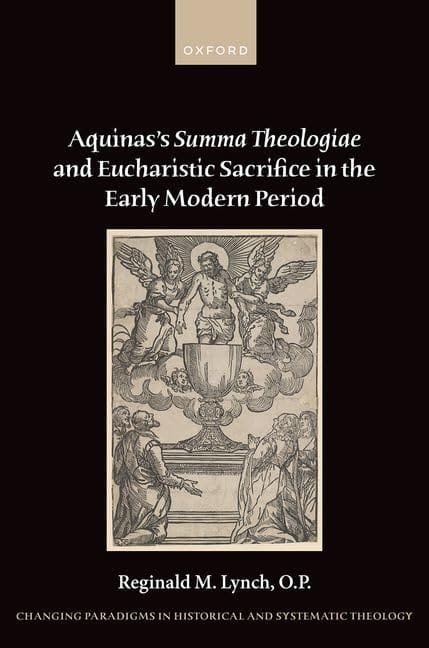
- The Mass: The Presence of the Sacrifice of the Cross
by Charles Journet - Cajetan Responds: A Reader in Reformation Controversy
by Jared Wicks SJ - Aquinas on Transubstantiation: The Real Presence of Christ in the Eucharist
by Reinhard Hütter - Francisco de Vitoria: Political Writings
translated and edited by Anthony Padgen - Meeting Christ in the Sacraments
by Colman E. O'Neill OP
In what sense the Eucharist is a sacrifice?
There was a great deal of debate over this topic in the sixteenth century before and during the Council of Trent, even though it is a doctrine the Catholic Church had long held.
Aquinas has different answers on the sacrificial dimension of the Eucharist, depending on the question being asked. In one sense, it is a moral act. In another sense, it is a feature of liturgical symbolism: the rite of the Mass makes present through signs the sacrifice of Christ in the same way that a painting of Cicero is said to represent Cicero himself.
In the Eucharist and its effects there is also a real participation in charity: in the sacrificial dimension of Christ's offering.
These are some of the ways in which we can think about the Eucharist as Catholics.
The Council of Trent states that the Mass is an unbloodied mode of Christ's bloodied sacrifice on the Cross. So, there is one sacrifice, but two separate modes. As Catholics, we have the great privilege to participate in that unbloody mode of the one offering of Jesus Christ, our eternal high priest.
For many of the faithful, the penny might not have dropped that the Eucharist makes present the sacrifice of the Cross. Is this just because of a lack of adequate catechesis or are there other reasons?
Sometimes. It is hard to speculate about why certain aspects of the faith are less intelligible.
This has waxed and waned over the centuries. In early modern Catholicism, the sacrificial dimension of the Mass and Christ's presence in the Mass was heavily emphasised in catechesis. It was depicted in liturgical art with great frequency. This peaked in the years after Trent, partly as a polemic against the Protestant reformers and to correct some of their errors.
Medieval liturgical art has equally evocative depictions of the sacrificial dimension of the Mass: the connection between the Eucharist and the Cross.
Over the last forty or fifty years, we have been through various catechetical models that have emphasized different aspects of the Eucharist. Some of these models have a lot to contribute. It is not necessarily helpful necessarily to be polemical about them. However, at the same time, there has been a more robust sense of the Eucharist. Pius XII’s encyclical Mystici corporis is an example. It includes the sacrificial dimension of the Mass within a larger Eucharistic ecclesiology. The Church draws its life from the body of Christ in the present. Sacrificial language is not just a moralistic reminder of what Christ did in the past. As a moral virtue, sacrifice becomes a way of participating in the Christian religion: a mode of participation in the Cross of Christ.
This is incredibly important. The Eucharistic theologies of Vatican II and the early twentieth-century magisterium are more inclusive, broader, admittedly more complex, but in the end richer. Frankly, they are reminiscent of medieval models. Peter Lombard talks of an analogical division within the reality (res) of the Eucharist that is contained within it—Christ crucified—and the broader reality that is not contained within it, namely, the mystical body or the Church.
 Five Books for Catholics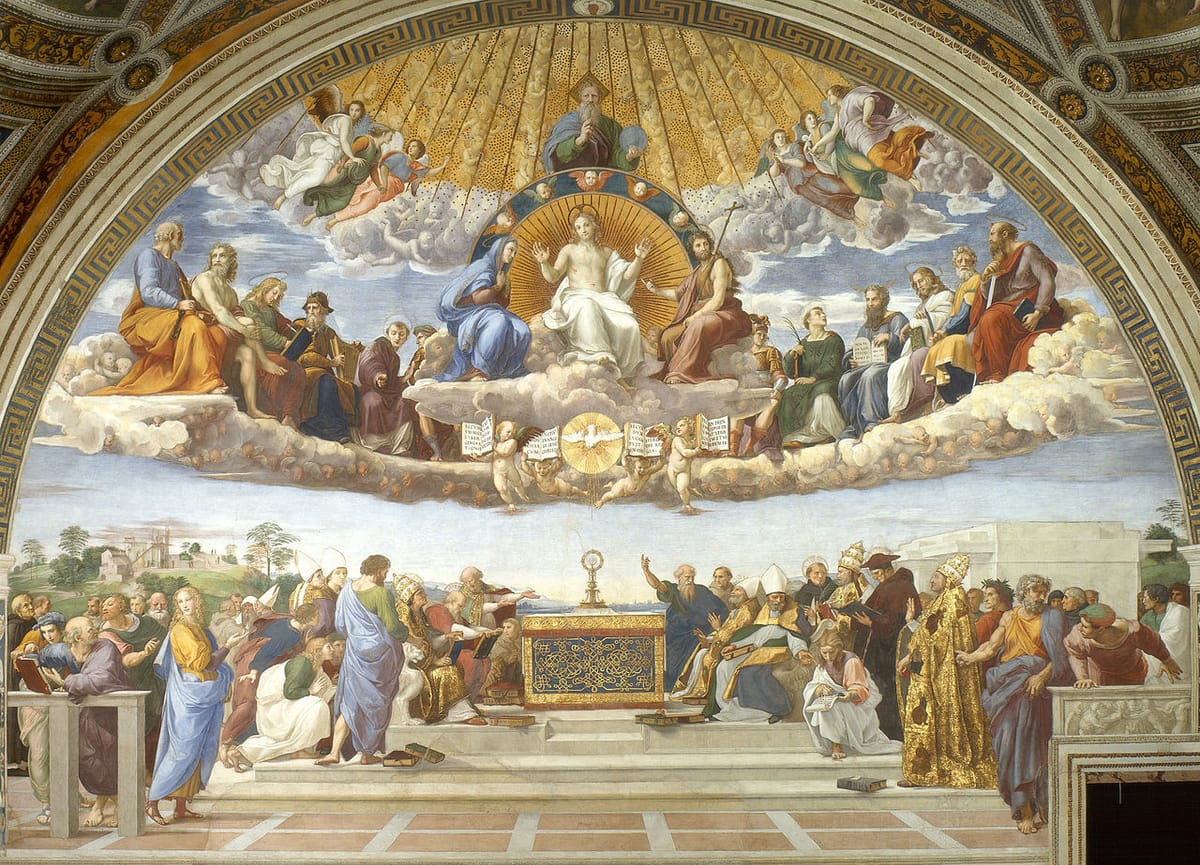
All these senses of Eucharist have indelibly sacrificial characteristics to them.
In many ways, the category of sacrifice captures the anthropological dimension of our liturgical participation in the Cross. Through sanctifying grace, we are beneficiaries of the fruits of the Cross: Christ's sacrifice on our behalf. We benefit from it in the sacrament of the Eucharist too, but as something we offer in grace as part of our liturgical life.
The Mass has an incredible power to transform the life of the Church: to become a space where not only we gather as some social organization or body, but as a sacrificial one: one which offers the sacrifice of praise that has been put upon our lips, as it were, by the Christ our High Priest.
Some might object that the Mass’s character as a sacrifice is less apparent in the Missal of Paul VI than the pre-conciliar Roman Missal or simply in the ars celebrandi that is widespread in certain parts. Is that a valid objection?
It is always good for the priest to be reverent. There is a sense in which you can never have too much of that. For Aquinas, religion is a moral virtue that comes to be operated by the higher virtue of charity. To be reverent in this sense is to perform with charity the inner acts of the virtue of religion: devotion and prayer. The external acts that flow from them are signs of these internal acts. Hence, the ars celebrandi and the externalities of the liturgy are very important. They are what Aquinas would call specified external signs. They can form the intellect by presenting us with what is to be done.
There are many rules the priest is meant to follow and many things he is meant to do in a certain way, but not out of empty external legalism. They are meant to form the heart of the priest, not just in his own offering but also inasmuch as he is offering the Mass on behalf of the Church. They are more than a play or a show for others. Real reverence is rooted in an internalization of the rubrics of the rite as an external sign of one's authentic devotion and prayer.
Changing the rite or celebrating without reverence is perhaps a sign of a lack of attention to the rite or of devotion.
In the Missal of Paul VI there is plenty of sacrificial language in the newer Eucharistic prayers. Eucharistic Prayer IV has quite a lot of sacrificial symbolism. It is perfectly possible to celebrate the Missal of Paul VI with great reverence. It has just as much sacrificial language as the Roman Canon. Most of the collects are either the same or very similar. There is a significant amount of textual overlap between the two missals. It is hard to argue that the change of missal alone is materially responsible for a diminished sense of the sacrificial character of the Mass. It might have been the occasion for, following the council, but the connection is accidental or anecdotal, not causal.
Some might find it repugnant to imagine that God desires sacrifices. What would you say to those who have such misgivings?
The models of sacrifice to which Catholic theologians reacted or objected during the twentieth century, beginning with the liturgical movement, emphasised destruction or killing. There was a motif of violence, even if only metaphorical, in these models. Hence, some early modern Catholic authors, such as those of the French school of priestly spirituality, which has many good elements, associated the priest’s utterance of the words of the consecration with a mystical slaying or a reenactment of the violence of the cross.
A more careful reading of Aquinas, even using some of the earlier Thomistic commentators, can be helpful in that regard. He avoids a physicalist approach to sacrifice, where violence is the archetype.
Some early modern Catholic theologians emphasised the sacrifice of Isaac or the violent sacrifices of the Old Covenant as the archetype of all sacrifice. That actually began with the Protestant Reformers. Zwingli and Calvin argue the Mass cannot be a sacrifice precisely because all sacrifices involve a violent death whereas there is no violent death in the Mass, only a symbol thereof. Hence, in their view, the Mass in not a real sacrifice.
Sometimes Catholic theologians, in their polemical response, accepted too many of their interlocutor’s first premises. They aimed to show that a violent death does occur in the Mass.
This carried over into the textual interpretation of Aquinas. What, for example, does Aquinas mean, in his discussion of the virtue of religion, when he describes the breaking, blessing, and consumption of bread as a sacrifice? He is drawing a parallel between the sacrifices of the Old Law and the Eucharist. This is biblical and not hard to justify. For Aquinas, a sacrifice is a moral act. It is similar to a holocaust offering. There is a change in the offering, which is then consumed.
In Book 10 of City of God, which was a major source for medieval theology, St. Augustine offers some ways for talking of sacrifices. In discussing the Eucharist, he sees the internal offering of charity as the consumptive offering—i.e. a holocaust. He does not focus on the exterior violence of the Old Testament offerings as an archetype for all sacrifice. That is not to say there is something wrong with the Old Testament offerings. However, they are imperfect in comparison to that of the New Testament.
Here, Aquinas is following the Venerable Bede, many other high medieval authors, and the Greek Fathers, who argue that the New Law fulfils what was foreshadowed allegorically in the Old, particularly with regard to the priesthood of Christ and the temple. The Eucharist, the Cross and the life of the Church fulfil in reality what was foreshadowed in type by the entrance of the high priest into the Holy of Holies each year. The Letter to the Hebrews is a significant hermeneutical key in this sense. The liturgical life of the Church and charity are an allegorical fulfilment of the rites and ceremonies of the Old Law.
St. Ambrose of Milan lays out similar ideas in On the Mysteries and On the Sacraments.
The concept of sacrifice is rooted in the religious anthropology of the human person. It does not have to be a violent offering that God demands. One way to think about it is to consider the offering oneself a holocaust offering. Aquinas does this is in his treatment of the ceremonies of the Old Law (Summa theologiae I-II, q. 102). He compares the holocaust offering to the profession of religious vows: the offering of one's life to Christ. So, there are all sorts of ways in which the Christian life itself can be viewed as an offering. These have a long tradition in the Church. That would be my preliminary response.
"In this divine sacrifice which is celebrated in the Mass, the same Christ who offered himself once in a bloody manner on the altar of the cross is contained and is offered in an unbloody manner."
Council of Trent
What is the proper framework for understanding the Eucharist’s character as a sacrifice: the covenants of the Old Testament or the general characteristics of the sacrifices of all religions?
This was a major topic of debate among Catholic theologians during the sixteenth century, in and around Trent.
Even well into the twentieth century, certain presentations of the sacrifice of the Mass began with natural law or human nature and built a Eucharistic theology out of that.
Others began with the Old Testament and built forward into the New.
There are examples of this in the patristic era. I mentioned Ambrose of Milan, but there are many other Church Fathers who see the typology of the Bible as the ground for understanding Christian liturgy.
During the early modern period, however, there was much more emphasis on natural law. The School of Salamanca was responsible for this development of natural law theory. A lot of scholarship on this has come out over the last generation or so.
I address this in the third chapter of my book. The Dominican School of Salamanca latched onto the sacrifices due under natural law because they were concerned with the Spanish Americas, the natural rights of the Native Americans, and with applying international law to them. They argued that religion is a natural virtue. Cicero, Augustine, and Aquinas do so too. This was not a new idea. New rather was this understanding of natural law as the foundation for building a Christian account of the human person and the Gospel.
The School of Salamanca was interested in dialoguing with the religions that the missionaries encountered. From a Thomistic perspective, you can bring in the virtue of religion and the opposing vices to do so. Dominican theologians of the period, such as Francisco de Vitoria, Bartolomé de las Casas, and Domingo Báñez did just that. Religion was a way of naming what was right and wrong about what the missionary encountered. It allowed them to acknowledge that the underlying inclination was part of the natural law yet exercised in ways that were both highly problematic and not part of the covenant.
The virtue of religion is directed towards sacrifice as one of its external acts. Idolatry and superstition are ways in which the natural teleology of religion is twisted and deformed.
From Aquinas' perspective, the typological approach and that of natural law are different but not contradictory.
You can start with the Old Covenant. Its ceremonial precepts are a species of positive law and specify what the external acts of religion should be.
We see something similar in pre-Christian Rome. It had a socially established and state-sponsored religion. The law of the high priest (ius pontificis) was even a category of Roman law. It was very codified.
In cultures that are not as well-developed or have developed in different ways, custom, which is law by analogy, is more prevalent. It captures the social dimension of religion.
For Aquinas, religion is a potential part of justice. It is an inherently social reality. It is directed to God rather than juridical obligations to one’s neighbour. However, as a praxis, social consensus plays a certain role. We can identify natural iterations of religion and the religious part of a culture. We can do so without in any way confusing it with supernatural divine Revelation and the gift of a divine covenant, which comes with its own ritual precepts for the external exercise of religion.
The moral and ceremonial precepts continue into the law of charity. Aquinas says that the Law of the Gospel has ceremonial precepts effectively. Hence, charity, the internal life of the heart in Christ, has an externality in the liturgical form of the Church's life.
You can take either of the aforementioned approaches.
Which are the most important magisterial documents on the Sacrifice of the Mass?
Session 22 of the Council of Trent cannot be underestimated. It was not the first time that the Church had mentioned the Sacrifice of the Mass. The liturgy had certainly done so. However, Trent offers a very clear and biblical exposition of the doctrine.
All the major Catholic theological schools of the time were present at Trent with a fairly large contingent. However, early on a decision was made not to use too much scholastic language. So the Doctrine and Canons on the Most Holy Sacrifice of the Mass is written in a biblical mode. This was partly for apologetical reasons. There was a need to address Protestant critiques and show that the Sacrifice of the Mass is a biblical doctrine. The decree also avoids taking sides in the disputes that were going on within the Church. That was probably prudent at the time.
Trent had mentioned the Sacrifice of the Mass offhand in one way or another: in the initial creed and its treatment of the sacraments and the Eucharist. However, its dogmatic teaching on the Sacrifice of the Mass has become an ubiquitous source on the subject.
Largely, it follows the trajectory of the Letter to the Hebrews. It teaches that the Old Testament archetypes are fulfilled in the Sacrifice of the Mass.
Although Trent is arguing from the Bible and does not explicitly cite Aquinas, similar arguments from Scripture were made by earlier biblical theologians. Trent’s distinction between the unbloodied mode and the bloodied mode, the Mass and the Cross, of the one single sacrifice had already been made by Cajetan. From a scholarly perspective, the strongest claim that I can make is that there are some textual parallels between Cajetan’s work and the eventual document of Trent.
Johann Eck also likely influenced the Tridentine Decree.
However, many other theologians were present and involved in the process. The Council of Trent was definitely a collective project. At least two generations had passed between Cajetan’s original response to the Reformers in the 1520s and the wrapping up of the council.
Beyond Trent, Pius XII’s Mystici corporis and Mediator Dei are excellent documents. They are very important texts for understanding the nature of the liturgy and the Eucharist’s relation to the Church.
Moreover, Mediator Dei probably contains most of what the magisterium has ever said about which part of the Mass constitutes the sacrifice.
Trent affirms that the mass is a sacrifice but does not resolve other questions, such as how we the offertory is related to the priest’s consumption of the Eucharist. It doesn't get into the weeds of these more liturgical questions. However, it clearly endorses the idea—found in Aquinas, earlier authors, and many other places within the tradition—that the double consecration is a mystical separation of the body and blood of Christ.
Vatican II also needs to be mentioned. Its documents are surprisingly rich on all these subjects and in deep continuity with the Church's earlier magisterium and theological tradition.
 Five Books for Catholics
Each of the books that you have selected is representative of the Thomist tradition. They also address the biblical and patristic teachings on the Eucharistic sacrifice, and alternative theological explanations of it. Where would you point some for a non-Thomistic account of the Sacrifice of the Mass?
Marius Lepin’s L’idee du Sacrifice de la Messe d’après les théologiens depuis l’Origine jusqu’à nos jours is an excellent comprehensive text from the early twentieth-century. I would not say that is methodology is outdated but it is not one that I would adopt. Still, it is an excellent resource and a powerful treatment of the Eucharist and the Sacraments. It is a historical survey by broad thematic categories and a very useful book.
Maurice la Taille SJ’s book on the Mass is from around the same period, though he would have considered himself to be broadly Thomistic. It is another book to read.
For a classic patristic author’s treatment of the Eucharist as a sacrifice, read Augustine's City of God: Book 10 if you do not have time to read it all.
Book 10 of the City of God is an incredible resource for thinking about the Eucharist and the Church in sacrificial terms.
We have inherited certain conversations from early modernity, which, as you mentioned, sometimes are a bit distasteful perhaps for some contemporary theologians. However, within the Church’s tradition there is a much broader range of paradigms for thinking about the Eucharist and sacrifice. Some of the earlier martyrs—such as St. Polycarp, St. Justin, and the Scililitan martyrs—also talked about the Mass as a sacrifice or connected their martyrdom to the Eucharist and the Church. From the persecutions of the Church during the second and third centuries, emerged an ecclesiology and Eucharistic theology with a deeply sacrificial quality.
These sources provide an excellent picture of the theological theme of sacrifice, one that is broader than some of the early modern debates about which gesture of the priest is the most sacrificial.
Besides the books you have recommended, are there any good overviews of the biblical testimony to how the Eucharist is a sacrifice and the consummation of those of the Old Covenant?
Yes, there is James T. O’Connor’s The Hidden Manna, a book that I cite when I teach the Eucharist. It contains a beautiful treatment of the Eucharist in the Bible and the early Church. It also covers the theme of sacrifice.
Card. Journet’s book is another resource I would turn to.
1.
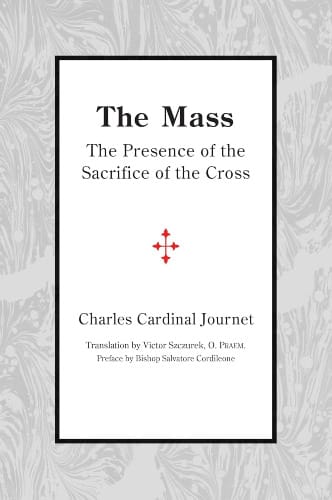
What makes Cardinal Charles Journet’s The Mass, a good guide to the Eucharistic sacrifice?
This is an excellent book, now in its second edition, that has been very popular for many years.
It is a twentieth-century work and so takes into account some of the contributions made by the early liturgical and ressourcement movements. It takes seriously the contributions of Odo Casel and others, who value the motif of sacrifice and liturgy and see the Eucharist as a liturgical mediation between the historical event of the Passion and the present day.
Journet also offers a fulsome Thomistic presentation of the Sacrifice of the Mass. He is aware of the historical development of the different theories of the Eucharistic sacrifice, some of which were not popular by the time he was writing. He provides a synopsis of the early modern debates. This is helpful for thinking about what we would want to glean from that burrow of theological work.
"The Church needed to respond to Protestantism in a balanced and well-researched way on various fronts. Cajetan was able to put forward the Church's teaching with clarity and thoughtful precision."
2.
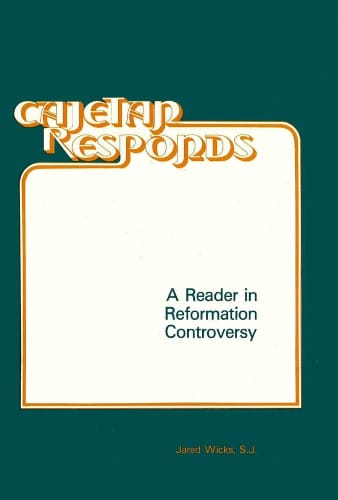
Second is Fr. Jared Wick’s translation of some of Cardinal Thomas Cajetan’s writings against Protestant Reformers. Cajetan is perhaps the most influential commentator on St. Thomas’s works: he wrote the first complete commentary on the Summa theologiae. He was also a key figure at the Fifth Lateran Council. He debated Luther, reviewed his writings as papal legate to the Diet of Ausburg, and took part in drawing up the bull of excommunication of Luther. Have you selected this book for his defence of the Sacrifice of the Mass against Lutherans?
Fr. Wicks has written several articles about Cajetan and that period in general. I recommend them too.
Cajetan is such an interesting figure. He was Master of the Dominican order and a very bright light, both in his youth and later years.
His early work was mostly on philosophy. There is for example his The Analogy of Names (De nominum analogia) and The Concept of Being (De conceptu entis), very dense philosophical works. Later, he wrote a commentary on the Summa theologiae, right when the Summa was beginning to replace Peter Lombard's Sentences as the standard text of commentary in the Dominican order, the University of Salamanca, other Iberian centres of study, and eventually throughout Europe.
Cajetan's popularity was fuelled in some places because he had written a commentary on the Summa, whereas earlier Thomists, such as John Capreolus, sometimes called the Prince of Thomists, had not. Capreolus had commented on Aquinas's work on the Sentences. So Cajetan's place within in early modernity is well deserved.
What is really interesting about him, however, is something that I deal with in the second chapter of my book. After meeting Martin Luther, he spent the rest of his life commenting on Scripture. He was already a cardinal. He had resources available, such as personnel. He really spent more than ten years writing at least one commentary on every book of the New Testament. These literal commentaries were meant to incorporate the best biblical scholarship available in the sixteenth century and draw arguments from the Bible itself for Catholic doctrine. This was a rather controversial approach among some Catholic theologians of the day.
During that period the motif or rhetoric that we currently use, and which Trent articulated, of ‘Scripture and Tradition’ was solidifying. Many believed that the consensus of the Fathers was the only lens for reading Scripture: that we should never read Scripture alone, but always within the Tradition.
That is not a bad idea at all. However, Cajetan's point—and the approach adopted eventually by the Council of Trent in many of its documents—is that Scripture can speak for itself. What the Church believes can be shown to be biblical or at least not contrary to the Bible.
For instance, in his commentary on the Summa Cajetan does not address many the questions that he does deal with in his New Testament commentaries: such as questions about the institution narrative and its connection to the form of the Mass. For his first biblical commentaries, he saved his discussion of the grammar of the form of consecration.
For Aquinas, the consecration of the Eucharist is valid only if the grammar is true of both terms of the change: of both the accidents that remain and the substance of the body of Christ. Even though the change is instantaneous upon the priest’s utterance of the words of consecration, there is never a point at which the formula of consecration is false. It is true of the accidents of bread and wine. It is true of the substance of Christ. Hence, it has a delicate grammatical structure. To deliberately alter it would, in the worst case, invalidate the Mass.
Beyond these questions of validity, Cajetan explores the implications of the institution narrative. He connects the institution narration to the modes of sacrifice. The truth of the form spoken creates, through the substantive presence of Christ in the Eucharist, this unbloodied mode of the sacrifice in the present.
Many of the later developments at Trent are indebted to Cajetan, to some extent. He was also very popular among the School of Salamanca and the Dominicans, because they too were teaching from the Summa and his commentary was a reliable source. Francisco de Vitoria and others cite him a lot.
However, his hermeneutical flexibility is admirable. The Church needed to respond to Protestantism in a balanced and well-researched way on various fronts. Cajetan was able to put forward the Church's teaching with clarity and thoughtful precision. He deserves a lot of credit for devoting so much time to this task. Others met with Martin Luther but did not devote nearly as much time to researching the arguments.
The Eucharist is a real sacrifice rather than a symbolic one if and only if the gifts offered are transubstantiated into the body and blood of Our Lord Jesus Christ. To accept that the Mass is truly the one sacrifice of the Cross, one must first believe in Eucharistic transubstantiation. Are the dogmas of transubstantiation and the sacrifice of the Mass two inextricable aspects of the same mystery?
Yes, I would say so. You cannot separate the two from one another. There is no Sacrifice of the Mass if there is no transubstantiation. If Christ’s sacramental presence in the Mass were purely symbolic, the Mass would not be a sacrifice in the way that the Catholic Church understands it.
The Eucharist has both a sacramental and a sacrificial side. Sacraments are means by which God passes on grace, whereas sacrifices are offered up, as it were. The Eucharist has these two dimensions.
One of the things I tried to show in my treatment of the Summa is that the real presence is a presence of Christ crucified. Aquinas says that repeatedly. Christ crucified is present. He is not being crucified in the present. Crucified is past perfect tense. It is a completed act. However, the crucifixion is very much part of his real presence in the Eucharist.
It is also part of the symbolism of the external form of the sacrament: the sign. There is a dimension of the form that looks forward towards the eschaton, the Church at the second coming of Christ, the fullness of salvation history. There is a sense in which both sides point to the truth of Christ's presence now. There is also a sense in which the two sides point backwards, to the event of the Passion.
The real presence is the Eucharist as sacramentum tantum and res et sacramentum. The res tantum is the grace that we receive and the unity of the Mystical Body. All that is united in a single sacramental mystery. To remove any part is problematic.
The ecclesial communities that arose out of the Protestant Reformation tend to celebrate a memorial of the Lord’s Supper and reject the idea that the Mass is a sacrifice. Is this because they followed certain tendencies that had arisen during the Middle Ages—for example with the Waldensians and Wyclif—and denied that Christ is present substantially under the Eucharistic species.
This is part of the story. Some heretical movements from the late Middle Ages and Renaissance are connected to Protestantism.
Another part of the story is that there was a wider breadth of sacrificial theologies in the Catholic Church before Trent. Some of them were condemned effectively by Trent. Someone like Martin Luther was reacting against such theologies.
For example, some fourteenth- and fifteenth-century Catholic theologians argued that there is in the Mass a separate sacrifice from that of the Cross. That is not compatible with Trent, but Martin Luther was writing on this, not in 1560, but around 1520.
Such trends in Catholic theology produced certain conversations about the Sacrifice of the Mass in the universities and in seminaries. Those conversation engendered reactions.
3.
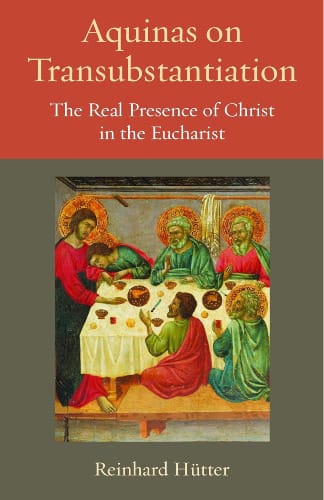
How can Reinhard Hütter’s study of St. Thomas’s teaching on transubstantiation help us gain a better understanding of the Sacrifice of the Mass?
This is an excellent book. I have really enjoyed it.
Mostly, it is about transubstantiation. In that context, however, Hütter treats the sacrificial dimension of the Eucharist.
Consider the role that that the truth of the form of the sacrifice plays in the teaching of Trent and in the theologies of Eucharistic sacrifice that develop thereafter. The truth of the form is connected directly to the validity of the real presence and to the sacrificial dimension of the Mass. The metaphysics of analogies matters a lot more here. The semantics of human speech in naming the substantial and accidental truth of things matters when it comes to transubstantiation. It is important to understand the nature of the metaphysical claims being made in the form.
At a certain level, transubstantiation is miraculous and supernatural. It relies completely on the agency of God and creation's obedience to him.God has the ability to work miracles: to part the Red Sea, to command the substance of red wine to depart while retaining the elements of the accidents remain. The accidental being of the piece of bread or the wine provides continuity for the change. That change is transubstantive because only the substance is changed but none of the accidental externals.
The form is a divinely instituted part of the sacramental rite. Understanding how the truth of the form relates to the mystery of human language is extremely helpful for students, especially seminarians and student brothers. As future priests, they need to think carefully, clearly, and deeply about what exactly it means that the Eucharist is Christ's presence by means of transubstantiation. The priest is intimately involved in this act daily. Having an unclear understanding of the real presence of Christ in the Eucharist is a real poverty in both priestly spirituality and lay piety.
The form is also part of an external rite. It is part of a series of the sacramental gestures and actions that make up a liturgical celebration. It is not just a theological idea or motif that structures our thought about the Church and Christ. It can provide those resources too. However, it is a very concrete and personal event.
"Both Sacrifice and Sacrament pertain to the same mystery and cannot be separated from each other. The Lord is immolated in an unbloody way in the Sacrifice of the Mass and He re-presents the sacrifice of the Cross and applies its salvific power at the moment when he becomes sacramentally present— through the words of consecration—as the spiritual food of the faithful, under the appearances of bread and wine."
Paul VI, Mysterium fidei
4.
At first glance, the Francisco de Vitoria’s Political Writings do not appear particularly relevant to the theme. Have you recommended it for his On Dietary Laws, or Self-Restraint (De temperantia), where, in addressing the Amerindian practices of cannibalism and human sacrifices, he brings up St. Thomas’s teaching on sacrifices and the Eucharist?
Part of my book looks at these schools of Thomistic interpretation. De Vitoria and the School of Salamanca School are best known, at least among modern scholars, for their work on human rights, natural law, and political jurisprudence. There work exerted great influence of the development of these area in early modernity. Many read Vitoria’s On Dietary Laws book precisely for those reasons. Earlier, however, I mentioned the bearing of natural law on how we can think about the Eucharist. That line of thought results from Vittoria's work. It can also be found in his commentary on question 85 of the Secunda Secundae, on the virtue of religion.
The translator of On Dietary Law opens with a nice introduction to Vitoria and the School of Salamanca.
It is surprising how important the Sacrifice of the Eucharist was for some of these debates.
Vitoria was active at Salamanca in the 1530s and 1540s. He had studied at Saint-Jacques in Paris under Peter Crockaert and some other Dominicans. There he learned the practice of Thomistic commentary of working from the text of Aquinas, even though most of the faculty of theology at the University of Paris had been nominalist for a long time.
He brought back to Spain this renewed process of working through the text of Aquinas and teaching from it. This started the whole School of Salamanca.
Their approach to the Sacrifice of the Mass looks different after Trent. Báñez, who writes after Trent, adapts the position of the School of the Salamanca in the light of Cajetan and Trent. Vitoria is important for understanding the School of Salamanca’s position prior to Trent, whereas Cajetan developed the double-consecration with which we are more familiar and that is taught in the seminary.
The School of Salamanca argues that there is a development from the offertory to the priest's consumption of the Eucharist. Their reading of Aquinas is heavily weighted toward his presentation of sacrifice under the natural law in the Secunda Secundae. There, he make some comments on the sacrifices of the Old Covenant, such as the killing and burning of an animal, a holocaust, or the breaking, blessing and consuming of bread. One way of reading Aquinas’s ambiguous comments is that there is a liturgical progression from the offertory to the priest’s consumption. This is the School of Salamanca’s interesting and historically unique reading of Aquinas’s remarks on this subject.
Báñez develops this doctrine by incorporating some of Cajetan’s ideas and bringing it in line with Trent.
Their interesting reading of the Summa is indebted to external political factors. There were no Protestants in Spain at the time, whereas Robert Bellarmine worked out his own approach to the Eucharistic sacrifice at Louvain in a mixed faculty. It was a very pressing existential issue. There were Protestants and Catholics in the same building at the same university, but the theologians at Salamanca in 1540 had only heard of Protestants. For them, the big issue of the day was the New World. For them, the pressing question was how could the sacrifices of natural law be coherent with the Catholic understanding of the Eucharist and the Mass.
The difference between Salamanca and Paris is not nearly as great as that between Salamanca and the New World. However, the New World formed their approach to the Eucharistic Sacrifice in a much stronger way than Protestantism. In other parts of Europe, Protestantism was the lens through which theologians thought about the Sacrifice of the Mass. They were wondering how to argue against Luther and Calvin. That was certainly Cajetan's hermeneutic.
This brings us to your own study of how sixteenth and seventeenth century scholastic theologians took up St. Thomas’s teaching on the Eucharistic sacrifice. What are the main contributions of your study?
Any one of the theologians that I have studied has probably made more of a contribution than I have. Methodologically, my study is an attempt to harness the hermeneutical value of reading a text in its context and approach it in the way that contemporary historical theology considers doctrinal development and textual influence.
The backbone of the study is the Summa, not as a medieval text but as a received text. Although the Summa is a medieval text, as a received text it is really a creature of the early modern period. It is not exclusively a creature of the early modern period. However, its reception has been coloured heavily by many of the issues, controversies, and questions of early modernity rather than those of the thirteenth century. This poses an interesting hermeneutical problem for the interpreter of Aquinas and his reception.
Medieval studies need the same hermeneutical tools, whether philosophy or theology, to look at the Summa in its original historical context: its relation to Bonaventure, Alexander of Hales, Roland of Cremona, the issues of the 1250s, and so on. There is a lot of great scholarship in that area because during the twentieth century there was a renaissance of historical studies on Aquinas and the Middle Ages. Early modern studies is also undergoing a renaissance and is a growing field. There are many great studies now, particularly on Catholic theology. Nevertheless, there is plenty more work to be done. Many aspects of that period have not been studied nearly as thoroughly as, say, the 1250s debate on the hypostatic union.
Moreover, the Summa provides a textual continuity between the Middle Ages and this new historical context. The Summa took on a life of its own with its reception in early modernity. You can see that in the approach of the School of Salamanca. Their questions on the New World that were obviously not part of the Summa’s original historical context. However, they are part of its reception in that period. Good scholarship keeps these issues distinct but also compares them and looks at how the one informs the other. It has a a clear understanding of both the text and context of the Summa.
This also enables us to recognise these receptions of Aquinas for what they are. There is a range of readings of the Summa. Some are interested in a close textual reading of the Summa. This historical work looks at it in its original context, its sources, arguments, and how it develops a theme. Others approach it as Aquinas would Peter Lombard’s Sentences: as a springboard and potential source of ideas or resources. This leads to creative and eclectic engagements with the Summa, where Aquinas is a subset of the interesting sources and ideas that shape the author's whole perspective on an issue.
However, even those who are more concerned with presenting Aquinas' views on their own terms sometimes have to address pressing issues. Take Francisco de Victoria. He does comment on the Summa in the classic sense: line by line. However, he does so while teaching at a university (this university context was the one in which the Summa, which is scholastic by design, was born) and so has to address the questions of the day. He kept alive that tradition while engaging with the present.
I have tried to capture the vitality that the Summa’s textuality has in new contexts.
5.
Finally, you have recommended Fr. Colman O’Neill’s Meeting Christ in the Sacraments.
I have benefited immeasurably from this excellent book. Everyone should read it. It has a robust Thomist account of sacramentality.
O'Neill also authored more technical writings on John of St. Thomas and the later Dominican commentatorial tradition on the sacramental sign and grace.
His vision of the sacraments is not unlike that of Servais Pinckaers’s popular Sources of Chrstian Ethics. He gives an authentic and robust voice to the mystical theology of the present. He captures much of the contributions made by the ressourcement movement.
As you mentioned earlier, there have been different theories, particularly during the 16th, 17th century, of what constitutes the Sacrifice of the Mass. Some of those have been surpassed. Is there any consensus today about what makes the Eucharist a sacrifice?
Aside from the magisterial documents that I mentioned, some liturgical theologians are influenced in their thought about the Eucharist by non-classical models, such as those of René Girard and phenomenology.
Jean Luc Marion, for example, has a lot to say about the Eucharist and its value, not just for theology and philosophy, but also for culture and thinking about human perception or the capacities of the human person.
The Eucharist is also at the centre of the whole phenomenological project of Jean Yves Lacoste.
Though I am committed to a scholastic approach, there is no longer a common scholastic vocabulary within Catholic theology. Nevertheless, what cuts across the different schools of theology is the deep continuity and commonality of the value they attach to these theological mysteries. That is where to situate the dialectic within contemporary Catholic theology, rather than the old arguments about first principles, as important as they are. There are also valuable new conversations. Aquinas' thought has the vitality and the resources to work as the foundation for that type of engagement.
The Eucharist is at the centre of many Catholic theologies, especially some of the most influential systematic Catholic theologies today. In many of them, sacrifice is a very prominent anthropological theme due to the influence of Girard or similar accounts.