

The Confessions of St. Augustine is “a work that is simultaneously autobiography, philosophy, theology, mysticism and poetry, a work in which those who thirst for truth and know their own limitations have always discovered their own selves. Toward the end of his life, he wrote: ‘Which of my works succeeded more often in being known and loved than the books of my Confessions?’ (De dono perseuerentiae 20, 53). History has never contradicted this judgment, but has amply confirmed it. Even today, the Confessions of St. Augustine is widely read, since the richness of its interior insight and religious emotion have a profound effect on the minds of men and women, stimulating them and disturbing them. This is true not only of believers; even one without faith, but in search at least of a certainty that will allow him to understand himself, his deep aspirations and his torments, reads this work with advantage. The conversion of St. Augustine, an event totally dominated by the need to find the truth, has much to teach the men and women of today, who are so often mistaken about the greatest question of all life.” St. John Paul II, Apostolic Letter Augustinum Hipponsensem.
In this interview, Jared Ortiz discusses the Confessions, how to read it, and selects the best translation and companion literature.
Jared Ortiz is Van Kley Professor of Religion and Chair of the Department of Religion at Hope College, where he teaches Catholic theology. He is founder and executive director of the Saint Benedict Institute, the Catholic spiritual and intellectual centre that serves Hope College. He specializes in early Christian theology, especially St. Augustine. He is the author of Deification in the Latin Patristic Tradition, "You Made Us for Yourself": Creation in St. Augustine's Confessions, co-author of Nicene Creed: A Scriptural, Historical, and Theological Commentary, and co-editor of With All the Fullness of God: Deification in Christian Tradition.

- Confessions
translated with introduction and notes by Thomas Williams - The Conversion of Augustine
by Romano Guardini - Augustine: Conversion to Confessions
by Robin Lane Fox - A Reader's Companion to Augustine's Confessions
edited by Kim Paffenroth and Robert Peter Kennedy - Augustine the Bishop
by Frederick van der Meer
...and a bonus recommendation... - The Confessions of X
by Suzanne M. Wolfe
Why did St. Augustine write the Confessions?
That is a much-disputed point in Augustine's scholarship.
St. Augustine started the Confessions in 396, when he became bishop.
Some believe that he wrote it as a defence against accusations that he was a closet Manichee. That theory has some plausibility. He was condemned as a Manichee in North Africa while he was away in Rome.
But writing the Confessions was one of Augustine's first acts as bishop, one his first pastoral acts. As I read it, he is trying to draw people to God.
Toward the end of his life, he wrote a work called Reconsiderations (Retractiones), where he goes through all his works and comments on them. There, he says that he wrote the Confessions to stir up minds and hearts into God. I believe that was his intention in writing the work: to use his life and Scripture as a way of praising God; to show what the Lord had done; and to inspire others to turn to God and to praise him for his mercies in their life.
"The Confessions is first and foremost a prayer."
What's the general structure of the Confessions?
The Confessions is first and foremost a prayer.
The word confessio has various meanings. One refers to what we think of by ‘confession’: confessing your sins and admitting your wrongdoings. That is certainly in the work.
For Augustine, however, there are two more primary meanings.
One refers to the confession of faith, just as the martyrs confessed their faith before a tribunal and their persecutors.
‘Confession’ also means to praise God. For Augustine, that is the primary meaning.
In the Garden of Eden, there was one form of confession: praise of God. With the fall, the other meanings of confession come into play.
The whole work, therefore, is a prayer. However, Augustine prays or, as he says, confesses from two sources. In books I-X, he confesses from his own life. He uses the material of his own life as a way of giving praise to God. In the last three books, he uses Scripture, especially the opening of Genesis, to confess to God.
That is the one basic structure of the work.
We could talk about the finer-tuned structures of the Confessions. He starts with his own birth in Book 1 and moves to his rebirth in Book 9. Overall, therefore, there is a movement from birth to death—he is born into this world of death—and then from death into life: eternal life and the new life of baptism. That is one movement with Books 1-9. Book 10 moves into the present tense: into considerations about memory and how we find God. Finally, the last three books reach forth to God in Scripture. Book 13 ends with a beautiful meditation which reads the seven days of creation that are narrated in Genesis allegorically, as an account of the Christian life in the Spirit. It shows that all is consummated in the Church, in the body of Christ and the union of God and man.
"The Confessions is an anti-autobiography. Augustine is not really writing about himself but about what God has done in his life."
The Confessions is often cited as an early and groundbreaking essay in the genre of autobiography. Is that an accurate assessment or is Augustine up to something else?
That is a good question. Using ‘autobiography’ as a shorthand is not necessarily wrong, given our categories. However, it is anachronistic. In an autobiography, we write about ourselves.
In a way, the Confessions is an anti-autobiography. Augustine is not really writing about himself but about what God has done in his life. Often, he undermines the conventions of an autobiography because, time and again, he stresses that he cannot really know himself. He attempts to plumb his own depths and the depths of God but keeps coming up short. He reiterates, therefore, that only in the light of God can we make any progress in coming to know ourselves.
The idea of writing an autobiography, therefore, would be foreign to Augustine and even problematic. We cannot sum ourselves up in that way. Moreover, the Confessions is really a prayer from beginning to end. It is addressed directly to God. The focus is not so much on Augustine himself, but on God and on praising the Lord for what he has done.
In the Confessions, Augustine describes his intellectual journey through various philosophical schools and religions, most notably Manichaeism, to Christianity. How relevant is his journey to modern readers?
It is quite relevant.
In one way, the Manichees were far out. They had quite wild beliefs that we might snicker at. However, Manichaeism was a variety of Gnosticism: the belief that one is saved through a secret knowledge and the attendant rituals. Gnosticism is a perennial human temptation. We all like to have secret knowledge. Wokeism is an example. If you are woke, everyone else is asleep but you are awake. You have the secret knowledge. QAnon is another example. If you believe in QAnon, you know the conspiracy theory that explains everything and have insights that no one else does. You have the secret knowledge. Such movements, moreover, have their own rituals and even their own religious commitments.
There are other Gnostic strands in our culture. There is a dualism between good and evil: good and evil people, such as woke and unwoke. There is a dualism between the material and the spiritual. This is expressed in the idea that my true self is this inner core which I discover, whereas my body is malleable and can be changed to conform to whatever I want to be.
The temptation of Gnosticism rears its head in every generation. Our generation has its own forms. We might snicker at Augustine, but he would also snicker at the contemporary forms of Gnosticism that many of us are tempted by and fall into.
More generally, what Augustine displays is an unrelenting quest for wisdom and truth.
He was a wayward youth. He liked girls and mischief. Many of us can relate to that. Then, he is set on fire for wisdom. He reads Cicero's Hortensius, an exhortation to philosophy and sets out on a quest for wisdom. That is partly why he falls in with the Manichaeans, who promise wisdom. However, after spendings nine years with them, he discovers that they come up short.
At that point, he despairs and, wounded, goes through a period of scepticism about everything. Slowly, however, he finds his way into the Church.
Mutatis mutandis, this is the story of many of us. You can watch me telling my own story on The Journey Home. I had my own wanderings in life, in sin, and in intellectual commitments. Augustine was helpful in this.
The Confessions contains more than 700 questions. Augustine does not answer them all, but he is a man on a quest, even when he is a bishop. His questions set us on a quest. He does reach some answers and conclusions, but they open even more questions. This is relevant to us today. There are many false philosophies and floating around and much scepticism. Our young people are very leery of commitment and inundated with many promises of how they will find satisfaction in the world or in certain ideas.
Augustine has a great deal of sympathy for those concerns and those in such a situation. However, he also shows us a way out and a path toward something beautiful, true, and enduring.
What are the main philosophical concepts and theological doctrines that Augustine explores in the Confessions?
All of them. The Confessions begins, “Great are you, O Lord, and highly to be praised, and man, a little particle of your creation, desires to praise you.” That paragraph ends with Augustine's famous words, “you have made us for yourself and restless is our heart until it rests in you.” This first paragraph contains several big philosophical ideas. It speaks of the nature of God, the nature of human beings, and how we form part of creation.
The doctrine of creation was not a given. Nor is it a given that we understand ourselves as creatures who have receive our being from God and are made for God, our end. The question of what constitutes our end, the purpose of our life, and what it means to be happy, is raised in the very first paragraph.
In the next few paragraphs, he asks two or three dozen questions about the nature of God and the world.
One of the biggest and most famous questions that he wrestles with in the Confessions is that of evil. First, he asks, “Where does evil come from?” However, he does not make any progress until he enquires into the nature of evil, free will, and free will’s interaction with grace.
Some of the other big ideas he addresses are scepticism, the meaning of death, and the nature of biblical exegesis. Philosophers still go back to his seminal treatments of memory in Book 10 and time in Book 11, whereas in Book 1 he takes up language theory. There is no shortage of things that he addresses in the Confessions.
St. Augustine wrote many important works, but perhaps his magnum opus is his The City of God (De civitate Dei). Similarly, subsequent to the Confessions he writes extensively against Donatism and the teaching of Pelagius on justification and grace. Does the Confessions anticipate his subsequent teachings on these issues?
In many ways it does. When he wrote the Confessions the Manicheans were obviously in full force and he was dealing with them as a bishop.
The Donatists were also a problem, though interestingly, he never mentions them in the Confessions. Possibly, this was meant to be an irenic offering to them as a bishop. The Confessions was meant to be a book that could inspire them too. In Book 13, he talks about the nature of the Church and provides a vision of what a Christian community can be. In Book 12, he talks about Christian interpreters of Scripture who disagree but come together to seek the truth together. Strictly, he may not have had the Donatus in mind, but these books may have been an opening to the Donatists. However, he does not really address them in the Confessions, even though he had already wrestled with them. Supposedly, the Donatist heckled him at his first few public appearances as a priest. So, he asked his bishop for more time to study Scripture so that he could push back on them.
On the other hand, it was the Confessions that sparked the Pelagian controversy. Back then, books were read out loud as public entertainment. At one point in Book 10, Augustine prays, “Give what you command, command what you will” (da quod iubes and iube quod vis). When Pelagius heard this, he interrupted the reading and protested that this statement was ridiculous because, if God gives what he commands, then there is no free will. This objection got back to Augustine, and he began the correspondence that prompted the full-blown Pelagian controversy.
As to The City of God, it attempted to dismantle the entire pagan system. For many, it narrates the conversion of the world, whereas, in the Confessions Augustine is narrating the conversion of the individual. In some ways, therefore, The City of God is the Confessions writ large. Even in the Confessions, you can see the seeds of the whole City of God.
What has been your own experience of teaching St Augustine's Confessions?
Very positive. I have taught it as part of a freshman seminar and as an upper-level seminar for my students. In the latter case, it is the only reading for the course. Each class, we read half a book, between five to ten pages. We read it slowly and deeply. The response of the students has been overwhelmingly positive, especially to the slow reading of the work. They rarely get a chance to slow down.
This slow, meditative reading of Confessions, in the manner of a lectio divina, really opens up the text for them. They see things that otherwise they would not have noticed, just as when you are driving fast you miss things that you notice when riding a bike or taking a walk. Whenever they stroll through the Confessions, they notice many things.
They love all the questions and philosophical topics that Augustine raises. They also love how honest he is about his struggles with sex, doubt, and such like.
When I first taught the Confessions to freshmen, we reached Book 11, which is on the nature of time. I reread the whole of Book 11. Understanding it was difficult even for me. I recounted this to the students when the class began. All of them burst out and said, “I know. I was up all night long thinking about it.” They are very interested in these very difficult questions. Augustine speaks to them existentially and stirs them to undertake this quest for truth and wisdom.
Why did you decide to make St. Augustine the focus of your scholarly interest?
I tried not to, so I blame God, Augustine, or someone else.
When I entered graduate-school, I decided not to write on Augustine because around a 300-500 new articles on him come out every year. It is impossible to keep up with the literature, even more so with a dissertation.
However, I took a class on the patristic exegesis of the first three chapters of Genesis and read Augustine's Literal Commentary on Genesis. It blew my mind. I was supposed just one part but I read the all the chapters on the seven days of creation because his literal reading of Genesis was so beautiful and interesting.
Shortly after, I took a course on the Confessions and saw many resonances between the way Augustine talked about the creation story and how he talked about his own story as a kind of recreation. For Augustine, there is a primordial conversion that all creation must undergo to exist. This idea set me on fire and I fell in love with Augustine.
I told one of my mentors that I was unsure whether I should write my dissertation on Augustine since so many write on him. He replied, “Yes, a lot is written on Augustine, but when it comes to getting a job, everybody wants a specialist in Augustine on the staff. You do not need to justify yourself for having written on some obscure fourth-century figure that no one has ever heard of.” So, I ended up writing on Augustine both because I had fallen in love with him and wanted good job prospects.
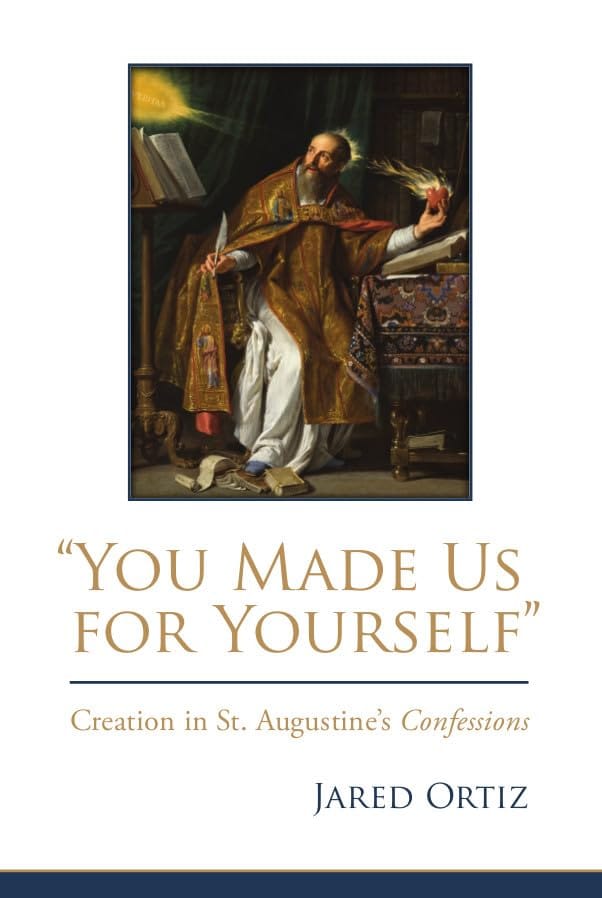
You have mentioned the relation between creation and the Confessions. Did that feed into your own study, “You Made Us for Yourself”: Creation in St. Augustine’s Confessions?
For my dissertation, I decided to work on one book to narrow things down. The advice you give to graduate students is to pick one author, one book, and one idea within that book. I decided to write on creation since I was excited about the Literal Commentary on Genesis and by Robert Sokolowski’s The God of Faith and Reason, which talks about just the importance of the distinctively Christian idea of creation. This was a radical idea in the ancient world. It changes our whole way of viewing reality, ourselves, and God. It makes it possible for us to understand the Trinity and the Incarnation. Though much has been written on the importance of creation, for some time the topic of creation has been neglected and somewhat embarrassing for theologians, and is now being rediscovered.
Augustine talks of a threefold structure in creation: there is creation, conversion, and formation (creatio, conversio, formatio). God creates all things from nothing. “In the beginning God created the heavens and earth.” However, Genesis describes everything as being formless. All of creation, therefore, turns toward God in order to be. Then God says, “Let there be light!” He converts the thing from formlessness to form.
This threefold process appears in the Augustine’s famous line, “You made us for yourself, and restless is our heart until it rests in you” (fecisti nos ad te et inquietum est cor nostrum, donec requiescat in te). The Latin actually says, “You made us toward yourself (ad te).” In other words, God has created us to turn toward him. We are oriented dynamically towards God. Once we understand this, the Confessions make much more sense. This is why Augustine talks a lot about creation at the beginning of the Confessions and then about his conversion as a recreation. When we turn away from God, we fall back into nothingness. However, God calls us again through the Word and recreates us and reforms us in his own image.
That also explains why the last three books of the Confessions are on Genesis and creation. Conversion and creation are interior to each other. This helps to make sense of the overall structure of the Confessions, which for a long time has been a struggle for scholars.

1.
There are various translations of St Augustine's Confessions. Why have you chosen that of Thomas Williams?
There is no shortage of good translations. When I was working on my dissertation, I had five or six handy. Back then I really liked the translation of John K. Ryan, a philosophy professor at Catholic University of America, because it was always on point. Sometimes I would become excited at an idea that I noticed in another translation, but when I checked the Latin I would find that the idea did not appear that way in the original. However, Ryan’s translation is very sober and helpful.
When the Williams translation came out, a friend recommended it. I read it carefully, found it both accurate and beautiful, and decided to use it for teaching.
The Ryan translation is accurate but not always beautiful. There are some translations that are beautiful but not always accurate. Williams has managed to capture both aspects: the beauty and the accuracy.
He accomplishes this in part with the formatting. The Confessions contains nearly a thousand allusions or references to Scripture. Many translations provide the biblical quote or give the reference or a footnote. However, Augustine is not always quoting Scripture. Sometimes he is imitating or paraphrasing it. Williams does not use any quotes but puts the references in the margins for you to check. This way you can read this Augustine's prose, see how it is infused with Scripture, without toggling up and down the page or imagining that that he looked up the exact biblical quote to make his point. This makes for a much smoother read and adds to the beauty of it. It gives you a clearer idea of how Augustine used Scripture. There were no references or quotation marks in ancient Latin.
I have written an article in which I evaluate eight or nine different translations of the Confessions. Each has its strengths, but for now I am sticking with the Williams one.
2.
The next few books are guides or companions to reading St. Augustine’s Confessions. First up is Romano Guardini’s The Conversion of Augustine. What makes this a good guide to the work?
Guardini probably needs no introduction. He was a luminary in the early twentieth-century who inspired Ratzinger and the ressourcement theologians. Anything he writes is beautiful.
Many scholars will deem this book dated. It is in terms of cutting-edge scholarship. However, Guardini gives an inside view of Augustine because he has undergone the same experiences. He believes what Augustine believes and so has a spiritual access to the work. The same Spirit that inspired the Confessions inspires Guardini's commentary on it. Guardini has a kinship with Augustine as a fellow Christian and seeker of God. This enables him to penetrate the interior logic of Augustine and the Confessions in a way I have not found anywhere else.
Yes, there are more comprehensive, historically informed, scholarly commentaries. However, Guardini is where to go if you want to get inside the Confessions and Augustine’s mind and heart.
3.
Not only is A Reader's Companion to Augustine's Confessions, edited by Kim Paffenroth and Robert Peter Kennedy, collect essays on the work from various scholars. Each of the thirteen essays focuses on one of the thirteen books of the Confessions and how it works as the key to whole work. Have you selected this collection of scholarly essays on account of this systematic principle?
Yes, though in some ways this is a very quirky, tongue-in-cheek principle.
There is much disagreement over the structure of the Confessions, the key to understanding it, or whether it has any structure at all. Many conclude that there is no such key and that we should stop looking for one.
The editors of this book propose that we assume each book is a key. They have chosen thirteen of the finest Augustine scholars to make a case for each book being the key.
In some ways this is an artificial and quirky conceit, however it also opens up the Confessions in all sorts of ways because the work is so polyvalent and polyphonic. It resonates deeply on so many levels that focusing on one part of it sheds light on everything else.
Moreover, this book contains some of the most insightful essays on the Confessions. The Fredrick J. Crosson’s, “Book Five: The Disclosure of Hidden Providence” is one of the best takes on the structures of the Confessions. Crosson is a philosopher but has a similar sort of mind to Guardini’s. He gets right to the heart of a thing and opens up its interior logic of it. He has disclosed the structure of the Confession better than anyone else. He also shows how there the Confessions probably has many structures. Hence, focusing on each book does provide insights into certain ideas, arguments, philosophical topics, or theological doctrines. It opens up other things that are going on shows how all the books are connected.
Another beautiful essay is Robert McMahon’s “Book Thirteen: The Creation of the Church as the Paradigm for the Confessions.” It shows how the whole trajectory of Scripture, history, and human life is ordered towards union with God and culminates in the Church. It also shows how Book 13, which is a very difficult to read, brings the whole Confessions together.
In one way, this book does not solve anything but with its many brilliant insights opens up interesting readings of the Confessions.
4.
Robert Lane Fox's biography of Augustine up to his conversion is the work of a non -believing classicist. How can this author's perspective help us understand the confessions if it is not committed to the central element of the work, the Christian faith?
This is a fascinating book. Years ago, a friend asked me to review it but I was not excited about it and put it off for a long time. However, it is delightful to read or even to listen to on Audible.
It is the work of a classicist and a very careful historian who has a remarkable breadth of knowledge at his fingertips. It brings together many things in Augustine's life that I had never put together.
A close reading of the Confessions gives you insight into Augustine, God, and all sorts of theological truths. However, a historian's perspective can bring out a wider range of connections.
Lane Fox sets his book up as a triptych, with Augustine in the centre, the pagan Libanius on one side, and the Greek bishop, Synesius, on the other. He uses these two as foils to show how often Augustine is brilliantly unique and strange in his takes on things. As a sympathetic outsider, Fox shows that there were other options and people did take them. They cut the lines in different ways or addressed the questions with different answers. Fox does not take for granted some of the things we do. He shows how certain historical developments were not inevitable and how some of the conclusions Augustine reached were not obvious or inevitable conclusions, as his contemporaries came up with very different answers to some of the same questions.
Reading this book is like visiting a foreign country, just as de Tocqueville did when he came to America. In like manner, Fox comes to Augustine and gives an outsider's perspective. Though he comes with his own views, he tries to understand Augustine on his own terms, but then points out that not everything had to be this way. He gives us a Tocquevillean approach to reading Augustine and the Confessions.
The classic biography of Augustine in English is that of Peter Brown. Why did it not make your shortlist?
Yes, Peter Brown's book is simply the best biography and everyone who cares about Augustine should read it! Though I wrestled for a long time over whether to include it or not, I have picked books that are more immediately relevant to the Confessions.
I love Brown's biography and recommend it. It reads like a novel. It is brilliant, beautiful and brings one closer to Augustine.
"Augustine’s writings are so brilliant and beautiful. However, he ministered in Hippo, which was pretty much a backwater. He was dealing with very simple people."

5.
The fifth book picks up where the Confessions ends and describes St. Augustine’s episcopal ministry in Hippo Regius. Frederick van der Meer’s Augustine the Bishop considers, among other things, how he moderated the liturgy, preached, and promoted popular piety. Have you recommended this book because it provides a fuller picture of Augustine than the one that can be gleaned from the Confessions?
We started by asking why Augustine wrote the Confessions. I argued that it was his first pastoral act as a bishop and was meant to bring people close to God.
In the Confessions, however, he does not give us a glimpse into his life as a bishop. We can get that from his letters, sermons, some other writings, but not from the Confessions itself. That is why I picked van der Meer over Brown. The former focuses on Augustine as bishop. He shows us what Augustine’s day-to-day life was like and the problems he wrestled with. He reached out to slaves or people who had been kidnapped. He helped married couples and in his sermons he preached about problems in the bedroom. He attempts to hold husbands accountable to a Christian sexual morality. He was solicitous for the poor.
Van der Meer shows what a typical Sunday in Hippo was like and what kind of people Augustine addressed. Augustine’s writings are so brilliant and beautiful. However, he ministered in Hippo, which was pretty much a backwater. He was dealing with very simple people.
Following his conversion, he started a little philosophical commune with his buddies in his hometown, Tagaste. When he was forcibly made a priest, he founded a monastic community. When he became a bishop, he founded a small quasi-monastic community in his own diocese. That community was made up mostly of ex-slaves. We tend to think of Augustine’s high intellectual culture. In his letters and his treatises, he dealt with the intellectual culture of the day. However, in his daily life he dealt with uneducated people.
Van der Meer provides insight into the context Augustine dealt with as a bishop. This also sheds light on how, in the Confessions, he is trying to reach people, even simple people, and draw them into God.
6.
As a bonus item, you have recommended Suzanne M. Wolfe’s The Confessions of X, a novel whose protagonist is the woman who was Augustine’s lover prior to his conversions and the mother of his son, Adeodatus. Can a work of fiction, such as this one, really help one understand the Confessions better?
It can. It is a work of historical fiction by a faithful and quirky Catholic. It does not have much historical value but is pure speculation. However, it brings to light this woman that Augustine really loved. He stayed with her for seventeen years. They had a child together. He says that when he sent her away, she was ripped from his side—he uses this biblical image—and his heart bled. He really loved her. Even though he sometimes talks about their relation as if in many ways it were just an exchange of sex, he still is very delicate in the way he talks about her in the Confessions. That is often overlooked but Suzanne Wolfe picks that up in a compelling way.
She gives the woman an interesting backstory. In her telling, she was the daughter of a mosaic worker who, as a result, had an intuitive sense of beauty. She was among those who taught Augustine about beauty and its importance. Though uneducated, she was insightful, just like St. Monica. The novel also imagines compelling interactions between her and St. Monica.
Wolfe’s imaginative foray into her life opens one possible window into the background of Augustine’s life and what is going on in the Confessions.