
The Fathers of the Second Vatican Council declared that “the human person has a right to religious freedom. This freedom means that all men are to be immune from coercion on the part of individuals or of social groups and of any human power, in such wise that no one is to be forced to act in a manner contrary to his own beliefs, whether privately or publicly, whether alone or in association with others, within due limits.” (Dignitatis humanae 2)
Nevertheless, the council’s declaration on religious liberty did not spell out the answers to several questions, at least not with sufficient clarity. As a result, it has generated continuous debate. One difficulty consists in explaining how it stands in continuity with earlier papal teachings. Another consists in defining the due limits to religious liberty.
In this interview, Michael Dunnigan discusses the declaration and some of the best literature on it.
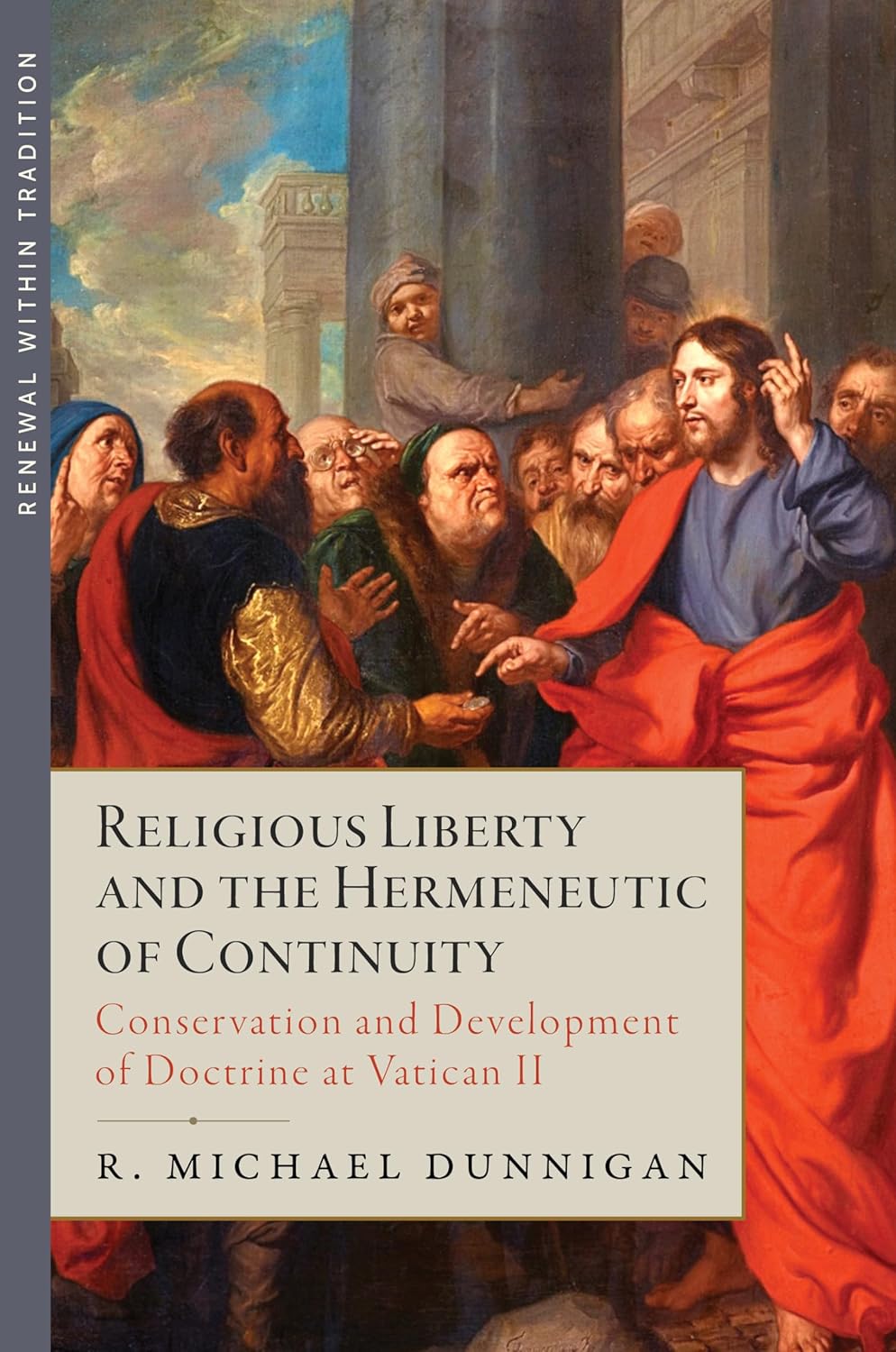
Michael Dunnigan is an attorney practicing in two distinct legal systems, the Anglo-American system of common law and the Catholic Church’s legal system known as canon law. He is associate professor of Canon Law at Saint Meinrad Seminary in St. Meinrad, IN. He holds a law degree from Georgetown, a doctorate in canon law from the Pontifical University of the Holy Cross, and a master’s degree in theology from St. Mary’s University (San Antonio). He has delivered speeches and written articles on a variety of subjects, including individual rights, the sexual abuse crisis in the Church, parish closings, art and architecture, the Church’s Latin liturgical heritage, Catholic associations, and comparative law. He is the author of Religious Liberty and the Hermeneutic of Continuity: Conservation and Development of Doctrine at Vatican II (Emmaus, 2023).
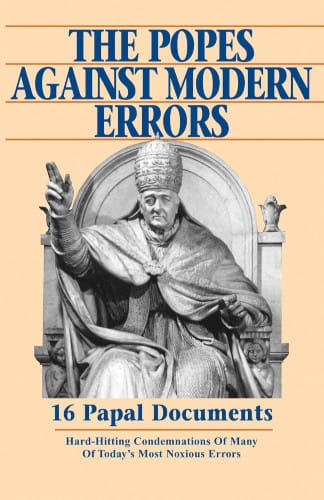
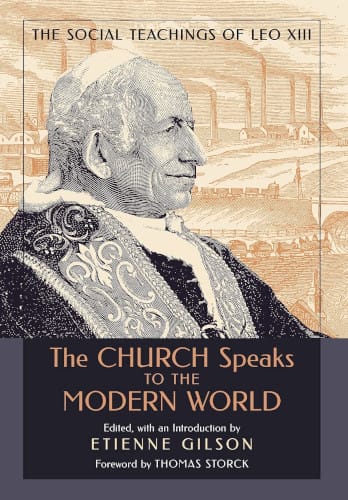
- Mirari vos, Quanta Cura (print edition), Immortale Dei, Libertas (print edition)
by Gregory XVI, Pius IX, Leo XIII - Religious Liberty and Contraception
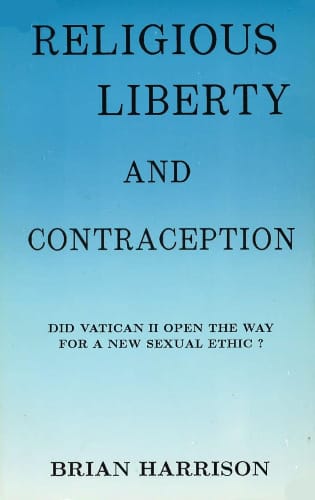
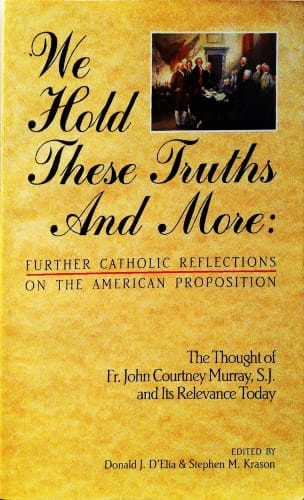
by Fr. Brian Harrison - We Hold These Truths and More: Further Catholic Reflections on the American Proposition : The Thought of Fr. John Courtney Murray, S.J. and Its Relevance Today
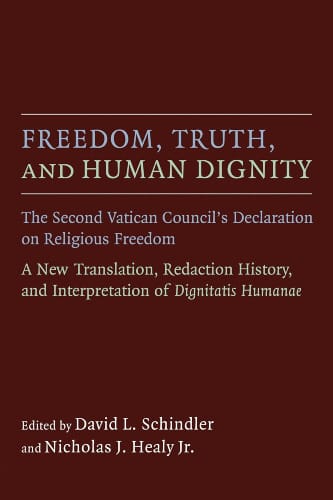
by Donald J. D’Elia and Stephen M. Krason - Freedom, Truth, and Human Dignity: The Second Vatican Council's Declaration on Religious Freedom
by David L. Schindler and Nicholas J. Healy Jr.
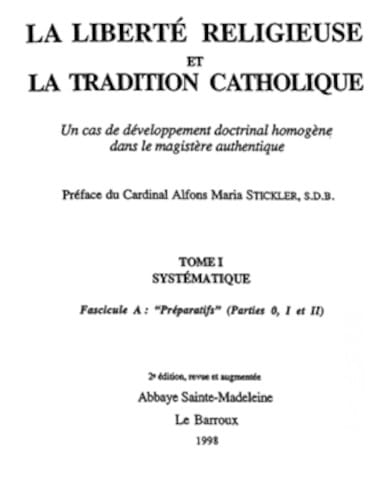
...and for readers of French... - La liberté religieuse et la tradition catholique. Un cas de développement doctrinal homogène dans le magistère authentique (6 vols.)
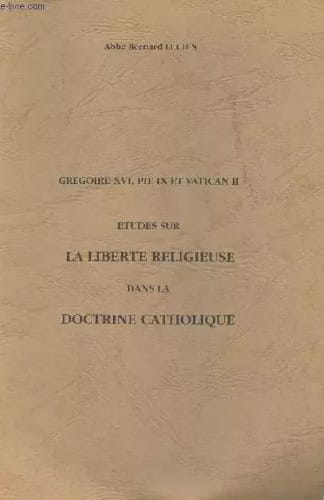
by Fr. Basile Valuet - Gregoire XVI, Pie IX et Vatican II. Études sur la Liberté Religieuse dans la Doctrine Catholique
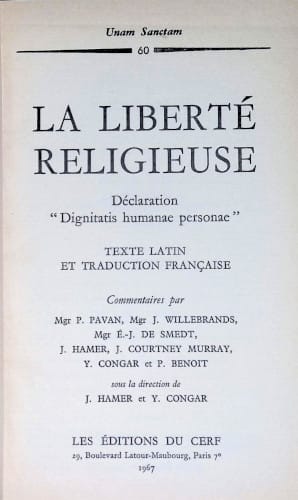
by Bernard Lucien - La liberté religieuse : Déclaration Dignitatis humanae personae
edited by Jérôme Hamer OP and Yves Congar OP
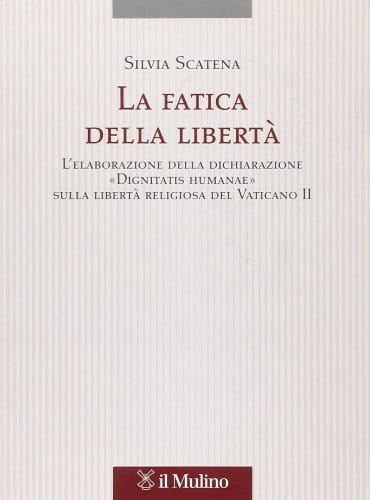
...and for readers of Italian... - La fatica della libertà: l'elaborazione della Dichiarazione Dignitatis humanae sulla libertà religiosa del Vaticano II
by Silvia Scatena
What is the central teaching of Dignitatis humanae?
The central teaching is that every person has a natural right to religious liberty, with religious liberty understood as an immunity in making religious decisions. It is the right to be protected from being forced to embrace a religion or to complete a religious act against one’s will. It is also the right for a person's outward religious actions not to curtailed or prevented, within limits. They can be curtailed or even prevented if they are harmful objectively to the public order. So, it is a natural right, but one that has limits. This makes it very different from the conceptions of rights that come out of the Enlightenment.
Dignitatis humanae has generated much discussion among people of good faith. This could be because the document is too vague and the issue is too mired in contingencies when it comes to concrete cases. It could also be because many misread it through a secularist lens. In your view, why has the declaration generated so much discussion and interpretative headaches?
That is a very important question. The last of the alternatives that you give is definitely in play: reading Dignitatis humanae through a secularist lens.
Russell Hittinger, a leading scholar of Dignitatis humanae, has written that we need modesty in respecting the silences of the document. One of the problems, especially in the United States, is that many conflate Dignitatis humanae with the thought of John Courtney Murray. Murray was an important scholar who made many positive contributions to the document. He also had some problematic ideas. Some of his thought made its way into the document. However, he lost battles on some important issues—especially the relationship between the Church and secular governments—but he refought them afterwards.
Is the language of Dignitatis humanae too vague? That is a good question, but a difficult one to answer. The document accomplishes something difficult. It holds on to previous teaching, avoids making a judgment about previous arrangements between the Church and civil governments, yet recognizes this right.
Some misunderstand the right recognised in Dignitatis humanae to be a right to embrace any religion whatsoever. It teaches rather that we have an immunity to make religious decisions. We might reject the truth we know or that which we do not know. However, the declaration teaches that, even if there is a problem with my decision, you cannot force me to make the right decision. You cannot even prevent me from acting on my wrong decision unless I violate somebody else's rights, the rights of the Church or other religious bodies' rights, or create some moral problem.
I am sympathetic to complaints that the document is vague. However, it is attempting to accomplish something difficult and, despite all the attention it has received, it is not that well understood. There might be complaints about the language, but it might have been difficult to improve on it.
"Whenever we think of rights in the West, we are referring to our rights to claim something. The Church's approach is very different. For the Church, rights are always tied to duties."
As you mentioned, on the popular level, many people misunderstand that when the Church talks about rights, it normally derives rights from duties. First, there is the duty to adhere to the truth about our ultimate end and order our lives accordingly. From that duty, comes the right to be free from interference that would impede one's freedom of inquiry in seeking the truth.
Yes, and this goes to your other point: the difficulty of reading the declaration through a secularist lens. Whenever we think of rights in the West, we are referring to our rights to claim something. The Church's approach is very different. For the Church, rights are always tied to duties. Every right has a corresponding duty or several.
The right to religious liberty that the council talks about is a right within civil society. However, it is at the service of our objective duty to seek God and, when we find him, to embrace him. This right in civil society is at the service of a moral duty. Though the council is not addressing the moral realm in the first instance—the subtitle of Dignitatis humanae specifies that it deals with a right in civil society—the human person has this right on account of the duty to seek the truth and God. The human person is a religious being by nature. The human person is a seeker of truth, and he is social and religious by nature.
Currently, what are the main schools of interpretation of Dignitatis humanae?
Probably, the largest divide is between those who believe that it can be reconciled with the previous tradition and those who believe that it cannot.
In the second camp, there is an interesting split.
Traditionalist Catholics, such as those of the Society of St. Pius X, use this as a criticism and argue that we need to return to the teaching of the nineteenth-century popes.
Then, there are progressive moral theologians. They applaud what they take to be a departure from tradition. Fr Charles Curran was a leader in this area. He argued that at Vatican II the Church changed its teaching on religious liberty and so could also change her teaching on contraception, in-vitro fertilization, and other matters.
Among those who believe that it is possible to reconcile Dignitatis humanae with the preceding tradition, are Dom Basile Valuet OSB, Fr. Brian Harrison, Russell Hittinger, and Barrett Turner.
The School of Bologna, with its interpretation of how Vatican II stands to the preceding tradition, might figure among those who postulate that there was a rupture. Thomas Pink, whose view differs from the authors you mentioned, argues that it is compatible. There is a wider plurality of positions.
Absolutely. The Bologna School’s position is close to Murray's. It is not happy with the final product. It claims that the “real document” consists of the novel parts whereas the late changes made at the behest of the Paul VI detracted from “the real spirit of the council.”
I disagree with that view. Harrison, Valuet, and Hittinger are correct to consider these late changes crucial. The bottom line is that the council adopted them.
There was a real hopefulness that Thomas Pink had found a way of reconciling the document with tradition that would be acceptable to the traditionalist faithful. I admire his attempt to do so but I do not believe that he has succeeded. He interprets Dignitatis Humanae as a change in ecclesiastical policy or law rather than in doctrine. There is some truth to that. There is a certain change in policy. However, Dignitatis humanae states right at the beginning that it is doctrinal in character. It aims “to develop the teaching of recent popes on the inviolable rights of the human person.” It is a pronouncement on natural law and the constitutional order of society. It could focus on law or policy to address the current order of society. However, by dealing with the inviolable rights of the human person, it is clearly articulating a teaching, not just a policy.
In his defence, Thomas Pink might say that he is not disputing its doctrine. He would understand the framework of that doctrine somewhat differently. He would say that the document supposes that the state should be the instrument or secular arm of the Church. However, as those conditions no longer hold, the state no longer has any power to enforce religious matters.
Absolutely. At first, this is what appeared promising in Pink's scholarship. This is where he resembles Murray, who also reads the document as being essentially about the state. However, this reading is too attenuated from the text of the declaration. The document makes it clear that it is not talking about state power alone, but a right against other people, social groups, and “every human power.” This is a weakness in both Murray's and Pink's commentary.
Murray's favourite idea is that the foundation of the right is the incompetence of the state. We have a right to religious liberty because religion is an area in which the state is unqualified to act.
Murray is really talking about political philosophy rather than theology.
However, there are many problems with reading the document as if it were only talking about the state. ISIS violates religious liberty but is not a state actor. The same is true of individuals who engage in unworthy, dishonest, or abusive proselytism. If one reads the document as being about the state, then it does not reach these other attacks on religious liberty by non-state actors.
You have already mentioned Murray. Who were the main other main protagonists in the drafting of Dignitatis humanae?
Three people were indispensable. Without them, we would not have Dignitatis humanae.
One is Murray. Though I am critical of Murray, he deserves the gratitude of those who believe that Dignitas humanae is a positive development within the Church's life. He was one of its catalysts and had been thinking about the issue before most others.
Another is the official relator of the document, the Bishop of Bruges, Émile de Smedt. He made several important speeches at the council, many of them on religious liberty. He produced the official statements (relationes) on each draft of Dignitatis humanae. It had an unusually high number of drafts. De Smedt was key in ensuring that it both recognized the right but also that this important innovation was put forward in a way that did not contradict the Church’s previous teaching
Paul VI was also very important, especially towards the final stages. This document was important to him. He delivered several speeches about it after the council. Both he and his successors have made Digniatis humanae the cornerstone of their diplomatic policy.
These three have pride of place. However, several other were also important.
One was an important collaborator and ally of Murray's: Mons. Pietro Pavan, an Italian priest who later became a cardinal. Murray's position is sometimes called the American position. It should really be called the American-Italian position on account of Pavan, who does not get as much attention as he should. He shared most of Murray's opinions but in some ways put religious liberty on a sounder basis. He acknowledged that it was a natural right and not just a development of political philosophy.
Also important is the only person who was involved in every stage of the drafting process: Jérôme Hamer OP. After the council he wrote some very important articles on the decree.
The prominent Dominican theologian, Yves Congar was also involved in some phases. In his diaries he describes the later stages of the genesis of the document.
What prompted your own study on Dignitatis humanae?
I used to work as a civil lawyer but switched gears and took a position with an apostolate that worked in canon law. In connection with that work, I went back to school and earned a master's degree in theology. For a class on ecclesiology, I wrote a long paper on whether Dignitas humanae can be reconciled with earlier Church teaching. Then, I wrote a master's thesis on the same subject. Later, when I studied canon law, I wrote my licentiate thesis and eventually my doctoral dissertation on it. My book Religious Liberty and the Hermeneutic of Continuity is an expanded version of my dissertation. The question intrigued me from the outset and has never ceased to do so.
What does your study add to the existing literature and debate on the interpretation of Dignitatis humanae?
One thing, which I consider to be the key question, is the foundation of the right to religious liberty.
Religious liberty has been recognized in some way or another at least as early as the late sixteenth century in Poland and the mid-seventeenth century in the U.S. State of Maryland. Erasmus talks about similar ideas. Ideas like those of Erasmus (and, to some extent, James Madison) end up with religious liberty, but they were often based on scepticism, rationalism, or simply a desire to be free from the religious strife.
There is an assertion of religious liberty in the Enlightenment. In some regards, this is an advance. However, it is based on scepticism. The Church could not accept bases like scepticism or rationalism for religious liberty. They are not Christian bases but virtually anti-Christian ones.
It is clear from Dignitatis humanae that Vatican II based the right on the dignity of the human person. After the council, however, Murray, who was very influential, relitigated this, and claimed that the incompetence of the state is an even better basis. There has never been a want of people who agree with Murray on this and who claim either that this is what the document is about—Thomas Pink is an example—or that, even if this is not what the council taught, it is a better foundation for the right.
One of the things I set out to examine was whether state incompetence could have been the basis. I concluded that it could not. It cannot ground a natural right. Its basis is in political philosophy, not human rights. Sometimes Murray talks about the human person but the argument on which he bet everything was the incompetence of the state. That is a shame because some of the other arguments are present in his writings. However, they are not the ones he championed.
There is another contribution that I hope to have made: to show not only that there is no contradiction, but rather a real positive continuity and harmonization between the teaching of nineteenth-century popes and that of Vatican II.
Vatican II’s teaching is primarily on the human person rather than the state.
The nineteenth-century popes talk constantly about how harmful Enlightenment ideas are to both the individual and society. Their concern for the integrity of the person is evident and Leo XIII makes it explicit. Even repressive regimes often permit the practice of one’s religion, but only provided that it is in private, not public. Leo points out that the promotion of unlimited or absolute liberties often leads to the fragmentation of the unity and integrity of the person. This is quite a subtle idea. It is found in Pius VI, Gregory XVI, and Pius IX, but is stated explicitly by Leo XIII.
The same idea is very important for Vatican II in general but especially in Dignitatis humanae. The council teaches that, by nature, we express our religion in a social context. Hence, curtailing one’s religious practice and its every social manifestation is an unnatural violation. The council thereby expands upon the teaching of the nineteenth-century popes on the integrity of the human person.
Now, those popes were mainly concerned with the Catholic faithful. Vatican II extends this teaching and talks expressly about the human person.
Third, I argue that a speech which Paul VI gave at the end of the council has been misinterpreted. The misunderstanding of this speech leads to incorrect conclusions about the relationship between the Church and the temporal authority. I attempt to provide a new and more accurate reading of this speech.
These are the three things I hope to have contributed to the discussion.
1.
For the first book you have recommended some of the major nineteenth-century encyclicals on liberty and toleration: Gregory XVI’s Mirari vos, Pius IX’s Quanta cura, and Leo XIII’s missives Immortale Dei and Libertas praestantissimum. What is the common teaching of nineteenth-century popes on religious liberty?
There were documents on the issue prior to Gregory XVI’s Mirari vos (1832) but they were usually addressed to only a part of the Church. Important as they are, they do not pose the same doctrinal difficulty as the encyclicals of Gregory XVI, Pius IX, and Leo XIII, who address the Church as a whole.
Gregory XVI does not talk about religious liberty but liberty of conscience. Unfortunately, he does not define it, except to say that it arises from indifferentism. As Harrison stresses, Gregory and other popes of the period were mainly addressing the ideas of Felicité de la Mennais, a fascinating but tragic figure.
Initially, Lamennais was very loyal to the Church and wrote in its defence, as in his Essay on Indifference in Matters of Religion. Leo XII commended him for his work in this regard.
In Mirari vos, Gregory XVI considers indifferentism to be the source of an unlimited right of liberty of conscience: an unlimited right to profess any idea whatsoever. He had Lamennais in mind. His Secretary of State informed Lamennais that his writings were the ones the pope was concerned about.
Lamennais was very critical of Gallicanism and of the Bourbon monarchy, which had been restored after Napoleon. Initially, he was distrustful of modern liberties and Enlightenment thought but ended up considering them the lesser evil and even embracing them. The tragedy is that, instead of revising these ideas by recognising that there is some truth to them and giving them a Catholic foundation, as Vatican II did, he simply adopted them in their most extreme form. Though a devout Catholic, he believed that, provided there was no bloodshed, there should be no limits whatsoever in society to liberty of press, free speech, conscience, or the profession of religion.
Starting with Gregory XVI, the popes were very alarmed about these ideas. This continues after the death of Lamennais. Even Pius IX's Quanta Cura addresses the errors of Lamennais because the Catholic liberalism movement that he inspired and its thinkers, such as Charles Montalembert, were still around.
Even Leo XIII’s long encyclicals about the states and about modern liberties are still concerned with the ideas of Lamennais.
That is one common thread. They are addressing the immoderate notion of religious liberty, not the one that is carefully framed at Vatican II.
"What are the public power’s duties towards the true religion? Dignitatis Humanae certainly does not give an answer."
The relator of the commission in charge of preparing Dignitatis humanae, Bishop Emil De Smedt, specified that the society which has the duty to offer God genuine worship includes the potestas publica. The first number of Dignitatis humanae thereby implies that government has duties toward the true religion: “it leaves untouched traditional Catholic doctrine on the moral duty of men and societies toward the true religion and toward the one Church of Christ.” What are those duties of government towards the one true religion? We do not tend to think of them nowadays, but the Church continues to insist that it does have such duties, even though it would be difficult to measure them in our current context.
That was one of the very last changes made to the document, even though it appears at the beginning of the text.
Some, especially Murray and the Bologna School, claim that “the moral duty of societies” does not necessarily refer to the state or public powers. However, in one of his relationes de Smedt says that this does refer to the public power. In an article written shortly after the council, Jérôme Hamer confirmed that it does: that the council meant every social body, from small groups all the way up to governments.
As Brian Harrison has pointed out, the statements of de Smedt are important because he was the official relator. He was charged with conveying to the council fathers the meaning of the document so that they could evaluate how to vote.
In the same speech, he explains that Dignitatis humanae leaves this traditional teaching in place, but emphasises the rights of the human person and develops some of the teachings of Pius XII and John XXIII.
What are the public power’s duties towards the true religion? Dignitatis Humanae certainly does not give an answer. So, where do we look for one?
Harrison notes that whenever a Church document refers to the state, the Latin word in the original document is usually civitas, “the city,” but this may not necessarily be equated with the state. Civitas or state can mean different things: the whole country; the people; the apparatus of government; the governing class; a nation; part of a nation, such as the state of Texas. So, whereas others talk about Church and state, Harrison usually talks about the Church and the civic community and is probably correct to do so. In his view, therefore, the civic community has a duty to God. Some take that to mean that the constitution should enshrine an official religion. However, Harrison notes that this is not the only way in which this duty might be fulfilled but simply one which has been adopted in history.
One place to look is Leo XIII. He talks a lot about the duty of rulers to God and to the Church, but not say much about what it consists of. Part of what it implies is some protection of the Church's rights.
We can also look at Quas primas, the encyclical in which Pius XI instituted the Feast of Christ the King, and where he states that leaders have a duty publicly to honour and obey God.
Harrison cites some other ways. Although he often disagrees with Murray, he acknowledges that Murray, with his insistence on the incompetence of the state, might be on to something. Whenever people are adopting a constitution, they might not confide the power to adopt a religion to their governors, even if they are a very religious people. Apart from adopting an official religion, the state could fulfil its duty toward the true religion through the recognition of religious holidays and institutions (e.g. chaplaincies), legislation on marriage, legislation on education, and such like. One of the examples Harrison points to is Colombia. It does not have a state religion, but the importance of Catholicism to the people is recognized in official documents. The Philippines is similar. Moreover, it has public celebrations that incorporate both the government and the Archbishop of Manila (or at least, this was the case back in the 1980s, when Harrison wrote his major book on the subject).
It is frustrating, but the Church documents do not give much of an answer. What we do know though is that the embrace of an official religion must guarantee respect for the religious liberty of all. Hence, if somehow there is a return of officially Catholic regimes, these would need to be somewhat different from past ones in this regard. They could not be like the one that existed in 1940s Spain. There would be allowance for the public profession of other religions.
2.
You have already mentioned Fr. Brian Harrison. His Religious Liberty and Contraception. It argues that Dignitatis humanae is consistent with previous magisterial teachings and cannot be cited in support of revisionist interpretations of the Church’s teaching on sexual ethics. Is this book one of the best studies on the document?
It is. More recently, he published another book on the subject in collaboration with Arnold Guminski. However, I have chosen his earlier book, which is still very good.
The Acts of the council were not published until the late 1970s. Harrison was one of the first scholars who took advantage of them and highlighted the speeches of Bishop de Smedt and other council fathers too.
Religious Liberty and Contraception is an unusual title but refers to the point, made by Fr Charles Curran, that if Vatican II’s teaching on religious liberty is a complete rupture with previous tradition, then the Church's moral teaching is also open to a wide array of very dramatic changes. Harrison concludes that the apparent innovations in Dignitatis Humanae do not pave the way for an overturning of the Church's teaching on contraception. Those innovations can be harmonized with tradition.
Harrison also highlights how important Lamennais was for nineteenth-century papal documents, even though his name is not mentioned very much, and how dangerous his ideas were.
"In the past, other religions seemed to pose the greater threat, but the council fathers felt that unbelief or atheism is currently the greater challenge to Catholicism."
One of the other texts that you have recommended is a 2000 edition of the magazine Catholic Dossier, which is no longer in print. This is not available online, so readers might need to look for it in the local library. Are there any articles in particular that you recommend?
This publication had an innovative format. It picked one subject and examined it in depth. Although the publication was popular, it also contained truly scholarly articles.
This issue has very good articles by Gerard Murray, Fr. Harrison, Russell Hittinger, and Fr. Kevin Flannery.
An article I especially like is Russell Hittinger’s. It addresses the question that Murray raised so adamantly. For Murray, the document essentially forecloses established religion. Hittinger asks whether it did so and argues that we need to respect its silences. Dignitatis huamane is not a complete treatise on Church and state and is especially silent on the confessional state. While many believe it thereby puts an end to the confessional state, Hittinger argues that it does not. It neither reaffirms nor prohibits the confessional state, and we need to respect its silence on this point, even though it frustrates nearly everyone.
In his view, though the traditional teaching on duties of the civic community to God is important and remains intact. However, the council fathers deemed that this was not the most important subject in our day. Rather, they wanted to stress the natural rights of the person.
In the past, other religions seemed to pose the greater threat, but the council fathers felt that unbelief or atheism is currently the greater challenge to Catholicism.
Moreover, a comprehensive treatment of Church and state would have required an evaluation of the major Church-State arrangements from the past. That would have been quite difficult to do. Earlier drafts or parts of drafts attempted a historical summary but were either unwieldy or unlikely to garner an agreement.
3.
The next two books cover two different approaches that were on the council floor during the discussion of Dignitatis humanae. Fr. John Courtney Murray SJ argued that the right to religious liberty has a purely juridical foundation. However, his view did not prevail at Vatican II, which taught that the right has an ontological foundation in human nature. An address by Bishop Alfred Ancel, on behalf of the French episcopacy, was influential in persuading the Council Fathers on this last point. We Hold These Truths and More is on the thought of John Courtney Murray. Freedom, Truth, and Human Dignity argues that Dignitatis humanae does not endorse Murray’s views but the ontological approach that was laid out in the council by Bishops Karol Wojtyla and Albert Ancel. Why is each of these two books important for understanding Dignitatis humanae?
We Hold These Truths and More is a collection of essays. Some discuss Murray's earlier work, especially his 1960 book We Hold These Truths. Others discuss his work at the council.
There are essays in defence of Murray, such as that by Robert R. Reilly, and there are essays that are critical of him, such as those by Harrison, Frederick Wilhelmsen and Gerard V. Bradley.
There were six drafts of the declaration. In addressing the history of the document, Murray claimed that there were really only three drafts and that three successive iterations only made minor revisions: the only important drafts were the three original ones.
Murray was very involved in the second and third. He was the leader behind a big advance that is made in the third draft. The earlier drafts situated the foundation of the right in the duty to follow one's conscience. Murray was astute enough to notice that there are some real problems with making conscience the foundation. The right is an immunity. If its basis is conscience, then virtually anything that one does in good faith should, prima facie, be immune from interference. However, all kinds of religious action could violate the common good.
Furthermore, if a sincere conscience is the basis of religious liberty, that might open the door to government investigating whether one is actually sincere. The government might say, “Your Church teaches that your right to religious liberty is based on the sincerity of your conscience. We, are going to examine you to see what you believe in conscience and whether you are acting in accord with it.” It does not take much to recognise that making freedom of conscience the foundation opens the door to intrusive action on the part of an abusive government.
This is what led to the declaration’s description of the right as an immunity. Murray cites this as the key breakthrough. Indeed, it is an important breakthrough.
"This phase was based mainly on an intervention primarily by Bishop Alfred Ancel...Out of this intervention comes the ideas about the human person as a truth seeker and his social nature."
4.
However, the book by Nicholas Healy and David L. Schindler points out that the second phase of the drafting is also very important.
This phase was based mainly on an intervention primarily by Bishop Alfred Ancel. Some other Council Fathers, such as Archbishop Karol Wojtyła and Bishop Carlo Colombo made similar interventions. However, Ancel’s was an oral intervention made in the name of most of the French bishops. It is a critique of the Murrayite drafts. It objects that these drafts use legal constitutional language but are insufficiently theological and do not account for our orientation to the truth or freedom’s connection to the truth. Out of this intervention comes the ideas about the human person as a truth seeker and his social nature.
Ancel was added to the drafting committee on the strength of his intervention.
Schindler is very critical of Murray, whom he accuses of trying to impose the American constitutional system on the entire Catholic world. That is perhaps an oversimplification, but the U.S. constitutional tradition was certainly Murray’s model. Schindler is very sceptical of that tradition and believes that Ancel provided an important corrective by injecting more theology into the declaration.
5. 6. 7.
For those who can read French and are interested in further study, you have recommended three works. The first is Fr. Basile Valuet’s six-volume study of the Church’s teachings on religious liberty. The second is a study by Bernard Lucien. The third is a collection of commentaries published shortly after the council in the Unam Sanctam collection and edited by Jerôme Hamer OP, later a cardinal, who participated in all stages of the drafting of Dignitatis humanae. Does your own book summarise for those who cannot read French the main results of these studies?
While it does not summarise them, I do rely a lot on Valuet. His book is almost a summa on religious liberty.
It opens with a long historical study. Whether you agree with him or not, it is a real gift to the Church on account of all its historical research. By reading my book, you can gain a good idea of Valuet’s ideas and perspective. Occasionally, I translate an important passage .
Valuet engages Lucien quite a bit because he regards him to be the most eminent of the traditionalist scholars of Dignitatis humanae.
In the Unam sanctam volume, the essays by de Smedt and Hamer are the most important. Hamer outlies the history and genesis of the document. It's very helpful. The book by Healy and Schindler contains another such history as does Conflict and Consensus by Richard J. Reagn, a protege of Murray's. It is worth reading several of the histories. Each emphasises different things.
8.
For those who can read Italian, you have recommended Silvia Scatena’s study on the drafting of Dignitatis humanae. What are her main findings?
Scatena belongs to the Bologna school and so she emphasises the novelties but is somewhat put out by the late changes that Paul VI called for and de Smedt implemented.
Interestingly, de Smedt was of much the same mind as Murray early in the process, but towards the end he, with Paul VI, was one of the persons who did the most to ensure that the document was in harmony with the preceding tradition.
Scatena's book emphasises the argument about the integrity of the person. The idea was in the draft of the declaration that was under Murray’s care. Regrettably, that idea was removed from the final draft but is still there in substance. The social nature of the person is discussed. However, many council fathers criticised the argument about integrity of the person because, in the way Murray framed it, it seemed to imply that conscience was the foundation of an overly broad right that virtually no government could regulate. There was so much criticism of the idea that it just fell out of the next draft.
Scatena is the only historian who is really interested in this issue and tracks it. She also starts out with meetings that took place prior to the council. Her book is of value to those interested in particular phases of the drafting process.