
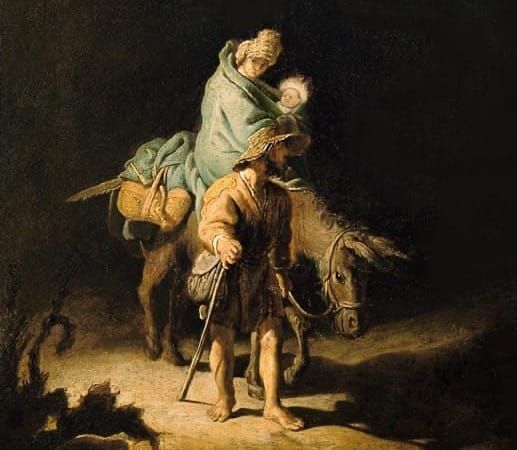
In recent years there have been massive migratory waves, particularly into Europe and the United States. However, there is deep and widespread disagreement over how the nations to which migrants are headed should deal with this situation. Some believe that they should prioritise the migrant’s right to a better life. Others object that they should prioritise the nation’s common good whenever unrestricted immigration could be deeply harmful to that country’s economy, culture, and local communities.
In navigating these debates, Catholics need to ensure that their guiding principles are evangelical rather than ideological. For this reason, they need to know and unpack the Church’s authoritative teachings on the right to migrate. That is easier said than done. There is much debate over what that teaching actually is. There is also much room for discussion over whether any concrete policy applies it soundly or only in part.
In this interview, Antônio Lemos discusses his pick of the five best books for learning about the Church’s teaching on the right to migrate.
Antônio Lemos is a Catholic moral theologian. After studying law at the Universidade Federal do Paraná in Brazil, he graduated in philosophy and theology at the Pontifical Athenaeum Regina Apostolorum in Rome, Italy. He completed his doctoral studies at the University of Notre Dame, where he submitted a dissertation entitled The right to travel and dwell in Francisco de Vitoria and Domingo de Soto: a historical retrieval of the right to migrate in Catholic social teaching. His research interests include Catholic social teaching, migration ethics, business ethics, and bioethics. Presently, he is a postdoctoral fellow at the department of theology at University of Notre Dame.

- On the American Indians
by Francisco de Vitoria OP - Deliberation on the Cause of the Poor
by Domingo de Soto OP - Exsul Familia
by Pius XII - Erga migrantes caritas Christi
by Pontifical Council For The Pastoral Care Of Migrants And Itinerant People - Migrants and Refugees: Witnesses to Hope
by Pope Francis, edited by United States Conference of Catholic Bishops
Does the Church teach that there's a natural right to migrate?
A very good question. During the twentieth century, the popes teach unanimously that there is a right to migrate. This teaching really starts with Pius XII’s apostolic constitution on the Church’s care for migrants, Exsul familia. In it, he talks of the natural right to migrate. This is a very bold statement. It means that we humans, on account of our human nature, should be allowed to migrate to other countries.
Pius XII repeats this teaching in several radio message and addresses. Later, John XXIII reiterates it in his famous encyclical Pacem in terrris. There he expounds upon the fundamental human rights, such as the right to freedom and life, and includes the right to migrate.
Every single pope since then has confirmed and reaffirmed that people have a right to migrate.
Nevertheless, Pius XII is the only pope to have said that it is a natural right. The other popes do not go that far. They say that the right to migrate is founded upon on the dignity of the human person or on the universal destination of goods (the theological principle that God has created the earth for the good of all human beings).
Interestingly, although they affirm that people have a right to migrate, all of them, including Pius XII, state that this right is not limited. It needs to be regulated by state in accordance with its common good and security.
You have just mentioned the modern papal teaching on the right to migrate. Does Sacred Scripture offer any clear teachings on the right to migrate, the duty to welcome migrants, or the limits of such a duty?
The scriptures do not mention explicitly a right to migrate just as they make no explicit mention of many other rights, such as the right of political participation. However, there are implicit references to the bases of the right. For example, the Bible is full of reference to hospitality, welcoming strangers, and charity towards foreigners.
Many of these references are in the Old Testament. Some are in the Gospel: the way Jesus received people and was kind to them. Especially St. Paul has some very clear references about hospitality. “Do not neglect to show hospitality to strangers, for thereby some have entertained angels unawares” (Hebrews 13:2).
Many popes have insisted that biblical hospitality is the basis of the right to migrate. However, the bible makes no explicit reference to allowing migrants to come into one's country. We are not talking here about sovereignty or the regulation of borders. Hence, some scholars ask what does Scripture’s talk of hospitality entail. Does it mean that we should receive for a few days the traveller who needs a place to stay for a few days? Does it mean to receive any foreign traveller or simply travellers from a neighbouring city or one’s own country? There is a debate about what this hospitality means. That is why it is important to read the Scripture together with Tradition and how these biblical passages have been received throughout the century by Christians.
 Five Books for Catholics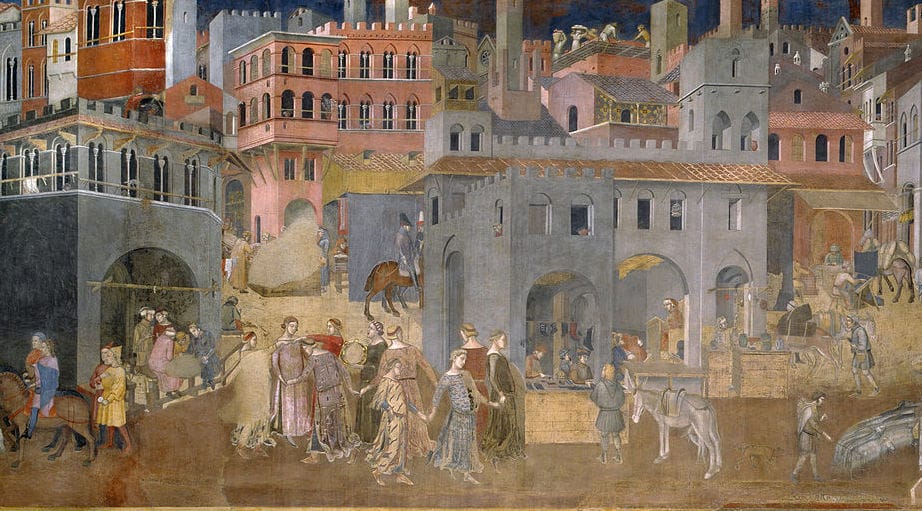
That brings me to my next question. Do any of the Church Fathers address this issue in detail?
Unlike the twentieth-century popes, no Church Father speaks explicitly of a right to migrate or goes as far to claim that it is a natural right. However, they set the bases for that teaching.
In some of his letters, St. Cyprian of Carthage, one of the most important Church Fathers of the third century, calls his friends and community repeatedly to be hospitable to travellers and foreigners. In one letter, he tells them to use his money to receive travellers and offer them whatever they need.
Another way of finding reference to the right to migrate in the Fathers is by looking at their teaching on the universal destination of goods. Basil, Ambrose, Augustine and especially John Chrysostom teach that God created the earth and its goods to serve the flourishing of all human beings. Nobody should be set aside or hindered from access to the goods—such as land, water, and the fruits of the earth—that they need for their survival and flourishing.
When John Paul II and Benedict XVI talk of the right to migrate, they recall these teachings of the Church Fathers on the universal destination of goods, a principle that is also very present in medieval theologians, such as St. Thomas Aquinas.
The popes argue that those who do not have access those goods, for themselves or for their family, should be allowed to relocate to another country to gain access to them.
We can see how the Fathers point to the right to migrate in this way. Usually, they talk about the situation of the poor and how the well-off should share their means with the poor. Often migrants are poor and do not have the means they need. Those with means have access to the goods of the earth. They should allow the poor to have access to them as well.
Some might want a quick summary of the Church's teaching on the right to migrate and a nation's duty to welcome migrants. Does the Catechism of the Catholic Church n. 2241 provide a complete summation of this teaching or does it leave out anything?
That number is a very good summary. What I like about it is that it talks not only of how migrants should be welcomed but also of the state’s duty to protect its borders. The state needs to be generous in welcoming migrants, especially those who are in most need or refugees of war, but also has a duty to oversee its borders, enforce its sovereignty, and ensure that the rule of law is observed and its own common good is in place. This number puts the two realities together.
However, when should a country receive migrants or deny them admittance to secure its borders and preserve its common good. When the situation becomes complex, it is useful to go back to what the popes have taught and the many resources of Catholic social teaching, or to complete that teaching by considering how the Fathers of the Church, medieval theologian, and the Catholic tradition dealt with these issues.
"Leo XIII was the first pope to refer to a right to stay."
The right to migrate appears to be more of a negative than a positive right. A right is negative whenever it consists in the moral entitlement to be immune from violent or coercive restriction when pursuing a certain end. The natural right to religious liberty is a negative right. So is the nubile adult’s natural right to marry. It is wrong to impede a nubile adult from marrying, should that person choose to. However, the natural right to marry does not entail that a nubile adult can demand that the partner of his or her choice must accept their marriage proposal. Although the right is natural, its specification is not. Whose child one is specified by birth, namely nature, but not whose spouse one is. Is not the right to migrate akin to the right to marry in this regard? Those exercising this right may not be impeded from migrating to another country but that does not entitle them to residency or citizenship in any country they choose.
Yes. This reminds me of a very important aspect of the Catholic Church’s migration ethics. As you mentioned, the right to migrate is a negative right. No one should be forced to migrate. That is why the popes also point out that alongside the right to migrate there is a right not to migrate. Sometimes they call it the right to remain or stay. Pope Francis called it the freedom to stay or migrate.
During times of war there is often the phenomenon of forced migration. Due to war, poverty, or political persecution, people feel forced or compelled to leave their country. That denotes a dysfunctional country. This is not how human communities should operate. People should feel free whether to migrate or stay in their homeland and lead a dignified life there, while providing for their families.
Leo XIII was the first pope to refer to a right to stay. He does so in Rerum novarum, when speaking of the importance of private property and for a worker to have his own assets. He argues that if people are not allowed to have property, they will be forced to leave their country. In a way, property gives people the freedom to stay in their homeland. Later popes, especially John Paul II and Benedict XVI, stressed this a lot. People should not feel forced to migrate.
Similarly, states should not be forced to accept migrants. They should be able to discern how many migrants they can receive, when and which ones.
It seems, therefore, that the Church's understanding of the right to migrate is quite different from some of the theories, such as cosmopolitanism, which are currently in vogue within mainstream political philosophy. According to cosmopolitanism, the nation state should be re-dimensioned in favour of internationalism or open borders How does the church's understanding of the right to immigrate differ from this cosmopolitan view that is quite prevalent today in academic philosophy?
Very recently I read a paper whose author argued that Church’s teaching does not support such a broad idea of cosmopolitanism, but what he called moral cosmopolitanism: that the good of human beings goes beyond borders.
Nevertheless, we need to give an important place to the sovereignty of each state. Each community needs to decide about its own laws.
The Church does a good job at balancing those rights that exist across borders and of defending the state’s role in deciding when it should receive migrants and in what number.
The Church emphasises the role of the state, rather than transnational organizations, in deciding these matters. The Catechism is very clear that each state should be able to secure its borders and so on, but also that it has a duty to be generous in welcoming migrants, especially those in greatest need.
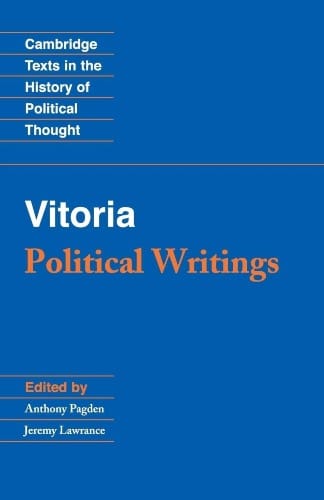
1.
The first two works that you have chosen are from sixteenth-century Spanish Scholastic theologians who were analysing pressing social issues of the day in the light of St. Thomas Aquinas and his account of natural law. Are they the proximate source of the modern Catholic social teaching on the right to migrate?
Francisco de Vitoria and Domingo de Soto are very dear for me. They have been the main source for my research on migration ethics in the Catholic Church.
In talking of the right to migrate, the popes never mention them explicitly but only principles, such as Christian hospitality and the universal destination of goods, and few quotes from the Bible.
However, in an address to the United Nations, John Paul II did refer to how Francisco de Vitoria is one of the founders of modern international law and human rights. So, the popes do have in mind Francisco de Victoria and Domingo de Soto, very important theologians at the Council of Trent and for the development international law. Their ideas on the right to migrate are very similar to the teaching of the popes.
Vitoria and Soto argue that people should be allowed to relocate whenever they have a need to do so. They too justify this right on the basis of universal destination of goods and Christian hospitality.
Francisco de Vitoria’s On the Indians (Relectio de indis) is not about immigration as such but is broader in scope. It is an inquiry into the Spanish crown’s right to rule over the indigenous peoples of the New World and the Church’s spiritual power over them. In what way does this work make an important contribution to the Church’s teaching on migration?
This is a lecture he gave on the ethics about the Spanish conquest and in response to the many missionaries who were denouncing the abuses of the Spaniards in the Americas.
He divides the lecture into three parts.
In the first part, he considers whether the Indians have dominion (which basically means sovereignty). Do they have private property and rule those lands as a sovereign people or have the Spanish reached and lawfully claimed an unoccupied land. Vitoria points out very strongly that the native peoples enjoy sovereignty over those lands. They have dominion. They have property and they rule over those lands. Upon arriving in the Americas, the Spanish find find a people that has its own political authority in place.
In the rest of the lecture, he wonders whether the Indians, for whatever reason, might have lost their dominion. One of the reasons he points to is that they might not have respected what Vitoria calls a right to travel and dwell. He believes hat there is a right to travel and dwell—a right to migrate— and that people can relocate to other countries if they find it necessary to do so. If the Indians had not respected that right, the Spanish would have grounds to take hold of those lands. However, as you read the lecture to the end, it becomes clear that Vitoria does not believe that the Spanish have a legitimate claim to take the lands. One of the things he argues is that people have a right to migrate as long as they do not harm the host people. Throughout the lecture, he emphasizes that a migrant people should not harm its host. Moreover, he believes the Spanish were harming the Indians. He refers to how the Spanish were seizing their property, murdering them, and even forcing them to convert to the Catholic faith. In the end, he does not believe that the conquest was legitimate but he cannot say that directly, lest he be persecuted by the Spanish crown.
That is how you can make an argument about the right to migrate based on the right to travel. It is the most extensive argument in the whole lecture. Vitoria defends this right to migrate with fourteen points. It is quite an incredible and very interesting argument. It is very similar to the one the popes make.
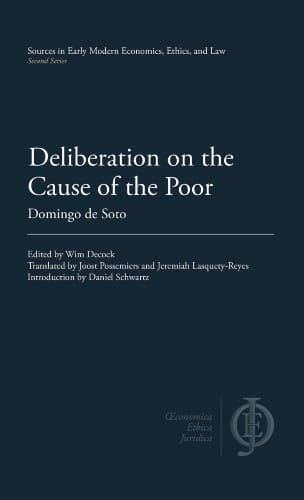
2.
Many migrate out of poverty and in the hope of building a better life abroad. Does Domingo de Soto, a disciple of Vitoria’s, mount an important defence of this right in his Deliberation on the Cause of the Poor (Deliberación en la causa de los pobres)?
Exactly. That is his main argument. From Vitoria’s lecture On the Indians, Soto takes the idea of a right to travel and dwell and applies it to the situation in Europe. This is very interesting. Some people might say that this does not make sense to appeal to the right to travel and dwell of when dealing with migration within Europe. Vitoria was discussing the Spanish migration to the Americas.
However, Soto argues that there is a right to migrate and that it is applicable to the situation of sixteenth-century Europe.
Throughout Europe at the time—whether in England, Germany, Spain, or Portugal—there was the problem of foreign beggars. Beggars would move from country to another. Many people found that problematic and started to enact laws against public begging and against foreigner begging.
Soto writes against this practice. First, he argues that people should be allowed to beg if they are in real need. Second, he argues that people should be allowed to travel, migrate, and live in other countries if they have a need. Interestingly, in making this point, though he is talking mainly of what we now call economic migrants, he goes beyond them. He believes that this right is so broad that you do not need to be a poor to be entitled to migrate to another country, provided you do no harm against your host and do not commit any crimes. You only need to have a good purpose. Maybe you want to start a business. Maybe you have a poor health and wish to go to a place where your health can improve. And so forth. For Soto, therefore, the right to migrate is very broad in scope.
"Pius XII talked about the natural right to migrate several times, starting in 1942."
3.
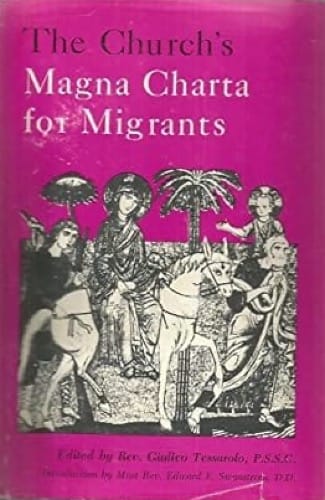
The next three readings are papal documents. First is Pius XII’s 1952 Apostolic Constitution Exsul Familia Nazarethana. How does Pius XII clarify the Church’s teaching on migration?
Pius XII talked about the natural right to migrate several times, starting in 1942. In the aftermath of World War II, he was very concerned about the refugees of war in Europe and in many other parts of the world, including Palestine. With the creation of the state of Israel, many Palestinians were displaced. Pius XII make reference to this in Exsul Familia.
Many countries had been bombed to the ground. There were no living conditions in place. Pius XII thought that such migrants should be received because God is very generous and has created a vast world that is full of goods and where there are many places that are scarcely inhabited. For these reasons, we should share land and resources and allow migrants to relocate so that they attempt to make a better life for themselves.
That is how Pius XII argues that there is a natural right to migrate. He also bases it on the way in which the Catholic Church has taken care of migrants throughout history. So, he presents an overview of the many different ways by which the Church has cared for migrants, especially during the twentieth century.
As you mentioned, Exsul Familia Nazarethana was written in response to the large-scale migration that occurred in the aftermath of World War II and was concerned primarily with the pastoral care of Catholic migrants. However, today’s social, economic, and geopolitical landscape is very different. Moreover, many of the migrants into Europe are not Christians. Do not Pius XII’s teachings on immigration, which were contingent upon a very particular set of circumstances, need some further qualification before they can be applied to today’s very different situations?
As I mentioned, Leo XIII is the first modern pope to address the migration crisis. However, he never talks of the right to migrate. Rather, in Rerum novarum and Quam aerumnosa, his 1888 encyclical on the critical situation of Italian migrants to the US, he speaks of the right to stay: the right not to migrate.
Many Italian migrants to the US were living in poverty. Often, they also lost their Catholic faith because they did not have priests to preach to them and give them the sacraments.
His successors—Pius X, Pius XI, and Benedict XV—all shared his concern for the spiritual care of Catholic migrants. This is the first stage of modern Catholic social teaching on migration ethics. It is centred on care for Catholic migrants.
It starts to change with Pius XII. He was still very concerned about the spiritual care of Catholic migrants and like Leo XIII and Pius XI, in Exsul familia, issues some canon law on the provision of spiritual care for migrants.
However, in Exsul familia, he also shows that we need to care not just care for Catholics but for every human being.
This becomes very clear in John XIII’s encyclical Pacem in terris, which discusses each human’s fundamental rights, the basis of those rights, and includes among them the right to migrate.
The basis for this right is the dignity of the human person, which goes beyond religion, nationality, or race. Because we have been created in the likeness of God and redeemed by Christ, we deserve this very special care, respect, and protection.
 Five Books for Catholics
4.
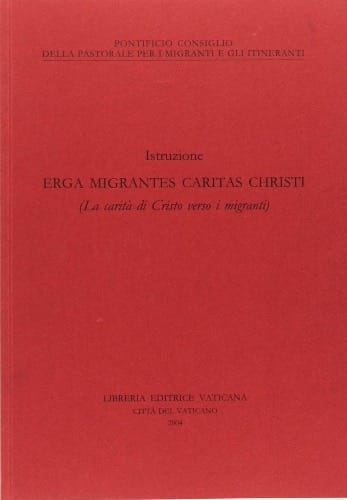
In 2004, the Pontifical Council for the Pastoral Care of Migrants and Itinerant People published the instruction Erga migrantes caritas Christi (Christ’s Love Toward Migrants). Does this document, which does not partake of the pontifical magisterium, hold any authoritative standing and add anything to the Church’s teaching on migration?
This document was authorized by Pope John Paul II. It takes up what Leo XIII, Pius XII and John XXIII said on immigration. It grounds the right to migrate on universal destination of goods and the dignity of the human person. It is a good summary of Catholic social teaching on the right to migrate and immigration in general.
“What is special about Pope Francis is his call for action and engagement in the concrete situation of our time."
5.
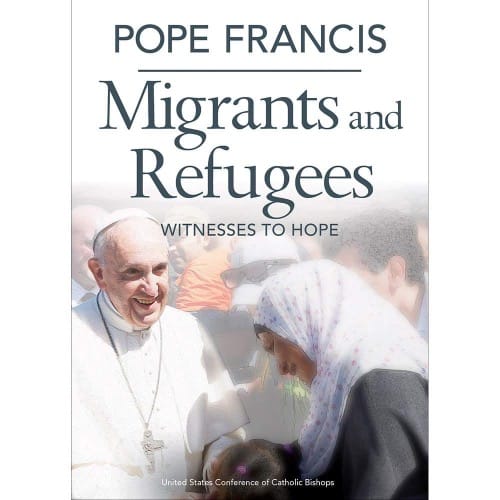
The final book is a collection of various interventions by Pope Francis, who made repeated impassioned calls for generosity towards migrants. What are his main points? What does he add to the teaching of his predecessors?
This collection of speeches, compiled by the United States Conference of Catholic Bishops, of the messages of Pope Francis for the World Day of Migrants.
John Paul II started the tradition of writing a message for the annual celebration of the World Day of Migrants. Each year he would talk about migration from a different perspective. One year it would be about the right to migrate; another, about the rights of migrant workers; another, about the challenges to migration, such as human trafficking. Each year’s message had a different theme.
Benedict XVI and Francis continued this tradition
In his messages, Pope Francis mainly goes back to what his predecessors have said. In a way, reading his messages is a way also to understand what the previous popes were saying on the matter.
What is special about Pope Francis is his call for action and engagement in the concrete situation of our time.
He has in mind the current crisis and calls us to act on it in different ways: to provide support to migrants and the poor so that they do not feel compelled, or forced to migrate, and so forth.
More than bring anything completely new to the existing teaching on migration, he calls people to action.
There is perhaps one new thing that he does, though it goes in the same direction of what other popes have said on integral ecology. He stresses that in general care for the earth and creation goes hand in hand with care for human beings. If we care for migrants, we should also care for the earth in general, so that migrants do not feel forced to leave their homes but flourish there.
There is a migratory crisis in different parts of the world just now. It can often provoke impassioned reactions. Some emphasise the plight of migrants, others that the host nation, for the sake of its common good, might need to limit the number of migrants it can accept or put further restrictions because extensive illegal immigration and human trafficking is going on. Should we not always distinguish between the principles which Catholics and their pastors invoke when interpreting these situations and their application of those principles? While the principles are sound and the Church’s teaching on them authoritative, we are not necessarily right when applying them or interpreting the whole picture.
Yes, it is very important that we allow each community to apply the principles and decide, given the reality of their circumstances, whether they can receive migrants and how many they can receive.
Bishops and priests are part of the community and their voices should be heard in the debate.
However, it would not be right to make judgments about how many migrants should be received and when without discernment and conversation on the part of the community, and without attending to the reality, needs, and resources of each place.