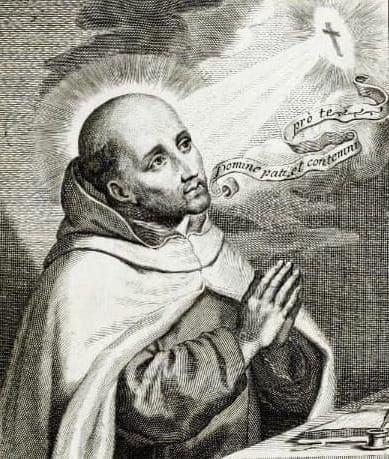
St. John of the Cross (1542-1591), a priest of the Order of Discalced Carmelites, is a Doctor of the Church and one of the greatest poets in the Spanish language.
Juan de Yepes y Álvarez was born into a poor family in Fontiveros, near Ávila, Castille. His widowed mother brought the young John and his surviving brother to Médina del Campo, where eventually he studied at the Jesuit school.
In 1563, he entered the Carmelites. He studied at the prestigious University of Salamanca and one of his teachers was Fray Luis de León. Shortly after his ordination to the priesthood, he met Teresa of Ávila, became a spiritual director to her and her nuns, and joined her project to restore the Carmelite Order to its original observance.
The Carmelite Order was opposed to some of the Discalced Carmelite’s expansion and in 1577 John was even taken prisoner by Carmelites and submitted to deplorable mistreatment, but managed to escape nine months later.
In 1580, Gregory XIII authorised the formal separation of the Discalced Carmelites from the Carmelites, and John occupied various positions in the government of the newly erected order. However, in 1591, after contesting some of the Vicar General’s decisions, he was removed from his position as counsellor and sent to a remote monastery in Andalucia, where he fell ill.
He died in Úbeda in 1591 but left behind a series of exquisite lyrical poems and treatises on the spiritual life.
Benedict XIII canonized him in 1726 and, two hundred years later, Pius XI declared him a doctor of the Church.
His memory is celebrated on 14 December and he is known as the Mystical Doctor.
In this interview, Dr. Edward Howells discusses the works of St. John of the Cross.
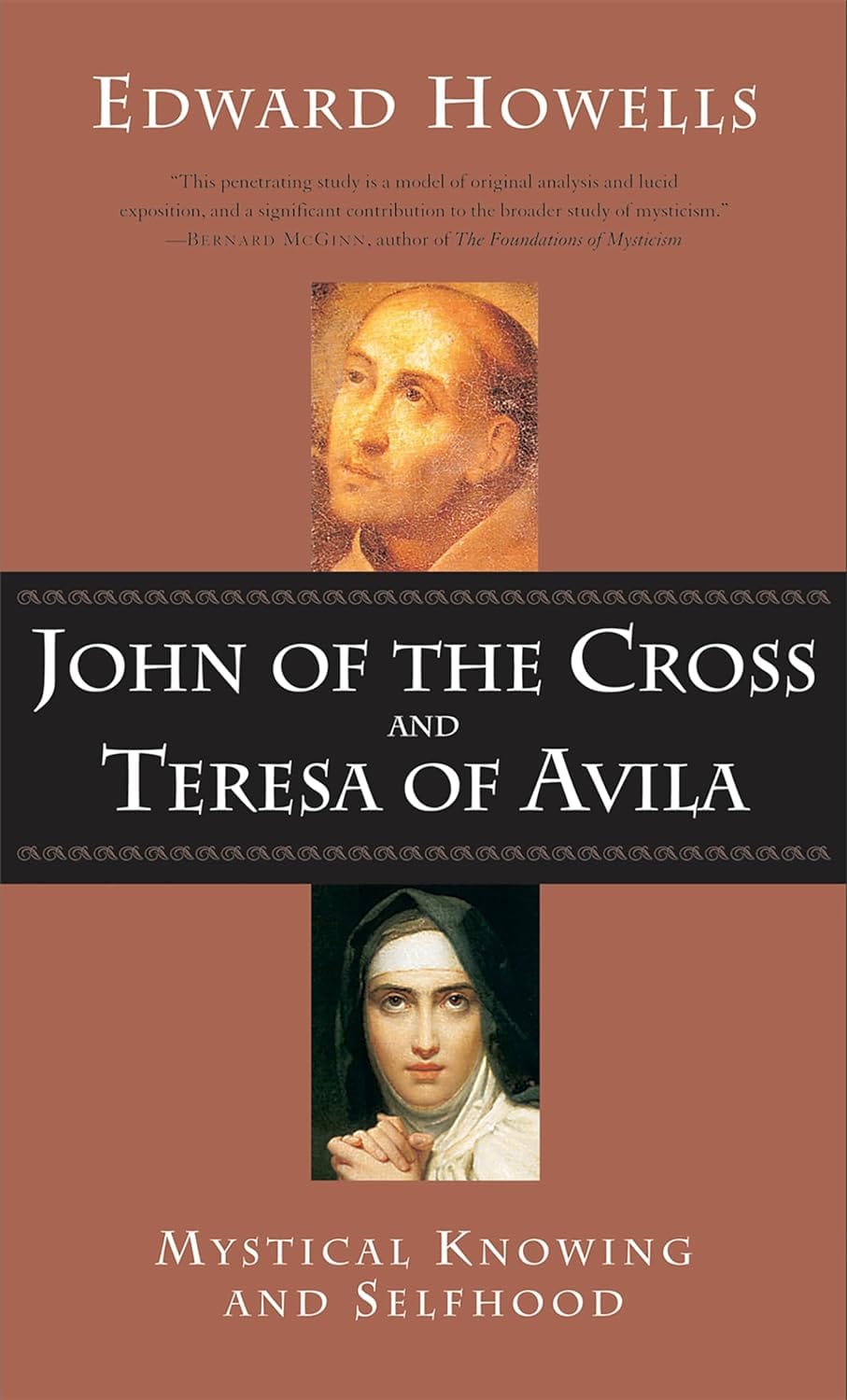
Dr. Edward Howells is associate tutor in Christian Spirituality at Ripon College Cuddesdon. He teaches the history of Christian spirituality and its contribution to the understanding and practice of faith today. His research is on mystical theology, especially the late medieval period, and he has written on the mystical theology of John of the Cross, Teresa of Avila, Augustine, Meister Eckhart, and Pierre de Bérulle. He is the author of John of the Cross and Teresa of Avila: Mystical Knowing and Selfhood (2002) and co-editor of Teresa of Avila: Mystical Theology and Spirituality in the Carmelite Tradition (2017), and The Oxford Handbook of Mystical Theology (2020).

- The poem "One dark night" (En una noche oscura)
by St. John of the Cross - The Ascent of Mount Carmel (Prologue, Diagram, and Picture)
by St. John of the Cross - The Spiritual Canticle
by St. John of the Cross - The Living Flame of Love
by St. John of the Cross - The Ascent of Mount Carmel and The Dark Night of the Soul
by St. John of the Cross - The Impact of God: Soundings from St. John of the Cross
by Iain Matthew - St. John of the Cross: His Life and Poetry
by Gerald Brenan
What would you add to the preceding biographical sketch of St. John of the Cross?
He was born in Fontiveros, a small village in Castile in 1542 and into a family which had fallen upon hard times.
His father was in the textile trade and died when he was probably about two or three. His mother was then cast into poverty and scraped a living by weaving. John's elder brother, Luis, died, possibly because of a famine which was ravaging Castille at the time. So, John had a hard beginning.
The family moved a few times before settling in Medina del Campo, where John went to a charity school called the Doctrina. There, he learned basic grammar and would have helped out at a local Augustinian convent a few hours every morning.
Then, he managed to get into the Jesuit school in Medina. This was his making. By all accounts, he received a very good education there.
From a fairly young age, at least from his teens, he considered entering a religious order. He entered the Carmelites in Medina del Campo at the age of twenty. A year later, he made his profession and was sent by the Carmelites to the University of Salamanca, where he studied arts and then theology. The BA in Arts would have included philosophy.
Academically, he was extremely gifted. His superiors probably expected him to stay longer at the university, but, during the summer vacation after his fourth year of studies, he met Teresa of Ávila while on a visit home in Medina.
He was unsure of his vocation in the Carmelites. He was thinking of becoming a Carthusian because he was attracted to a harsher and more ascetic regime of greater solitude and contemplation. St. Teresa told him that she was starting a reform of the Carmelite order that would return it to its contemplative roots. John found that a very attractive idea and joined Teresa's reform.
At some point during the next year, he was sent with a couple of other friars to start a Reformed Carmelite Monastery in a remote village of Castille, Duruelo. He built that community up.
He was then promoted through various positions in the Discalced Carmelite Order. During this time, there was a falling out between the reformed and the unreformed parts of the order Many monastic orders were undergoing reforms during the sixteenth century in Spain. The Carmelites had yet to be reformed and the reform started by Teresa of Ávila seemed to be the way to do it. However, there was a dispute about who was in charge of this reform. The various parties were divided on this point: the King of Spain, who was interested in the reform, the pope, the nuncio, and the general of the order. John was caught in the crossfire.
He was captured by the opposing party and imprisoned in the Carmelite Priory in Toledo for nearly a year. He was told that he was disobeying the order. Of course, this cut him very much to the heart because he had taken his vow of obedience very seriously.
It is assumed that his teaching on the dark night of the soul grew out of what he experienced while imprisoned. He may have doubted his vow of obedience. He asked where God was in this darkness that was both a psychological and a physical suffering.
He then made a remarkable escape, apparently by throwing himself out of a high-up window and landing on a ledge beneath.
He made his way to the Discalced Carmelite nuns in Toledo. They took him in and he spent several months recovering from the deprivations of his time in prison.
Encouraged by the nuns, he began to write his remarkable works.
He wrote spiritual poetry as a hobby but, through his commentaries, he came to use it also as an aid to teaching.
Now he is considered one of the greatest poets of the Spanish Golden Age. Even if we did not have the spiritual teachings of his longer works, he would still be remembered as a great poet.
The nuns asked him to write some commentaries to explain how his poems apply to the spiritual life. Hence, he wrote long commentaries on quite short poems. In them, he uses the images of the poems to describe the soul's journey towards union with God. Many of the images are taken from the Bible but are elaborated and developed with his own words and poetry. Best known is the image of darkness and light in the Dark Night.
His phrase—the dark night of the soul—has become a household word.
After this period, he enjoyed a very fruitful spell of teaching and writing. Unfortunately, there were further problems in the Carmelites, now divided between the Calced and the Discalced, that is, the unreformed and reformed branches of the order.
Within the Discalced Carmelites, John had a disagreement with how things were going and volunteered to go on a missionary expedition to Mexico. However, before leaving, a cut in his leg went septic. Coming down with a fever, he went to the Carmelite monastery in Úbeda to be cured. He did not recover but went downhill rapidly and died there at the age of 49.
St. John of the Cross entered the Carmelites out of devotion to the Blessed Virgin. The order’s full title is Order of the Brothers of the Blessed Virgin Mary of Mount Carmel. How is it connected to Mount Carmel and to Mary?
During the Crusades, some religious started a hermitical community on Mount Carmel, in what is modern Israel. Mythologically, they traced their origins as a contemplative order back to Elijah on Mount Carmel. Hence, the name of the order and of John’s work The Ascent of Mount Carmel.
When the order moved back from the Holy Land to Western Europe, it became a major order. Its members became more like friars than hermits and the rule was mitigated to allow for preaching and teaching outside the monasteries. Indeed, there are various versions of the rule. So that is where the associate with Mount Carmel comes from.
However, I am a little hazy about the devotion to the Virgin Mary, though it was always strong.
It had to do with St Simon Stock, who was prior general of the order. He received an apparition of the Blessed Virgin holding the brown scapular. That is where the order’s connection with the Blessed Virgin comes in. He was the one responsible for the order’s early expansion.
St. John of the Cross was influenced deeply by St. Teresa of Ávila. Are there any significant differences between their thought and approach to the spiritual life?
They were great friends.
Teresa very much appreciated John's spiritual direction, for which she invited him to her monastery in Ávila, the Incarnation, which she had reformed. As part of that reform, she invited him to be the confessor to her nuns. That was a high accolade and she says very positive things about him in her letters. So, we know that they were close.
John also recommends her writings in his own. The first edition of her writings had been published while he was writing his Living Flame of Love.
However, they were very different characters. This comes out in their writings. Teresa had a very developed interior life but was an extrovert and a larger-than-life character. John was much more unassuming and self-effacing. He was a very good at spiritual-direction and one-to-one encounters, but less comfortable in a crowd.
In terms of teaching, the main difference is that John is interested in what goes on when God feels absent: the psychological suffering of feeling that God is not present even though you have devoted your life to him in prayer and so on.
Teresa does not really deal with this. She does talk about trials. However, usually they are trials that come from the outside rather than from within. So, the focus in John's Dark Night and The Ascent of Mount Carmel is different from that of anything that Teresa writes.
What led you to study St. John of the Cross?
I first read John of the Cross in a third-year course of my undergraduate theology degree and was struck immediately by the depth and richness of his teaching.
I was particularly interested in the pastoral or psychological question of what you should do when you cannot or do not experience God as you expect.
What I found very exciting was John's notion that such a situation can be an invitation of God. He had the courage to go into that sort of experience and to reassure us that God can be found even when he feels absent. I found that paradox an exciting one back then and still do.
1.
You have proposed two preliminary readings from St. John of the Cross and then five books. You recommend that those new to St. John start with the preliminary readings. The first one is the poem on which he bases his commentaries The Ascent of Mount Carmel and Dark Night of the Soul: “One dark night” (En una noche oscura). Why should someone approaching the works of St. John of the Cross for the first time start here?
In most editions of John's works—indeed all the ones I have come across—the order is The Ascent of Mount Carmel, Dark Night of the Soul, The Spiritual Canticle, and Living Flame of Love . These are his four main works. Most people begin by reading the first of these commentaries, the Ascent of Mount Carmel. However, they soon get bogged down because it is an intricate and quite long-winded work. It is not the best place to start.
There is a way to counteract that problem. Looking at the poetry first is much more inviting. Moreover, “One Dark Night” contains the central paradox that John goes on to talk about: even when things look dark, there is some invitation from God that draws the soul forth. That comes out very powerfully in this poem but is harder to see in the commentary.
The poem begins thus:
“One dark night,
fired with love’s urgent longings
— ah, the sheer grace! —
I went out unseen,
my house being now all stilled.
In darkness, and secure,
by the secret ladder, disguised,
— ah, the sheer grace! —
in darkness and concealment,
my house being now all stilled.
On that glad night,
in secret, for no one saw me,
nor did I look at anything,
with no other light or guide
than the one that burned in my heart.
This guided me
more surely than the light of noon
to where he was awaiting me
—him I knew so well—
there in a place where no one appeared."
While everything looks dark, something deeper is drawing the soul forth towards the one she loves. Not surprisingly, this turns out to be God: it is Christ. But it is not clear in the darkness; there is only the inward drawing towards—towards what? It only emerges that it is God in the burning of the heart and the deep personal engagement in love. This paradox comes out strongly in the poem. It is the central paradox of the poem and the commentary.
2.
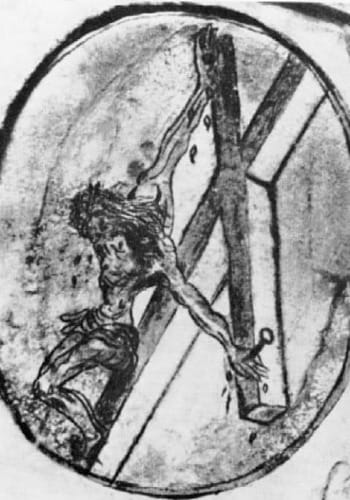
One of the best-known works of modern religious art is Salvador Dalì’s Christ of Saint John of the Cross (Kelvingrove Art Gallery and Museum, Glasgow). It was inspired by the saint’s sketch of Christ on the cross. Instead of looking at Christ crucified from below or in front of him, it looks at him from above his left side. Why have you selected this sketch, together with the prologue and diagram of the Ascent of Mount Carmel (Subida del Monte Carmelo), as the second preliminary reading?
Apparently, John gave this sketch to one of the nuns in Ávila. It shows that he was also quite a skilled artist. Moreover, it is a very emotive drawing of Christ's suffering, seen from above the cross. Christ is leaning forward. You feel how his dying body weighs on his arms and his nailed hands. The crown of thorns is on his head. Sweat or blood—it is hard to tell—is dripping from him. The sketch is quite gruesome in some ways, but its emotiveness also draws one towards it.
Of course, Christians see God’s love behind Christ’s suffering. This is the key to John’s theology of the dark night: Christ has entered this place of agony and redeemed it through love.
The drawing of Christ on the cross, therefore, is another way to understand the paradox of darkness and light. It brings us close to the centre of John’s theology. It links Christ’s suffering on the cross to his journey to meet us in darkness.
The love with which our heart is drawn to Christ in this picture parallels the way in which it is drawn to God through darkness.
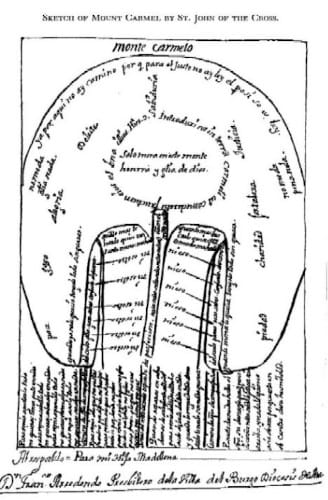
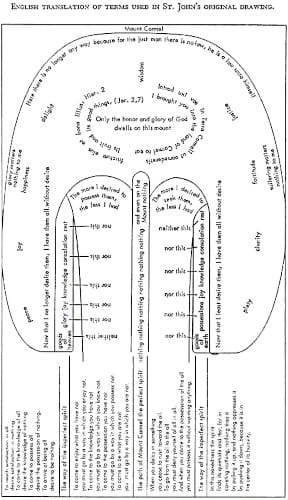
There is also the diagram and the prologue.
The diagram depicts nicely the whole of The Ascent of Mount Carmel . It contains some of John's most famous verses.
“To reach satisfaction in all,
desire satisfaction in nothing.
To come to possess all,
desire the possession of nothing.
To arrive at being all,
desire to be nothing.”
These stark aphoristic statements, for which John is also well known, come up in T. S. Eliot's poem, “East Coker”, one of the Four Quartets.
The diagram indicates how nothing (nada)—no ‘thing’—is the way to the summit of the mountain.
On the summit of the mountain, there is the abundance, life, and love of God—not a thing, just God. The diagram also shows the positive side: God’s presence and love are affirmed.
It reflects John's whole teaching, present in The Ascent of Mount Carmel, of active and passive purgation.
Active purgation is the way of ascetic self-denial. Passive purgation is the apparent loss of God. On this journey, there are concepts or things that we grab onto to give us security that God is there. These are negated or lost. We are encouraged to let go of them actively; passively, they are taken from us. Nevertheless, this process reveals that God is present more profoundly in the heart than what we thought hitherto. That is the summit of the mountain.
The path through nothing, therefore, comes into view well through this sketch.
St. John of the Cross’s writings can be daunting and even suppose a certain knowledge of the Scholastic analysis of the powers and virtues of the soul. Do you have any tips for reading and making sense of his works?
Yes, this is particularly the case in The Ascent of Mount Carmel or the Dark Night, where he describes the journey through the theological virtues: faith, hope and love. He relates the graces which take us through the dark night to a scholastic teaching that goes back to Augustine: that we have a capacity for God which consists in intellect, memory, and will. He correlates these with faith, hope, and love. Faith correlates with intellect; hope with memory; will with love.
This becomes quite convoluted. However, he is simply explaining how faith, hope and love grow despite this lack of a secure object on which to focus—in the darkness of no-thing.
Yes, he uses the scholastic language to explain how the objects of faith, hope, and love are lost. For many modern readers this is quite difficult to grasp. However, there is less of that in the other works. That is why it is easier to start—and I would recommend starting—with The Spiritual Canticle and Living Flame of Love , rather than the Ascent of Mount Carmel and Dark Night. They also use some scholastic language, but less, partly because they stick more closely to the structure of the poems on which they are based.
How is St. John of the Cross rooted in the preceding tradition of Catholic spiritual writers?
John draws on a wide range of previous writers in the Western tradition of mystical theology.
There is what we call his faculty psychology of memory, intellect, and will. This anthropology or understanding of the soul comes from Augustine.
His notion of the spiritual life as a journey goes back before Augustine to the long engagement between Christianity and Neoplatonism, which was prominent during the Middle Ages.
Central to John is the metaphor, based on the Song of Songs, of the bride and bridegroom. This comes from St. Bernard of Clairvaux and goes all the way back to Origen.
John also draws on the apophatic or negative theology of Pseudo-Dionysius. His notion that God is found in darkness is a development of the long tradition of negative theology, which focuses on God's transcendence and incomprehensibility.
Other late medieval figures, such as William of Saint-Thierry and Richard of Saint Victor, are echoed in his writings.
The Spanish and Northern mystics also exerted a big influence on him. There are echoes of John Ruusbroec, probably mediated through the Flemish writer Hendrik Herp or Harphius, who summarized much of the language and teaching of the Northern mystics and was popular in Spain. Many such texts came to Spain through Spain’s link with Northern Europe under Emperor Charles V.
The Spanish context is evident in John’s talk of the prayer practice of recollection. This is a technique of prayer technique that was spread particularly by Francisco de Osuna, who was part of the Franciscan reform in early sixteenth-century Spain, which exercised a large influence on the reform of the Carmelites.
Some, therefore, look to Teresa of Ávila and John of Cross as a kind of summary of the medieval tradition of mystical theology because they bring together so many elements. It is hard to draw a firm line between this wide range of influences and their own teaching—though the way they put it together is, of course, highly original.
You have mentioned how he differs from St. Teresa of Ávila with his focus on purification through feeling God's absence. Is this what he adds to the preceding Christian spiritual tradition?
I think that it is. John gives a more psychological reading of the experience of God's absence. He is very interested in what it feels like to go through that experience and how we should deal with the various feelings and experiences that may accompany it.
Previously, spiritual writers had talked about states of desolation and God's absence, but they had not given this sustained psychological analysis of how it feels and develops and can be worked through. He seeks to name each experience as it follows upon another and what to do in each case. John writes to help people through that set of experiences and this is a development of the negative tradition of mystical theology.
He is very much an original thinker. In each area that he works in, he contributes something new.
For instance, take his treatment of the Song of Songs compared with other commentaries from the tradition.
The Song of Songs starts with the love between the bride and the bridegroom, or the soul and Christ. It expresses their love: “Let him kiss me with the kiss of his mouth!” John, however, while having this line in his mind, begins his poem of The Spiritual Canticle rather differently:
“Where have you hidden,
Beloved, and left me moaning?
You fled like the stag
after wounding me;
I went out calling you, but you were gone.”
For John the question is, “Yes, God meets us in the heart, but what happens when we feel that he is gone?” This moment is also present in the Song of Songs. The beloved, the figure of Christ, withdraws at some points and comes back at others. Bernard of Clairvaux also alludes to this experience. For John, however, this is the beginning of the poem. We know that God gives us a sense of his presence, but what happens when he seems to be hidden? He then undertakes a lengthy and innovative treatment of unfulfilled desire.
You have mentioned John’s psychological probings. In spiritual authors such as St. Ignatius of Loyola, St. Teresa, and St. John of the Cross, there is a greater focus on the soul's experience and mental prayer. Some might object that this more psychological approach to spirituality, if taken unilaterally, can be misunderstood and lead one unmoor the spiritual life from liturgical prayer. The preceding tradition was more focused on Scripture and liturgical prayer. Are there dangers in sixteenth-century Spain’s more psychological approach to spirituality?
Yes, but they are dangers that I think we are reading into the period rather than ones that were characteristic of it.
For instance, we tend to think that we start with an experience and then look for some theological explanation of it. That is a distinctively modern perspective: experience comes first, explanation after. But for John it is the other way round. Yes, he is trying to understand his theology through experience. But he starts with the liturgy, Scripture, and theology, and then asks how experience fits in with those things. He wouldn’t be bothered by the experience of the absence of God unless he started with the scriptural and liturgical affirmations of God’s presence.
Broadly speaking, the order of experience in theology has changed since the sixteenth century. However, that change had not occurred at John’s time.
We put a great deal of emphasis on experience. The problem comes when theology becomes only the subsequent explanation of my private experience. Then the scriptural and liturgical dimension is lost. You just theologize about private experiences and do not necessarily return to the communal. That would certainly be a problem if it was what John was doing—just theologizing his own private biography. But instead, he is working from a communal theology to the question of how we try to interpret our own experience in the light of that.
One sign of this is his talk about darkness. In his work, ‘darkness’ has many different meanings. The darkness he refers to is not one’s own experience alone. It can also be the blinding light of God's presence. John gets this notion from Scripture. It is possible, he notes, to look at the light of God and see darkness because that light is excessive. This darkness as an excess of light is very different from an individual’s sense of being in the dark.
3.
The first book on the list is St. John’s Spiritual Canticle (1584), a commentary on a poem that St. John composed in his mind during his imprisonment. Drawing on a tradition that goes back to Origen’s commentary on the Song of Songs, the poem and commentary deal with “the exercise of love between the Soul and Christ the Spouse.” Why is this the first of St. John’s books that you recommend for reading?
It is easier to start here than in the place where The Ascent of Mount Carmel and Dark Night of the Soul do. John sets out layer upon layer of purgation before we get to illumination in those works.
His main point in the Ascent of Mount Carmel is, in fact, the same as in his other works: light and darkness belong together in such a way that there is never a place, no matter how dark, where God is not present, revealing and giving himself.
But it is easy to miss this point during the first half of the Ascent of Mount Carmel and Dark Night because there is so much talk of darkness, and the key to how it might also be light comes a long way down the line. Perhaps this is more true to experience. But if you want to know what is going on, The Spiritual Canticle will tell you right from the start. In fact, God is revealing himself in your heart. You know that the Trinity, the creator, dwells within your soul; but you are confused. You do not feel this presence. The feeling comes and goes, raising all kinds of doubts.
John starts with this paradox and then works it out in terms of desire.
This too is where one should start with John: his focus on our desire for God.
For John it is absolutely essential to learn that whenever we long for God, we actually have God. We usually associate longing with the absence of the thing loved. Theologically speaking, longing is a form of presence because God does not lack anything whatsoever but is abundance. But this is demanding to grasp. We do not long for God because he is absent but because he is more than we can grasp. Our desiring must be transformed to pursue this. Desiring based on lack changes to desiring based on abundance: from thinking there is not enough of God to being dwarfed by the extraordinary abundance.
The Spiritual Canticle goes through the many ups and downs of human experience, but also dwells a great deal on union with God. This is another focus of John’s. John did not get round to dealing with this union in the The Ascent of Mount Carmel and the Dark Night, but it is right at the centre of the Spiritual Canticle and the Living Flame of Love. It is a quasi-marriage with God. It consists in knowing that God is present, responding to his presence, and being in an exchange of love with God—while knowing at the same time that the longing for God will only increase, because there is always further to go into the abundance of God’s love. These works present this goal as attainable in this life, showing John’s great optimism—his focus on darkness and absence does not make him a pessimistic saint.
4.
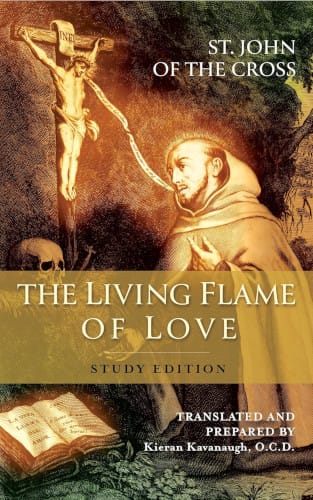
The next book up is St. John’s Living Flame of Love (Llama de amor viva), an “exposition of the stanzas which treat of the most intimate and perfected union and transformation of the soul in God.” Is this a description of what the Church Fathers call theosis or divinization?
The short answer is yes. He does talk about deification.
This was a period when many spiritual teachers including John were very positive about the possibilities of union with God, which is an anticipation of heaven. John specifies that this union with God does not have the same quality that it does in the afterlife. We have yet to break through the veil of the flesh and do not yet God see face to face with the clarity and permanence of heaven. We still see him through a glass darkly. But it is a darkness thoroughly outshone by the intimacy of God’s presence as light.
He talks about this union in terms of theosis, or in his terms, becoming ‘deiform’. We become not just one with the Son but take on the divine form of the Son in the Trinity. That is to say, we are adopted in such a way that we participate directly in the divine life of the Son. Reflecting a distinction which is central to the Christian tradition, he is always careful to say that we do not become God but only participate God. Nevertheless, through the hypostatic union, we join Christ and, by adoption through grace, occupy the same position as the Divine Son. This is real. We can really experience it.
5.
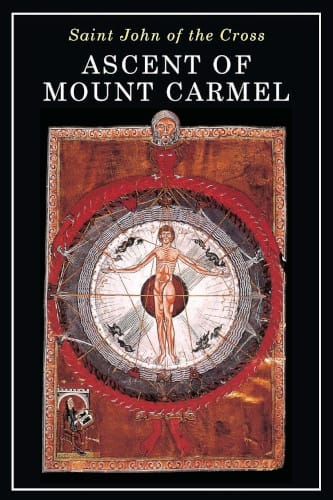
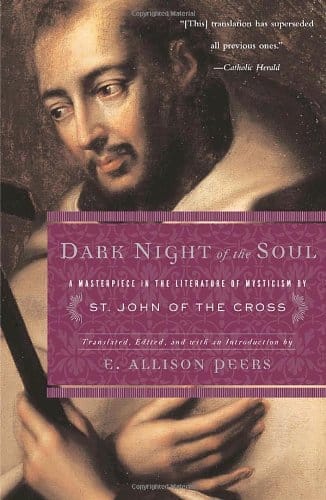
The third book by St. John of the Cross is a two-volume one. The first volume is The Ascent of Mount Carmel (Subida del Monte Carmelo); the second Dark Night of the Soul (Noche oscura del alma). In the first, he deals with the active night of the senses and the spirit. In the latter, with the passive night of the senses and the spirit. What does he mean by each of these ‘nights’.
He sees the spiritual journey as moving inward from the bodily senses, the outer person, to the inner person: the memory, intellect, and will.
Among the senses, he includes the imagination. He contrasts everything that is concerned with manipulating and grasping the objects around us through the senses with our inner capacity to feel spiritual realities: God, the angels, and so on. The devil works upon us at this inward level as well.
This is a psychology and an anthropology. However, what John is really talking about is the process whereby we know God not just through what we see and learn about him, but also and more deeply through his intimate address to our heart. That is where we move from the senses to the spirit.
6.
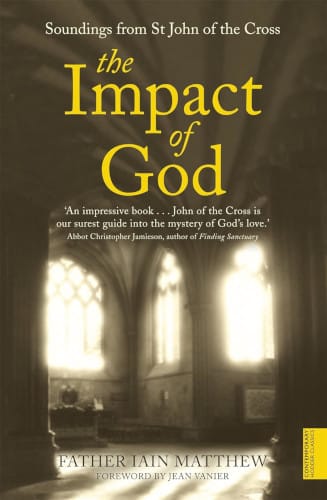
What makes the fourth book, Iain Matthew’s The Impact of God, a good introduction to St. John of the Cross?
I recommend this short book as a way into John. It explains his historical context and teaching. The author, Iain Matthews is a Discalced Carmelite who not only knows John very well academically but has really thought about how to lead the life that John teaches.
It situates and clarifies very well the various themes in John's writing, in particular his talk of darkness and suffering. It shows that John is a very warm and companionable guide.
This book is for those who want to engage with John as a spiritual guide and is written by someone who knows all about this.
7.
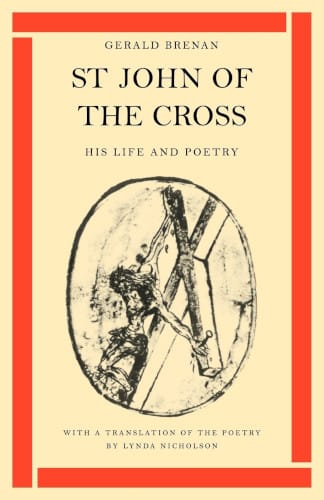
Finally, there is the study by the Hispanist Gerald Brenan, St. John of the Cross: His Life and Poetry, which contains Lynda Nicholson’s translations of his poetry. Have you chosen this work because it is not only a biography but, above all, a literary study of his works?
That's right, it's a classic.
Gerald Brennan was able to popularise John in the English-speaking world in a new way, no longer just as a religious teacher and poet but as a gifted and intriguing character.
In the first part of the book, Brennan tells the story of John of the Cross. It is quite idiosyncratic but, of course, he writes well.
Then there are beautiful translations of the poems by his friend, Lynda Nicholson. This is my favourite translation.
There is another very famous translation of the poems from the 1950s: Roy Campbell’s. It too is beautifully done and Campbell manages to follow much of John’s verse form. That is the real challenge when it comes to translating: not just to convey the language in English, but to replicate the form of Renaissance poetry, particularly that of lyric poetry. It is very difficult to do.
Lynda Nicholson's translation is freer. Sometimes she follows the form and sometimes she does not. However, I find her words sit well, and mostly sound and feel right to me. Of course there are some passages where I prefer another translation, but I like her version altogether. The Spanish original is of course best, and it is not too difficult for a foreigner and is well worth grappling with.
What do you make of the early twentieth-century writings about St. John of the Cross? That was when the critical edition of his works was prepared. There was also much interest in him. The Dominican Réginald Garrigou-Lagrange wrote on the compatibility and correspondence between St. John of the Cross and St. Thomas Aquinas. One of his doctoral students, the future St. John Paul II, wrote his dissertation on St. John of the Cross, was deeply influenced by him, and had even considered becoming a Carmelite. This movement lays the ground for Vatican II’s teaching on the universal call to holiness. What do you make of the writings of this period? Are they still worth reading today?
I find works from the period difficult to read because they are couched in Scholasticism.
John was made a Doctor of the Church in 1926, on the bicentenary of his canonisation.
At the time, there had been much study, particularly among French scholars. John’s teaching on the spiritual life was regarded as a pinnacle. Jacques Maritain’s The Degrees of Knowledge (1932) attempts to ally John with Thomas Aquinas. As does Garrigou-Lagrange.
There were connections between John and Aquinas. However, the scholastic and mystical approaches to the spiritual life are quite different. Already in the Middle Ages, they were different and deliberately so.
Attempts to ally John to a scholastic like Aquinas can be helpful to some extent. But John and Aquinas are working through different questions, with different methods and language. Aquinas is writing for university students who are getting their heads around all the different aspects of theology. John of the Cross is writing for people who are trying to live the spiritual life and pray. The two things are obviously connected, but they are not the same. You do not teach them in the same way.
So, yes, there is plenty of amazing scholarship from that period on St. John of the Cross. I would like to have known those people and to have joined in with their conversations; the scale of academic interest probably hasn’t been matched since. Academics will still want to read them, to understand John. However, I do not find them easy and reading these works does not get any easier as time goes on.