
The Council of Florence is the seventeenth of the Church’s twenty-one ecumenical councils and achieved a short-lived union with most of the Orthodox Churches. It was convoked in 1431 by Pope Martin V and opened in Basel. However, Pope Eugene IV could not approve either the decrees of the Council of Basel or the refusal of many of its members to accept its transferral to a see acceptable to the Orthodox delegation. When he decreed the transferral of the council to Ferrara in 1438, some members of the assembly at Basel rejected his decision, declared him a heretic, elected an antipope, and continued to hold a conciliabulum in Basel. Emperor John VIII Palaiologus, the Patriarch of Constantinople, and other Orthodox bishops arrived in Ferrara. However, at Ferrara there was the threat of plague and finances were running low. So, in 1439 the council was transferred once again, this time to Florence. There, the council issued the decree of union (Laetentur coeli), which defined the doctrines of the procession of the Holy Spirit from both the Father and the Son, purgatory, papal primacy, and the validity of both Latin and Easter eucharistic liturgies.
In this interview, Fr. Thomas Crean OP discusses the Council of Florence and recommends some of the best books on it.
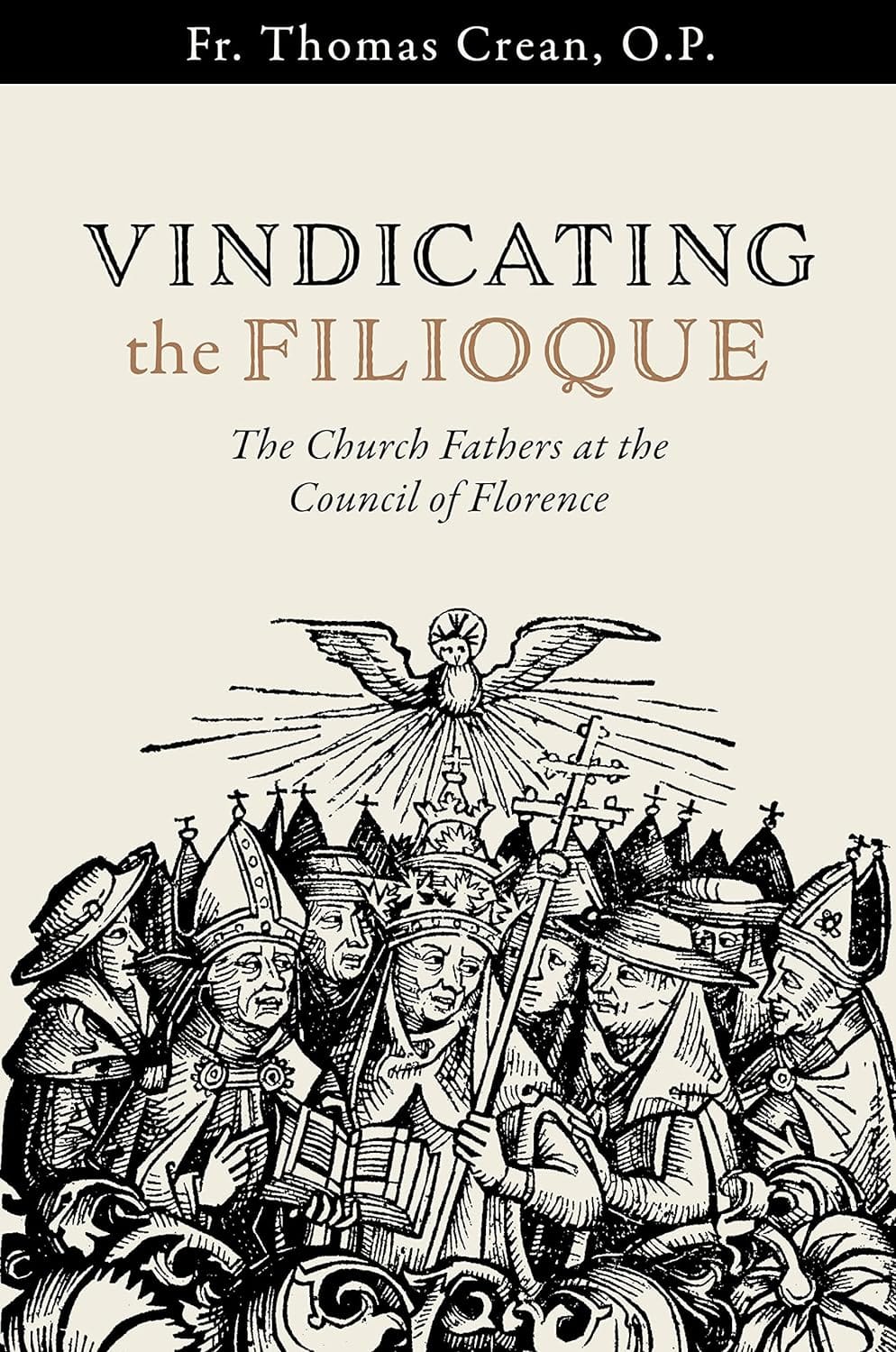
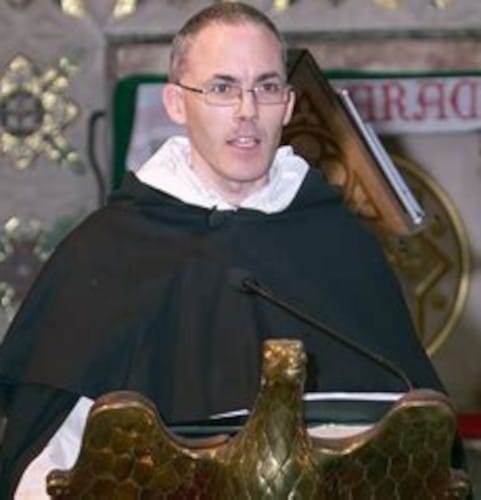
Fr. Thomas Crean OP is a member of St Dominic’s Priory, Haverstock Hill, in north London. He has published articles in various popular and academic venues, including Antiphon, Augustinianum, Christian Order and New Blackfriars. He is the author of several books, including God is no Delusion, The Mass and the Saints , St Luke’s Gospel: a Commentary for Believers, Integralism: a Manual of Political Philosophy (with Alan Fimister), and Vindicating the Filioque: The Church Fathers at the Council of Florence.
- The Council of Florence
by Joseph Gill - Personalities of the Council of Florence
by Joseph Gill - The Filioque: History of a Doctrinal Controversy
by. A. Edward Siecienski - The Orthodox Eastern Church
by Adrian Fortescue - Rome and the Eastern Churches: A Study in Schism
by Aidan Nichols OP - Christian Unity. The Council of Ferrara-Florence 1438/39 – 1989
edited by Giuseppe Alberigo
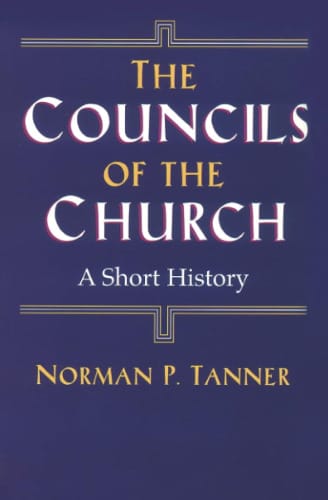
...and a bonus recommendation... - The Councils of the Church: A Short History
by Norman Tanner
Why was the Council of Florence convoked?
The Council of Florence was convoked for several reasons. Most profoundly, of course, there was the longstanding division between Latin-speaking Christians of the West and Greek-speaking Christians of the East whose centre was Constantinople. There had long been a desire to heal this rift and eve several attempts to do.
The immediate motivation for the Council was the need of the Greek-speaking Christians to muster assistance and protection from the West against the Turkish threat to Constantinople. The emperors in Constantinople understood spiritual union between Catholics and Eastern Orthodox was a useful precondition for this to happen. Nevertheless, there was a lot of enthusiasm for reunion for much more profound reasons.
Was the Council of Florence held to comply with Gregory XII’s institution of regular councils in Frequens and Quanto Romanus Pontifex?
The situation was complicated. There was a schism at the time. In Basel, there was a conciliarist council. A group of bishops denied that Pope had supreme authority in the Church but asserted that the council had it. Essentially, they were making the ecumenical council separate from the Pope and into the highest authority in the Church.
Both the Pope and the Council in Basel, which by this point had become a schismatic council were hoping that the Emperor in Constantinople would send his representatives to them and thereby vindicate their authority. In the end, he sent them to the Pope and to the bishops meeting with him in in Ferrara. Then, they moved to Florence.
This situation had arisen from the earlier councils that you mentioned and the decrees that ecumenical councils be held regularly. The popes then decided that they did not really like this measure but the schismatic council meeting in Basel had gone ahead to carry them out anyway. The Council of Florence did not exactly result from those earlier decrees. Rather, those decrees were relevant because they meant, when the Council of Florence began, a rival council was being held.
That explains why the two-volume Decrees of the Ecumenical Councils refers to the council held between 1431-1449 as the Basel-Ferrara-Florence-Rome Council. Why do we call it the Council of Ferrara-Florence, or simply Florence?
It was transferred from Basel to Ferrara but not all agreed to this. Those who did not agree to be transferred became, what their opponents would call, a conciliabilum, namely, their own little council. Although there were quite a lot of bishops there, from the moment at which the Pope transferred that council from Basel to Ferrara, it was no longer recognised by the Catholic Church as an ecumenical council.
"Interestingly, Greek writers of the time who accepted the council do speak of it as an ecumenical council. They speak of it as the eighth ecumenical council, the first to follow Nicaea II."
In a 1974 letter to the President of the Secretariat for the Unity of Christians, Paul VI referred to Lyons II and the seven preceding medieval councils held in the West as general rather than ecumenical councils. Is Florence an ecumenical council or a general council of the Catholic Church?
It is necessary to define terms, but I do not believe that Paul VI meant to say that earlier councils, such as Lyons II or Lateran IV, were not ecumenical councils. That would have been a reversal of the Catholic Church’s understanding them and their authority. Rather, he used the more modest phrase and called them “general councils of the West” because, at that point, only the West was in communion with Rome. He also used that more modest phrase to not annoy Eastern Orthodox, who do not recognise them as ecumenical councils because there was no Greek participation at them. So, Paul VI was not denying that those councils were ecumenical.
Florence, however, ticks all the boxes of an ecumenical council.
It had participation from West and East: from Latins and Greeks, and later on indeed from other separated Eastern churches. It had the consent of the pope but also the approval of the emperor in Constantinople and the four Eastern Patriarchs, who were either present or represented by their proxies. So, Florence fulfils the definition, both past and present, of an ecumenical council.
Interestingly, Greek writers of the time who accepted the council do speak of it as an ecumenical council. They speak of it as the eighth ecumenical council, the first to follow Nicaea II. For us Catholics, the other medieval ones count as ecumenical councils too.
"In the Greek speaking world, especially since the ninth century, the idea had emerged that the Holy Spirit proceeded from the Father alone."
What were the main doctrinal and disciplinary decrees of the Council of Florence?
The question of the procession of the Holy Spirit from the Son, or the Filioque, took up the vast majority of the time.
The question is whether the Holy Spirit proceeds from the Father and the Son, as we Catholics profess in the Creed.
In the Greek speaking world, especially since the ninth century, the idea had emerged that the Holy Spirit proceeded from the Father alone. That is obviously incompatible with saying that he proceeds from the Father and the Son. This question needed to be thrashed out and was debated at great length, with much discussion of patristic texts.
Another topic discussed was the nature of purgatory. The Greeks were not happy with the idea of purgatorial fire. Interestingly, this was not because they thought the doctrine too severe but because it reminded them of Origen’s idea that there would a final reconciliation of the demons once they had passed through a purifying fire.
Anyway, this was not very difficult matter to resolve. The Latins explained that it was not obligatory to believe that there is a literal fire. Hence, the Greeks and the Latins came to an agreement about purgatory quite easily.
The other important issue that they discussed was that of liturgical rites. The main issue was the use of leavened rather than unleavened bread to confect the Eucharist. Historically, this had at times been a matter of great dispute. However, it did not cause too much trouble at Florence. It was agreed without much difficulty that Latins could rightfully use unleavened bread, and the Greeks leavened bread.
There was also the question of how the consecration of the bread and wine into the body and blood of our Lord is confected. Some of the Greeks claimed that it is confected by the invocation of the Holy Spirit: the so-called epiclesis. However, there was no epiclesis in the Roman Canon. Catholic theologians, therefore, claimed that it was confected, and the epiclesis accomplished, by the speaking the words of our Lord, “This is my body”: the words by which Christ instituted the sacrament. The Greek delegates agreed on this. Their real concerned was that they would not be forced to change their own liturgy. They were not and were given perfect freedom to carry on as they were.
What agreement did the Council of Florence reach on the Filioque?
They agreed that the Father and the Son are one principle of the eternal procession of the Holy Spirit. They agreed that the Son has it from the Father, because he has all that he is from the Father, be the with the Father the one principle of the eternal procession.
They also agreed that this truth could be expressed suitably by saying either that the Holy Spirit proceeds from the Father and the Son or that he proceeds from the Father through the Son. These two formulations are complementary. Each brings out a slightly different aspect of the same truth.
By saying that the Holy Spirit proceeds from the Father and from the Son, we bring out that the Father and the Son are a single principle of his procession. It is not as if the Father contributes part of the Holy Spirit, and the Son contributes another. That would obviously be nonsense.
By saying the Holy Spirit proceeds from the Father through the Son, we bring out a different aspect: that the Son, who proceeds from the Father, has it from the Father to be the single principle, with the Father, of the procession of the Holy Spirit. The Son has this from the Father, but the Father does not have it from the Son. We profess that the Holy Spirit proceeds from the Father through the Son, but not from the Son through the Father.
The council fathers agreed that both these formulations were correct. They argreed on the dogma behind these formulations and that this dogma was the teaching of the Fathers of the Church.
This was all expressed with great clarity in the final decree.
Today, there people who claim that the council fathers did not understand each other and may have meant different things. Such a view is untenable. The discussions and the final decree, a marvellous crystalline piece of writing, do not bear it out.
Yes, it is a remarkable text and could be republished today for any ecumenical discussion. It is so precise and succinct.
Yes, it is a model of theological writing. Unfortunately, today there are agreed statements that seem to proceed by calculated ambiguity and do not do any favours to anyone. The Council of Florence did the opposite.
"The Council of Florence achieved lasting good, though not exactly the good it was aiming at."
The Council of Florence restored communion between Constantinople and Rome. Why did that communion break down so swiftly afterwards?
That is a very interesting question, but one for historians. I am a theologian rather than a historian.
There are two possible views. One is that it was that the Council of Florence did not stand a chance because its decrees were not popular enough among the person in the street at Constantinople. Moreover, the emperor's heart was not in it.
Another view is that while there was a lot of hostility to the idea of reconciling with the Latins in Constantinople, there were also plenty of people who did not mind or even liked the idea. So, it could have worked if it had not been for the fall of the city to the Turks in 1453. The Turks then put their own man as Patriarch of Constantinople: a Greek Christian who was hostile to union with the Latins, so that there would no danger of help coming from the West to fight off the Turks.
I do not know which of those two hypotheses is correct. Perhaps there is no definitive answer to the question.
Was the Council of Florence a failure or did it make an enduring contribution to the growth of the Church?
In a way, both.
It was a failure in that it did not bring about what it expressly desired: lasting union with separated Eastern Christians, especially those whom we call the Greek Orthodox.
Nevertheless, it was a success in two important ways.
First, it defined a portion of revealed truth in a very clear way. Every definition of an ecumenical council stands forever. It is a gift for the whole Church. So, from that supernatural point of view, the council was certainly a success.
It was a success in another regard. Later, it was the benchmark for future reunions that did last. The decree of union that was drawn up was used as the decree for union with Ukrainian dioceses in the late sixteenth century and then with Romanian dioceses.
So, the Council of Florence achieved lasting good, though not exactly the good it was aiming at.
"I had been studying the Council of Florence and was struck by the prevailing myths that float around in the ecclesial consciousness."
1.
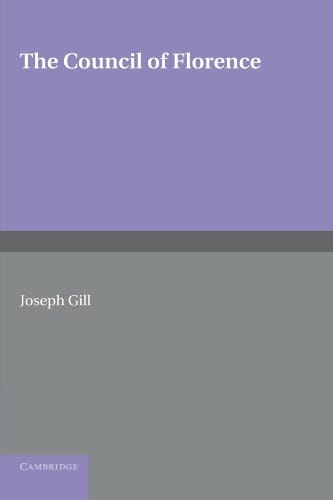
What makes Fr. Joseph Gill’s The Council of Florence a good overview of the event?
Yes, it is an excellent book.
Fr. Joseph Gill was an English Jesuit who was a great scholar during the mid-twentieth century. His life's work was research into the Council of Florence. At the end of the 1950s, he wrote a lengthy, general history of the council.
He covers the negotiations that led up to it and explains its background: how the emperors in Constantinople sought this council to gain more help from the West. Gill explains how finally it came about, the discussions, and provides a very good overview of both the theological issues and the personalities of the council.
He gives a good sense of the drama of the council. Up to the very end, it was not clear whether the Greek bishops were going to assent or return home with everything unresolved.
Gill concludes with a sketch of situation in Constantinople after the council, where there were two different parties and it was not clear which would come out on top.
"Bessarion, had a change of heart as the council proceeded."
2.
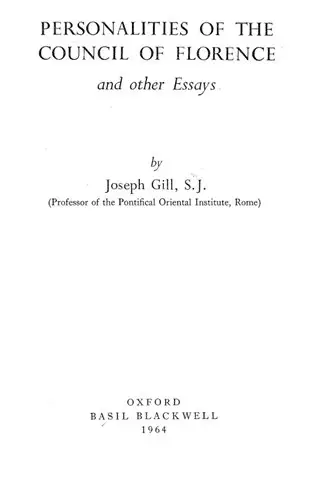
The second book is Joseph Gill’s Personalities of the Council of Florence. Who, according to Gill, were the main personalities and how did they shape the council?
This is a book that he wrote after his general history of Florence. It is a collection of articles on persons or themes of the council.
The main persons to whom he draws attention are three on the Greek side. Two of them were bishops: Bessarion and Mark Eugenikos, the two chief spokesmen for the Greeks. The third was the emperor of Constantinople.
Florence was a rather strange council. Normally at an ecumenical council, the bishops discuss among themselves. At Florence, the bishops from Constantinople, especially Bessarion and Mark Eugenikos, spoke at the public sessions, whereas on the Latin side it was not a bishop who spoke but a Dominican friar: Giovannai Montenero, the provincial of Lombardy. This is never really explained in the acts. The reason, it seems, was that, as far as the Latin bishops were concerned, the Filioque was not an open question. It had already been defined by an earlier councils: Lyons II. Hence, the Latin bishops deemed it unseemly to treated it as an open question. Nevertheless, they knew that they needed to have a council to discuss it for there to be a reunion. They got around this problem by appointing a priest to speak on their behalf.
Bessarion and Eugenikos started off on the same wavelength. They both believed that the Latins were simply wrong to profess that the Holy Spirit proceeds from the Father and the Son. However, Bessarion, had a change of heart as the council proceeded.
In particular, he read more and more of the patristic testimonies brought from by the Latins. Finally, he became convinced that the Fathers of the Church must agree among themselves and that, whereas there was a certain unclarity about the meaning of the Greek Fathers, there was no unclarity in the meaning of the Latin Fathers, who clearly taught that the Holy Spirit proceeds from the Father and the Son. Since the Fathers of the Church agree among themselves about such fundamental questions, Bessarion became convinced of the Catholic position.
Mark Eugenikos, on the other hand, did not allow himself to be persuaded by any of the patristic texts brought forth, even very clear ones from, say, from St. Augustine. He would just say that these were fabrications, corruptions, or miscopied texts. He was utterly intransigent and was one of just two Greek bishops who refused to sign the Decree of Union.
That is how the story is generally told. However, there is a slight twist to it. It seems that Mark Eugenikos told the emperor privately that he would be willing to sign but did not want to be put to the shame of signing it in Florence itself after he had been so adamant an opponent of the union. This is the account given by a Greek author from the time of the council, Sylvester Syropoulos, whose memoirs are one of the main sources on the council. However, when Mark returned home, there was much support for his anti-unionist position. He took this to heart and became the standard bearer for anti-unionism in Constantinople.
Finally, there is Emperor John VIII Palaiologos. He comes across as rather an attractive figure. Often, we hear of how emperors used to browbeat their bishops into voting for political reasons. The acts of the council do not give that impression about John VIII Palaiologus. He was keen that they should make a decision about the Filioque but did not guide them either way. Once there had been much discussion, he thought it was his job as emperor to tell them to get their act together and reach an agreement. However, he did not tell them which way they had to vote. Rather, he stressed that they need to think carefully and then vote give the importance of an ecumenical council—and he explicitly says that it was an ecumenical council—whose decrees are fixed forever.
Once they had voted in favour of the union, he respected the decision and entered into the union himself. He remained faithful to it, even though he did not do much to enforce it. It would have been within his rights, as understood at the time, and according to the precedent of earlier Roman emperors, to depose anti-unionist bishops. He did not, possibly because it would have been too unpopular, possibly because he preferred a gentler approach. Rather, hHe just let things develop. When he died, his brother took over and followed the same policy. Constantine XI was also a Catholic. It is in his reign that Constantinople falls to the Turks.
Those are the most important characters on the Greek side.
According to my reading of the Acts, no one on the Latin side is quite as vivid as any of these three.
Giovanni Montenero, the spokesman for the Latin bishops is very important and his approach is very interesting. One of the many myths about the council is that the Latins were only interested in philosophical arguments, terribly scholastic, and confused the Greek bishops with their many philosophical distinctions, so much so that the Greeks were ready to sign anything to stop the philosophy. That is not true at all. Giovanni Montenero eschewed scholastic argumentation completely, even though he would have been very familiar with St Thomas Aquinas's arguments in favour of the Filioque. He limited himself to quoting from the Fathers of the Church. That procedure had been agreed upon explicitly by the two sides.
Then there is Pope Eugenius IV. He managed to persuade the Greeks to come to him rather than to the rival council in Basel. He saw the council through but was very much in the background and never spoke on the council floor.
The other important person is Cardinal Julian Cesarini, the papal legate. He did not engage in the arguments about the substantive theological issues but guided the proceedings. Five years after the council, when military help to the Greeks came from the West, he died at the Battle of Varna, which, unfortunately, was decisive in the wrong sense. He put his money where his mouth was.
What led you to write your recently published book Vindicating the Filioque: The Church Fathers at the Council of Florence?
Several things. I had been studying the Council of Florence and was struck by the prevailing myths that float around in the ecclesial consciousness.
One myth is that there was not any free discussion and that the Greeks were pressured.
Another is that the Latins relied on false patristic citations, were only interested in scholastic philosophy, and made statements that the Greeks did not understand. As a result, there was no real meeting of minds and the union achieved was not genuine.
When I read the Acts of the Council, it was evident that this was not true at all. I thought, therefore, that it would be interesting to write something to show this.
I was also struck by the modern attempts to challenge the Catholic dogma of the Filioque.
It has become fashionable to claim that the Catholic position, rightly understood, is no different from that of Photius of Constantinople, which became the official position of the Orthodox Church: that the Holy Spirit proceeds from the Father alone. In my view, that is not the case, and it is important to be clear about that. As part of this misguided attempt to reinterpret the Catholic position, a certain amount of work has been done on the Fathers of the Church. This work makes unclear what is actually clear. It casts doubt on whether this or that Father of the Church—St. Ambrose, St. Hilary, or St. Gregory the Great—would have accepted the doctrine of the Filioque, as defined by Florence. They would have and I considered that it was important to explain why. All these ideas came together in this book, which has three parts.
In the first part, I look at the Fathers of the Church who talk about the subject, especially those who were important to Florence.
Secondly, I look at what an ecumenical council is. One of the complaints that's made about Florence is that it is not a true council because it does not fulfil the criteria for one. Hence, I consider what those criteria are and argue that Florence fulfils them all impressively.
The third part looks at the proceedings of the Council of Florence and tries to dispel some of the myths about it.
The three parts come together to showing how the Council of Florence accomplished a great work. It vindicated the doctrine of the Filioque and its work withstands the modern criticisms.
In your view, the dogma of the Filioque differs from the doctrine of Photius of Constantinople. Wherein lies the difference?
Photius rejects explicitly the role of God the Son in the procession of the Holy Spirit. He was not the first person to coin the phrase, “from the Father alone,” but he was certainly the one who promoted it successfully.
There had been precursors in the patristic period, such as the non-canonized patristic writers Theoret of Cyrus and Theodore of Mopsuestia, but not among the Fathers of the Church. These precursors denied that the Son played a role in the procession of the Holy Spirit. Photius, however, makes this his cause of war against Rome, his casus belli, when he defends his possession of the See of Constantinople. The Pope disputed his right to the office. Unfortunately, Photius proved very successful in pressing his cause.
Later, out of adherence to Photius, many efforts were made to explain away the patristic statements which clearly teach that the Holy Spirit proceeds from the Father and the Son. Some claimed that such passages referred not to eternal procession of the Holy Spirit, but to Christ’s sending of the Spirit in time. Others claim that they do not state that the Father and the Son are really one principle, but that the Father, who is always the Father of the Son, is the one source of the Holy Spirit.
Near the beginning of my book, I cover twelve different theories. However, the basic distinction is very simple. Photius denied that the Son is eternally a principle of the Holy Spirit.
Do any of the Greek Fathers teach the Filioque?
That is a big question. In my view, they certainly do. However, this is not a question that you can answer by pointing to one sentence. Nor can you do so with the Latin Fathers. You need to look at the Fathers in detail, read their words in context, and compare one passage to another. This is what I do at some length in the first third of my book.
Some Fathers are clearer than others. Among the clearest is St. Gregory of Nyssa. He draws a famous comparison between the Blessed Trinity and three torches, where the first torch lights the second and the second the third. St. Cyril of Alexandria is also very clear. Others less so. There is a lot of room for discussion about St. Basil and St. Gregory Nazianzen. I argued that the only way you can make sense of what they say is to understand them as teaching the same doctrine as Florence. In that case, they would have accepted the definition of Florence. However, they were not addressing the question of the Filioque. Rather, they were asserting the full divinity of the Son and the Holy Spirit. That is why you cannot just go to them for a proof text on the Filioque. There are proof texts, but they cannot be pulled out as if there is no room for discussion. They need to be studied and interpreted carefully. That takes a long time.
3.
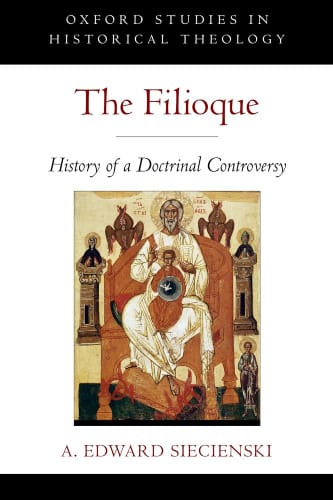
You have also recommended A. E. Siecienski’s The Filioque: History of a Doctrinal Controversy. What makes this a good study of the subject?
It is a very thorough discussion. It starts off with the Bible and ends in the twenty-first century. In between, it covers the Fathers of the Church and the various stages of the controversy.
Of course, the controversy did not begin with the Council of Florence. Arguably, it began in the 600s and was definitely underway in the 800s. Prior to Florence, there had been various attempts to resolve it, most notably at the Second Council of Lyons in the late thirteenth century.
Siecienski looks at the Council of Florence and the subsequent events, including the curious twentieth-century phenomenon where Protestants and then some Catholics suffer a lack of confidence, suspect we were wrong all along, and reinterpret the Filioque to make it more acceptable to the Photian position.
Siecienski’s book is a very useful overview. I do not agree with all his interpretations of the Fathers and criticize a few of them in my own book. However, it is a very good overview of the topic.
What is the present state of the ecumenical dialogue over the Filioque?
In 1995, the Pontifical Council for Promoting Christian Union released a paper on the subject. It's called Greek and Latin Traditions Regarding the Procession of the Holy Spirit. I begin my book by looking at it and laying out my views on what is wrong with it.
Somebody might wonder, “Who are you to say what is wrong with the document of a Pontifical Council?” However, a Pontifical Council is not a magisterial body. Criticising its papers is not an act of dissent from magisterial teaching. In my view, moreover, the document attempts to paper over the cracks. It endeavours to say that both sides, Catholics and Photians, are right. Paradoxically, it also gives the impression that the Photian side is more correct than the Catholic one. As I explain in detail, the document is unhelpful but has been very influential.
Many have praised it and consider it an ecumenical breakthrough. Recently, a head of the Pontifical Council gave a talk in which he said that disagreements about the Filioque mainly resulted from linguistic misunderstandings on each side. That is quite a popular opinion these days and adopted by the 1995 document. In my view, however, it is incorrect. There is a substantive disagreement. One of my motives in writing my book was to explain this and the problems with this 1995 document, which tends to undermine the Filioque. This is obviously an important question.
4.
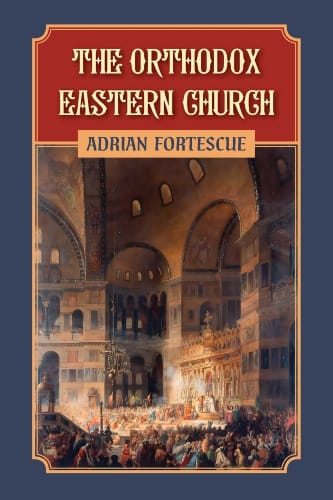
To understand the background and aftermath of Council of Florence, it is necessary to study how the schism between the Orthodox and Catholic Churches developed. On this subject, you have recommended Fr Aidan Nichols’ Rome and the Eastern Churches or Adrian Fortescue’s The Orthodox Eastern Church. What light do these books shed on the subject?
The Orthodox Eastern Church by Adrian Fortescue is quite an old book. He was a scholar in early twentieth-century England. In some ways, his book is dated both in its scholarship and its tone. He was by no means an aggressive writer but is very self-confidently Catholic. He had a great love for Eastern tradition, but the book may sound strange to many a modern reader. Nevertheless, it is very entertaining, intelligent, and lively. It is a useful introduction on how Rome and Constantinople, the Catholic Church and the Orthodox Church, drifted apart.
5.
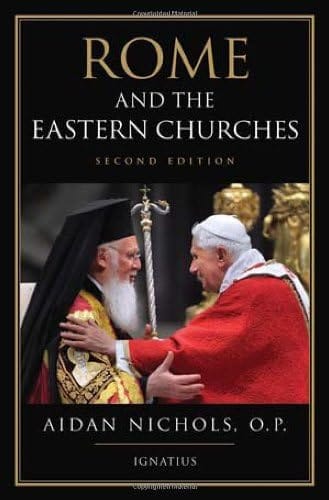
Fr. Aidan Nichols, a confrere of mine, dedicated his own book on the subject, written in the early 1990s, to Adrian Fortescue. He covers the same ground but as a theologian, whereas Fortescue was essentially a historian. He also brings in not just the Orthodox Churches in communion with Constantinople but also those that derive from Nestorius and rejected Chalcedon: the Coptic Orthodox and Assyrian Orthodox Church, as they are called today. Hence the title of his book is in the plural: Rome and the Eastern Churches. This book is useful and interesting for those whose primary interest is theological rather than historical.
6.
Why have you recommended the collection of essays edited by Giuseppe Alberigo, Christian Unity: the Council of Ferrara-Florence, 1438/9-1989?
This collection of essays came out of a symposium that was held in 1989 for the 550th anniversary of the council. It is essential reading for anyone with a scholarly interest in the council and covers different aspects of it.
In my view, the line it takes is not the correct one. Overall, it is rather hostile to the Council of Florence. It was edited by Giuseppe Alberigo, whose History of Vatican II is very well known and who belongs to what has come to be called the Bologna School. For the Bologna School, Vatican II was a rupture with the preceding tradition rather than in continuity with it. Of course, such a view poses important problems for the Catholic theologian. As Benedict XVI taught, in the history of the Church there is no rupture on any essential matters. For example, once defined by an ecumenical council, a doctrine remains binding forever, as John VIII Palaiologos reminded the Greek bishops before they voted at Florence.
Several of the authors in this collection do not take that view. In some cases, this is understandable. Not all the scholars, such as the Anglican historian Henry Chadwick, are Catholic or even theologians. The Greek Orthodox contributors, for example, hold that an essential part of an ecumenical council is its reception by the faithful and critique the Council of Florence for failing on that score. This is quite a common view. Some of the other authors arguing that there was no proper discussion at Florence and the two sides did not understand each other. One contributor even argues that the council was a dialogue of the deaf. I do not agree with these positions but some do take them. So, reading a book like this is important for knowing what people say about the Council of Florence. This book is probably the only relatively recent scholarly collection of essays on all the various aspects of Florence.
A bonus suggestion is Fr Norman Tanner’s A Brief History of the Councils. Have ¡you recommended it because it gives a reliable, brief overview of the Council of Florence?
As the title says, it is a brief history. Tanner covers twenty-one councils in just under 120 pages. So, this is not where you go for a thorough description of any of the councils.
It is also problematic theologically. To be frank, Tanner does not appear to have grasped that once a dogma is defined, it is defined forever. For example, he claims that the Decree of Union defined at Florence is of historical rather than everlasting theological interest because it was later rejected by the Greek Church. That is an astonishing thing for a Catholic theologian to say. I do not recommend this book, therefore, as a theological guide. However, it is not a bad book for those who are in a hurry and want a brief historical account of what happened at the Council of Florence and afterwards. Go to Joseph Gill for a much more thorough and scholarly account.