There are many reasons to study Ancient Greek. Learning it gives you access to the New Testament and the writings of the Greek Church Fathers in the original language. It gives us the same kind of access to the Ancient Greek authors whose works are the cornerstone of Western literature and philosophy. However, learning a language is generally a challenge, especially if you are studying by yourself and do not have the assistance of an experienced teacher.
In this interview, Prof. Michael Boler selects five books for learning Ancient Greek and offers some advice on how to study it.
Dr. Michael Boler is Associate Professor of Classics, Director of the Honors Program and Program Director of Classics at the University of St. Thomas, Huston. He teaches Latin, Classical Greek, Latin and Greek literature, and ancient history. His area of research is classical reception. He is the author of Introduction to Classical and New Testament Greek: A Unified Approach and the accompanying Answer Key and Commentary to Introduction to Classical and New Testament Greek.
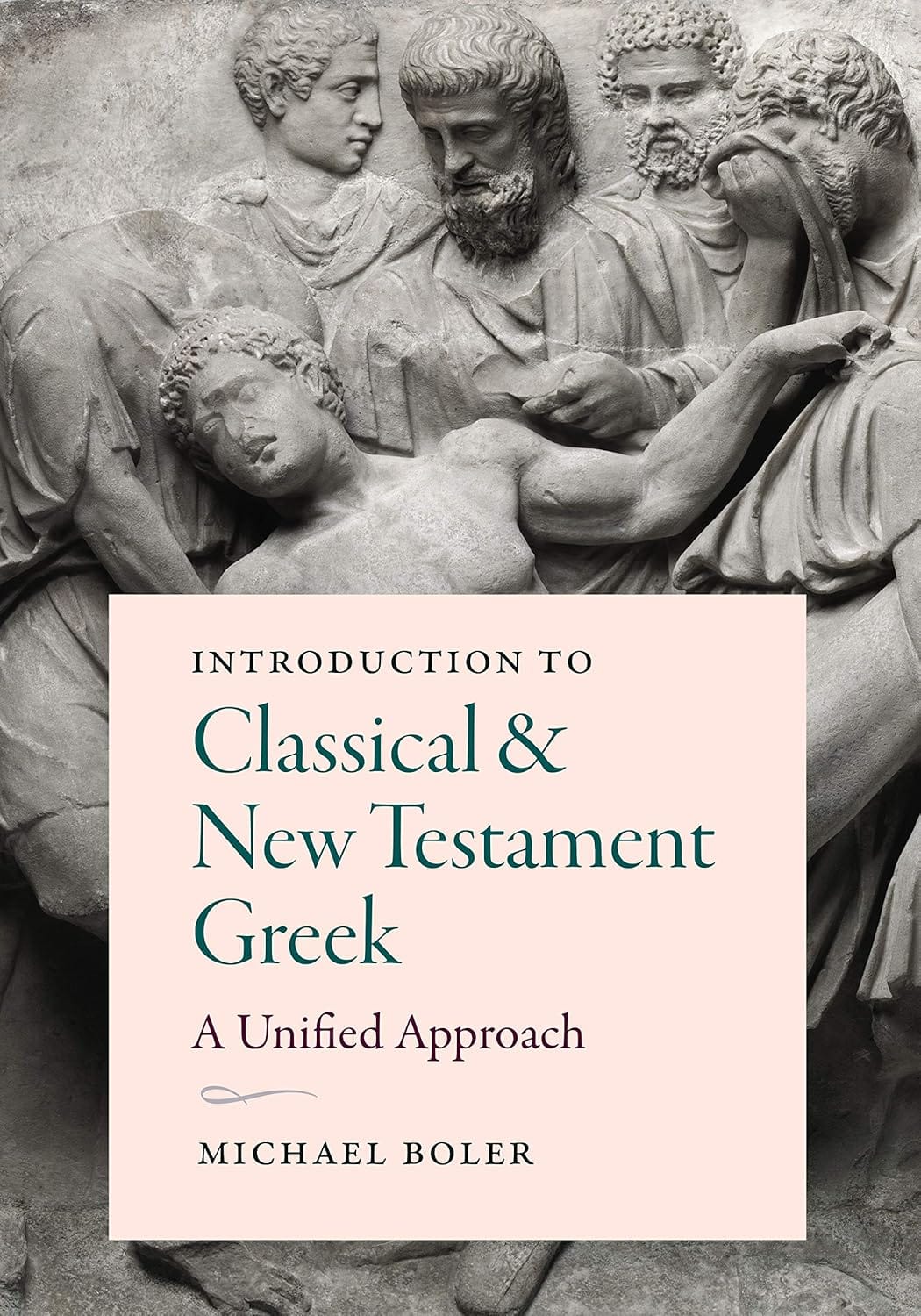

- Introduction to Classical and New Testament Greek: A Unified Approach
by Michael Boler - A Reader's Greek New Testament: Third Edition
by Richard J. Goodrich and Albert L. Lukaszewski - A Patristic Greek Reader
by Rodney A. Whitacre - A Student Handbook of Greek and English Grammar
by Robert Mondi and Peter L. Corrigan - A Greek-English Lexicon of the New Testament and Other Early Christian Literature, 3rd Edition
by Walter Bauer and Frederick William Danker
Should someone seeking a well-rounded education in the liberal arts study Ancient Greek?
Yes. However, I would preface that by saying something that I always tell my students. Learning Ancient Greek, or Latin for that matter, will not make you holier. You can lead a full Catholic life without learning ancient Greek. You do not gain any esoteric knowledge or secrets by learning it.
However, it is an incredibly rich field of study, particularly for reading the Gospels in Greek. Are you going to lose crucial information if you do not know Greek? No. However, there are some really wonderful things that you get from studying it, things which are really hard to get from the translation.
One of the reasons why I wrote Introduction to Classical and New Testament Greek was to give students the experience of reading passages in Greek from the outset. This really sparks their interest.
Besides the Scriptures, there is classical poetry, history, and philosophy. There is an incredible richness there. Nevertheless, no one should feel that their life is incomplete if they do not know Greek.
Until recently, study of the classical Greek authors was part of a Christian education. The goal was to draw not on the wisdom of Jerusalem, Athens, and Rome. That was true of the Church Fathers, medieval scholastics, the Christian humanists of the Renaissance, and even the classically trained theologians of Vatican II. However, now we have good translations. Moving forward, do we need to recover the study of Ancient Greek as an essential part of a Christian education?
It would certainly help. In the United States, there is a growing classical education movement. My children are enrolled in such schools. There, they start Greek quite early: in fourth grade, with eight- and nine-year-olds. This can be very beneficial.
Logistically, it is very difficult. Any movement to recover the study of Ancient Greek needs to be organic and from the ground up, rather than top-down. Classical education mandated from on high would not be very successful. It is more successful whenever it grows from the bottom up, as with parents who homeschool their children or freely send their kids to classical schools.
Does the study of Ancient Greek inculcate any valuable soft skills?
It does. Above all, it allows the student to see that there is not always a one-to-one correspondence between words in one language and another. Learning other languages does this as well. This is not a relativistic way of thinking about language. Rather, various English words can translate a Greek word. There is no right answer.
My students pick up quite quickly on one of my pet peeves. Whenever they ask what the translation for a sentence is, I always reply that there is no such thing. There is only a translation.
Sometimes, this comes across as relativistic. It is the reverse. It is the intellectual humility to know that one's native language is not 100 % sufficient for communicating certain things. Any language struggles to communicate the objective reality that lies beyond it. It is a matter of triangulation. The more languages you study, the more attuned you become to the reality that each one is trying to express.
Another benefit, especially for children, is that learning a language trains the brain in memorization. Many classical schools are reintroducing the memorization of large pieces of poetry. Study after study shows that—whether due to a lack of reading in school or technology—the current generation of children and young people has the lowest ever capacity to retain and memorize information, since these were measured.
The advantages you have just mentioned can be acquired through learning any foreign language. However, Greek seems to be in a class of its own when it comes to its cultural legacy. Our theatre, literature, and philosophy all go back to Ancient Greece. Does not learning Ancient Greek offer something more than other languages, no matter how valuable their cultural traditions?
I agree completely. On the first day of a Greek course, I make two lists of things that the study of Greek will give you. One is of the ways it forms the brain and teaches you to think about the world. The other is of the works to which it gives you access. These works are the foundations for how we think today politically, artistically, and philosophically.
One of the main reasons why I wrote the Introduction to Classical and New Testament Greek was that some students wanted to read Scripture but others wanted to read Aeschylus, Plato, or Aristotle. There was no textbook that covered both. Most textbooks did not want to have anything to do with Scripture and excluded it completely. Similarly, the textbooks for New Testament Greek were aimed exclusively at teaching people how to read Scripture. They never covered Plato, Aristotle, or Aeschylus. Each class of textbook did a great disservice. All these works are written in the same language. It is a great benefit to have access to the original text of all of them.
Are the books you have recommended for high-school and university students or are any suitable for middle school students?
They would be difficult for middle-school students. There are different approaches to teaching Greek. I only teach college students and so I do not know what is best for middle-school students.
Most of the classical schools adopt a more inductive method for middle-school. The students do not learn grammar from day one but receive a general familiarization with Greek. Taking this approach early on can be very beneficial.
In general, the inductive method works better for young children.
For high-school students, there is a great benefit to explaining the grammar behind what they grasp intuitively: to teaching all the forms of the noun and so forth. Another great benefit is that you do not have to teach much about English grammar to those who have studied Latin and Greek.
Today, many in the United States are not taught grammar, unless they attend a private or a classical school. Hence, there is an educational crisis among those entering university. They do not know what a subject or a predicate is. Learning Greek or Latin is very beneficial for them.
You mentioned the inductive method. As you pointed out, there are various methods for learning ancient languages. One teaches students the grammar, the vocabulary through the exercise of speaking and writing Ancient Greek. Others focus on reading classical texts. You have already noted that inductive method is maybe better for younger students. Which approach do you recommend for adults?
It really depends on how much time you can devote. Typically, I have a student for two semesters, for three fifty-minute periods a week. In that incredibly short time, I need to teach them the complete grammar and cover twenty chapters a semester.
In a year, you can work through a book on the basic grammar. You cannot do that with the inductive method, even though speaking and composing in Greek is fantastic and very helpful. The only way to teach Greek during two semesters in a traditional university setting is by teaching grammar.
If you are studying on your own, you can follow the inductive method. There are many great online resources for composing and speaking in Greek. We practiced them in grad-school and they are incredibly beneficial. Though the inductive method is not for everyone, it can be great if you have the time and financial resources. For most people, however, it will be a challenge both financially and timewise.
You have just talked about the challenges of learning a foreign language. Learning a language can be difficult and boring, especially in the early stages. What advice do you have for discouraged students of Ancient Greek?
Again, this may seem self-serving, but I always tell my students that life is too short to read made-up Greek sentences in the early stages of learning. One of the main reasons I wrote the book is I wanted all the example sentences to be real, from cool sources, very interesting and attention-grabbing.
Pedagogically, it would be better to start with made-up sentences. However, they are very boring. The very first sentence in my Greek book is John 3:16. The key is to get students to read early on interesting passages early on from works that were actually written in Greek.
I love languages, memorizing forms, and comparing them to other forms. That is not for everybody. The sooner students have some real payoff from reading texts in the original language, the more interested they will be. So, I am a big believer in reading original, fun texts.
I also enjoy explaining the Greek etymology of words. The more you grab the interest of the students and show that there is some real payoff, the better.
"I have studied Greek because I believe it is the key to understanding the wisdom of the ancients."
Desiderius Erasmus
1.
First up is your own textbook which, as the subtitle states, takes a unified approach. What is this unified approach?
The unified approach is simply to teach the Greek in which both the New Testament and Plato’s works were written as the same language because they were written in the same language. The differences between them are so minor that they rarely come up whenever I teach Greek.
Yes, the more you advance in your study of Greek, you will begin to notice differences everywhere. You will note an influence of Hebrew on the New Testament writers or see a construction in Plato that does not feature in the koine Greek of the New Testament. However, each is written in the same language. Plato could have read the New Testament without any difficulty and Paul could have read Plato.
The reason for treating them as different languages is ideological. In general, classics professors, including myself, tend to be somewhat snobbish and do not consider New Testament Greek as sublime as that of Plato. Some, for other ideological reasons, do not want to cover the New Testament. These are the main reasons why Sacred Scripture is not used in the typical Ancient Greek course at universities that do not have a religious affiliation. It is not considered necessary. It is siloed off into other courses for those who want to read the New Testament in the original Greek.
Some textbooks did make a half-hearted effort to use the New Testament but they would only include two or three Greek sentences from Scripture in a chapter. None ever made a fifty-fifty split between actual sentences and passages—not paraphrased or dumbed-down sentences—from both Sacred Scripture and classical Greek authors. However, my students at Catholic University of America wanted real Ancient Greek sentences from both sources together. I wrote my textbook out of need. There was no textbook available that did what I wanted to teach in the classroom.
Are there any other features to your textbook?
The biggest feature is that it uses original sentences from both the New Testament and classical Greek authors. This cannot be overstated.
I always wondered why there were so many made-up sentences in the textbooks rather than original ones. When I sat down to write my book, I realised why. It is very hard to find original sentences that are good examples. You might find a sentence that is perfect, but then has a type of verb and that has not been introduced yet. Another sentence might illustrate perfectly a certain kind of genitive but contains a noun that the students have not learnt yet. That is why most textbooks either make the sentences up or heavily paraphrase original ones.
I decided, however, to only use real sentences from the sources. In the sentences from the Scripture, nothing has nothing has been altered, not one iota. The sentences appear exactly as they do in the critical editions. Those from the classical sources are a 98% match. In the early chapters, I sometimes insert words such as ‘is’ and ‘the’. Many of the sentences used in those chapters, and which are very suitable for beginners, are maxims and proverbs. However, Greek authors tend to truncate maxims and proverbs. I was not making an artificial paraphrase of these maxims but simply writing them out in normal Greek. By the fifth chapter, I stopped inserting a couple words here and there. From then on, everything is exactly as it is in the original.
At that point, I had to add a few notes next to text for those things that the student has not learnt yet. However, it took far longer to research and find sentences that were good grammatical examples. I had to read through the New Testament line by line and, whenever I found a good grammatical example, jot it down. That took longer than the writing of the book itself. However, it was worth it because students start reading the real thing as early as possible.
2.
One of the other books I recommend is a text on English grammar for students of Greek. One of the great challenges in teaching Greek is that I now have to operate under the assumption that my first-year university students have not been formally trained in grammar. Most of them do not know what a predicate is. Instinctively they do, but they do not know the term. They do not know what modifying is.
Hence, I wrote my book under the assumption that the student has no knowledge whatsoever of grammatical terms and that I need to explain them all from scratch, Even so, some students need extra help to learn English grammatical terms, as used to describe Greek.
Mondi and Corrigan’s tiny volume is fantastic at explaining verbs, nouns, adjectives, what they do, and how they operate. They illustrate English grammar with great sentences but use the same language as any textbook of Ancient Greek.
This little volume is a great help, particularly for those who are studying by themselves and have not diagrammed sentences or learnt grammatical terms during their earlier education.
3.
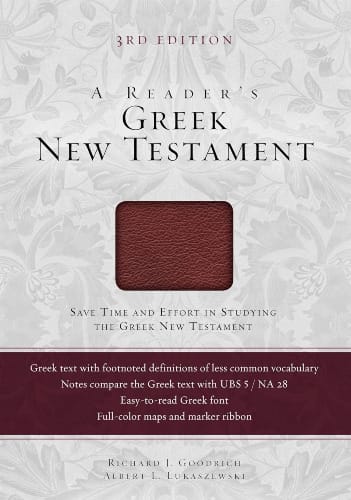
Next up is A Reader’s Greek New Testament. How does this book help students read the New Testament in the original language?
This is the text that I use in classes that go beyond the textbook.
Once students have completed the textbook, my advanced course is always set around a theme. During the first half of the semester, we read a classical text on that theme. During the second half, we read selections from Scripture on it.
I am a big believer that once students have worked their way through a basic textbook and start to read Greek on their own, the fewer pages there are to flip, the better. The more information there is on the same page, the better.
That is what I really like about this text. The top half of the page is Scripture; the lower half contains are all the vocabulary used. Hence, you do not need to look up the words with a separate dictionary. Having to do so is really frustrating for students, takes a lot of time, and dampens the joy of reading Greek.
Other editions of the New Testament also do a very good job at this and even explain complicated grammatical points. However, they have the binding of a cheap paperback. Most, whether me or my students, like to feel that they are holding Scripture whenever they read Scripture. The Zondervan version is faux-leather bound, with gold-gilt pages, and has a ribbon bookmark. It feels like Scripture. So, it is nice to have for lectio divina or prayer.
Zondervan also issues an equally nice edition of the whole Bible, with the Old Testament in Hebrew and the New Testament in Greek.
The authors of the New Testament and the Church Fathers cite not the Hebrew text of the Old Testament, but the Greek translation of it: the Septuagint. Is there something like A Reader’s Greek Old Testament?
I am sure something like that exists, but I am not aware of it.
I side with St. Jerome on this point. I am a big believer in reading the original text. For this reason, in my Latin classes I do not make my students read any of the Vulgate. This is not because I believe the Vulgate is a bad translation. It is probably best translation I have ever seen of the New Testament. However, one of the things that makes it so good is that it is faithful to the rhythms and workings of Greek. Hence, it gives kind a skewed picture of the natural rhythms of Latin.
Something similar occurs in the Septuagint. It is influenced heavily by the Hebrew of the original. It is not the best text for teaching a student how Greek can naturally express his words. Once a student has learnt Greek, he can read the Septuagint if he wants.
"The first thing I shall do, as soon as the money arrives, is to buy some Greek authors; after that, I shall buy clothes."
Desiderius Erasmus
4.
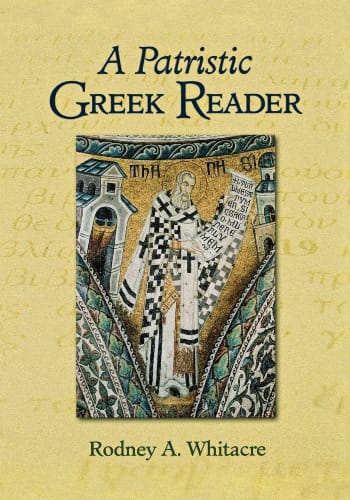
From the New Testament to the Church Fathers. Rodney A. Whitacre’s A Greek Patristic Reader. It contains passages and translations the Didache to Symeon the New Theologian.
This is one of my favourite texts and a phenomenal book. It has everything that you would want to introduce someone to Patristic Greek. Patristic Greek is not my specialty. I was classically trained. So, there might be other good readers out there. What I love about this one is that the top half of the page contains the Greek text and the bottom half the vocabulary, grammatical notes, and explanatory notes. This textbook gives you notes on an alternative phrase or particularly difficult construction. This makes reading the Greek very accessible for a student who has just finished a basic grammar textbook.
The other thing I love about this book is its wide selection of authors. It covers any of the Greek Church Fathers you may be interested in and all the famous texts you would want to read.
The third thing I like—and some instructors will disagree with me on this—is that it contains a complete translation of every text used. Those who study by themselves at home need to check their work. Not everyone has the benefit of being in a class with a professor who can tell them where they have made an error in their translation. At the beginning, you make many such errors. The danger is that you will just flip to the translation rather than work through the text yourself. Nevertheless, in this book you have somewhere to go if you are studying on your own and get stumped. This is of incredible value.
At first, I was very much against answer keys. In fact, I did not write one for my Greek textbook for that very reason. However, I kept getting emails from people who were self-studying at home. With the passages from Scripture, they could look up any translation but were not able to track down the other passages. I realized that I was wrong about answer keys. They can be very valuable.
Do you come with a danger? Yes, but in general they are good.
The answer key to my textbook has just come out. However, I did not want to just write an answer key for it. Instead, I followed what I do in the classroom: discuss two or three translations for each sentence and their pros and cons. “You could translate it this way, but here is another way. Here is why I like translating participles this way. Here is why I prefer to do it this way.” So, I provide some commentary on the sentences, not just an answer key for exercises.
Once you have learnt enough grammar and vocabulary, it is time to start translating and reading classical texts. Xenophon’s Anabasis or Cyropaedia are sometimes a good starting place. Which classical and patristic works would you recommend?
I would recommend that you stick to a text that is written for students of your level, especially during the first five years. For any text that you read in Greek, use an edition that is made for learners. Such an edition provides all the vocabulary and helpful notes on the same page at the text, so that you do not need to flip pages or consult a dictionary. All the information is right there.
There are editions of this kind for Xenophon’s Anabasis. That was what I first read when I had finished learning Greek, much like Caesar's Gallic Wars is the first work Latin students read. While the syntax is easy, the first quarter of the book is about all marches made. Caesar's Gallic Wars is similar. As a result, very few people become excited about Xenophon's Anabasis, even though it is a fantastic work. There is just too marching to get through before the battle with Cyrus and the king. So, I would encourage students not to use Xenophon’s Anabasis.
At the end of my textbook, there is an appendix, “Suggestions for Further Reading.” I recommended that you read something in which you are interested. That is more important rather than complexity of the text. It is the most important consideration. After all, why do you learn Greek in the first place? Because there is something you really want to read. So, read that.
If you want to read Pindar's lyric poetry, that it is not the best place to start. Start instead with some easier poetry, and then move on to Pindar. Other than that, read what you are passionate about. That makes a huge difference.
I suggest you start with prose, but if you really want to read Homer, start off with an edition designed for students.
The fables are usually a good place to start. Aesop's fables are nice. Plato is also quite nice as well but tricky at times. Plato’s Euthrypo is a good place to start, though many of my students start with his Ion, which is very funny and short.
Buy an edition from a textbook company. Bolchazy-Carducci, which specialises in this sort of book, publishes an edition of many of the works you may want to read.
There used to great ones made for schoolboys in England and that could fit in your jacket pocket. I tracked down a set before it was thrown in the trash heap. Those ones are fantastic but are only available from a seller of used books. Nevertheless, some very good new publishers are putting out texts of this kind.
5.
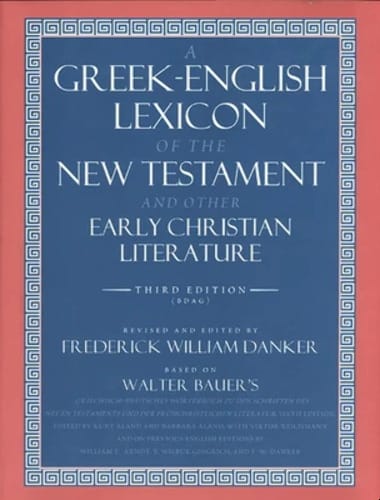
There are various Ancient Greek dictionaries for students. Liddel and Scott’s comes to mind. It focuses primarily on classical authors. What are the strengths of the one by Robert Mondi and Peter L. Corrigan? Have you recommended it as a better resource for those who wish to read the New Testament and the Greek Fathers?
Yes, but do not feel that you need to rush out and buy this giant textbook right away. Wait a while. Moreover, many software packages, such as Logos, have an online subscription to this volume.
At the beginning, you do not need a dictionary if you have a text that includes the vocabulary. There are so many such texts that you do not need to rush out and buy a dictionary.
Dictionaries are interesting but they are written by human beings. The lexicographer’s knowledge of the language is fantastic and should be consulted. However, particularly with controversial passages, we tend to put too much emphasis on what the dictionary says. The overwhelming majority of times, the first and most common definition of a word is the right one.
The benefit of a giant dictionary is that, when you really want to dive deep into a word and determine what it really means in a certain passage, you can look at its wide range of meanings and the specific passages in which it has a certain meaning. This is incredibly valuable. However, such a dictionary is a research tool for later. Using it is inefficient for just reading a passage. It takes so much time to find the right page and right column for the word in such a long tome.
This dictionary comes highly recommended by my colleagues who study the New Testament. It covers the words that occur in the New Testament and in early Christian sources. It is worth consulting the other sources to see how the words used in the New Testament have a wider range of meaning in other works. For example, daimon means ‘demon’ in the New Testament. You might be shocked to learn that Socrates uses this word in his Apology to refer to the voice that tells him what to do. However, he is not referring to a demon. The word has a wider range of meanings.
It is also the root of Aristotle’s word for happiness, eudaimonia.
Exactly, but Aristotle was not worshipping demons. So, we need to think how a word is used and its various meanings. That is why a dictionary can be very valuable. However, a dictionary that is limited to one specific work can sometimes give a skewed notion of a word’s actual meaning.