In a letter written around 412 AD, St. Augustine notes that, “If Christian teaching condemned all warfare, then the soldiers in the gospel who were seeking guidance about their security would have been told to throw away their weapons and withdraw entirely from the army.” At the same time, he stresses that warfare is legitimate if and only if it is waged for the sake of peace and in a moral way. Over the centuries, the Catholic Church has matured its teaching on the ethics of warfare. Some may wonder, though, whether that teaching is still valid in a world where the military marshals advanced technology to produce arsenals of immensely destructive weaponry. In this interview, Prof. Gregory Reichberg, a specialist in military ethics, explains his pick of the five best books on the ethics of warfare.
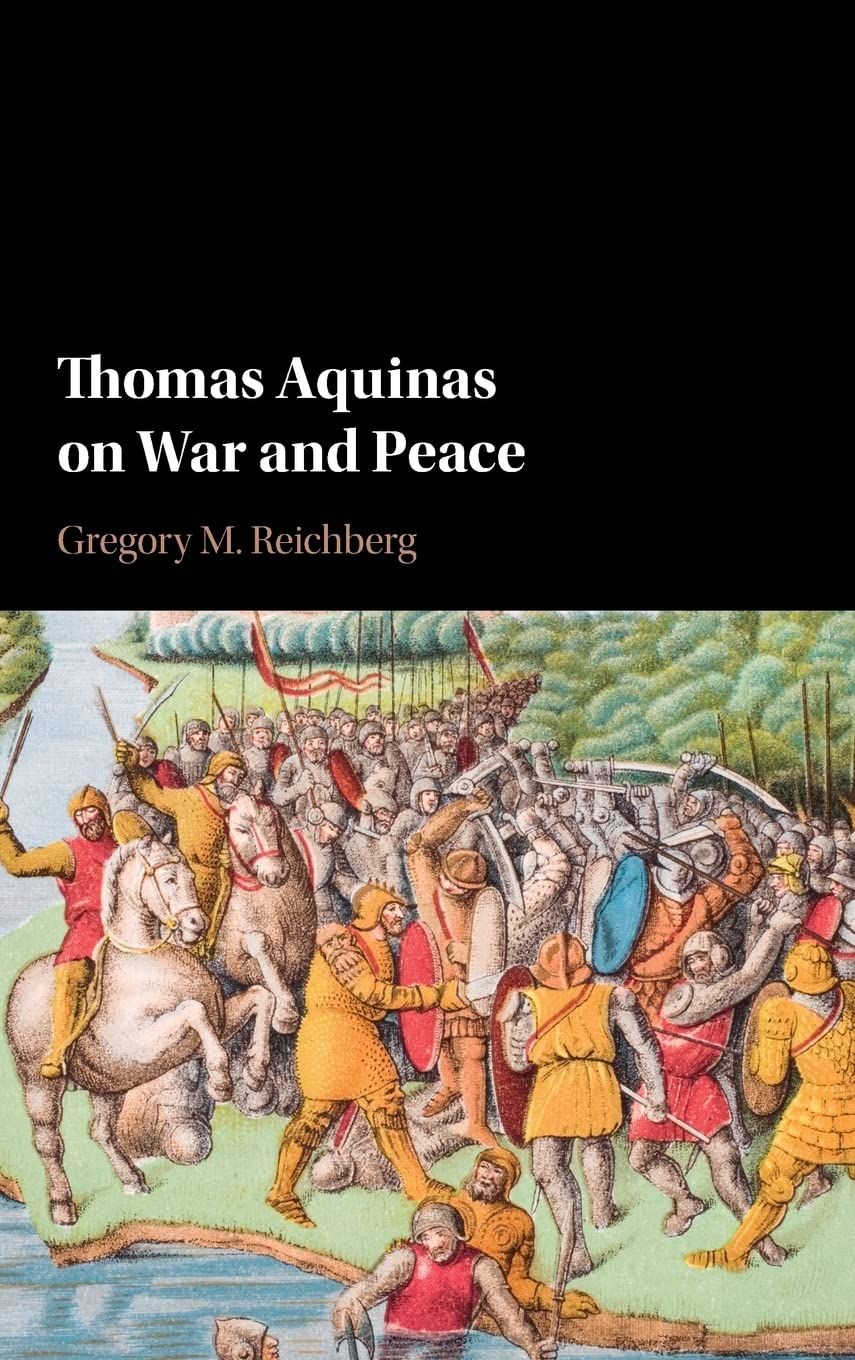
A philosopher by training (with a Ph.D. from Emory University), Gregory Reichberg is a Research Professor at the Peace Research Institute Oslo, where he writes on historical and contemporary issues in military ethics. He is the author of Thomas Aquinas on War and Peace (Cambridge University Press, 2017) and co-editor of several volumes, including The Ethics of War: Classic and Contemporary Readings (Blackwell Publishing, 2006), Religion, War, and Ethics: A Sourcebook of Textual Traditions (Cambridge U P, 2014), and Robotics, AI, and Humanity: Science, Ethics, and Policy (Springer, 2021). His articles have appeared in Catholic journals and magazines, including The Thomist, La Revue Thomiste, Nova & Vetera (English Edition), Proceedings of the American Catholic Philosophical Association, Commonweal, and America Magazine. His current work focuses on artificial intelligence and its implications for military ethics.

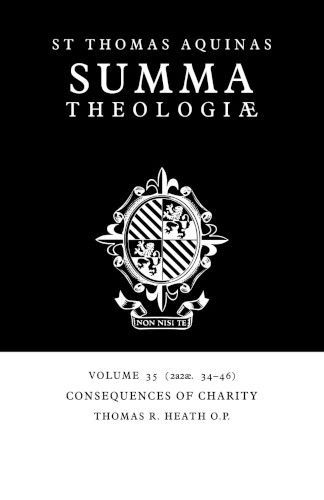
- Summa Theologiae: Volume 35, Consequences of Charity: 2a2ae. 34-46
by St. Thomas Aquinas - Vitoria: Political Writings
edited by Anthony Padgen and Jeremy Lawrence - Freedom in the Modern World
by Jacques Maritain - The Church of the Word Incarnate
by Charles Journet - Fratelli tutti
by Pope Francis
Prof. Reichberg, welcome.
Very good to be here. I start with one qualification. The books that I propose are not necessarily the best books on war and ethics. However, these books provide a window onto important issues relating to war and ethics.
What led you to specialise in military ethics?
My first exposure to military ethics was during the First Gulf War. I was an assistant professor of philosophy at the Catholic University of America in Washington, DC. The then Dean of the School of Philosophy, Jude Dougherty, asked me whether I was willing to be interviewed on the radio about the US-led intervention and whether I could situate this in relation to the thought of Thomas Aquinas. I was paralysed with fear at the prospect of doing that because I had not looked into just war theory at all. So, I found a way to evade the task that he had proposed for me.
But then, several years later, I ended up in Norway and had the opportunity to work at the Peace Research Institute, where I currently work. This was back in 1998. I was hired into a group that was researching humanitarian intervention. It was a significant theme then because of the US-led air war over Kosovo. I was hired into that research group because of my background in mediaeval philosophy, particularly Thomas Aquinas. The roots of humanitarian intervention, and just war more broadly, are often traced back to Thomas Aquinas. The incident at Catholic University put just war on my radar scope, and then I really dove into it as an area of research after coming to Norway in 1998.
Part of the reason for Aquinas's impact was that he took rather complicated discussions about war and ethics, and he reduced theme into three basic principles.
1.
First up, is the section of the Summa theologiae that St. Thomas Aquinas dedicates to war (II-II, q. 40). Presumably, this tops your list because it is a canonical statement of Catholic principles regarding the ethics of war. However, St. Thomas is also drawing on previous theological reflection on the matter, most notably upon St. Augustine. Why have you chosen St. Thomas and what does he add to the preceding reflection?
I could have started with Augustine. There are other important thinkers along the way: for instance, the canon lawyer, Gratian, who took many elements from Augustine's thought on just war and systematised them. What we today call the theory of just war does not emerge directly from Augustine. It emerges remotely from Augustine, but through the prism of the canon lawyer, Gratian. So, I thought it would be good to start with Thomas Aquinas because he was the first thinker to systematise principles around just war. Gratian organised passages from Augustine, but Aquinas distils a core teaching around the idea of just war.
His account in the Summa has had an enormous influence. It is the principal way that the question of rightful engagement in war has been raised within a Catholic framework. However, he is also a point of reference for many secular thinkers or individuals doing research on just war. Part of the reason for Aquinas's impact was that he took rather complicated discussions about war and ethics, and he reduced theme into three basic principles. His treatment of war, the one that's referred to as article 1 of question 40 of the Second Part of the Second Part of the Summa. is about two-and-a-half pages long; maybe even less, depending on the version that you read. Its impact is largely a function of the simplicity of his treatment but also its profoundness. That is why I thought it would be a good starting point.
Earlier I mentioned your monograph, Thomas Aquinas on War and Peace. What do you bring out in your book-length study on Saint Thomas's thought on this matter?
Based on what I have just said, it can seem rather surprising that I managed to write an entire book war and ethics in Aquinas.
There are two things I tried to do in the book.
One is show that Aquinas's perspective on the moral problem of war should not be reduced to what he does in Summa theologiae II-II, q. 40, a. 1. He addresses the use of force in other contexts within his writings. Particularly important are his scriptural commentaries. He has got quite a bit to say there. Also very important is the fact that he situates his discussion of war within the wider context of a discussion about peace. I wanted to bring the discussion of war in question 40 back to the wider horizon of peace. In some respects, Aquinas's commentators have done him a disservice because they have detached question 40, article 1, from its anchoring in peace.
The other aspect of my book is to drill down into some of the key topics that Aquinas discusses apropos war.
He gives three famous criteria or moral requirements that must be met if the war is to be considered just. The war must be declared or undertaken: 1) by the legitimate authority; 2) for a just cause; 3) for a right intention. I have separate chapters on legitimate authority and just cause. Right intention ends up getting discussed in several of the chapters.
I also look at related issues, such as the relationship of just war to the so-called “precepts of patience”, to use a term from Gratian. The precepts of patience are derived from the Sermon on the Mount. For instance, Jesus tells us to turn the other cheek. To what measure is this idea of just war compatible with the evangelical call to nonviolence in God's Kingdom? I have a chapter on that question.
I look at some issues that that have been debated in recent times: for instance, the question of preventive war. Can war be waged preventively to forestall an even greater evil?
Then, I examine what has come to be called the moral equality of combatants. This is the supposition grounding much of modern international law. When armies confront each other on a battlefield, in making judgments about the individual soldiers fighting in the war, we abstract from the cause for which they're fighting. That is an issue for their superiors. Instead, we focus on how they conduct themselves in the war: whether or not they follow the rules of war. The idea is that combatants on each side face off as equals, as it were, who are held to the same moral standards on the battlefield. I examine whether the moral equality of combatants is rooted in the thought of Thomas Aquinas.
Finally, I conclude the book with an examination of how Aquinas’s thought has been received within the contemporary teaching of the Catholic Church. I try to bring the story up to date, as it were.
The Relectio de indis...was really the first time that we find a Catholic thinker in the just war tradition examining a concrete case of use of armed force.
2.
The second reading is the Relectio de indis (On the American Indians) that the Dominican Francisco de Vitoria delivered at the University of Salamanca in 1538. Vitoria asks whether the Spanish crown has any right to rule over the indigenous peoples of America. The following year, he delivered another relectio or research lecture On the Law of War (Relectio de iure belli). What makes the earlier lecture more informative for the ethics of war?
Literally, a relectio is a re-reading. A relectio will begin with a citation from Scripture. It is an elaboration on an issue prompted by Scripture. It is not an exegesis of the passage. It is an exploration of a theme prompted by a line of Scripture.
The Relectio de indis is by far the most famous of the two, mainly because—and this is why I wanted to put it into the discussion—this was really the first time that we find a Catholic thinker in the just war tradition examining a concrete case of use of armed force. If you read Aquinas's question 40, he does not talk about any historical situations. You can read the very influential commentary on question 40 by Cardinal Cajetan. That too does not drill down into any concrete cases. Vitoria was among the first to say, “Well, how can we use these principles that were formulated by Augustine and Aquinas and apply them to a contemporary case of war, to illumine the ethical aspects of what is going on and make an assessment?” The case that Vitoria considered in De indis was the Spanish conquest of the Americas, which mainly proceeded through the use of force. He raises the question whether it was right and justified to use force against the American Indians. This was an epochal shift in the just war tradition. It started using the tradition to think about concrete cases.
3.
Third is Jacques Maritain’s Freedom in the Modern World (Du régime temporal et de la liberté), originally published in 1933. In the third part of the book, Maritain turns his attention to the means for reconstructing a temporal order based on Christian principles. There he considers both spiritual and secular means of warfare. He also argues that non-violent means of securing peace have priority over violent ones. Why has this book made it to your shortlist?
In this section from Freedom in the Modern World, Maritain takes up an issue which has become a central one in contemporary Christian reflection on the use of armed force. Do Christians have an obligation to refrain from using forceful means, particularly warfare? Do they have an obligation to pursue a strictly nonviolent path in responding to wrong? Or, should Christians attempt to blend both approaches. Today, this question of the relationship of armed force to non-violence often goes under the heading of just peace.
I find it quite fascinating that, in the 1930s, Maritain took up this issue. This was at a time when Christians hardly appealed to non-violence or pacifism. During that period, pacifism was under a cloud. People who refused to fight in the First World War were branded pacifists. Very adverse moral judgments were made about them.
In the early thirties, Maritain read the writings of Gandhi and he saw much value in Gandhi's endorsement of nonviolence. What Maritain attempts to do in the essay is situate the question of nonviolence as a method of political action within a wider Catholic teaching on how Christians should engage in the temporal, political sphere. He ends up arguing for a hierarchy of means, when it comes to Christian action in the world.
First of all, he places in a category of its own, Christian means directed toward eternity: prayer, sacraments, ascetical practices, and holy martyrdom. Then, there are Christian means directed towards the temporal sphere: matters that we would place under the heading of the political. Here there are three modes of Christian action. The first he calls organic construction. It has to do with building institutions, supporting constructive institutions that already exist, favouring the just economic order, and so forth: all sorts of positive contributions to building up temporal society. Later in Catholic thought, a lot of this came under the heading of “development, a new name for peace”.
Maritain recognises that often, when we try to build up the temporal sphere, there are going to be detractors and people who want to undermine these constructive initiatives. What do we do about them? This is where Maritain takes up the discussion of the use of force.
He says that there are really two ways of dealing with detractors, people who would undermine the peace. One is through spiritual means of nonviolence. That is how Gandhi used nonviolence to affect social change. The other is what he calls means of carnal warfare, which consist in using force. Maritain's main thesis is that Christians need to situate this last category, the use of heavy means, within this wider hierarchy of Christian means for engaging in the temporal sphere. If Christians forget to situate use of armed force within this wider hierarchy of means, they will inevitably end up resorting to ways that are counterproductive and end up harming the common good.
A lot of what he is arguing against in this essay is Christian Machiavellianism. This is the idea, prevalent in his day, that you looked to the Church to care for your personal salvation, but when it when it comes to temporal society, you look to the State, which will take care of your temporal needs and deal with detractors. So, there is a split between Christian ethics, on the one side, and an ethics built around effective state action, on the other. That effective state action does not need to look to Christian moral principles. It just needs to look to effectiveness. Machiavelli laid out a whole set of rules for effective rulership and was quite clear that you do not think about Christian principles when you want to act effectively in the temporal field. Maritain was arguing against this Machiavellian split.
Between Gospel principles and raison d’état?
Yes.
In the Church of the Word Incarnate, he engages with the question of holy war. Can Christians engage in warfare and use armed force for Christian ends?
4.
For your fourth book, you have chosen a treatise on the Church, not on war: the first volume of Card. Charles Journet’s Church of the Word Incarnate (L'Église du Verbe Incarné). However, Chapter Six, which is on the relation between canonical power and political power, ends with a section of the war. Have you chosen Journet’s treatise on the strength of this section?
I have been an avid reader of Journet for a long time, not only of the section of the work dealing with war, but of his wider teaching on the Church. I have always found a lot of insight in Journet
In the Church of the Word Incarnate, he engages with the question of holy war. Can Christians engage in warfare and use armed force for Christian ends? The most famous case of using armed force for purportedly Christian ends were the Crusades. There is also the case of the Inquisition. The background for Journet’s discussion of this issue in The Church of the Word Incarnate was the Spanish Civil War, which ended in 1939.
The Church of the Word Incarnate is in three volumes. The chapter dealing with the crusades and Inquisition, and the wider problem of holy war, is in the first volume, that was written around 1938-39 and published in 1940-41. Journet was a priest living and teaching in Fribourg; he also frequently preached in Geneva. The Spanish Civil War had had been started by a group around General Franco. They did not begin the war for overtly religious reasons, but once it was underway, they progressively appealed to religious reasons to justify their engagement in the conflict. Some priests, bishops, and even one cardinal, defended their engagement in the war by appeal to the idea of holy war. They actually used the term. I have on my shelf a book which talks up the holy character of the war, and it is prefaced by Cardinal Gomá, the primate of the Church in Spain at that time. The idea was that they were using force against the Republicans to restore the Catholic identity of Spain and defend Christianity. They referred quite often to the war that they had started as a crusade against unbelief. This was the historical background for Journet taking this theme up in The Church of the Word Incarnate.
In 1937, Jacques Maritain wrote an essay which had an enormous impact. It was widely referred to. He argued that, at the very limit, Franco's insurrection against the Republican government of Spain might perhaps be called a just war (although this he doubted), but under no condition should it be called a holy war.
If we open up the relevant sections of The Church of the Word Incarnate, Journet does not mention the situation in Spain. Perhaps he cited Martain's essay on Holy War, but the focus is on the very idea of waging a holy war and whether it is consistent with the Christian message.
Journet focuses on three contexts in which there was often an appeal to a holy war: the outer Crusade to recover the Holy Land, the inner Crusade against the Albigensian heretics in the South of France, and the Inquisition that arose from the inner crusade. The holy war was often framed in the context of these three.
Journet asks whether this notion of waging war for God's sake is that compatible with Christian teaching. His fundamental answer is no. Within Christianity, the idea of a holy war is a contradiction in terms. Christianity is first and foremost about the Kingdom of God and there can be no use of force within the Kingdom of God. Hence, the Sermon on the Mount and related passages.
Journet has to face the fact that, over the course of history, beginning around the time of the Crusades, and then moving forward in time, there have been Church leaders, including popes, who encouraged these forms of warfare. The First Crusade was called by Pope Urban II. Journet tries to disentangle this question. His framework for disentangling it is to discuss it in relation to the Church's jurisdictional power.
There are two fundamental powers, conferred by God, that characterise the Church. The Church is the society of the faithful under Christ. One power is the sacramental power: the power through which the apostles and their successors confer the sacraments. There is another power: the Church’s canonical power. This is the power by which Church leaders govern the society of believers. Journet asks whether the waging of holy war is an extension of the Church's canonical power. This appears to be the case. Pope Urban II called the Crusade. Innocent III supported the Inquisition and even called for it. Recall that heretics were burnt at the stake during the Inquisition. Journet ends up denying that these appeals to armed force in the name of advancing the Kingdom of God are expressions of the Church’s canonical power.
Having established that, he asks whether Church leaders, in promoting these activities involving armed force, erred and sinned. He argues that they did not. In principle, it was not sinful, in that historical context, for Popes and other church leaders to advocate the use of armed force. We can think about the Church's relationship to armed force on three levels. On the level of just war, one of the tasks of Church leaders is to remind political leaders of their duties. It was altogether in keeping with the role of the Church leaders to remind political leaders that they needed to maintain order within their domains. They needed to see to it that people were protected from harm. In reminding political leaders of this, they were reminding them of a task that does not belong to the Church but to political leadership in the temporal domain. This was not an activity proper, not to the Church itself, but to the State. Journet sees no problem in that whatsoever. He supports the idea of just war. He thinks it has ongoing relevance. That would even be applicable today. In a moment, we shall discuss Fratelli tutti by Pope Francis. Recent popes have even supported the idea of humanitarian intervention, saying that it could be good use armed force to protect civilians from unjust attack. That is the first layer or level.
The second level arises in that, up until the end of the Papal States, popes were temporal rulers for a long time. They were princes over states and rulers over a territory. They had armies. These armies engaged in fighting and bloodshed. They would receive instructions from the Pope. In this case, it is not by virtue of the Pope's canonical power that he resorted to armed force. This was by virtue of the Pope's function as a political leader and ruler over a territory. Basically, at that time, the popes and many cardinals were wearing two hats: a clerical hat and a hat as a temporal ruler over territory. Since 1871, that is no longer the case.
Now we come to the third level. This is the most significant one. During the Middle Ages, and even a long while afterwards, European society was organised along Christian lines. It was organised as a Christendom: a temporal order organised around Christian values. The leader of Christendom was often thought to be the Pope. So, when the unity of that Christian society built around Christian principles was endangered, either by external hostile powers, say an invasion of the Ottomans, or by internal dissension, heresy, the popes, as leaders of Christendom, could appeal to armed force and encourage its use. Journet says that this was not done by virtue of the Pope’s canonical power. It was done by virtue of the Pope's role as leader of Christendom. Journet establishes a tight distinction between Christianity, on the one hand, and Christendom, on the other. Christianity is fundamentally the teaching of Jesus about the Kingdom of God, which begins here and comes to its fruition in heaven. Christendom is a matter of Christian values informing temporal society. In the Middle Ages, this informing by Christian values was thought to be a formal unifying bond within the temporal society. Hence, only Christians in mediaeval Europe were considered to be fully-fledged citizens. Other groups, who were not Christians—Jews or Muslims—were outsiders in a way. Journet calls this a sacral conception of Christendom: Christianity as a principle of political unity. Under sacral Christendom, if the Christian unity of the political order was threatened, it could be right to use armed force in its defence and the popes could encourage that. Again, this was not by virtue of the Pope's canonical power.
Now, Journet maintains, that under the conditions of modernity, we are no longer living under sacral Christendom. We no longer believe that faith should be the organising principle of the societies that we live in. We believe that the societies we live in should be organised under what we can call secular principles. So, under conditions of modernity, this idea of the Pope being the leader no longer has application. It would no longer make sense or even be right for popes to use armed force in support of expressly Christian values. If the popes do urge use of armed force, say in in humanitarian intervention, this should be for the protection of human values, not specifically Christian interests.
Journet comes into a very important yet neglected domain. I wrote an article on this, “Journet and the Impossibility of Christian Holy War”.
5.
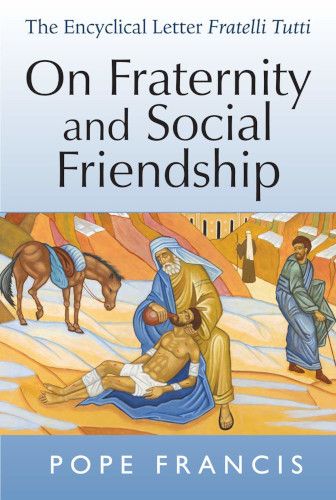
Last, but not least, is Pope Francis’s most recent encyclical, Fratelli Tutti. While Pope Francis’s commitment to peace is well-known, what does this social encyclical add to the earlier magisterium on war.
One thing to note at the outset is that Pope Francis's predecessors did discuss matters relating to war, but hardly ever in encyclicals. Mainly, you find discussions of war in their addresses. Pius XII often gave Christmas addresses. However, Fratelli tutti is one of the first encyclicals where there is a section specifically on the problem of war.
There are two things going on in Fratelli tutti that I find quite interesting. One thing is that Pope Francis returns to the way in which Thomas Aquinas raised the question of war. We can only speak meaningfully about war, whether it be just or unjust, within the wider horizon of peace. That is how Fratelli tutti proceeds. The first part of the encyclical is really about peace and the conditions for peace in our day.
The concrete setting for Aquinas’s discussion of just war is the virtue of charity. St Thomas notes that peace is among the fruits of charity. The other fruits are joy and mercy. So, Aquinas notes, peace flows from charity. That is why he has a whole question devoted to peace.
After discussing how peace flows from charity, he considers the sins opposed to peace. That is the procedure he follows in the Second Part of the Summa. He discusses the virtue and then looks at the opposing vices. Among the vices opposed to peace is war. So, Aquinas addresses the question of war explicitly apropos of charity: precisely because it is a sin opposed to charity. But then he recalls that there is this idea of just war, which was discussed by Augustine and Cicero before him. So, instead of embarking on a discussion of war as a sin opposed to charity, first he asks whether it is the case that warfare is always unjust. That is where he gives his famous account of just war. But the goal of this account of just war is to explain that there is unjust war and that unjust war is a really grave sin.
Pope Francis follows a similar trajectory. Fratelli tutti is about the conditions for peace in the world. Peace flows from charity and is an extension of charity. We need to examine all the different ways in which charity can be drawn into our lives together. So, it is really about the requirements of charity for our life in society. In this first part, Pope Francis does not quote from Thomas Aquinas, as far as I can recall, but to my mind he follows a very Thomistic approach in Fratelli tutti.
When we finally come to the section of the encyclical that deals specifically with war, Pope Francis is very focused on the sinfulness of war. You could say that this is in continuity with Aquinas's approach, as I have just explained. However, unlike Aquinas, Pope Francis does not launch into an explanation of how and when war might be considered just. He does not really embark on a differentiation of just from unjust war.
In reading that section, one can come away with the impression that, for Pope Francis, warfare is always unjust. He does not go quite that far. He does admit that the use of force in legitimate defence is still an integral part of Catholic teaching. He does not use the term just war. I believe he speaks of legitimate defence.
Using the label legitimate defence instead of just war is not an innovation on Pope Francis's part that. It is a common practice or way of speaking, one that stretches all the way back to Pope Pius XII. I have gone through and read the writings of Popes, going back to Pius XI, on matters relating to war. It is very rare that popes use the expression “just war”. The last time I have seen a pope using the expression “just war” in an approving way was Pius XII and this is not his favoured term. So, Pope Francis is not innovating in that regard.
Pope Francis returns to the way in which Thomas Aquinas raised the question of war. We can only speak meaningfully about war, whether it be just or unjust, within the wider horizon of peace
What we find in Fratelli tutti is that Pope Francis’s conception of what can be done in legitimate defence tends to be more restrictive than what one would see in the writings of previous popes, including Pope Benedict by the way. He expresses great reserves about using force in the interests of humanitarian intervention. He seems to pull back somewhat the support given to the responsibility to protect that you find in John Paul II and Benedict XVI. He does not say that it is no longer possible, but he seems more reserved than they were about the potential of using armed in the protection of civilians from harm.
To provide context for Pope Francis's position in this regard, the humanitarian interventions of the past years have not been particularly successful. Among the most recent was the intervention in Libya, which pretty much just ended up hastening the country's descent into disorder and violence. Our experience of the last years with humanitarian intervention have not been altogether satisfactory. Based on this through more recent past, I can understand why Pope Francis expresses reserves about it.
However, on the specific question of just war, the term does come up in a footnote within Fratelli tutti. It is in the section where he talks about war and, in that footnote, he disparages this idea of “just war”. He quotes from a passage in Augustine and says that no one would approve of this view of just war, as expressed by Augustine.
So, Pope Francis seems to really want to turn the page on the traditional Catholic teaching on just war. There is a whole school of thought within the Church today that advocates for just peace as the needed alternative to just war. Before Fratelli Tutti was written, the folks who ascribe to this line of thought lobbied the Pope to write an encyclical where he would finally set just war aside as a legitimate teaching within the Church. You could read that footnote in Fratelli tutti as a nod in favour of those who want to set the idea of a just war aside.
In an article in Revue Thomiste, I do a bit of exegesis on this footnote. The conclusion that I came to, by looking closely at that footnote and the passage from Augustine to which Pope Francis, is that when Augustine says that it is better to wage war with words than with arms, he is basically endorsing non-violence. Attempts at dealing with wrongdoing through persuasion, Christian witness, and so forth, is far superior to using armed force to confront wrongdoing and evil. Augustine is setting up that that contrast. But Augustin does speak approvingly of using armed force to confront wrongdoing, even though the way of non-violence and witness is better. But in the passage in question, Augustine is writing to a Roman who comes from a military background. He adopts some of the language and presuppositions of that Roman governor. He speaks about the glory of courage on the battlefield. He uses language that exalts courage in that setting.
This is fully understandable, once you realise that Augustine is adopting some of the phraseology of the person to whom he is writing. He wants to relate to that person. We do not ascribe to that sort of language today. We are no longer in a context where we speak of the glory of courage on the battlefield. That is not a way that Christian writers from Augustine himself—when he is not writing rhetorically, to make his words understandable to a Roman— Aquinas, and the thinkers who come afterwards view war. There is no exaltation of war. There is a recognition that it can be good to exhibit courage in a just war, but it is certainly not a matter of glorifying that mode of action. So, if you read the whole passage in that way, it is fully understandable that Pope Francis would say that we do not ascribe to this idea of just war today: that glorification of courage on the battlefield.
I came across The Path to Change, interviews with Pope Francis by Dominique Wolton, and there is a short discussion about Pope Francis's thoughts on just war. What he ends up saying is that he does not like the label “just war” because it makes it sound as though it is a great thing to be in war: as though this is a setting where justice in the full sense of the term can be realised. He reacts against that because, if you look at concrete wars, even wars that are waged for just purposes, like the Allied cause in the Second World War, lots of really bad things were done. War is not a setting to which you would want to apply the label “just” in the full sense of the term. So, Pope Francis does not like the label. If you build that sort of meaning into it, I don't like it either. People like Aquinas use the label “just war” (bellum iustum) not because they thought that this was a setting in which there is thoroughgoing justice. Aquinas realised that lots of bad things happen in war, even in just wars. He used that label because it was just the received term of art that was used, going back to Augustine and, before him, to Cicero.
At the end of the day, I think that Pope Francis is not adopting a pacifist position. He is not rejecting the very possibility of engagement or a rightful use of armed force. He wants to caution restraint. He does not like the term “just war” that is used to describe that sort of action. I do not think that he is turning the page on the just war idea. Of course, this has now come back. It is extremely relevant today because of the ongoing conflict in Ukraine. These issues have taken on a new urgency.
Modern technology has increased warfare’s destructive potential. Can the conditions for a just war still exist and does the Catholic teaching on just war still hold up?
In Fratelli tutti, Pope Francis says that, under conditions of contemporary warfare, it is very hard to meet the criteria for a just war. It is noteworthy that he does not say that it is impossible. I would agree with him. It is very hard to meet the just war criteria today for a variety of reasons, including modern technologies of warfare.
One reason why it is very hard to meet the criteria is that, unfortunately, a lot of wars take place where people happen to be living. When you wage war in a setting where people are living, and not where two armies are just on their own somewhere, say out on the high seas, it is very hard to maintain the fundamental principles of proportionality and discrimination. It is not impossible. Pope Francis does not say that it is impossible. It is a very challenging terrain.
Some forms of modern technology, if used, would render war morally illegitimate. A use of nuclear weapons, for example, are wholly incompatible with the principles of the just war that stemmed from Aquinas. I do not see how you could use a nuclear weapon and still keep to the core principles of discrimination and proportionality. On this score, Pope Francis has been really clear. He has condemned not only any possible use of nuclear weapons, but even the possession of nuclear weapons for other reasons: for instance, for reasons of deterrence. On this question of the permissibility of nuclear weapons, he has moved the teaching of the magisterium in a somewhat new direction. I would like to say that he has moved the teaching forward because I support this teaching. I think that it is the right way to go.
The previous magisterial teaching, that was begun under Pius XII but was articulated clearly by Pope John Paul II, was that it was permissible for states to possess nuclear weapons for reasons of deterrence, as an interim measure, while good faith efforts were being made for full nuclear disarmament. There was an allowance for the possession of nuclear weapons, not for use, but for deterrence. Pope Francis has sought to change that teaching for a reason that is consistent with that earlier teaching: that these efforts towards full nuclear disarmament have not really been made. State that possess nuclear weapons have not effectively sought to renounce them through an international process. They could be permissible as an interim measure, but the interim measure no longer seems to be applicable. It makes sense to come right out now and say that it is simply wrong to have these weapons, full stop. I need to add, so that there is no confusion here, that I do not think that this position, which has been clearly adopted by Pope Francis beginning in 2017, entails a call for unilateral disarmament, as though the United States, in heeding Pope Francis, should just give up nuclear weapons. I do not think that this is an implication of the teaching.
Some modern technologies are incompatible with discrimination and proportionality and have been banned: for instance, biological weapons, chemical weapons, and cluster mines. There are certain technologies that simply should not be used in warfare and, if they are used, this would be a violation of fundamental just war precepts.
Other technologies are bad, not so much in themselves, but because of their proliferation: for example, the prevalence of small arms throughout the world. It is not a good thing that small arms are so accessible. Their proliferation is quite harmful and has enabled conflicts in various places.
Other technologies can make war more discriminate. Certain forms of precision weaponry can have that effect. In World War Two, if you wanted to bomb a particular site, you just had to saturate the area with bombs, hoping you would hit the right site, but you would hit a lot of other things around it. Nowadays you do not need to do that because we have so-called precision weapons. In that sense, this is an advance.
Now, there are big discussions about so-called algorithmic warfare, which includes autonomous weapon systems. These are systems that that can function as enabled by artificial intelligence. There is a big discussion now about whether these autonomous weapon systems, and algorithmic warfare more broadly, would foster compliance with just war or counter it. There is no simple answer to this. That would have to be a topic for another discussion, but LAWS (lethal autonomous weapon systems) are the cutting edge of the recent discussions. In a book that I co-edited— Robotics, AI, and Humanity: Science, Ethics, and Policy—there is a chapter that I co-authored with my colleague Henrik Syse, where we examine the ethical debates surrounding LAWS (Lethal autonomous weapon systems).