

Attentiveness is a quality to be prized, distractedness detrimental, especially when it comes to the things that really matter in life. Philosophers, psychologists, and Christian authors have long studied attention and its importance. As Scriptures says, “Incline your ear, and hear the words of the wise, and apply your mind to my knowledge.” (Proverbs 22:17). In today’s world, however, not only can we access information of all sorts. We are bombarded by it incessantly. We are driven to distraction. As a result, our attention span diminishes. We may even lose the centre. Increasingly, we recognise the need to think about attention and form it.
In this interview Gregory Reichberg, discusses some of the best books on attention.
A philosopher by training (with a Ph.D. from Emory University), Gregory Reichberg is a Research Professor at the Peace Research Institute Oslo, where he writes on historical and contemporary issues in military ethics. His current work focuses on artificial intelligence and its implications for military ethics. He is the author of Thomas Aquinas on War and Peace (Cambridge University Press, 2017) and co-editor of several volumes, including The Ethics of War: Classic and Contemporary Readings (Blackwell Publishing, 2006), Religion, War, and Ethics: A Sourcebook of Textual Traditions (Cambridge U P, 2014), and Robotics, AI, and Humanity: Science, Ethics, and Policy (Springer, 2021). His articles have appeared in Catholic journals and magazines, including The Thomist, La Revue Thomiste, Nova & Vetera (English Edition), Proceedings of the American Catholic Philosophical Association, Commonweal, and America Magazine. On attention, he has published, "Studiositas, the Virtue of Attention," in The Common Things: Essays in Thomism and Education (Edited by Daniel McInerny); “Thomas Aquinas on Moral Responsibility in the Pursuit of Knowledge,” in Thomas Aquinas and his Legacy (edited by David M. Gallagher); "Toward A Thomistic Theory of Attention" (The Thomist, forthcoming).


- The Principles of Psychology
by William James - On The Trinity (De Trinitate), Book 11
by St. Augustine - Summa theologiae, Secunda Pars
(I-II, qq. 1-70) (I-II, qq. 71-114 )
(II-II, qq. 1-56) (II-II, qq. 57-140) (II-II, qq. 141-189)
by St. Thomas Aquinas - Treatise on the Love of God
by St. Francis de Sales - The Attention Merchants: The Epic Scramble to Get Inside Our Heads
by Tim Wu
You have a forthcoming article in vol. 88 (2024) of The Thomist: “Toward a Thomistic Theory of Attention.” Did you become interested in attention for purely speculative reasons, as a philosopher and scholar of St. Thomas, or because you were concerned about the detrimental impact of modern mass media on our capacity to concentrate on what really matters?
Originally, I became interested in this as a subject of theoretical inquiry, in 1990, just after I had finished my doctoral dissertation and was starting out as an assistant professor of philosophy at Catholic University of America. Only in the last few years I have become interested in how the teaching of Augustine and Aquinas on attention is relevant to contemporary issues, such as the impact of digital media.
What drew me to the topic was my dissertation, Moral Choice in the Pursuit of Knowledge: Thomas Aquinas on the Ethics of Knowing. In it, I showed how the uses to which we put our minds are an important topic for ethical reflection.
Take, mathematics. It is hard to find any moral matter within mathematics as such. Nevertheless, applying our minds to mathematics instead of thinking about something else can have moral significance. So, my dissertation studied the moral significance of our speculative intellectual acts.
During my research, I came across a distinction that Thomas Aquinas makes: between the specification or object of thought and the exercise of thought.
Often, the specification of our thought falls outside the realm of freedom. Take 2 + 2 = 4. I do not choose this to be the case. Rather, it is something I see or perceive. There are many other such examples. However, thinking about 2 + 2 = 4 is a free act. I could just as readily think about something else. This hinges on free will. With free will, ethics comes into play. Ethics is about how we use our freedom.
Soon after, I realised that whenever Aquinas talks about the exercise of thought, he could have used another term: attending to objects or paying attention to them. Around the same time, I discovered that within psychology there was a large body of literature on attention.
Many are aware of the substantial body of research in the natural and social sciences on factors that contribute, positively or negatively, to our attentiveness and concentration. Do these studies make important new discoveries or simply confirm what we have always known about the necessity of attentiveness and the ordinary means for fostering it?Attention is a phenomenon. It is a feature of our experience. We have been aware of this for ages. However, as far as I can see from my studies on the history of philosophy, Augustine is the first to conceptualise this phenomenon of our mental life. There are allusions to attention in earlier thinkers, such as Plato and Aristotle. However, it is Augustine who notices that something special is going on here and differentiates this aspect of our mental life from related ones.
In the modern period, beginning mainly with William James, there are attempts to build a theory of how attention functions. Some argue that we need several theories of attention to account for all its various aspects.
For instance, one aspect that the contemporary theory of attention examines is divided attention. We often refer to this as multitasking. However, is there such a thing as divided attention? Can attention really be divided at one and the same moment onto different objects or is something else happening? Are we simply switching very quickly between objects of thought? Much work has been done on this, beginning first and foremost with William James. This has become a major area within psychology, which often uses experimental techniques to sort out such issues.
Are the books that you have selected primarily speculative or practical? Do they describe the characteristics of attention as a cognitive act or show us how to form attentiveness as one or more virtuous dispositions?
The books cover a range of topics.
William James focuses mainly on the speculative aspects of attention. Nevertheless, towards the end of Chapter 11 of The Principles of Psychology, he makes powerful statements about the impact of attention on our moral lives.
Similarly, in De Trinitate, Augustine concentrates on the theoretical aspects of attention. At the same time, he is acutely aware of the impact attention has on our moral and spiritual life. In certain passengers of the Confessions, for instance, he is explains how attention can either draw us closer to God or away from him.
In the Secunda Pars of the Summa theologiae, St. Thomas brings the two prongs together: the moral psychology of attention and the actual ethics of attention.I have included a text from St. Francis de Sales’s Treatise on the Love of God because he delves into the spirituality of attention.
I round out the selection with a recent book, Tim Wu’s The Attention Merchants: The Epic Scramble to Get Inside our Heads. It is about the so-called attention economy. This takes us directly into sociology of attention, as well as its moral and political aspects. In the conclusion, Wu makes strong statements about the importance of preserving our attention. This is fundamental to a life well lived.
"God always has the first initiative in our spiritual efforts. He can draw out our attention in unexpected ways. This is basically what takes place in a conversion."
As you noted, Augustine, Aquinas, and Francis de Sales stress the importance of attention for the spiritual life. Should we not distinguish between secular conceptions and practices of attention and Christian ones? For example, mindfulness has become a buzzword in recent years. To a large extent, the practice of mindfulness is rooted in Eastern religious practices, whereas St. Augustine, St. Thomas Aquinas, and St. Francis de Sales are referring to specifically Christian forms of prayer and meditation. Do not many of the problems surrounding attention boil down to the fact that we do not dedicate enough time or effort to prayer?
The little I know about mindfulness is that it is about emptying one's mind and removing determinate thoughts. It seems to originate out of an impulse that is not distinctively Christian. It is not necessarily anti-Christian. That depends on how one practices it. However, in the Christian tradition, the idea is that emptying one's mind of certain thoughts and preoccupations renders it attentive to God. The emptying of one’s mind is not an end itself. It is instrumental to another end. This is perhaps the main difference.
There is another difference, one which is crucial to my reading of Augustine and Aquinas. The freedom of our attending is essential. At bottom, though, God always has the first initiative in our spiritual efforts. He can draw out our attention in unexpected ways. This is basically what takes place in a conversion.
A long time ago, I read a book written by André Frossard, a French journalist who was a militant atheist. One day, he went into Notre Dame Cathedral in Paris and was just seized by the thought of God, the presence of God. He was startled by this and eventually became a Christian. It was as though his attention was directed toward something he had never thought about. Otherwise, he would have resisted such thoughts. God takes the initiative and we need to leave ourselves open to him. This is fundamental. We talk about listening, but we do not always know what it is we are going to hear.
All of us Christians have had experiences of this sort. Even Aristotle acknowledged that there are moments of attentiveness that come from without: the mind is turned in a direction to which it has not turned itself. In the Eudemian Ethics, Aristotle talks about chains of deliberation. At the starting point of that reasoning process there needs to be an insight. In that insight, the mind is directed toward something but has not directed itself. Aristotle concludes, therefore, that there is something divine at the beginning of thought. St. Thomas Aquinas develops this idea but Aristotle had already pointed to this fundamental aspect of human nature: our attention is directed from without to certain things.
"In reading a great book, you are submitting your mind to a teacher. Reading consists in being taught."
In a celebrated article, Leo Strauss defined the liberal arts education as the study of the great books as a means of entering into conversation with minds greater than our own. Attentiveness is both a condition and an effect of a liberal arts education. Over the last few years, I have noticed how students have increasing difficulty in summoning the concentration needed to read such books. This is understandable. So many of the things take up their attention. Is the study of the great books one of the main ways to develop attention to the fundamental questions of human life?
In one of his discussions of attention, St. Thomas notes that there are three fundamental ways in which our attention gets directed to something.
One is the way we can apply by choice the knowledge we have acquired about a particular subject. This is what is going on now. You are asking me questions. I have thought about them and can call to mind my knowledge in the manner of a habitus or intellectual virtue.
The third is the way our primary thoughts are set in motion by God. We speak of this in terms of divine inspiration.
However, there is an intermediate way in which our attention is directed: through others. Learning is such a process. The teacher points to signs, symbols, and experiences that can lead the mind toward a truth. This is an intermediate way in which our attention is directed to truths to which we might not have attended otherwise.
The human mind is open to the infinite. That is what it is to have in mind. The senses can be applied to a vast range of things, but the human mind is even wider in scope. So how do we end up focusing on this rather than that? Teaching has a lot to do with that.
In reading a great book, you are submitting your mind to a teacher. Reading consists in being taught.
Lately, I have been reading novels by Doris Lessing and have learnt a tremendous amount. I have become aware of facets of my own experience to which I had paid hardly any attention at all. The same thing happens, albeit in a different way, when you are reading a master like Thomas Aquinas. I have been reading him for almost forty years but am always discovering new things and seeing new connections. It is always enriching.
We have a tremendous amount to learn from the great books, whether those in the Western tradition or other traditions.
Within the literature on attention, there is a discussion over sustained attention and what promotes it. William James took the topic up. He says that it is very hard to sustain one's attention by a sheer act of the will. When you try to sustain it in this way, you need to keep renewing that act of will. This is borne out by the research within contemporary psychology. Highly focused attention is hard to sustain. In the end, as James notes, what carries attention along is our interest in the object and finding the topic pleasurable. Our mind is fixed on the thing being studied not so much by choice but is carried along by its salience. For something to become salient for me, it needs to resonate in some fashion with my emotional life (taken broadly as including the will). We cannot force oneself into attentiveness. Rather, we need to be carried along by objects that are attractive. The problem with certain forms of digital media is that they attract our attention in unhealthy ways. The flashiness, movement, and colours of the phone promote a sensory activation which the plain print of book does not.
Appreciating the pleasure of having one's imagination activated by reading a book is something that the world has only learnt relatively recently: since the Gutenberg Bible and the invention of the printing press, when books became widespread. Prior to that, most people had their minds activated in other ways, such as stained-glass windows.
The long and short of it is that finding the reading of a book appealing is the result of a learning process.
1.
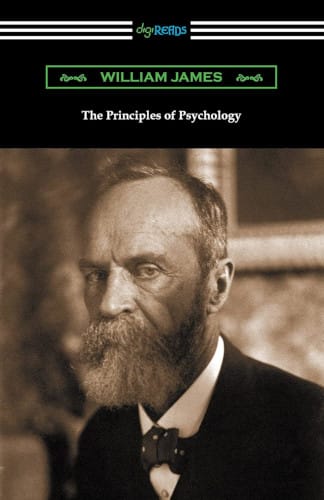
For the first books, you have turned, not to sacred teaching, but to psychology. Moreover, you have not turned to the recent literature, but to one of the discipline’s early classics: William James’ Principles of Psychology. Why have you selected this work?
It is a good place to start because James focuses on what attention is and is also good at separating the different parts of the question. How does attention arise? How is sustained? And so forth. Besides providing a nice overview, he is an excellent writer.
There are some famous passages in James that all the literature cites. Take this one.
“Everyone knows what attention is. It is the taking possession by the mind, in clear and vivid form, of one out of what seem several simultaneously possible objects or trains of thought. Focalization, concentration, of consciousness are of its essence. It implies withdrawal from some things in order to deal effectively with others, and is a condition which has a real opposite in the confused, dazed, scatter-brained state which in French is called distraction.”
Here, James highlights several key aspects of attention. Maybe the primary one is that attention is always selective. This is crucial within Aquinas's account.
Then, James explains that we cannot attend to many things at once unless they are inherently connected somehow. “Properly speaking, there is before the mind at no time a plurality of ideas, properly so called.”
There is a discussion of the varieties of attention.
“Attention may be divided into kinds in various ways. It is either to
a) Objects of sense (sensorial attention) ; or to
b) Ideal or represented objects (intellectual attention).
It is either
c) Immediate ; or
d) Derived…
Furthermore, attention may be either
e) Passive, reflex, non-voluntary, effortless ; or
f) Active and voluntary.”
Finally, James discusses the effects of attention. What follows from it?
“(E)ach of us literally chooses, by his ways of attending to things, what sort of a universe he shall appear to himself to inhabit.”
You choose what aspects of reality will become important to you.
I have put James first because the thinkers that I am most interested in, St. Augustine and St. Thomas Aquinas, never provide a systematic account of attention.
St. Thomas, for example, never asks “Quid sit attentio? What is attention?” However, he does asks, “What is pleasure?” and examines this question systematically. In both St. Augustine and St. Thomas, you find the elements that James later systematises.
By reading James first, you can go back to Augustine and Aquinas and discover points that they make but which you would never have noticed before. A whole world of considerations emerges. I am surprised how little scholars of Aquinas have noticed the importance of attention within his overall moral psychology, virtue theory, and even his metaphysics. I would not have noticed these aspects of his thought had I not studied the systematic work by later thinkers.
2.
For the second book, we move from psychology to sacred teaching and Book XI of St. Augustine’s On the Trinity. This work might strike some as an odd choice. It is concerned with clarifying the central mystery of the faith and refuting heretical readings of Scripture’s teaching on it. How come it makes an important contribution to the study of attention?
Yes, this does seem paradoxical. How does the Trinity come into the picture?
Book XI is part of Augustine's wider discussion within On the Trinity of psychological analogies of the Trinity.
It is only through divine Revelation that we know that God is triune. However, to understand what it means for God to be triune, we need to look for aspects of our experience that are analogous to God’s threefoldness. In De Trinitate, Augustine spends a lot of time looking at such possible analogies.
In Book XI, he discusses the outer man. The idea is to show how there is a trace of the Trinity in the functions of the soul that are common to both humans and other animals: sensation, imagination, and memory. Here, Augustine is not discerning an image of the Trinity in the human being but vestiges of it that are common to humans and other animals. Later, he looks at analogates of the Trinity that can be found in the inner man.
Augustine tracks a double trinity in the outer man. There is the first trinity: a sensible body; a sensory power trained on a sensible body; the act of will that unites the two.
Take, the fragrant smell of a turkey roasting in an oven. The turkey is a sensible body. Smell is the sensory power trained on that body. As it smells really good, there is a third aspect—the act of wanting to smell it—that joins the two together. However, by finding the scent of the roast turkey attractive, my emotional, appetitive life is awakened. I can’t wait to eat it. I focus on it. I might start to think back to when my mother prepared turkey during my childhood and how good it was.
Augustine argues that the sensible body corresponds to the Father. The sensory cognition begins with the thing itself, which informs the senses. Then there is the sensory perception itself. It corresponds to the Son. The desire to focus on that object and experience it sensorily corresponds to the Holy Spirit. The Holy Spirit is the binding power that joins together the Father and Son.
That is the first vestige of the Trinity. The second that Augustine highlights in Book XI is: the image preserved in one's memory; the act of focusing on that image; the act of will that joins the two together. For example, I may have in my mind an image of the roasting in the oven, back when I was a kid. I can voluntarily direct my mind to that image and attend to it.
To reflect on an image or past-experience, three things need to be present. I need to have that image. However, I must also want to recall the image. It is only then that I have the actual cognition that flows from it. The coupling act provides a vestige of the Holy Spirit. At this level, attention emerges. Again, your attention is focused on an object because it is moved by appetite. If you did not have that appetite, your mind would not be engaged.
This is the trajectory that Augustine follows in Book XI. Successively, he fills it out.
3.
Third up is the vast Secunda Pars of the Summa theologiae of St. Thomas Aquinas. Where in this part of the Summa does St. Thomas discuss attention?
The main locus of his discussion of attention is the Secunda Pars.
The topic already arises in the Prima Secundae (The First Part of the Second Part), in the discussion of human acts, the acts that we perform voluntarily.
A distinctively human act proceeds from reason and will. Aquinas contrasts these to the acts of a human being. Not all our acts are human acts. As we speak, I am breathing. However, I am not choosing to breathe. I could. I could decide to focus on my breathing. However, breathing, like all the other processes going on in our body, is not a distinctively human act but an act of the human being.
Thomas has an extended discussion of what sort of acts are human acts. It really comes down to those acts that can be chosen. However, there is also the whole domain of the emotions. They are not entirely voluntary but often arise within us. Nevertheless, we have a measure of control over them. Finally, Aquinas notes that exercising the intellect itself is a human act. We exercise thought at will. There is even an article on whether the act of reason can be commanded by the will, that is, directed by it.
In the Prima Secundae, therefore, he provides a speculative account of how intellect or reasoning can be chosen or self-directed.
In the Secunda Secundae, he starts to spell out the moral or ethical implications of this teaching. He discusses the vice of morosa delectatio (lingering on a disordered delight). At the same time, he is acutely aware that virtue requires that we take delight in good things. So, the ethics of attention deals not only with the negative side, vice, but also with the positive side: pleasure insofar as it is an essential component of virtue.
This reaches its fruition in his consideration of the virtue of studiositas. This virtue is the disposition to apply one’s mind rightly. It is a virtue of the will, an appetitive power, insofar as it directs the mind. St. Thomas is acutely aware, therefore, of the moral dimensions of attentiveness.
He also has a significant discussion of the role of attention in prayer.
First, he lays down the moral psychology and inner dynamics of attention. Later, he shows how this can shed light on living virtuously.
He believes that knowing something is always voluntary, in some measure, but not that every single act of knowing results from an act of will. Not every act of thought can be a willed act. If it were a chosen act, you would end up with an infinite regress. Every act of will presupposes a thought. If every act of cognition were preceded by an act of will, which in turn requires an act of thought, you would end up in an infinite regress. So, some thoughts just come to us. However, when they come to us and have not originated in a choice, we always have the choice whether to stay with the thought or not, particularly when we find that thought pleasurable. Pleasure plays an important role in attention. But so do the other appetites. “Even the demons believe—and shudder.” (James 2:19). St. Thomas says that they do not have faith but, as their minds are so rapid, they cannot but acknowledge that God exists. They just infer it so quickly. Similarly, when they see the acts that Jesus performs, they cannot but acknowledge that that there is something about him a mere human cannot do. However, as soon as they perceive that God exists, they recoil. They find this truth detestable and do not maintain their attention on it.
"What sort of things do you enjoy knowing? Addressing that question is crucial in the spiritual life."
4.
Fourth, is St. Francis de Sales’s magnum opus, the Treatise on the Love of God. It is one of many classic works on spirituality that were written during the period, such as those of St. Teresa of Ávila or St. John of the Cross. Does this work focus more clearly on attentiveness than comparable writings of the period?
I converted to the Catholic faith when I was twenty. When I was received into the Church, my godmother was a Visitation nun. So, I decided that I should read St. Francis de Sales, the founder of the Visitation order. I started reading the Treatise on the Love of God and was surprised at how Thomistic it is.
In the introduction, St. Francis de Sales refers to St. Thomas's account of goodness and the co-extensiveness of goodness and beauty. In Book One, he talks about the centrality of love in our lives. Every single action is directed by love. It may not be a rightly ordered love, but love governs everything we do. Love is the fundamental emotion.
Even our acts of thought are directed by love. You think about that which you love and dwell on it.
St. Francis de Sales provides a Thomistic account that tracks the sequence of the Prima Secundae. However, instead of framing the discussion in terms of will, as Aquinas does, he focuses on love, the fundamental act of the will, and shows how it impacts everything we do.
He has a beautiful discussion about how important it that the love of God should penetrate and direct one’s will. This is all about attention and sometimes he uses the word ‘attention’.
He presents this whole dynamism of love directing thought in experiential and phenomenological terms. What is mysterious here is that—and this also goes back to Augustine and Aquinas—there is something more than willpower at work. You cannot will yourself into certain mental attitudes.
On the other hand, effort does play a role. Often, when you put the effort in, certain modes of thought become more spontaneous, habitual, and pleasurable. So, it is important to learn how to take pleasure in things that merit enjoyment and remove oneself from the things and thoughts that might provide immediate pleasure but are unfulfilling in the long run. What sort of things do you enjoy knowing? Addressing that question is crucial in the spiritual life.

5.
In the modern information economy, increasingly homo sapiens has become homo distractus. This phrase is used in your final pick, Tim Wu’s The Attention Merchants. Wu charts the modern commercialization of every moment of our life and argues that we should care about how radically this can impact our life for the worse. What lessons does one take away from the book?
Wu is a professor of law at Columbia University. He puts a very sharp light on the dynamics of attention in today’s public sphere.
The book is basically a history of the advertising industry. Advertising is something we take for granted because it is all around us. However, it arose at a certain historical period. In Wu’s account, it arose about 150 years ago, in mid-nineteenth century France.
Back then, streetlamps and small electrical installations had paintings on them. Someone in France realised that you direct people's attention to what you wanted to sell by putting paintings of beautiful women on lampposts.
Then, during the First World War the British Government moved to encourage people to support the war effort. This was the beginnings of propaganda: using advertising to move people to act in certain ways.
A whole industry has arisen around the capture and monetization of people's attention. Advertisers find ways to attract our attention to a particular object for sale. The advertiser sells that attention space to clients. A TV commercial is a clear example. In the beginning, you did not pay a subscription to watch TV. The shows were free. But then there was the commercial break. The advertiser owns that break and sells it to the highest bidder, who can use it to focus to the collective attention of the audience on a product. The advertisers spent a lot of time refining the various techniques for drawing out our attention.
At the beginning of the book, Wu notes that the Church was the original master of drawing our attention. Think of cathedrals and their beauty, both on the outside and the inside. They were a way of drawing people's attention to God. The Church became a master in drawing our minds and attention to the transcendent good so that might will direct ourselves more fully to that good. Think of the Mass: the beauty of the ritual and the importance of vestments. These are means of drawing our attention.
However, roughly a hundred years ago, people developed techniques for drawing out our attention and making things salient, not for our good, as the Church had done, but for the financial gain of third parties.
Wu tells how this progressed, both in commerce and propaganda.
Think about how Hitler succeeded. It was not by accident. He learnt certain techniques for drawing people's attention. After the First World War, he was hired by the Bavarian intelligence service to find out more about certain groups that were recruiting members in beerhalls. He acted as if he were a member of those groups. To do that, he had to give speeches in the beerhalls. In the process, he discovered a set of techniques for making ideas interesting and appealing to people. Unfortunately, what he learned were ways of appealing to people's baser instincts.
If you bring the story up to the present, as Wu does, there is a whole account of how Facebook functions. Facebook was all about taking the attention we direct to friends and networks, collecting it, and selling it to advertisers. Instead of getting a group of people to collectively attend to something, as with the old TV technique, Facebook found ways of individualising the collection of attention.
Google replicated this incredibly effective technique and developed it further. Why does Google give a service for free? It is not for free. Every time you click on an Internet site, Google saves that that bit of information about the internet user and sells it. A whole economy has developed around tracking each individual’s attention, finding what you have attended to previously, guessing what you will find pleasure in, and pitching products that will appeal to you. You end up in a digital environment where so many things are tailored to you and set up so that you find them. You get sucked into a web of attention-attraction, one that can be hard to get out of.
Wu describes this dynamic, how it works, the various techniques, the companies in question, and how they have really studied attention. They have hired psychologists who understand the dynamics. They have an edge over the consumer, who does not have this inner knowledge of how attention works. We are prone to manipulation.
In the concluding chapter, Wu says,
“At bottom, whether we acknowledge it or not, the attention merchants have come to play an important part in setting the course of our lives and consequently the future of the human race, insofar as that future will be nothing more than the running total of our individual mental states. Does that sound like exaggeration? It was William James, the fount of American Pragmatism, who, having lived and died before the flowering of the attention industry, held that our life experience would ultimately amount to whatever we had paid attention to. At stake, then, is something akin to how one’s life is lived. That, if nothing else, ought to compel a greater scrutiny of the countless bargains to which we routinely submit, and, even more important, lead us to consider the necessity, at times, of not dealing at all. If we desire a future that avoids the enslavement of the propaganda state as well as the narcosis of the consumer and celebrity culture, we must first acknowledge the preciousness of our attention and resolve not to part with it as cheaply or unthinkingly as we so often have. And then we must act, individually and collectively, to make our attention our own again, and so reclaim ownership of the very experience of living.”
Two of my colleagues at the University of Oslo, Katharine Browne and Sebastian Watzl, have a website entitled Ethics, Attention and the Digital World. It is about learning how to take possession of one’s attention in the context of digital media. It's an excellent resource.
The fundamental truth here is that our mental life, including our spiritual life, is really about what we have paid attention to overall. St. Thomas comments that attention becomes habitual and has a momentum to it. Once you attend to something in a focused way, even if you stop to do something else, you come right back to it. There are patterns of attention that characterise our life. Crucially, living well depends on the good or bad patterns of attention that you have developed.
Does Wu also explore the impact of the attention economy on the workings of democracies? A well-functioning democracy requires high levels of public debate and critical thinking, whereas, with the new social media, people do not develop those capacities to a sufficient degree and become more manipulable.
He examines this mainly in the context of propaganda. However, there are considerable studies about why some digital platforms and media sites have become such awful places to be. A lot of it boils down to how these sites appeal to our baser emotions, such as outrage or delight at seeing other people humiliated.
We can go back to St. Francis de Sales’s idea that love is the fundamental directive force in our lives. The love in question is not necessarily virtuous but simply the attraction of the will. Unfortunately, baser attractions can have a very potent hold on our states of attention.
Think of some of the techniques that former President Trump developed and used so effectively. He said outrageous things and this attracted attention.
Wu has an account of how newspapers discovered this early on. Advertising is one of the main vehicles that led to the establishment of newspapers. You can only make so much money selling papers by themselves. To become a significant media platform, newspapers had to bring in advertising money. Very early on, it was found that if you appeal to certain kinds of emotions, such as outrage, you could attract readers. However, all of this is fundamentally detrimental to democratic modes of social existence. It is important for people to live, not only according to the senses, but according to reason.
There is a saying in Norwegian: “Taste is like someone’s rear end. It is divided in two.” Taste is always individualised. If our attention is focused on reactions that are not founded on reason but on passing emotion, there is very little you can do to appeal to someone and reflect together on an issue you disagree over. Everything becomes based on emotion. “I feel this way. You feel that way.” That's it. There is nowhere else to go. Consequently, you gravitate to all the people who feel like you do, and you do not pay attention to the people who think differently or reject them utterly. The only way to overcome that is to have some sort of reflection that derives from reason. As Aristotle and Aquinas note, reason focuses on that which is universal. By focusing on truths that are universal and seeing how they are connected with one another, we have a chance of meeting another mind that, at the outset, might be moving in a different direction and thinking differently from us. This is crucial in a pluralistic society. What we are getting into now is a dividing up of society into different camps which hardly commune with one another. People are reading different newspapers and listening to different political figures. In the end, this will undermine society. However, much of it derives from a manipulation of attentional processes in favour of what is basest in us.
So, we are in danger of becoming Alypius, St. Augustine's friend, who was drawn to the circus.
That is right. I tell his story early on in my forthcoming article in The Thomist. In his youth, Augustine had this friend who refused to go to the circus and gladiatorial spectacles, where humans were slaughtered. Eventually, a group of his friends just dragged him into the circus. He protested that this was beneath him, shut his eyes, and put his hands over his ears. However, at one point the roar and the enthusiasm of the crowd for the killing caught his attention. He opened his eyes, believing he could control himself and not be affected. However, he was seized by the spectacle, sucked into it, and went back to the circus time and again. At that point, he could not help himself. He had discovered a pleasure.
This is a classic case of what theologians, such as Aquinas, call an occasion of sin. There are certain situations in which we should not place ourselves because we know that, once in those situations, we will likely fail and fall.
A long time ago, I heard a Sunday homily in Atlanta, Georgia, where the elderly pastor talked about the evils of pornography. It was not the sort of subject you want to hear about at Sunday Mass, when you hope to be uplifted. However, I still remember this pastor saying that he knew cases where people just dipped into it and fell into a habitual compulsion that they had great difficulty coming out of, even though they really wanted to. They found it nearly impossible to do so. Alypius’s is a story about occasion of sin. Pornography is a case of attentional attraction. It is a case of how a pattern of attention builds up and becomes habitual.