
Modern science uncovers ever more evidence that evolution is behind the origin of man and every other biological species. For some, science thereby confirms that there is no need to postulate a divine creator. For others, we cannot accept evolution as it appears to be incompatible with the Bible's teaching on the creation of man. The Catholic Church, on the other hand, insists that Revelation and science do not contradict one another and that we should inquire more deeply into each. Even so, many struggle to square the theory of evolution with the Church's teaching that God creates each human person directly.
In this interview, Matthew Ramage discusses these problems and recommends some recent studies on the compatibility between evolution and the Christian faith.
Matthew Ramage is a professor of theology at Benedictine College and an adjunct professor of Sacred Scripture for the graduate programs at Holy Apostles College and Seminary and St. Bernard’s School of Theology and Ministry. His research and writing concentrates on the theology of Joseph Ratzinger/Pope Benedict XVI; wedding ancient and modern methods of biblical interpretation; the dialogue between faith and science; and the development of a robustly Catholic approach to care for creation. He is a science and nature enthusiast and a Scholar Associate of the Society of Catholic Scientists. He is the author of The Experiment of Faith: Pope Benedict XVI on Living the Theological Virtues in a Secular Age, Jesus, Interpreted: Benedict XVI, Bart Ehrman, and the Historical Truth of the Gospels, Dark Passages of the Bible: Engaging Scripture with Benedict XVI and St. Thomas Aquinas, and From the Dust of the Earth: Benedict XVI, the Bible, and the Theory of Evolution.
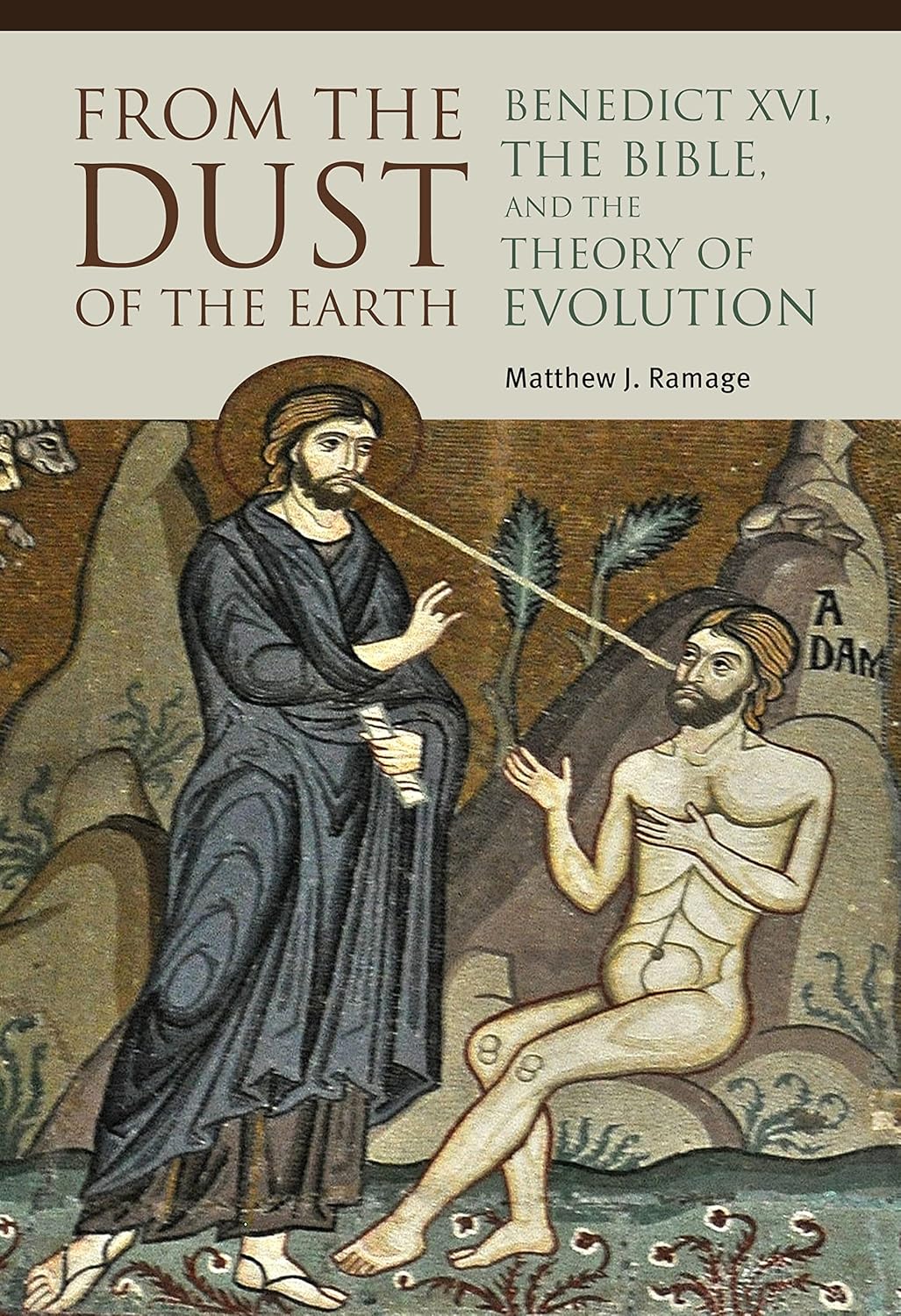

- Faith, Science, and Reason: Theology on the Cutting Edge
by Christopher T. Baglow - Thomistic Evolution: A Catholic Approach to Understanding Evolution in the Light of Faith
by Nicanor Pier Giorgio OP et al. - Creation through Evolution: New Perspectives from Thomistic Philosophy and Theology
edited by Nicanor Pier Giorgio OP - Theistic Evolution: A Contemporary Aristotelian-Thomistic Perspective
by Mariusz Tabaczek OP - From the Dust of the Earth: Benedict XVI, the Bible, and the Theory of Evolution
by Matthew Ramage
Is evolution a scientific hypothesis, a fact, or a theory?
A theory. I subscribe to the view that science needs to be inherently falsifiable, otherwise it is not science. Hence, theory is the better word.
As John Paul II famously said, evolution is definitely more than a hypothesis. A hypothesis is put out as a possibility for which there is not yet proof. It is reasonable to pose a hypothesis. However, a theory arises whenever a hypothesis has been tested and proven to not be falsified. It must be open to at least some revision, and yet it offers a very strong explanatory framework.
Like many words, such as ‘myth’, ‘theory’ has gone through a devalued process. Nowadays people say things such as, “That is just your theory.” Here, ‘theory’ is a synonym for ‘that is just your conjecture or opinion.’ However, in science, a theory is a well-established framework for understanding something.
What is the current consensus within the scientific community over the mechanism of evolution?
The consensus is constantly developing. It is neat to be a theologian who is interested in science rather than a PhD in science. Of course, your question is best answered by a professional biologist. However, natural selection and the recombination of DNA remain part of the consensus about the mechanism.
As a Thomist, I would say that there is also some element of contingency or chance in the process of speciation and genetic change, just as there may be some chance to how the rain falls or to how a river arises. However, this process is governed by a teleology. In the scientific literature, there is some recognition of an underlying teleology.
Once you have that current cut, there are only so many pathways it can take. The classically trained Catholic philosopher or theologian understands that some degree of chance is involved in the evolutionary process. Chance is part of God's providence. It serves a greater goal, just like human freedom.
Natural selection, within an underlying teleology, is certainly part of evolution. So is survival of the fittest. The birds were the only dinosaurs that were fit to survive after the great events that occurred 66 million years ago. They were the fittest to survive in the new climate because they could fly.
I am an example of a human who would have been selected against if not for man's unique rationality. I have lupus. I have had kidney failure and heart issues that would have killed me already. Man is part of this evolutionary process but is more than it. He is a rational animal, as Aristotle says. He can transcend the evolutionary process.
The modern popes are not only comfortable with the scientific theory of evolution but have even put it forward in a way.
"We need to educate people about evolution because there is no reasonable alternative scientific proposal."
You are a theologian. What prompted your interest and research on theistic evolution?
During my undergraduate years at the University of Illinois, I was trying to defend the Catholic faith at a secular university. One of the things that kept coming up was that science disproves God. John Paul II’s encyclical Fides et Ratio was relatively new. In it, he decried scientism: the reduction of all knowledge to the empirical sciences.
Ironically, back in high-school, I had a wonderful zoology teacher. He was a six-day-creationist who thought the world was 6000 years old. I was just an average Catholic, and not a very staunch one. However, I was struck by his views and became interested in defending both my faith and science.
My love for the natural world and creation also underlies my interest in this issue.
When I started at Benedictine College, I noticed that students were increasingly distraught by the seeming incompatibility between creation and evolution. Even today, people who do not even take my classes come and ask me about this problem. They have heard the two are incompatible from an atheist podcaster. More often than not, Catholic personalities have told them than they cannot believe in evolution.
Hence, I have become increasingly interested in defending the classical teaching of the Church on the unity of faith and reason, particularly as regards evolution.
As you mentioned, many find it difficult to reconcile Christian belief with evolution. Many even conclude that science thereby disproves the doctrine of creation. To what extent are such difficulties and conclusions based on a deficient understanding of science and, perhaps even more fundamentally, philosophy?
It is certainly based on a deficient understanding of science.
Honour students can invent a class and have asked me a couple of times to teach one on faith and evolution. Some had followed a Protestant homeschool curriculum that presented the two as incompatible. So, there is a problem of scientific illiteracy.
We need to educate people about evolution because there is no reasonable alternative scientific proposal.
My homeschooled children are taking high-school biology classes from one of my own colleagues and are learning the basics of evolution. It is framed within the content of faith.
A group of Dominican friars and nuns have launched a Thomistic Evolution project. There are even writing materials for incorporating it into high-school instruction.
However, as you said, there is a deeper philosophical problem. Pope Benedict claimed that it stems from an understandable fear that once you open the door to modernity and give an inch, it will take a mile. The fear is that the faith will end up like a jellyfish, with nothing to hold onto. His response, like that of his friend Henri de Lubac, is that we must not fear that the faith is too weak to stand up to scrutiny. Such a fear often signals a loss of faith. That is my quasi-pastoral experience of evangelizing my students or people who send me emails. The faith is strong enough to stand up to these questions. Not only that, the faith needs to have a voice. We cannot cede this territory to secularists.
What are the main magisterial teachings on evolution? What does the Church teach about evolution?
We need to begin in 1950, with Pius XII's Humani generis. This is the only encyclical to address evolution. Remarkably, it came out when the evidence was much less strong than it is now. There are now multiple strands of science— from biogeography to genetics—that point in the same direction. The homologous structures, different species, and the fossil record all point in the same direction.
However, Pius XII was the first pope to officially address evolution in a systematic manner. He taught that Catholics can accept evolution of the body, but must hold that the soul is created directly by God. That remains the teaching of his successors. Neither Paul VI nor John XXIII said much about the matter. John Paul II and Benedict XVI have said the most. Francis has only touched upon it tangentially.
Pius XII then stated that it is in no way apparent how you square polygenism with original sin.
Kenneth Kemp has pointed out that, back in the 1940s and 50s, polygenism was the belief that humans arose on multiple continents. That ‘theory’ really is a hypothesis. Some even held that the white race is better because it arose in Europe or that blacks were inferior because they evolved separately. Pius was right to decry that thesis theologically. Moreover, that hypothesis is scientifically false. The human race is one.
In his letter to the head of the Vatican Observatory, John Paul II stated that evolution is more than a hypothesis and that we need to investigate whether an evolutionary perspective might shed more light on anthropology: on man created in view of Christ.
Benedict XVI states that there are so many proofs in favour of evolution and that we see it right before our eyes. The theories regard the mechanism, but it is a fact that life evolved gradually.
He spent decades probing this problem and wrote about it off and on.
The other day, some students came to my office to ask me a few questions. They had heard from a biologist that, given evolution, humans are not unique. They wondered why the Church does not come out and just declare evolution true. My first inclination was to wish that it did. However, the Church should not do so. Science does not belong to the realm of faith and morals. There should be no magisterial declaration about the science because we will come to an ever deeper understanding of the mechanisms of evolution.
The International Theological Commission’s document Communion and Stewardship was the last time the Church wrote something fairly authoritative on evolution. It is worth checking out. However, it is not magisterial per se. It is the document of a Vatican curial body that the magisterium stamps as orthodox.
That document describes how mankind arose, either as an individual or in populations, around a couple hundred thousand years ago in Africa. That is still largely accurate. However, it would be best not put such claims into a magisterial declaration.
Staying on Humani generis, does Pius XII really teach that evolution entails that God does not create the body directly?
If I understood him correctly, he says that the body can evolve.
Does he actually opt for one hypothesis or the other?
He leaves it open. In my opinion, he seems to root against evolution even though he is open to it.
Pius XII is a very interesting pope. He declared the Assumption of Mary, but was also very nuanced on biblical scholarship. His encyclical on interpreting Scripture, Divino afflante Spiritu, is quite advanced. He was the first pope to open the door to the now well-established findings of modern biblical scholarship.
Humani generis teaches that there is an apparent incompatibility between polygenism, the descent of humans from more than one pair of parents, and the universality of original sin. Original sin is transmitted through natural generation from Adam to all humanity. Has this teaching been revised by a magisterial teaching of equal or greater authority?
No, it has not.
Professor Ratzinger inquired into this. With a priest, who is a friend of mine, I am working on an article on Ratzinger's lecture notes on creation. Importantly, he distinguishes polygenism from polyphyly, the view that there are multiple lineages. He accepts polygenism, though in a sense different from Pius. So do an increasing number of orthodox Catholics.
Last summer I was on a panel on this subject with Kenneth Kemp and Fr Mariusz Tabaczek OP. As Thomists, we agreed that the first humans, Adam and Eve, had genetics from a very large population of prior breeding hominins. Science has established that the breeding population was at least several thousand hominins that were biologically almost identical to us. We can call this polygenism. However, polygenism is this sense is different from that of which Pius XII spoke. In modern terminology, it is polyphyly that is difficult to accept theologically: that humans arose once, say, in sub-Saharan Africa and sometime else in super-Saharan Africa. Scientifically, this does not seem to have been the case. Even so, it would be difficult though maybe not impossible to square such a situation with the dogmas of the faith.
Were the first parents created at one single moment? The magisterium leans in that direction. However, it is not 100% clear. This is a topic Fr. Tabaczek and I are currently probing.
Scripture teaches that man is made in the image and likeness of God but palaeontology has identified various species within the genus homo. Is homo sapiens the species of homo that is created in the image and likeness of God, or does the current state of palaeontology suggest otherwise?
As Ratzinger says, we will never be able to excavate the first human with a shovel. His preferred way of speaking about what makes us uniquely human is to say that we are the only species capable of a relationship with God. Thomists would say that only humans have an intellect capable of concepts and free will. Science does not disprove any of that.
The science becomes interesting when it can start to delineate the latest or the earliest that humans originated.
Neanderthals were making jewellery 200,000 years ago. They were our cousins and share a common ancestor that was already rational.
Some argue that homo erectus, from 2,000,000 years ago, was already rational because he stood upright and walked like us. This is a hypothesis rather than a theory. However, some argue that homo erectus lit fires and brought them deep into caves, thereby demonstrating a level of forethought that far outstrips anything else that had ever existed on the planet.
Kenneth Kemp and William Lane Craig have written very interesting studies on this. They posit that, given the current evidence, homo heidelbergensis from 750,000 years ago was already rational. Though I have a hypothesis on out of my own, I do not have any horse in the race. The point is that science can help us figure out when we humans must have first existed. As Aquinas says, we know the soul by its actions. A mere chimp or non-rational animal cannot have produced sophisticated eagle-talon jewellery.
You noted that Kenneth Kemp has written a history of the debate between Christian theology and the theory of evolution. He sums up the thesis in the title of his book: The War That Never Was. Is that an accurate description or an oversimplification of the debate?
I love Kemp's book and he is writing another, which will be the definitive history of Catholicism's engagement with the theory of evolution. Maybe there was a war over evolution but it did not have to be that way.
Ratzinger admitted that the Church engaged in some warfare with Galileo and did not need to have been so severe with him. Not that Galileo was treated poorly. My astrophysicist friends who specialize in the Galileo case tell me that he was treated quite well in his house arrest. And no, he had not proven everything that he claimed to have proved.
Still, Galileo and Copernicus were right: heliocentrism is correct and geocentrism is wrong. Incidentally, heliocentrism is a theory. You could call it a fact, but it is still an explanatory framework. The Church and everybody in Western civilization had held that incorrect scientific worldview for millennia.
Nevertheless, while there have been moments of battle, if not warfare, the Church has always been pro-science, just as she his pro-man even though her record on slavery, the treatment of Jews, or any number of issues, is not perfect.
Some might argue that there are theological and metaphysical reasons for maintaining that God creates both the body and soul of a first parent directly, rather than by transforming some member of a pre-existing species of hominin into a new kind of creature. What are the main philosophical and theological arguments against special transformationism?
A literal reading of Scripture supports the view that God created both our first parents’s body and soul directly. However, along with Ratzinger and John Paul II, I would say that this is a somewhat illiterate reading. Vatican II calls us to read Genesis in light of its literary genres. As the Catechism teaches (n. 390), the creation narrative of Genesis relates real events, but in figurative language.
In the first account of creation in Genesis 1, it looks as if God creates each species through a fiat. That would be a stronger argument against transformationism. Nor did the Church Fathers know about evolution. Naturally, they believed each species came about individually.
I was thinking more along the lines of the argument that relies on the Thomistic concept of soul as the form of the body, which is also dogmatized in the Council of Vienne. Infusing a new type of soul into a pre-existing body does not seem compatible with the soul's nature as the form of a body.
The Council of Vienna comes up in Kenneth Kemp and Mariusz Tabaczek. They are better than I am on this concept and have dug deeply into the wells of Thomism. However, I am of the same view as them.
According to hylomorphism, the soul and body have to conform: they have fit one another. Any living thing has a soul; only man has a spiritual soul.
Kemp takes up the discussion of the first human. It cannot be an all-or-nothing one-time affair. The fossil record that bespeaks the continuity between homo sapiens and earlier hominins. However, let us say that the creation of the first human was a unique event. The first human’s parents would be human biologically, but not spiritually or theologically. They would have had an animal sensitive soul, but not a rational one. Whatever biological changes need to take place, the spiritual changes went along with them, and vice versa.
Fr. Nicanor Austriaco of the Thomistic Evolution Project explains that some biological change needed to have occurred. There are certain genes associated with language. Some Catholic scientists are researching this. At the same, there is definitely a biological continuity between us and earlier species of homo. Hence, their soul, though not a spiritual soul, would have to fit with a body that had a share in rationality. St. Thomas allows for even ordinary mammals to have a share in rationality. That helps a lot because the proto-humans would have had many traits that were already more advanced than those of chimps, a species from which we split around six million years earlier.
“Science can purify religion from error and superstition; religion can purify science from idolatry and false absolutes. Each can draw the other into a wider world, a world in which both can flourish.”
John Paul II
Each of the books you have recommended argues that evolution is compatible with what God has revealed about the creation and fall of our first parents. Who makes the strongest case for the opposing position?
I have read many of them and I believe that they are all weak. Most are fundamentalist and accept six-day creationism, but the one I would recommend is Thomistic: Fr. Michael Chaberek’s Aquinas and Evolution. Those interested should read it in concert Fr. Mariusz Tabaczek’s book. Fr. Chaberek is not a fan of evolution on the principle that more cannot come from less.
To my mind, Fr. Tabaczek’s more recent tome, Theistic Evolution, definitively answers all of Fr. Czabarek's qualms.
1.
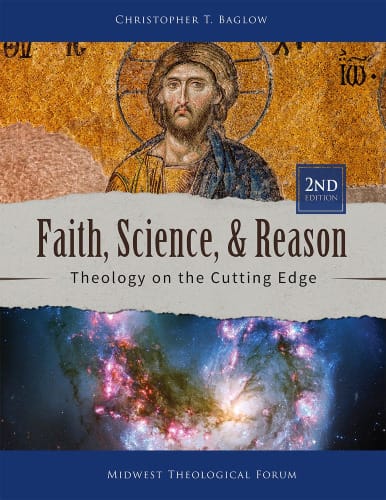
Why is your first recommended book one that is written for school and college students: Christopher T. Baglow’s Faith, Science, and Reason: Theology on the Cutting Edge?
It is a tremendous book. I believe that Baglow assigns it to freshmen at Notre Dame. Along with the Society of Catholic Scientists president, Steve Barr, he has a curriculum for high school teachers. It can be used as a high school text.
This book is tremendous for several reasons. Its publisher, Midwest Theological Forum, do a nice job at so many things. The book is faithful to Church teaching and cites the popes repeatedly. It is deeply biblical. It addresses all the major areas of science. Even I, who specialize in this subject, picked up on some new information. However, a high schooler can also read it.
It goes through evolution and the big bang. It also addresses the case for miracles: how miracles are compatible with science and science points to them.
The book also has images of, for example, the Laetoli footprints. These are some of the earliest extant footprints that belong to an upright hominim because there are no knuckle prints. There are images of reconstructions of skeletons, actual fossils, and the art of the Church. This is my go-to book for people who are ordinary Catholics.
What is Baglow’s position regarding the compatibility between evolution and the Church’s teaching on the creation of man?
Baglow takes the position of the modern popes, such as John Paul II and Benedict XVI: the process of evolution is guided by God and mankind is unique despite emerging through evolution. In this regard, Ratzinger states that although man came through evolution, he is more than evolution. It is not a matter of either creation or evolution, but of creation and evolution. Each answers a different question. Baglow emphasises John Paul II’s remark that, “Science can purify religion from error and superstition; religion can purify science from idolatry and false absolutes. Each can draw the other into a wider world, a world in which both can flourish.”
I love discussing this in seminars with students. Faith can purify scientists— who sometimes act as if they know everything—from idolatry and false absolutes. However, science can purify faith from superstition. It can purify it from magical thinking: the idea that things just happen. This idea arises when we do not engage with the dynamics of the real world. Baglow forces the reader, in a good way, to think through how the Scriptural narration of God’s works needs to correspond with the world we know. The more that we engage both together, the better we know God.
Is Baglow’s Creation: A Catholic’s Guide to God and the Universe a more accessible introduction to the same topics?
Yes, and you can read it in a couple of days, whereas as you would probably need a couple of weeks for the other one. If I had to pick only one of the two, I would go with Faith, Science, and Reason because it is more in-depth. However, I was delighted with the shorter book too.

2.
-The next three books are by Dominicans and draw heavily on St. Thomas Aquinas to argue that evolution is compatible with God's action in creation. Like St. Thomas, they seek to show that what they know by faith is compatible with what we discover through reason. First up, is Thomistic Evolution: A Catholic Approach to Understanding Evolution in the Light of Faith. This collection comprises short essays on biblical exegesis, dogmatic theology, philosophy and science. What makes this a good guide to debate over the compatibility of evolution with creation?
In terms of accessibility, it is second to none. Each chapter is very short—about five or ten pages—and easy.
The articles have been written by a team of Dominican scholars with different specializations. Some of the authors are scientists; some are theologians; some such as Fr. Nicanor Austriaco, are both.
They argue that, if Aquinas were alive today, he would have accepted evolution, along with many other things that he did not know about. He respected nature. Even in his own day, he stood out for believing that, though man started to die because of the fall, the fall did not cause animal death. As he pointed out, falcons and lions have never been herbivores. Most Catholics might not realise it, but Aquinas’s thought is compatible with the current science.
This book delves into both the science and the philosophical relation between evolution and divine causality. It also considers how original sin fits into the picture. It covers all the major topics.
"It is more accurate to say that God governs the world through evolution rather than creates through evolution."

3.
Third is Theistic Evolution: A Contemporary Aristotelian-Thomistic Perspective by Fr. Mariusz Tabaczek OP. Tabaczek criticises some of the arguments and conclusion of the preceding volume. What is his position?
It has been a joy to get to know Fr. Tabaczek. One of his observations has struck a chord with me. It has become commonplace to speak of evolutionary creation or creation through evolution. Even Ratzinger speaks in this way. Technically however, as Fr. Tabaczek notes, God creates once and for all. Creation is ongoing in that God is eternal. If we follow St. Thomas’s lead, however, it is more accurate to say that God governs the world through evolution rather than creates through evolution. Divine providence and governance are the ways in which God, once he has created things, operates in space and time. Evolution is one mechanism that he uses to achieve the telos of creatures.
Fr. Tabaczek also emphasises that the human body was not developed first and then a soul infused. The soul has been there the whole time because soul and body must be fit with one another. Some imagine the soul as if it were a separate thing that enters into the body. The human soul is immaterial and so we need to use analogical metaphorical language to describe its creation, such as infusion. However, we also need to uphold a robust hylomorphism and not divide man up. Body and soul are in utter unity in this life. Fr. Tabaczek’s emphasis on this is a real strength of his text.
Let’s stay on one of the points you made. Evolution belongs not to God's creation but to his providential governance of creation. Fr. Tabaczek, if I have understood him correctly, considers evolution to be a process of production rather than creation. Only God can create. However, the process by which one species gives rise to another is a case of production rather than creation.
Yes, I think he is right about St. Thomas on this. He also goes into prime matter in a way that was helpful to me: regarding the conservation of energy. There is no new energy in the universe since it has been created. We are all stardust. We all come from the same single common ancestor about 3,500,000,000 years ago. Since then, there is production. Creation has occurred. God lovingly maintains it. However, he gives to creatures the power of secondary causality to move themselves into being. Other Thomists teach this too. However, Fr. Tabaczek emphasizes that the dignity of the creature is enhanced by its contribution to speciation. We have an active role. As parents, we contribute to the origin of this creature, even though God immediately creates the soul.

4.
At the time of this interview, the next book has not hit the market. Creation through Evolution: New Perspectives from Thomistic Philosophy and Theology “contains ten new essays that directly respond to the most common philosophical and theological objections put forward by Catholics who are skeptical about evolutionary theory.” What are its main responses to those objections?
There is a wonderful essay, “What Kind of Death? Romans 5 in Modern Science,” which discusses Paul’s teaching on how death came through the fall is much more nuanced many suppose. Animal death did not come after the fall. Animals have been dying for billions of years before humans ever existed. Hence, Paul has spiritual death primarily in mind
Another of my favourite essays is “Nihil dat quod non habet. Nothing gives what it doesn't have: Thomistic Naturalism contra Supernaturalism on the Origin of Species.” Another is, “Thomas Aquinas on the Proportion of the Living Species.”
These essays, especially the last one, take up the charge some anti-evolutionists make that evolution violates the principle “that which is greater cannot come from what is less.” The argument the essays make is that, while St. Thomas endorses this principle, his teaching is much more nuanced. For example, he believed in spontaneous generation, as did everyone else at the time. He believed that bugs were generated spontaneously in manure from primary matter under the causal influence of the sun. Interestingly, he envisages something that is similar to random genetic change. For Aquinas, therefore, it is possible for the more to come from nothing in a certain sense: locally and in spontaneous generation. However, in the grand scheme of things, bugs do not come from nothing. For Thomas, the sun preserves the system. This applies to modern science and other areas in the following way. Locally, in a closed system, the greater cannot come from less. With evolution, we are not operating in a closed system. With evolution, material is drawn from the outside. It is not that the greater comes from less in the strict sense whenever a new species comes into being.
The authors of this book also talk about Aquinas’s conception of instrumental causality. An instrument can produce something that exceeds its natural power. By itself, a saw cannot cut down a tree. Under the agency of a higher cause, it can. In the process of evolution, God takes creatures which, by themselves, may be unable to produce something greater to produce it. Ratzinger gives a great example. We humans always outstrip ourselves when we conceive and give birth to a new human life. My seven children really did come from me and Jen. However, our DNA did not produce the human person or its soul. God created them but he did not do so apart from us. The marvel is, as Ratzinger says, that he does so though the causality of the creatures involved and by enhancing it rather than sidestepping the creatures.

5.
Finally, we come to your own book, From the Dust of the Earth: Benedict XVI, the Bible, and the Theory of Evolution. One of its aims is “to provide a systematic…treatment of Ratzinger’s extensive contributions on the subject.” What are his main contributions?
He was a landmark ecclesial figure who, over five decades, had a sustained interest in evolution and showed its compatibility with Scripture and prior dogma.
At heart, he was a biblical theologian. Hence, one of the main things he does is spend a lot of time on the Bible, though he was hardly the only theologian to do so.
In my book, I refer frequently to two of his books. One is In the Beginning, a set of four homilies on creation. The other, which is my top recommendation, is The Divine Project: Reflections on Creation and the Church.
He looks at the biblical account of creation both dogmatically and literarily. He shows that the bible’s description of Adam is not meant to be a scientific teaching about how humans arose. Adam is the first man, but he is also every man. The story of Adam is the story of mankind as such. It is the story of Israel, their creation, and their fall. Whenever, Ratzinger comes across an apparent incompatibility between faith and established science, he shows there need not be a contradiction because the Scriptures are teaching us science but something that science cannot.
For example, in describing how Adam is created from the dust of the earth, the Bible signifies that we are nothing on our own. “What is man that you care for him?” (Psalm 8:4). By describing how the breath of God that is given directly to man alone, Genesis signifies that we are raised above other creatures. We are unique. We are called to till and keep (avad and shamar) the garden, something no other creature can do. These are the words used to describe the office of the Levitical priests. We are the priests of creation.
Eve is created out of Adam's rib. Scientifically, that is implausible. However, from the perspective biblical literary genres, this is an instance of aetiology. The Bible is showing a deep truth that, in theory, we can know through reason, but sometimes fail to recognise: the equal dignity of man and woman. Eve is not created from Adam’s foot, as if she were lower that him. She is created from his side. She is his equal to him. She is taken from near his heart and meant to return back to his heart, and him to her. They are incomplete without each other, as John Paul II would say. The human person does not make sense by himself. Adam and Eve show forth the conjugal or spousal meaning of human nature.
These are a couple of my favourite things, among many others, that Ratzinger shows. He shows that God creates through rather than aside from evolutionary processes.
Every time I have a question that seems to plague me, he has already put it better than I have, answered it, and added nuance to what I wished to say.
Are there any other good forthcoming resources on the relation between evolution and revealed truths about the origin of man?
There is a new edition of Thomistic Evolution. Another, published by Word on Fire, is Darwin and Doctrine by Dan Kuebler, a biologist and major player in the Society of Catholic Scientists. Usually theologians write on this subject, but Kuebler's theology is very sound.
Here is a beautiful analogy that he draws in the book.
“Christ did not enter creation fully formed to set about his work of redemption. Rather, he entered it completely taking part in every stage of human development. In doing so, he allowed himself to be dependent upon humans, Mary and Joseph. Likewise, the first human would not have entered creation fully formed in a disruptive manner, much like a foreign interloper. Rather, he would have entered and participated in every stage of human development. In doing so, the first human would have been dependent upon other creatures for his physical survival, just as Christ made himself dependent upon Mary and Joseph. But, just as Christ's divinity was not compromised or diluted by being nurtured by mere creatures, the first human would not have had his human nature compromised by being nurtured by advanced non-human hominins. This is particularly true, he says, given that he would have been endowed with the original state of justice. In fact, given the Catholic notion that man is the crown of creation, it would seem fitting that the first man be brought to completion with the direct aid of God's creation, the creation in which we all find ourselves deeply embedded and for which we are given responsibility. Just as Christ, who is the fulfilment of humanity, took his material nature from Mary and transformed it. The first human who was the fulfilment of creation, the only creature God willed for its own sake, would have taken his material nature from hominins, such that God, through the creation of the human soul, could transform it.”
This is a fascinating reflection. Theologically, we cannot know for certain how the creation of the first parents took place. However, it is fitting that, just as Christ went through and became truly man in all its stages, taking the prior mere matter from Mary, so too it seems supremely fitting that, the true image of God emerged on earth in a similar manner. The first man would have not been plopped down as a fully formed thirty-year-old.
God's pedagogy, whether it be in the development of the Scriptures or in nature, tends to work itself out gradually to achieve its telos.