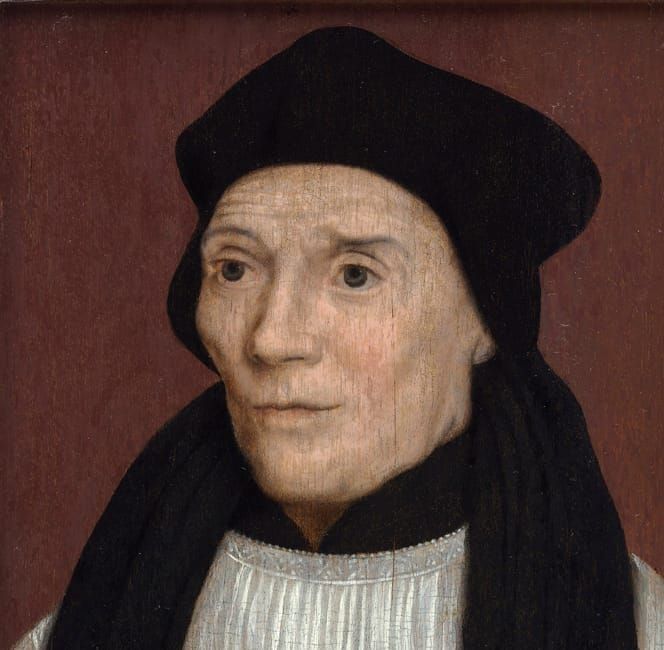
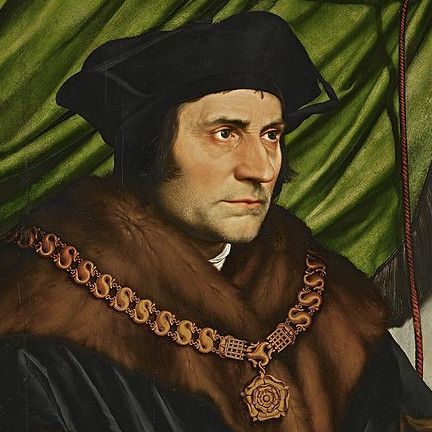
St. Thomas More (1478-1535) was a leading humanist, English statesman, and ended his earthly pilgrimage as a martyr. The son of a judge, More received an excellent classical education before becoming a lawyer. After a period of vocational discernment, he decided to remain a layman rather than become a Carthusian. He married twice and had four children with his first wife. Elected to Parliament in 1504, he rose through a series of public offices until succeeding Cardinal Wolsey as Lord Chancellor. He was esteemed by leading humanists of the age, such as Erasmus and Juan Luis Vives. He also engaged in theological debates with Martin Luther and took action to quell the nascent spread of Protestantism in England. However, he fell out of favour when he refused to recognise the validity of Henry VIII’s marriage to Anne Boleyn and the king’s claim to be the head of the Church in England. Finally, after various attempts, a trial found him guilty of treason and he was executed, refusing up to the end to renounce his Catholic faith.
He was beatified in 1886 and canonised along with St. John Fisher in 1935. The memorial of the two saints is celebrated on June 22. In 2000, St. John Paul II named Thomas More patron saint of statesmen and politicians.
In this interview, Frank Mitjans explains his pick of some of St. Thomas More’s writings and studies on him.
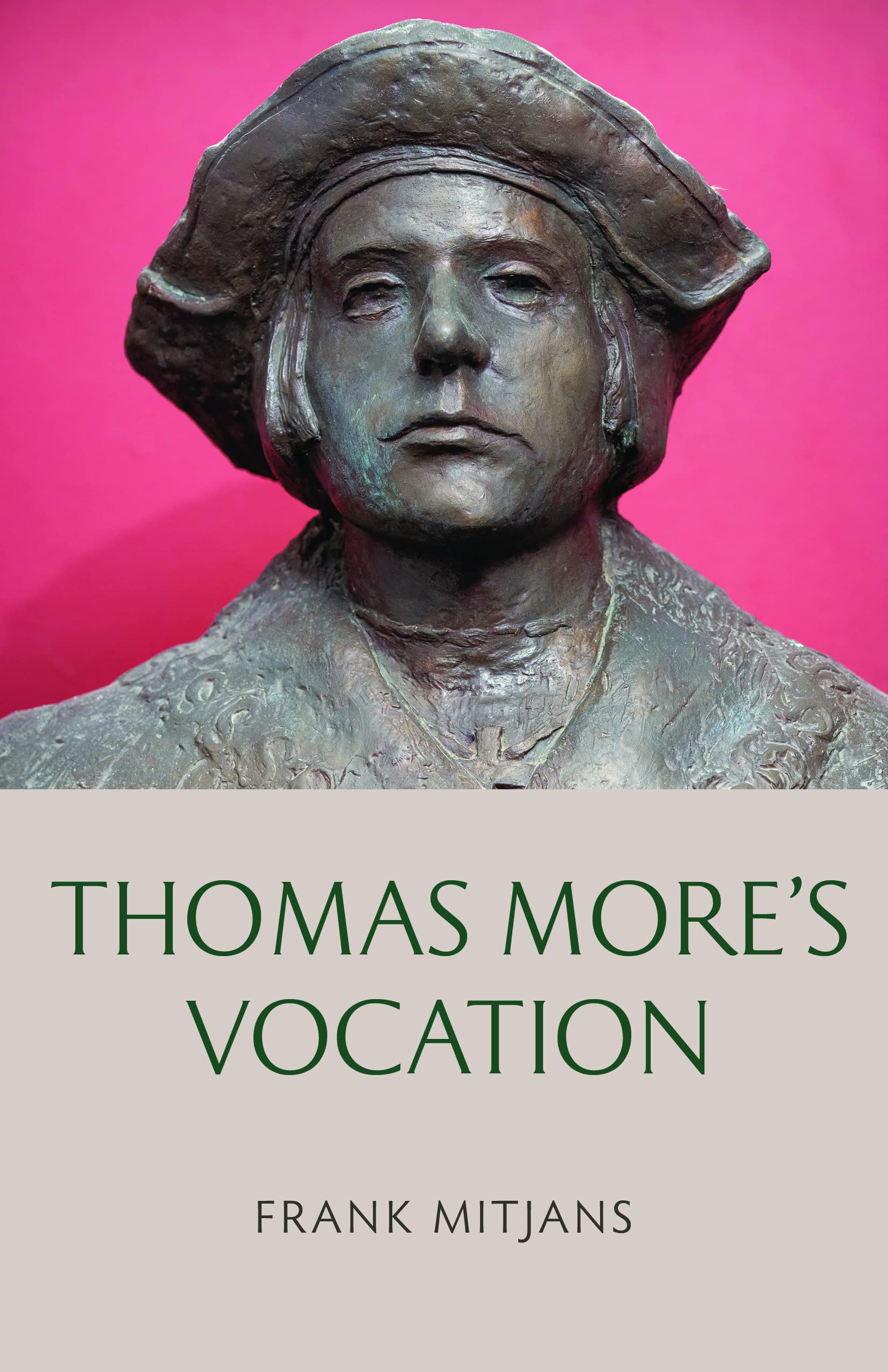
Frank Mitjans is a Spanish architect who has worked in London since 1976 and has long been interested in St. Thomas More. Since August 2002 he has given many presentations and talks on the topography of More’s London to groups of students and other interested people in Britain, Ireland, and Sweden. He has published various papers on St. Thomas More and more recently Thomas More’s Vocation (Catholic University of America Press).

- Thomas More: A Short Biography
by James McConica - Thomas More: A Portrait in Courage
by Gerard Wegemer - Thomas More (Classic Thinkers)
by Joanne Paul - The Life and Illustrious History of Sir Thomas More
by Thomas Stapleton - The Sadness of Christ
by St. Thomas More
You have mentioned that a visit to an exhibition on Thomas More at the National Gallery started your interest in him. Why did it spark of your interest in him, and how did that interest develop?
I was invited to attend that exhibition by an author who had written a biography of Thomas More in 1962. He was very keen on St. Thomas More and so he invited me to the exhibition, which I found very interesting.
That got you interested in researching on Saint Thomas More and writing on him?
Up to a point. Much later, I met Gerard Wegemer of the University of Dallas. He is the one that encouraged my interest in St. Thomas More.
In parenthesis, you mentioned that Thomas More thought of becoming a Carthusian. We do not have any early record of someone saying that he was thinking of becoming a Carthusian. He lived near the London Charterhouse and participated in some of the practices of piety with the Carthusians there. Nonetheless, neither he, nor Erasmus, nor his son-in-law William Roper, nor any of his other biographers ever said that he thought of becoming a Carthusian. Somehow, a few modern authors draw that conclusion.
Are there any other aspects of his biography you would like to stress that have not been mentioned already?
We know that Thomas More is a saint because the Church has canonised him and did so because he was obviously a martyr. However, he was not a saint because he was a martyr. Rather, he received the grace of martyrdom because, throughout his life, he tried to respond to God’s call. Therefore, in my book, Thomas More’s Vocation, I focus on his early writings and choices. When he was quite young, he was writing poetry and putting God first. There is an early poem, “The Pageant of Life”. It is in English, yet he writes the last stanza in Latin, where he states that the love of God is the greatest thing of all. We see how his interior life, his spiritual life, was there from the very beginning and in his upbringing. Moreover, he writes these early poems prior to living near the Charterhouse.
St. Thomas More is just one of the Church’s many saints. Why is he worth reading today? How is this sixteenth-century humanist and statesman relevant for us today?
Of course, there are many saints, and we can learn from them all. However, as a statesman, he was in a prominent position. He was the Lord Chancellor. At the time, the Lord Chancellor was the king’s highest minister. Confronted with serving the king and keeping his own position, he decided to side with the demands of his conscience. The demands of his conscience were not simply whatever he thought, but his willingness to always do the will of God.
Henry VIII was very adamant that he wanted to divorce his wife. He sought an annulment. It was not granted. Throughout this process, Thomas More was very clear that the marriage between Henry and Catherine was valid, and that in no way could he agree with what Henry was trying to do. In upholding the validity of the marriage and the unity of the Catholic Church, he was giving not just his opinion but his life. When the Pope refused to declare the marriage null, the only way Henry could obtain the needful decree was to make himself the head of the Church. All the bishops in Parliament, except John Fisher, went along with that. John Fisher and Thomas More gave priority to being faithful to God instead.
On a less scholarly note, many know St. Thomas More from popular media. On the one hand, Robert Bolt’s play A Man for All Seasons, adapted into an Oscar-winning film by Fred Zinnermann, presents More as a man of integrity and a martyr of conscience. On the other hand, Hilary Mantel’s Wolf Hall trilogy, later made into a TV series, presents him as a rigid authoritarian, hell-bent on torturing Protestants. Which of these two literary presentations is the more accurate?
Well, Mantel won prizes for her fiction, and that is fine. She wrote well but she wrote “fiction”.
Robert Bolt’s A Man for All Seasons is a play. Plays need to have a unity of time, place, and scene. So, nor is a playwright writing history.
So, there is the novel and the play. The play is the more accurate of the two. It gives an accurate characterization of Thomas More, even though many aspects of it are not historical.
The best way to form a view on Hilary Mantel is to go to the website of Prof. Richard Rex, a professor of Reformation history at Cambridge University. He emphasises that Hilary Mantel’s fiction is not at all accurate: she transfers the virtues and good humour of Thomas More to Thomas Cromwell, and Cromwell’s defects to More. She transfer’s the character of the one onto the other.
"More is a man of angel's wit and singular learning; I know not his fellow. For where is the man of that gentleness, lowliness and affability? And as time requireth, a man of marvelous mirth and pastimes; and sometimes of as sad a gravity; a man for all seasons." Richard Wittington
But even though she writes fiction, should we let her off the hook so easily? She is writing historical fiction and trying to shape the public's perception of historical figures, perhaps not in the most honest of ways.
It is legitimate to write historical novels. Robert Hugh Benson wrote historical novels. However, both historical novels and plays must convey the truth and portray the character of the person properly. This is not the case with Hilary Mantel. She denigrates Thomas More. She claims to have done a lot of research, but that does not mean that what she portrays is in any way accurate.
In the motu proprio in which he declared More patron of statesmen and politicians, St. John Paul II noted nonetheless that “in his actions against heretics, he reflected the limits of the culture of his time.” Did Thomas More adopt reprehensible means against early English Protestants?
In 1401, Parliament passed a bill whereby heretics were to be stopped, judged, and punished. The bill established the burning of heretics. This punishment was not devised by Thomas More but by a 1401 bill of the English Parliament. That bill was aimed mainly against the Lollards. When taking any public office, civil servants had to agree to this bill of Parliament and to oppose the expansion of heretics. So did Thomas More, even before he became Lord Chancellor.
Once again, this whole issue is explained very well by Richard Rex in his chapter in The Cambridge Companion to Thomas More (2011): “Thomas More and the heretics: statesman or fanatic?”
In January 1518, Lutheran books started to come into England. First, Erasmus wrote to Thomas More about these Lutheran books. Henry VIII took some interest. However, it was only with Luther’s On the Babylonian Captivity of the Church, which is clearly subversive, that Henry considered that this would cause a rebellion against the civil authority and tried to stop the Lutheran influence in England. To that end, he appointed Thomas More as one of the persons charged with tackling this. At some stage, the Bishop of London asked Thomas More to write against the heretics. In 1529, he wrote A Dialogue Concerning Heresies. Once he became Lord Chancellor, under the terms of the 1401 bill of Parliament, he, as the civil authority, had to identify those who were somehow disrupting the peace of the country, and bring them to justice. The civil authority detained the heretics, handed them over to a court of the bishops, who had the authority to declare whether someone was a heretic or not. Those declared heretics were handed back to the civil power, which imposed the punishment decreed by the 1401 act of Parliament.
During More’s time as Lord Chancellor, six people were executed for heresy. In three of these cases, More was involved in seeking the witnesses and testimonies.
Nowadays, when we speak of humanism, we mean something different than the sixteenth-century humanists did. They were Christian humanists.
1.
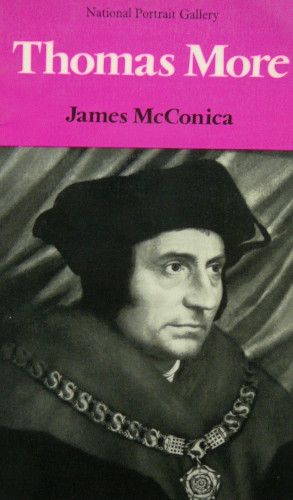
Your first recommended book is a short biography written by Reformation historian, Fr. James McConica. Why does it top your list?
Often, biographies portray the vision of the author. It is highly difficult to render the reality of a person, but James McConica gives a very accurate view of Thomas More. It is a short book: sixty-four pages in all. It has an excellent understanding of how More was a good friend of his friends and a humanist with a clear idea of public service.
Nowadays, when we speak of humanism, we mean something different than the sixteenth-century humanists did. They were Christian humanists. They saw their study of Sacred Scripture in the original languages, the Church Fathers, and the works of classical Greek and Latin literature, as a way of contributing to the evangelization of society. They were aware that, at the time, there was a certain decadence in Christendom. To promote an improved understanding of Christianity, they went to the sources and fostered the study of the classics. That was stopped by the Protestant reformers. This is a great pity because the Christian humanists tried to reform the Church within the Church, whereas the Protestant reformers did not.
As McConica explains, Thomas More understood marriage as a vocation to holiness and his service to the king as a contribution to the common good. He saw, therefore, that he had to defend the validity of Henry and Catherine’s marriage.
2.
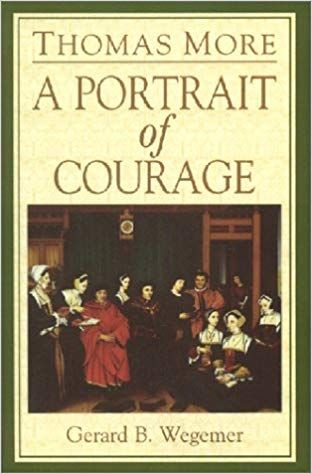
Next is Gerard Wegemer’s Thomas More: A Portrait of Courage. As the subtitle suggests, this biography focuses on his struggles to be a man of courage. What are its main lessons in this regard?
Gerard Wegemer starts by considering Thomas More’s translation of The Life of Pico della Mirandola. There, More added a passage on the properties of a lover, including the lover of God. He also added twelve characteristics of spiritual struggle. Wegemer considers how, throughout his life, More tried to grow in the spiritual virtues but also, as Wegemer has emphasised in his more recent books, in the virtues that one finds in the Greek and Latin classics. For Wegemer, this helped More to build his character and confront the difficulties that came up.
3.
For the third book, we pass from modern biographies of St. Thomas More to Joanne Paul’s recent study for Polity Press’s Classic Thinker’s series. What makes this a good guide to his political thought?
Well, she is writing for university students who are interested in political thought. She portrays the mind of Thomas More very well and shows how he defended Christendom and the common good. This is very relevant because, as she puts forward, the politician must work towards the common good.
Looking at Utopia, she stresses how Thomas More described a society in which there were common values, even though one might disagree with some of the values he mentioned.
One thing that I discovered from her book is how More learned from his intervention in the riot of 1 May. It is well known that while he was under-sheriff of the City of London, he managed to stop a riot of Londoners on 1 May 1517 on account of his prestige. He was much praised for this. Joanne Paul points out, however, that subsequently there were further disturbances and troops had to be brought in. According to Paul, More realised that his personal prestige and office in the city were not enough, but that he had to intervene at the national level as well and work for the king.
You have not included St. Thomas More’s most celebrated work, Utopia, in your list. Have you chosen Joanne Paul’s survey of his political thought as a surrogate for the more challenging Utopia?
Yes, she speaks a lot about Utopia. According to her reading, Utopia is a defence of holding everything in common: there is no place for private property in Utopia. That is one view of the work.
Obviously, some conceptions of this common ownership, such as the one given by Plato in the Republic, are erroneous. Plato extends this common ownership to sexual relationships between men and women. That is not the case at all in Utopia, where Thomas More places the family as the nucleus of society. It is not that he is under the influence of the Republic. Rather, he is responding to some things that Plato wrote, but which do not make sense, and correcting them. In my opinion, he is well aware of St. John Chrysostom’s claim that the Republic does not make sense in many aspects.
Utopia has been the object of much scholarly debate. Some wonder to what extent More is being ironical. Others, such as Marx and Lenin, thought it was a precursor of socialism. Indeed, Lenin had Thomas More's name engraved in the Alexander Obelisk, near the Kremlin. But you are saying that it represents a traditional Christian position.
Well, Utopia has two books. The second book describes a society that is nowhere to be found. The preceding book contains the dialogue between Raphael, Peter Giles, and Thomas More. This dialogue addresses the dilemma of the scholar: whether to concentrate on wisdom and the study of books—which is portrayed in Raphael—or to choose the active life of service to society, which is the position of Thomas More. This first part of Utopia is very clear and recommendable. It conveys the mind of More clearly.
At the end of the second part, with its description of that society that is nowhere to be found, More says that he is not sure whether he agrees with it or not. If he does not know whether to agree or disagree, we are entitled to follow his example: think about it, while remaining free to agree or disagree.
"Most of the things that we know about him come from two sources: this book by Stapleton and the writings and letters of Erasmus. This book was written on the continent in 1588. It is based on the testimonies "
4.
Your fourth pick is one of the earliest biographies of St Thomas More, that of the English theologian Thomas Stapleton, published in 1588. Why should it be of interest to general readers today?
This is the one that gives us most information about Thomas More. Most of the things that we know about him come from two sources: this book by Stapleton and the writings and letters of Erasmus. This book was written on the continent in 1588. It is based on the testimonies of those who belonged to More’s circle and had left England because of the persecution of Catholics, first under Edward VI and then under Elizabeth. They have the English and Latin writings and letters of Thomas More. Most of his letters are part of this book. The previous biography, by William Roper, does not mention More’s children, Utopia, or his other writings. Roper’s biography has been highly praised because it was written in English and the Early English Text Society made a point of studying it. It is important as a work of English literature, but, as a history of Thomas More it is the brief recollection of just one person. Stapleton, on the other hand, draws on the testimonies of More’s circle, his books and letters.
5.
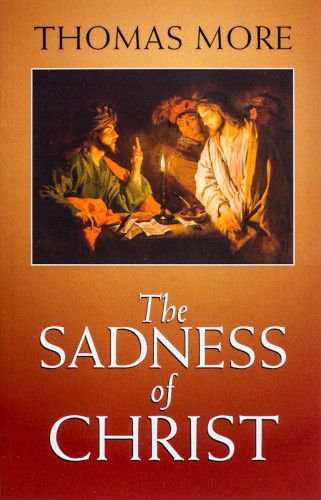
Finally, there is De tristitia pavore tedio et oratione Christi ante captionem eius (The Sadness, the Weariness, the Fear, and the Prayer of Christ Before He Was Taken Prisoner), which appears in vol. 14 of Yale’s edition of The Complete Works of St. Thomas More. Why have you singled this work out from More’s various writings?
This is a marvellous book. It is More’s best book. You have given the full title of the work, which can be abbreviated in English as The Agony of Christ. Abbreviating it as The Sadness of Christ is inaccurate. The last word of the sequence within the title is the important one.
More began to write about the prayer of Christ (De oratione Christi), but then added ‘On the Sadness, the Weariness, the Fear, and the Prayer of Christ’. He wrote the work very quickly. He was aware that he was nearing his death. He meditates, contemplates, and prays on the prayer made by Christ prior to his capture. He tells the reader that we need to pray and set fixed times for prayers. Correcting himself, he insists that we need to pray always. We are on a pilgrimage and yet a pilgrim needs to rest. One remains a pilgrim, even when at rest. So, the Lord’s injunction to pray always is true, not allegorical. We need to be always in the presence of God, even when we are sleeping.
It is worth getting volume 14 of The Complete Works of St. Thomas More. It is probably in every university library. It contains the Latin text as well and a photographic reproduction of the manuscript.
From the outset, Thomas More also speaks with a great hope in heaven. He has his mind on heaven. Aware of his own impending martyrdom, he stresses that, just as Jesus Christ suffered, even to the point of shedding blood, one should not go towards martyrdom reluctantly.
He ends by speaking of Mary Magdalen’s love for Christ. Finally, he speaks of the passage in Mark where a young fellow follows Christ, observes what was going on in Gethsemane, and because of his love for Christ, was very close to him during his prayer there. Then, when everybody else had left, he continued to be close to Christ. When they try to take him, he flees. More sees in this young man a representation of how the love of Christ cannot be hidden. It is apparent to everybody. Everybody else there was either terrified or full of hate against Christ, this young fellow was full of love for him. More writes “how hard it is to disguise the love we feel for someone!”, and stresses that we need to go to heaven with this youthful love for Christ.
There is also a popular edition of the work, edited by Gerard Wegemer. Yes, there is that edition from Scepter Press. The Spanish and Italian editions are just as accurate as the English one, when it come to their translations of the original Latin, but they have the advantage of translating the title as The Agony of Christ. The Sadness of Christ gives a very partial view of the work.
Do you recommend any other of St Thomas More’s spiritual writings?
If you have access to the Yale edition of The Complete Works of St. Thomas More, you can find some of the early writings.
The marvellous Dialogue of Comfort Against Tribulation is a book for spiritual reading. A few weeks before he died, my friend Dominic Baker-Smith, an expert on the literary aspects of St. Thomas More, sent me a very nice e-mail on the saint’s dies natalis (6 July), and described how he was then reading The Dialogue of Comfort not as a scholarly work, but as spiritual reading.
Similarly, his brief treatise To Receive the Blessed Body of Our Lord Sacramentally and Virtually is also marvellous. In it, he says that we need to receive the Blessed Sacrament just as Elizabeth received Our Lady. When Our Lady, who was full of the Holy Spirit, approached, Elizabeth received the Holy Spirit and the child in her womb jumped with joy. According to St. Thomas More, this is the way in which we need to receive the Eucharist. This brief treatise is one that we can read every day after receiving Holy Communion.