
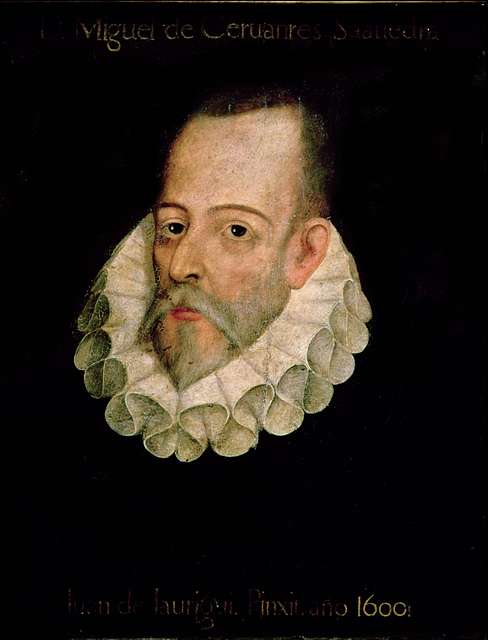
Miguel de Cervantes Saavedra (1547-1616) is widely considered to be the finest writer in the Spanish language. Many deem his Don Quixote (pt 1, 1605, pt 2, 1615) the first and greatest modern novel. Forced to leave Madrid after wounding a man in a duel, he moved to Rome to serve under Card. Giulio Aquaviva. He was seriously wounded while commanding a skiff in the Battle of Lepanto and ended up spending five years in captivity when taken hostage by Ottoman corsairs. After regaining his freedom, for years he struggled to make a living. A writer of plays and poetry, he is best remembered for his novels and short stories: La Galatea, Exemplary Stories, The Trials of Persiles and Sigismunda, but above all, The Ingenious Hidalgo Don Quixote de la Mancha.
In this interview, Prof. Michael J. McGrath will explain his pick of the best books on Cervantes and his work, and whether there is more spiritual depth than meets the eye to the escapades and musings of Don Quixote and Sancho Panza.
Michael J. McGrath is a Professor of Spanish at Georgia Southern University and a corresponding fellow of the San Quirce Royal Academy of History and Art in Segovia, Spain. His research focuses on early modern Spanish life and literature, with special emphasis on cultural studies, the comedia, Don Quixote, and intellectual history. He is the author of more than seventy publications, including Don Quixote and Catholicism: Rereading Cervantine Spirituality and the first English translation of Spanish priest Ruy López's chess treatise from 1561 titled The Art of the Game of Chess.

- The Sanctification of Don Quixote: From Hidalgo to Priest
by Eric J. Ziolkowski - "Incarnation in Don Quixote" in An Idea of History: Selected Essays of Américo Castro
by Américo Castro - Grotesque Purgatory: A Study of Cervantes's Don Quixote, Part II
by Henry Sullivan - Don Quixote and Catholicism: Rereading Cervantine Spirituality
by Michael J. McGrath - Cervantes
by Jean Canavaggio
What would you add to the preceding biographical sketch of Cervantes?
For years, his Catholic faith has been discounted by many scholars. While they recognise it, they attribute his religious beliefs more to Christian humanism than traditional Catholicism. That is something I discuss in Don Quixote and Catholicism. I began to think more about Cervantes’s Catholicism when I was studying to be a permanent deacon. During the five-year formation program, one area of concentration was Ignatian spirituality. The life of St. Ignatius inspired me to rethink my understanding of Cervantes’s masterpiece.
As you have already mentioned, there is a certain theological and spiritual content to Cervantes's work. While he is not a preacher, but a writer, is there a deliberate theological or spiritual impetus?
I think so, and that has been, for the most part, overlooked. Don Quixote is a satire. Cervantes's faith, however, is also prevalent throughout the novel. Américo Castro, one of Spain’s most influential literary critics, describes Cervantes as a skilled dissembler. In other words, the reader needs to read beyond the words and contemplate what Cervantes says between the lines. To appreciate Cervantes’s Catholicism, it is also necessary to learn about Cervantes’s life and understand how his upbringing and life experiences inform how he portrays his religious beliefs in his literature. This biographical information, for example, supports my contention that Cervantes was a devoted Catholic.
Cervantes, according to witnesses, lived “as a good Christian, zealous for God's good name, confessing and taking communion when Christians customarily do so; and if he occasionally had dealings with Moors and renegades, he always defended the Holy Catholic Faith, and he strengthened and inspired many not to become Moors or renegades."
By some accounts, Don Quixote is the most widely translated book after the Bible. Furthermore, many consider it to be not only the first but also the greatest modern novel. Would you agree with that assessment?
Most definitely. Regardless of the class I teach, be it a first semester Spanish class or a graduate level class, I talk about Don Quixote. I ask the students, “Why is a book from early seventeenth-century Spain, published in two parts, in 1605 and 1615, the most widely translated book in the history of literature, apart from the Bible? Why are we talking about it here in the twenty-first century?” I want my students to discover why Don Quixote is a blueprint for humanity.
1.
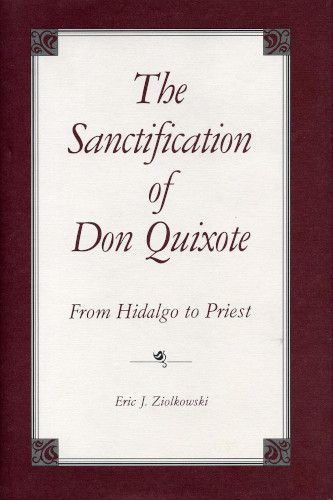
The first book you have chosen is Eric J. Ziolkowski’s The Sanctification of Don Quixote: From Hidalgo to Priest. Ziolkowski argues that a number of subsequent authors have drawn inspiration from Don Quixote and see him as embodying the condition of religious belief in modernity. Leading a religious life in modernity is a quixotic pursuit because one takes for granted that which society deems illusory. Ziolkowski analyses three novels that interpret and reelaborate Don Quixote in this way: Henry Fielding’s Joseph Andrews, Dostoyevsky’s The Idiot, and Graham Greene’s Monsignor Quixote. What else can you tell us about this book?
This is one of the first studies to examine the lineage of the character of Don Quixote. Ziolkowski lists several characteristics that Jesus Christ shares with the knight. For example, Christ “was alleged to be the blood of David”; Don Quixote “claimed to be descended from a king”. Christ “was called the ‘Galilean’ after his region’s name”; Don Quixote, “the Knight of La Mancha”. Jesus Christ “was born in a humble village which his birth raised from obscurity”; Don Quixote too “was of a humble village, which, through his name lives in the world's memory.” He makes this comparison, but he also points out that there are more than 160 quotations and paraphrases of the Old and New Testaments in the novel. Cervantes never denies God or his institutions, which is consistent with what Américo Castro wrote: Cervantes is a skilled dissembler who professed allegiance to Catholicism.
Ziolkowski also describes Don Quixote as a kenotic figure. St. Paul's description of the Incarnation in Philippians 2:7 talks about it as an emptying event. Christ is the suffering servant. Ziolkowski compares this kenotic figure to Don Quixote, whose many adventures humble the knight throughout the novel and culminate with his deathbed conversion.
Ziolkowski also notes the irony that many scholars interpret as Cervantes’s subversion of Catholicism. For example, in Chapter 6 of Part One, the priest and the barber decide whether the books in Don Quixote’s library are harmful to his mental state. The books they deem harmful are burned. Many scholars read this scene as a satire of the Inquisition’s burning of heretics. In another episode, Sancho places the same garb that the Inquisition’s convicts wear on his donkey. Ziolkowski notes that Cervantes does not criticise the Church or its dogma. If anything, he criticises its vehicles, such as the Inquisition.

2.
Your second pick is a book chapter, by the noted Spanish literary critic and cultural historian Américo Castro. A century ago, he published a book called The Thought of Cervantes and was one of the first scholars to argue that Cervantes had a systematic conception. What is the thesis of Castro’s "Incarnation in Don Quixote"?
Américo Castro talks about the incarnation within the context of a secularist perspective. Incarnation, he writes, is a process of life: “Unconsciously, we lose ourselves in the charm of these unique pages; for in effect, such is the essential process of all human life—that of self-creation and expression in contexture with all possible circumstances.” After this discussion, he addresses incarnation in its religious context: “The major theme of Don Quixote is the interdependence, the ‘interrealisation’ of what lies beyond man's experience and the process of incorporating that into his existence.” Castro makes a distinction between limited lives, which he illustrates in several one-dimensional characters of Don Quixote, and lives of self-creation, which he illustrates with Don Quixote and Sancho, who evolve throughout the novel: “Contrast those limited lives with the inner richness of Don Quixote, in whom is incarnated the dual process of achieving the plenitude of his existence.”
In addition, Castro divides the characters into lower strata—those that Cervantes treats irreverently, from time to time—and the upper strata, such as St. Paul, whom Castro describes as “all spirit,” in contrast to other saints, such as St. George, St. Martin, and St. James the Moorslayer, whom Castro assigns to the lower strata because they “meddled excessively in the affairs of this world.” Castro also cites Cervantes’s description of St. Paul as an example of Cervantes’s reverence for characters in the upper strata: “a knight-errant in life, a steadfast saint in death, an untiring labourer in the Lord's vineyard, a teacher of the Gentiles, whose school was heaven, and whose instructor and master was Jesus Christ himself” (Don Quixote, Part 2, Ch. 58).
“Incarnation in Don Quixote” is one of the earliest and most substantial articles or books to discuss Cervantes's Catholicism.
You can read the novel at different stages of your life and, depending on your age and experiences, it appeals to you in new and unexpected ways. In other words, while you read the novel, it reads you.

3.
Your third pick is a study of Part Two of Don Quixote. In Part Two, Don Quixote suffers various misadventures. In Grotesque Purgatory, Henry Sullivan focuses on these, especially the descent into the Cave of Montesinos and Don Quixote’s mistreatment at the hand of the Duke and Duchess. Sullivan argues that Cervantes’ narrative is informed by the doctrine of purgatory. Does Don Quixote help us appreciate the need to offer penance for our sins?
Most definitely. This is a topic that I address in my book as well: the Ignatian idea that Don Quixote is a contemplative in action. All his adventures lead to the end of Part Two. There, near death, Alonso Quijano—his name before he becomes Don Quixote—returns and renounces Don Quixote. He even admits that he should have spent his life reading books about saints rather than books of chivalry.
Sullivan studies the Cave of Montesinos episode from Part 2. Don Quixote is lowered into a gorge, and he apparently falls asleep. He has visions and experiences in the cave. From that moment on, he is more in touch with reality. As Sullivan says, “Don Quixote is cleansed of sin and saved in this life through the instrument of a living purgatory”.
He comments on how the Cave of Montesinos episode affects the end of the novel, when Alonso Quijano returns: “But is Don Quixote's spiritual journey merely a parody of these books? Is Don Quixote’s cure a last minute miracle, a deus ex machina, to bring the narrative to a suitable close? Or is the cure a slow and gradual process that spans the novel’s entire action? And if the cure is gradual, what are the steps by which it is achieved?”
Sullivan is one of the earliest critics to focus on the Christian trope that life is a journey in the novel Don Quixote. He also cites E.C. Riley, a well-known critic, who affirms the importance of the Cave of Montesinos episode to the ending of the novel: “the conventional view of the Cave episode as pointing towards the end of the novel, and as a prelude to Don Quixote's recovery and death, therefore, seems to me to be well founded.”
Don Quixote can be a timeless source of spiritual guidance

4.
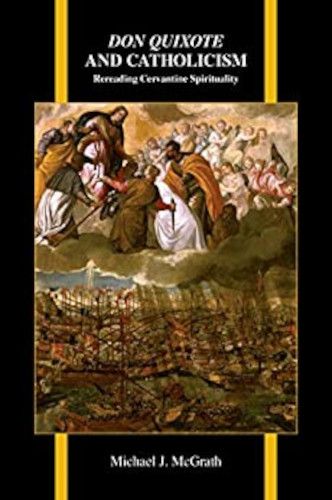
Fourth, we come to your own Don Quixote and Catholicism: Rereading Cervantine Spirituality. You stress that, while Don Quixote is not primarily a religious text, it is suffused with orthodox Catholic religiosity and spirituality. You counter the scholarly tradition that sees the novel as an expression of the ideas of Erasmus. Can Cervantes’s novel offer spiritual guidance for those living in today’s world?
Very much so. Having gone through the formation to be a permanent deacon, I had a new perspective on the novel. Episodes, such as the Cave of Montesinos, suddenly spoke to me in ways they had not before. You can read the novel at different stages of your life and, depending on your age and experiences, it appeals to you in new and unexpected ways. In other words, while you read the novel, it reads you. That is why in Don Quixote and Catholicism, I argue that the core of Cervantes’s spirituality is Catholicism. To appreciate Cervantes’s Catholicity and how Don Quixote can be a timeless source of spiritual guidance, it is also important for the reader of novel to understand the nuances of early modern Catholicism, which I address throughout Don Quixote and Catholicism.

5.
Does your fifth pick, Jean Canavaggio’s acclaimed biography of Cervantes, give us a deeper understanding of his writings too?
Yes, indeed. There are very few authoritative biographies of Miguel de Cervantes in English. In fact, Canavaggio’s biography of Cervantes first appeared in French; Joseph R. Jones translated it into English. It is very comprehensive and in-depth, but also very provocative. Jean Canavaggio effectively situates Cervantes and his literature within the cultural and historical milieu of early modern Spain. In other words, he takes 16th and 17th century Spain into account, which is necessary to understand and to appreciate Don Quixote. It is important to have the complete picture.
For example, he addresses Cervantes’s time as a prisoner in Algiers from 1575 to 1580: “Placed in that context, Cervantes’ dealings with Moors and renegades, his stirring defence of the Catholic faith, are illuminated with the new light, one that makes him more accessible, more human and—in a word—more real.” During this time, Cervantes refused to convert to Islam. Even though he was living in an environment that was very hostile to Christians, he remained steadfast in the faith. Canavaggio writes that Cervantes, according to witnesses, lived “as a good Christian, zealous for God's good name, confessing and taking communion when Christians customarily do so; and if he occasionally had dealings with Moors and renegades, he always defended the Holy Catholic Faith, and he strengthened and inspired many not to become Moors or renegades.”
What led you to study Spanish literature and to focus on Cervantes in particular?
With respect to Spanish literature, my interest began as an undergraduate. I began to learn Spanish when I was twelve years old, and I continued to study it, not knowing for sure how I would use it. Then, when I was an undergraduate at Georgia Southern University, where I currently teach, I read Don Quixotefor the first time. After I graduated, I earned my M.A. degree in Spanish at Middlebury College. One of my professors was Alberto Sánchez, a well-known scholar of Don Quixote. His passion for Cervantes and Don Quixote was infectious.
Then, I went to the University of Kentucky, where I earned my Ph.D. The director of my dissertation and my mentor was John Jay Allen, another well-known Cervantes scholar from whom I learned how to appreciate the genius of the novel Don Quixote and who inspired me to pursue the research that I have engaged in throughout my career.
Which English translation of Don Quixote do you recommend?
I recommend the translation by Thomas Lathrop. It was published by Juan de la Cuesta Hispanic Monographs. Lathrop is the only person to do an edition of Don Quixote both in Spanish and in English. One of the reasons I recommend Lathrop's translation is there are more than 1,000 footnotes that explain in detail the literary, historical, and cultural references that surround the knight's many adventures.
You have focused on Don Quixote. What is your second favourite work by Cervantes?
Great question. The Novelas ejemplares (Exemplary Stories). You do not see the same Cervantes, with respect to the satire, that you do in Don Quixote. The title is a misnomer. In these short stories, the characters teach us how not to act. The Exemplary Stories are not only a source of entertainment, but also edification.