

Blessed John Duns Scotus (c. 1265/66-1308) was the leading theologian at the transition from the thirteenth to the fourteenth century. He is believed to have been born in Duns, on the Scottish borderlands. He entered the Order of Friar Minors and studied at Oxford, where he lectured from 1298-1302. In 1302 he transferred to Paris, but he and eighty-two other Franciscans were forced to leave the city in 1303 when they sided with Pope Boniface VIII against Phillip IV of France. He returned in 1304 and was appointed the Franciscan Regent Master at the University of Paris. In 1307, he was transferred to the Franciscan house of studies at Cologne and died there the following year. The epitaph on his tomb in Cologne reads, “Scotland begot me, England took me in, France taught me, Cologne holds me.”
Scotia me genuit,
Anglia me suscepit,
Gallia me docuit,
Colonia me tenet.
In this interview, Thomas M. Ward discusses Scotus and the best ways of approaching his writings.
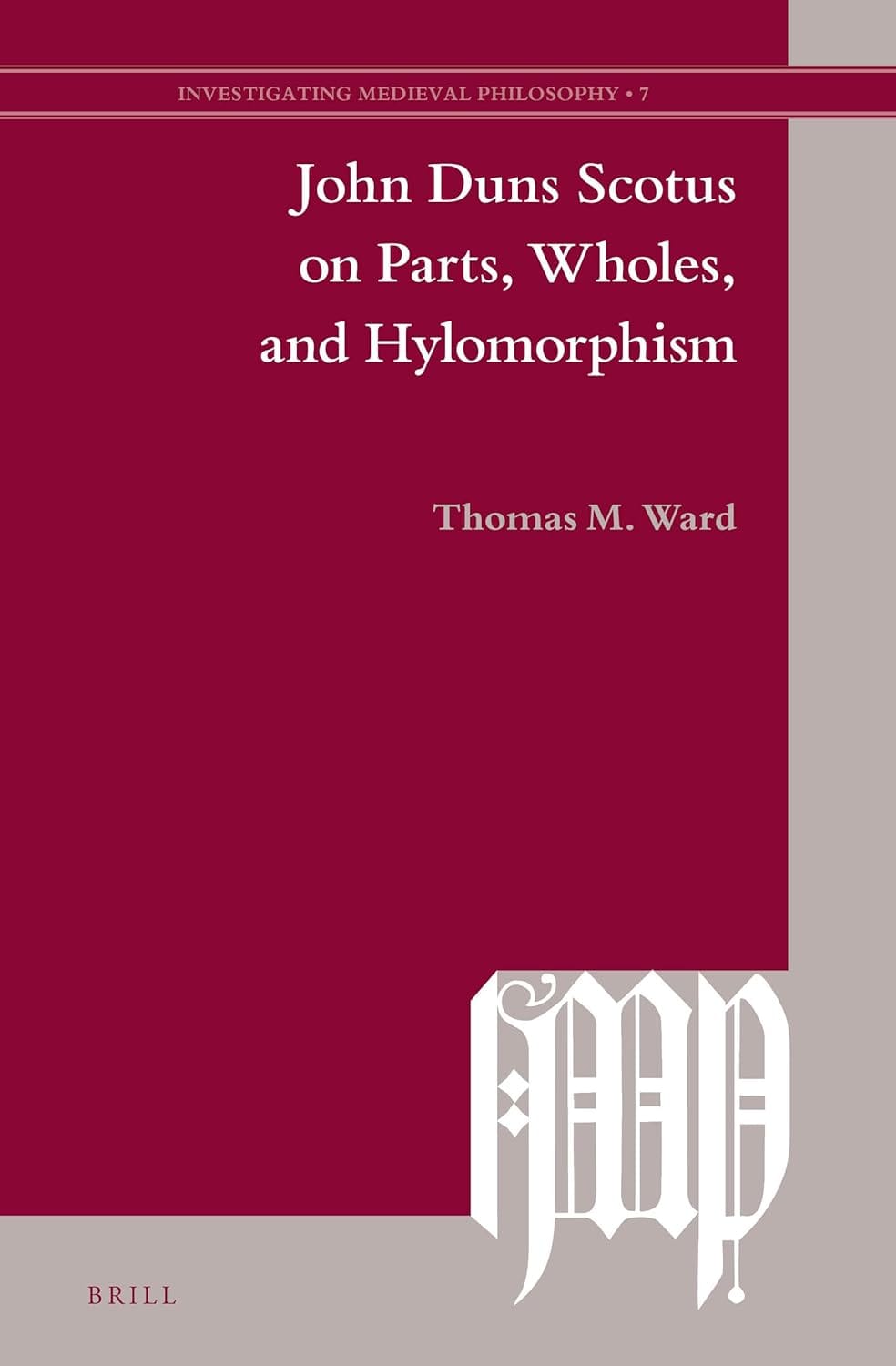
Thomas M. Ward is UNSC Assistant Director and Associate Professor of Philosophy at Baylor University. His research is on the history of philosophy (especially medieval), the philosophy of religion, and metaphysics. He is the author of John Duns Scotus on Parts, Wholes, and Hylomorphism (Brill), Divine Ideas (Cambridge University Press) and Ordered by Love: An Introduction to John Duns Scotus (Angelico Press).
- Ordinatio (online translation)
by John Duns Scotus, translated by Peter Simpson - Treatise on the First Principle
by John Duns Scotus, edited and translated by Thomas M. Ward - John Duns Scotus: Selected Writings on Ethics
translated and edited by Thomas Williams - Duns Scotus
by Richard Cross - Understanding John Duns Scotus
by Mary Beth Ingham CSJ - Ordered by Love: An Introduction to John Duns Scotus
by Thomas M. Ward
What drew you to study the writings of Blessed John Duns Scotus?
Originally, I was interested in the medieval reception of Aristotle, particularly with respect to natural philosophy. Hence, I was very interested in hylomorphism, teleology, essentialism and drawn first to Thomas Aquinas.
Then, in graduate school, I had to select a dissertation topic. I realized that quite a lot had been written on Aquinas's natural philosophy, but comparatively little on that of Duns Scotus. In a sense, therefore, I came across Scotus by accident when exploring dissertation subjects.
I had not been formed within the Catholic intellectual tradition and was unaware of some of the battlelines that existed between different schools of thought in the Middle Ages. I was just an eager Catholic intellectual who had not been formed in a particular school. The more I read about Scotus, the more interested I became in his natural philosophy and his pluralistic approach to hylomorphism. So, I settled on that as a dissertation topic.
During my doctoral studies on Scotus, I read a wide range of his writings and was oftentimes sympathetic to what he said, always intrigued by it. I have just kept at this for twenty years now.
"Scotus considers all theology to be a practical science. It is ordered not to the perfection of the speculative intellect, but to action and, above all, to loving God. "
Why should anyone who is neither a trained philosopher nor theologian bother to read John Duns Scotus?
Of course, Scotus is most honoured within the Catholic Church for his teaching on the Immaculate Conception. Among the medievals, there was a broad consensus that Mary, by the time she was born, had been cleansed of all original sin and so had received a very special grace. Scotus pushed that idea a bit further and argued that at no moment whatsoever was Mary with original sin. At first, this was controversial within the schools. Eventually, of course, it was dogmatized.
Blessed John Duns Scotus' veneration for the Blessed Virgin Mary is one of the main reasons why Catholics should honour him.
Now, that does not quite get to your question: why we should read him? Unfortunately, Scotus is an extremely abstruse writer. He lacks the lucidity of St. Thomas Aquinas. This is one of the main reasons why he is so neglected. That said, modern translations—such as Peter Simpson's recent efforts to translate the whole of the Ordinatio—do make his writings more accessible to English readers.
My hope is that the more his writings are made accessible, the more he will be read by theologians.
That said, while Flannery O 'Connor, who was neither a theologian nor a philosopher, read a bit of the Summa Theologiae at bedtime, it is hard to imagine that any of Scotus’s will ever occupy a similar place in a lay Catholic's intellectual or spiritual life. Further on, however, I shall suggest ways into Scotus that can generate something of the appeal that people like me find in him.
 Five Books for Catholics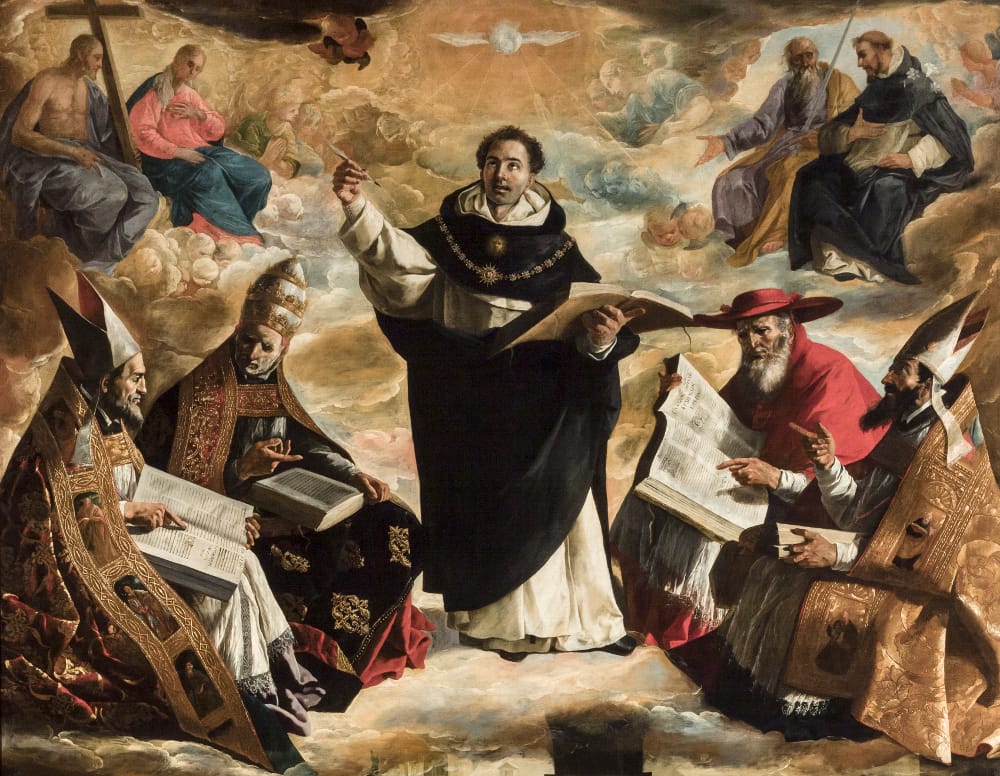
Scotus has attracted the attention of several writers. Some, such as the nineteenth-century Jesuit poet, Gerald Manley Hopkins, wrote about him favourably. However, there are also satirical send-ups of Scotus in Jonathan Swift’s The Battle of the Books and Alexander Pope’s Dunciad, a mock epic dedicated to Scotus.
Yes, he has. Of course, ‘dunce’ comes from Duns Scotus. Everyone recognized that Scotus was a philosophical genius, but dunce became the name of one engaged in irrelevant intellectual pursuits. In the Swiftian send up, the point is that no matter how intelligent Scotus might have been, he was engaged in pointless intellectual hair-splitting. This criticism is in the same spirit as that of Aristophanes, who in The Clouds criticises Socrates. Aquinas himself makes very fine distinctions but has not received the derision that Scotus has.
Like any master at the universities at that time, Scotus lectured on the Sentences of Peter Lombard. His major works are his commentaries on the Sentences: the Lectura, the Ordinatio, and the Reportatio examinata. Can you explain the chronology and status of these essays?The Lectura is his first go at the Sentences. He completed it in Oxford, before moving to Paris.
The Ordinatio—which means carefully edited or ordered for publication—is considered his most thorough commentary on the Sentences. However, significant portions of it were never finished. The editors of the Vatican critical edition of his works, therefore, have made attempts to supplement them so that it stands as a complete commentary on the Sentences.
Third, there is his Parisian Reports or Examined Reports. These are transcriptions students made of his late Parisian lectures and over which he had some sort of editorial oversight. They were never finished but in some cases they offer the most advanced or sophisticated expression of his views on various topics.
The Ordinatio is the home base for students of Scotus, who, whenever necessary, then look back to the Lectura or forward to the Paris Reports to fill in his overall view on a topic.
Why is Scotus known as the ‘subtle doctor’ (doctor subtilis)?
For introducing various distinctions, which are sometimes difficult to grasp, to explain his philosophical and theological theories.
The most famous one is the so-called formal distinction, that is a distinction between formalities. It lies somewhere between a real distinction and a mere distinction of reasoning. Two things that are really identical but nonetheless susceptible of different definitions or descriptions are formally distinct.
The most important context in which Scotus deploys this distinction is to articulate the doctrine of the Trinity.
There is one divine essence and then the personal properties: paternity, sonship, being spirated. Now, if there are three distinct persons in the Godhead but only one essence, what kind of relationship exists between the Father’s paternity and the divine essence? The doctrine of simplicity requires us to say that these are identical. However, if identity is transitive, as many metaphysicians believe, then the Son appears to be identical with the Father. Of course, that cannot be the case. So, Scotus argues that it is a case of formal distinction. The personal property of paternity and the divine essence are really identical with each other but also distinct in some way. There is no real distinction between them. That would imply non-identity. Rather, there is a formal distinction between them.
Such difficult metaphysical reasoning is quite subtle. It is hard to understand and articulate. Such metaphysical rigor is all over Duns Scotus's writings. Spending much time with them and following all the fine reasoning he offers for his various views can be exhausting. Hence, the subtle doctor.
"The primacy of love, both as applied to the divine nature and to human beings, is a good way into some of Scotus's primary concerns."
From what you have already said, it is apparent Scotus writes at a high level of abstraction, but he must have concrete theological, spiritual, and pastoral concerns. What are his main such concerns?
That is a very good question. One is the primacy of love. This is a philosophical or theological abstraction from various Franciscan concerns. It is manifested in his doctrine of how God may will things ad extra, that is, toward creatures or possible creatures.
For Scotus, neither reason nor goodness compel God to do anything one way or the other for creatures, not even to create them, let alone to sustain them in being. So, what is it, ultimately, that explains why there is something other than God?
According to Scotus, the deepest answer is divine love. God simply wanted there to be other creatures that could share in his love, they could share it with each other, and be united in love with him at the end of time.
The primacy of love is expressed or manifested most famously and poignantly in Scotus's discussion of the beatific vision. Famously, there was a dispute between Franciscans and Dominicans about whether in the beatific vision—the enjoyment of God—consists primarily in an act of the intellect or an act of the will. Scotus comes down on the side of the will.
Of course, the beatific vision involves a supernatural understanding of the divine essence. That is a condition of the love of God that comes with the beatific vision. For Scotus, nevertheless, it is not knowledge but love that is the primary activity of beatitude. This is also expressed in his understanding of the science of theology.
Scotus considers all theology to be a practical science. It is ordered not to the perfection of the speculative intellect, but to action and, above all, to loving God. Even the most speculative or abstract components of theology are meant to promote the love of God.
The primacy of love, both as applied to the divine nature and to human beings, is a good way into some of Scotus's primary concerns.
In this regard, I would be remiss not to mention one of the most startling aspects of Scotus's theology: the primacy of the Incarnation. This idea is sometimes called the Franciscan thesis. It is not original to Scotus but articulated by him in a superlative way. It is the idea that even if Adam and Eve had not sinned, God would have become incarnate. Scotus defends this idea and argues that it would be unfitting of God to make fixing the problem of sin the primary reason for becoming incarnate in Christ Jesus. Instead, love is the primary reason for the Incarnation. The Incarnation is a non-necessary, free way in which God unites himself with his creation. He does so to demonstrate and share his love in a very peculiar way and thereby unite all human beings in that love.
You have described how Scotus emphasises the primacy of love. This ties in with his voluntarism, the thesis that certain acts of willing are anterior to any intellectual or rational specification but are responsible for choosing the reasons by which one will act. Scotus is a voluntarist. Did the earlier Franciscan intellectual tradition or the Archbishop of Paris’s apparent endorsement of voluntarism in the condemnations of 1277 influence his commitment to voluntarism?
The foundations of his voluntarism were already in place with the Franciscan emphasis on love as the primary activity of beatitude. However, you are right to emphasise the influence on the condemnations of 1277 on Scotus's own thought.
It is best to look at voluntarism of the theological variety and its metaethical implications regarding God's relationship to moral norms as one instance of a broader emphasis on divine freedom.
If God is utterly unconstrained when it comes to creating the world, a particular type of world, or in his action on creatures, then everything that he does do to create, sustain creation, and to beatify is free. In that case, it begins to make sense to suppose that moral norms themselves fall within the scope of divine willing in some way.
There is much debate among scholars about just what sort of control God has over moral norms and to what extent he can change the natural law. This is a very interesting debate. I believe Scotus is less extreme on these issues than some scholars do. In this respect, I follow Fr. Allan Wolter, probably the greatest Anglophone Scotist of the twentieth century. While God does indeed have certain freedom over the moral law, we should not conclude therefrom that he could make evil things right and vice versa. This Franciscan and Scotist emphasis on divine freedom does not entail a willy-nilly moral universe.
There is explicit evidence in Scotus’s writings that he takes the condemnations of 1277 to be authoritative over his own theorizing: maybe not in this particular context, but in general. He does seem to have thought that he was bound by the condemnations in his theoretical work.
With whom was Scotus mainly engaged in debate? Henry of Ghent? Others?
Henry of Ghent is his most common interlocutor. He seems to have admired Henry's thoroughness and proclivity for making distinctions. However, he also thought that Henry was theoretically gratuitous or extravagant. Hence, he was often engaged in trying to clean up what he regarded to be Henry’s useless theories.
He also engages extensively with St. Thomas Aquinas, with whom he is often but not always in disagreement. The presumed disagreements between Aquinas and Scotus are magnified in modern debates. However, Aquinas does not have as central a role in Scotus's own theorizing as one might expect. Henry, not Aquinas, is his main interlocutor.
"Having struggled with Scotus for many years now, my own view is that he is best encountered with a guide. "
Scotus’s argument in favour of the Immaculate Conception is often cited as influential on the definition of that dogma. Has Scotus influenced any Church teachings?
Not that I know of. However, no distinctive Scotist thesis has been condemned.
Various scholars such as Étienne Gilson, Cornelio Fabro, or André de Muralt have argued that Scotus plays a decisive role in the subsequent development of rationalist or nominalist tendencies within modern philosophy. Do you agree with this critique?
I strongly disagree with it. It rests on a confusion between two themes in Duns Scotus.
On the one hand, there is the question of universals. Here, Scotus is one of the most robust realists of the Middle Ages. Probably only Walter Burley is the stronger realist.
Scotus emphasises that there is a real but not a numerical unity of natures across various instances of it. This thesis must be maintained. There is no hint whatsoever of nominalism in his speculations about universals.
How, then, can some read off nominalism or proto-nominalism from Scotus's writings? Well, this has to do with his understanding of the principle of individuation: his famous view on haeccitas or thisness.
For a strong realist such as Scotus, we share one and the same human nature. What, however, makes each one of a distinctively individual human? Scotus criticises Aquinas’s famous theory that our particularised materia signata individuates us and deems it inadequate. In his view, is there is a real individualized nature that is in principle unshareable. One thing alone has it and can ever have it. There is your Farrellness and my Wardness. Despite our unity as human beings, each of us is individuated by our real unshareable nature.
Here we have the makings of what Charles Taylor has called a Franciscan turn to the individual. That is the closest there is to a nominalist impulse in Scotus. However, it is very unfair to saddle Scotus with genealogical original sin responsible for nominalism. When it comes to such genealogies, Ockham is a better candidate as the initiator of the true nominalist impulse within European philosophy.
Do you have any tips or advice for those approaching Scotus for the first time, since he is notoriously difficult to read?
Having struggled with Scotus for many years now, my own view is that he is best encountered with a guide. There are some good introductions out there. It best to get a feel for Scotus from them before diving into the primary texts.
The work of translating Scotus has been for some time now and is making more of his writings available in English. This will make him more readable. Nevertheless, unless one is already acquainted with the scholastic ways of writing, it is almost impossible to just jump into Scotus. Scotus is a strange beast even for those who do have some serious acquaintance with scholasticism or have read a decent smattering of Aquinas and Bonaventure.
"Thomas Merton...says that during his schooldays he gathered that Scotus's writing on the proof is 'the most perfect and complete and thorough proof for the existence of God that has ever been worked out by any man.' "
First, you have recommended not a book but an online resource: Peter Simpson's translation of the Ordinatio. Do you have any suggestions on how to use this resource?
I came across Peter Simpson’s translation work by accident. He is doing it on his own time and probably does not intend to publish it as a book, and so it is not as polished as you might expect. Still, it is quite good.
For readers trying to get a feel for Scotus, the best thing to do is just jump into the prologue of the Ordinatio. There, we learn quite a bit about Scotus's method in theology, his emphasis on divine freedom, his understanding of theology as a practical science, and so on. Then, you can dip into the topics that take your interest, whether it be his teaching on the relation between charity and grace, the Immaculate Conception, or the primacy of Christ.
1.
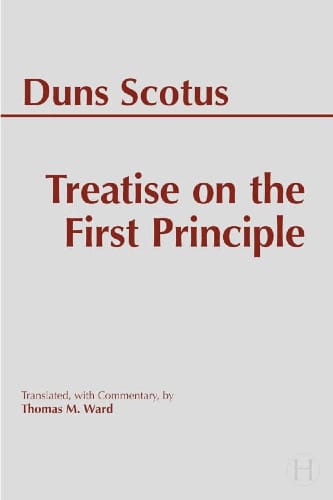
Is Scotus’s Treatise on the First Principle a good place to start reading?
For those interested in natural theology, it is the best place to start.
My translation of it, came out with Hackett earlier this year, and includes a long commentary on it.
At some places in De primo principio, Scotus adverts to some of his own distinctive views that he develops elsewhere. In the commentary, I discuss these views and help the reader make sense of them.
Scotus was a brilliant natural theologian and the argument that he develops is a hybrid between the cosmological approaches associated with Aquinas or Avicenna and the so-called ontological approaches associated with Anselm.
It is a very interesting, lively work. In The Seven Storey Mountain, Thomas Merton, who was not a worldclass natural theologian, says that during his schooldays he gathered that Scotus's writing on the proof is “the most perfect and complete and thorough proof for the existence of God that has ever been worked out by any man.” Whatever Merton's own abilities as a natural theologian, I believe that in this case he is quite right. I certainly have not encountered anything as robust in the Middle Ages as the Treatise on the First Principle. I highly recommend it.
Scotus takes himself to be developing a strictly metaphysical demonstration of God's existence. The works is 30,000 words of rigorous metaphysics. So, it is not the place to go to see the spiritual or pastoral sides of Scotus. However, for those who are interested in metaphysics, it is an extremely rewarding intellectual experience.
As you mentioned, Scotus’s argument for God’s existence combines the cosmological and the ontological approach. For those who are not familiar with these terms of art, the cosmological approach argues that we can come to know that God exists by observing and understanding the structure of nature, the world, or the universe (kosmos), whereas the so-called ontological arguments part from the concept of God or a certain conception of him to show that merely possessing such a conception of him indicates that he necessarily exists. What then is distinctive of Scotus's argument in De primo principio?
Instead of looking to the structure of contingent existing things, he looks to the structure of essences themselves and identifies an ordering of dependence that obtains at the level of essence. Hence, we can abstract from contingent facts about what may or may not exist and consider necessary facts about the way in which essences, by their essences, are related to each other. From the essence, say, of a producible thing, we can infer, regardless of whether anything has ever been produced, that there is an essence that is productive.
Then there are familiar considerations about the impossibility of an infinite regress of producible producers. However, Scotus is operating at the level of essences instead of contingent facts about the way the world is. If his argument succeeds, he has demonstrated God's existence from necessary premises rather than from a contingent premise, such as that something has come into existence. His argument, therefore, better satisfies the Aristotelian criteria for real demonstration.
In one sense, it is an Anselmian argument because it infers from the concept of a producible thing to the concept of a nature that exists necessarily. How, though, does it move from the realm of essences or the merely conceptual to something that in fact exists? The idea is that if the first principle does not exist, then nothing else can exist, because there will be nothing that can produce it. The first principle can only produce something else if it actually exists. From the fact that something is producible, even if it in fact has not been produced, we can conclude that a first principle exists in fact, necessarily, is uncausable and is the ground or condition for the possibility of anything else that exists. Of course, the first principle is also the ground for the fact that other things exist. Here, however, Scotus is more interested in what grounds the possibility of the existence of contingent things.
2.
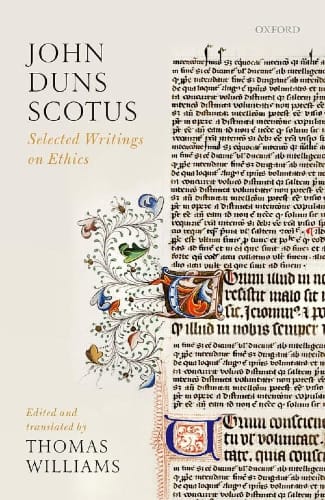
At the beginning of his excellent anthology of Scotus’s selected writings on ethics, Thomas Williams notes that Blessed John “did not write systematically about ethics and moral psychology, but he did write extensively.” A generation earlier, however, St. Thomas Aquinas had written what is arguably the most enduring and systematic account of ethics and moral psychology in the Catholic tradition: the Secunda Pars of the Summa theologiae. What does Scotus add that Aquinas had not already covered in the Summa theologiae?
Williams is right. Scotus's writings on the virtues are much more piecemeal. Aquinas had much more to say. To go back to something we discussed earlier, the real difference between them regards the role of the will in moral life, both the divine will and human will.
In the case of the divine will, Scotus emphasises God freedom vis-à-vis the natural law. He believes that God need not command in every way in accord with the natural law. He offers an arguably disconcerting gloss on God's command that Abraham sacrifice Isaac (Genesis 22). According to Scotus, this as a dispensation that God makes from the natural law against murder. God is the sovereign of the universe and is not constrained in any way by creaturely facts in what he wills. He can simply do this.
Aquinas does not accept this and insists that there is no aspect of the natural law that God can command against.
I lean more toward Aquinas’s position. However, if there is one difference you need to understand between these major medieval thinkers with respect to morality, this is the one.
In the case of human willing, Scotus locates the moral virtues in the will. In his interesting discussion of the four cardinal virtues, justice, temperance, and fortitude are perfections of the will under various aspects. He borrows and develops Anselm’s distinction between the will’s two native affections: the orientation or drive toward justice (affectio iustitiae) and the other toward personal advantage (affectio commodi). In many ways, the moral life consists in navigating these twin orientations. The virtue of justice perfects the affectio iustitiae; temperance and fortitude perfect the affectio commodi.
On the other hand, Scotus agrees with Aquinas that prudence is a virtue of the practical intellect. He also grants that you could have prudence without any of the moral virtues, but not the moral virtues without prudence. Someone can be practically intelligent and discern what should be done here and now, but lacks the virtues of the will to carry out the deliverances of prudence. Nevertheless, someone cannot possess the moral virtues—namely, habitually will the good with excellence—without practical knowledge about what to do. This theory of the partial disconnection of the virtues is distinctive of Scotus. His slightly different understanding of the will and its orientation, provides a slightly different anthropology onto which he transposes his theory of virtue.
3.
So far, you have recommended selected writings of Scotus. For the other entries on the list, you have recommended not one but three introductions to his thought: your own, and those of Sister Mary Beth Ingham and Richard Cross. What are the strengths and emphases of each one?
I shall start with Richard Cross. His Duns Scotus was published in Oxford University Press's Great Medieval Thinkers series. It is best conceived as a reference book. It is quite thorough. It does not have a great deal to say about every topic it treats, but it provides an introduction and orientation to virtually everything about which Scotus wrote.
The emphasis is more on Scotus's theology than his metaphysics, though it includes a lot of philosophy as well.
4.
Sister Mary Beth Ingham's book functions very well not only as an introduction to Scotus, but also as an introduction to philosophy. A Franciscan educational institution could use Understanding John Duns Scotus as a philosophical primer. From it, you learn a great deal not only about Scotus, but also about philosophy in a broadly Aristotelian key and how to do it.
5.
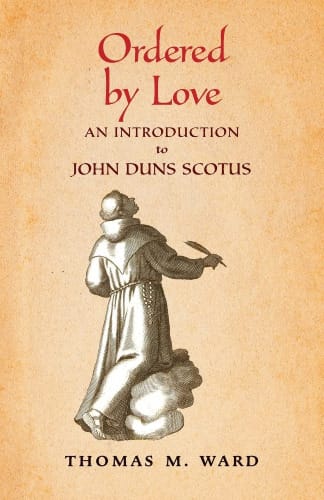
My own Ordered by Love is less systematic and thorough than either of these two books. It aims instead to offer a highly sympathetic introduction to Scotus as a Catholic thinker, one of whom Catholic intellectuals need not be afraid.
For example, it addresses the longstanding controversy about Scotus on univocity. It offers a mitigating interpretation of Scotus’s view of univocity and shows that, properly understood, it is not so opposed as Thomists might think to St. Thomas’s emphasis on analogy.
This is a bit self-deprecating, but you can of Ordered by Love as cheerleading for Scotus, whereas the books by Ingham and Cross lay out the facts about him.