
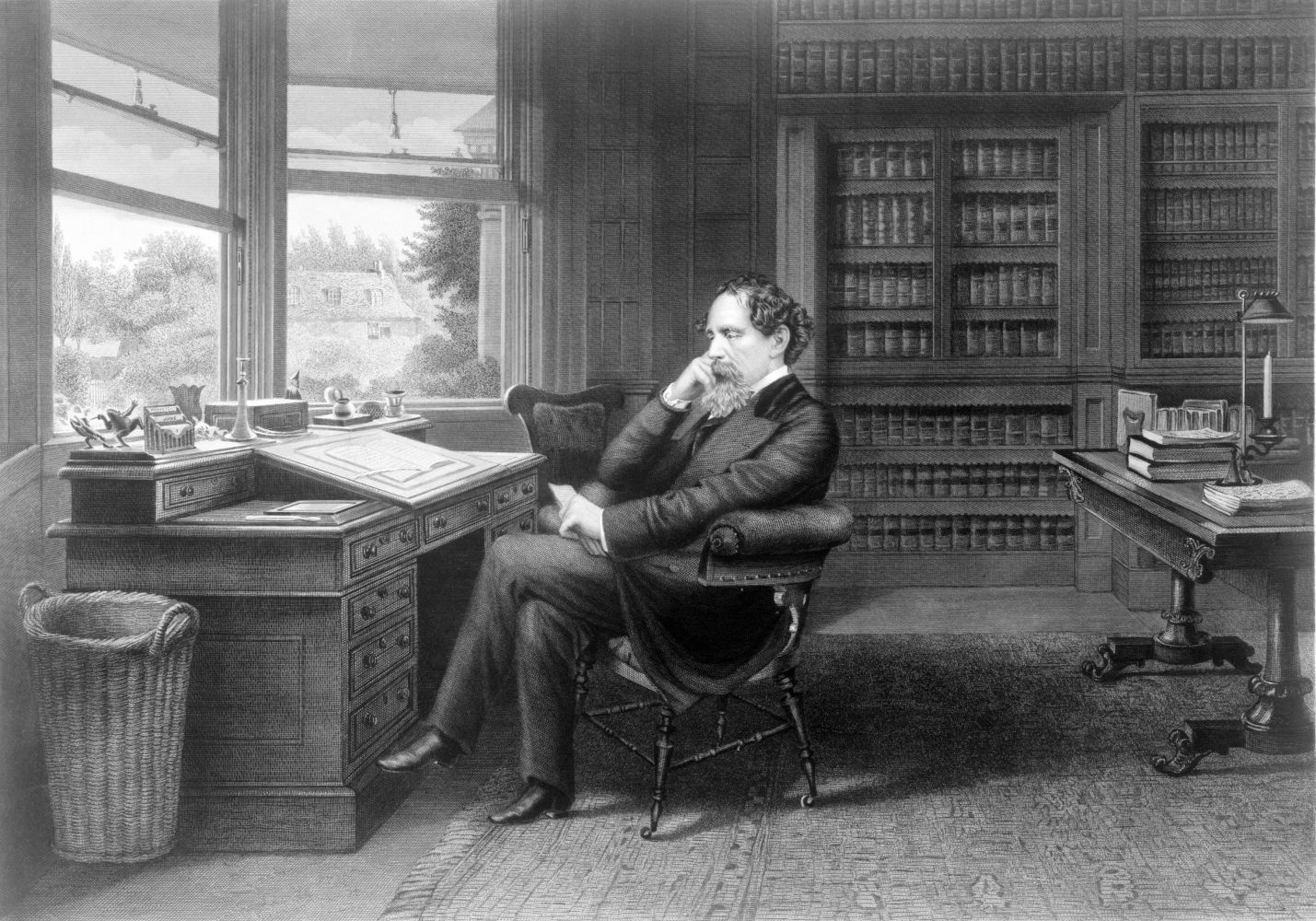
Charles Dickens (1812-1870) is one the best-loved novelists in the English language and arguably the greatest. Like Shakespeare, he created a host of memorable characters from all stations of life, entertained a wide public, and was equally adept as a writer of both tragedy and comedy. Whereas Shakespeare exploited his gifts as a poet and actor in his plays, Dickens, a novelist, deployed his extensive skills and experience as a journalist. He described vividly the plight of the poor, the injustices wrought by the Industrial Revolution, malfunctioning institutions, and widespread indifference. This led Dostoevsky to call him “the great Christian.”
In this interview, Prof. Dwight Lindley discusses some of the best of Dickens’s novels and of the studies on them.
Dwight Lindley is the Barbara Longway Briggs Chair in English Literature at Hillsdale College. He has published essays and articles on Jane Austen, George Eliot, John Henry Newman, Gerard Manley Hopkins, Virginia Woolf, and others. He lives in southern Michigan with his wife Emily and their nine children. His free course Charles Dickens’ A Christmas Carol is available online.
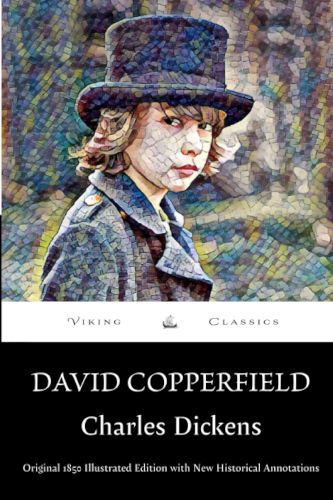
- David Copperfield
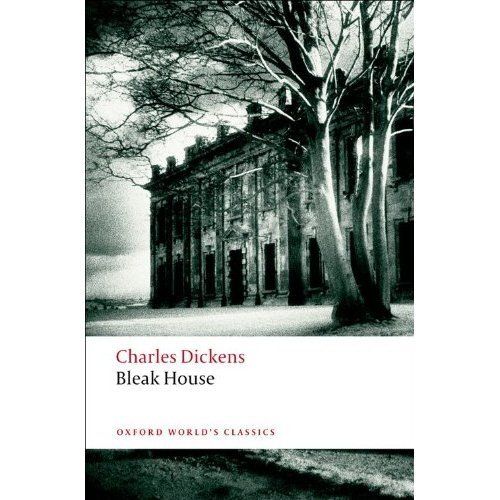
by Charles Dickens - Bleak House
by Charles Dickens - A Tale of Two Cities
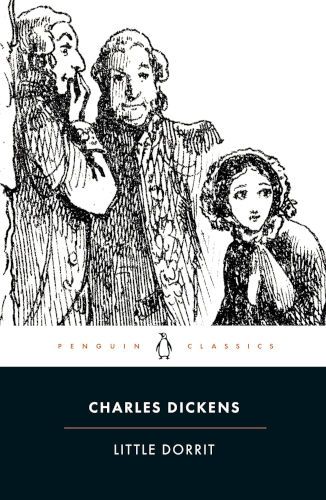
by Charles Dickens - Little Dorrit
by Charles Dickens - Chesterton on Dickens (Ignatius Press Collected Works of G.K. Chesterton, vol. 15)
by G.K. Chesterton
...and some extra recommendations... - Hard Times
by Charles Dickens - The Genius of Dickens
by Michael Slater - The Mystery of Charles Dickens
by A.N. Wilson
Dickens was so active and productive that his life cannot be summed up in a few lines. You have recommended a biography, A.N. Wilson’s The Mystery of Charles Dickens. We shall discuss it at the end. However, to kick things off, are there any aspects of Dicken’s biography that we should keep in mind to understand his novels properly?
Well, he was the most popular novelist of the Victorian period in England. Famously, he rose from poverty to considerable wealth just through the publication of his novels. He was very successful, beginning in his mid-twenties. By the time he died, he was one of the most famous people in England. He toured the country, America as well, giving public readings of his works. Thousands of people would come to see him. He was popular; his stories and characters were powerful.
While most literary critics acclaim Dickens, there have been periods when many have dismissed him as a low-brow writer. Has this ebb and wane in his standing among literary critics ceased?
His star has risen somewhat over the course of the twentieth century.
He is not the most intellectual of the nineteenth-century novelists. George Eliot, for example, was better educated and, in general, a more philosophical writer. So, theoretical readers of English novels have often liked her more.
By contrast, Dickens is an everyman's novelist and not an intellectual in the sense that George Eliot was. For that reason, he did not necessarily open all the normal theoretical doors that literary critics are interested in.
Gradually, his different kind of intelligence has been better appreciated.
At the same time, his star has not risen completely, and he has not become massively popular. He still bothers some readers. However, people do not hold his relative lack of education against him as they used to.
"Dickens felt very strongly that we need to have a faith that is worked out actively in love and in taking care of the people who are in our lives. "
Dickens was an Anglican and professed Christianity. He wrote a private manuscript, The Life of the Lord, that he read to his children to instruct them about Jesus. His writings are informed by Christ’s command to care for the poor. Moreover, Dickens practiced what he preached. He supported his own needy relatives and worked hard to promote charitable organizations and social causes. However, it is not entirely clear how orthodox his beliefs were. During the 1840s he was interested in Unitarianism which, along with the rise of liberal Protestantism, tended to reduce Christianity to morality. His Christmas stories are moralistic rather than mystagogical. His Christianity was somewhat secularist, naturalist, or, as some might say, Victorian. In that case, why should Catholics read Dickens?
The story you just gave of his religious beliefs is the typical one. It is helpful and true up to a point. However, a slightly broader context is helpful.
Dickens’s version of Christianity defines itself against the Calvinistic-leaning evangelicalism that we might associate with the great religious revivals of the late 18th and early 19th centuries in America. They were called the Great Awakenings. There were versions of them in the United Kingdom as well.
This kind of Evangelicalism emphasised the development of faith to the exclusion of works, and Dickens felt very strongly that we need to have a faith that is worked out actively in love and in taking care of the people who are in our lives. He also had a sort of sacramental desire. He thought that we encounter God most deeply and imitate Christ in the lived reality of working out our faith. He found the practice of the faith around him wanting and was trying to complete it.
There are some things that we do not find in his writings that we would want of religion. However, in my experience, oftentimes Catholic readers find him more congenial than ‘faith alone’ (sola fide) Protestants do because he dramatizes our encounter with Christ “in the least of these”: our encounter with God in service to the poor.
Dickens produced a long list of classics. Have you followed any criteria in selecting the ones included in this list?
Yes, the books that I have selected are, by common consent, some of his greatest novels.
Many have said that David Copperfield is the greatest Dickens novel. It is the one that he liked best.
Bleak House is a runner-up.
So is A Tale of Two Cities. It is commonly assigned in schools, partly because it is shorter than those first two big ones.
I also listed Little Dorrit because, even though it gets less attention, it is very apropos for our day in several ways.
On my extended list, I have included Hard Times. It too is assigned frequently in schools.
I chose a combination of those that are my favourites, most relevant for our day, and generally held in high regard.
They also happen to be the five novels that Dickens published between 1849 and 1859. Is there a reason why you have settled on this period?
I admit that I have a preference for the works of the second half of his career.
He was writing novels from 1837 until he died in 1870, and left his last work unfinished. The ones I have chosen are from the middle ten years of his writing career. They are the works of his maturity.
Earlier novels, such as The Pickwick Papers (1837) and Dombey and Son (1846) have wonderful things going on. However, they are not as mature as novels: arguably, the characters are not as fully realised and integrated into the plot.
"One of the remarkable things about Dickens is that he used his novels as a way of investigating his own life."
1.
Do you have a favourite Dickens novel?
My favourite is probably David Copperfield.
That brings us to David Copperfield. As you mentioned, of all his novels, David Copperfield was Dickens’s favourite. Was this because it is the most autobiographical of his works?
Yes, in part. It is a distant mirror of his own life. In the preface, he calls it “my favourite child,” and it’s worth noting that every author who writes a book has a kind of parental relation to it: gestates it, in a manner of speaking, and so forth.
In David Copperfield, Dickens told truths about his life that he had a hard time admitting to anyone, even his wife and best friends, although these things gradually came out.
As a young child, Dickens lived through a period of tremendous poverty. His parents were in a debtors’s prison and he had to work in a small factory under poor conditions, making blacking polish. This left a mark on him and he never really discussed it until he wrote this book.
One of the remarkable things about Dickens is that he used his novels as a way of investigating his own life and talking about things that he had a hard time talking about with other people. He ended up telling truths there that were unusual or hard to tell.
That may not explain completely why he loved David Copperfield, but it does shed some light. It is also a marvellous book thematically.
What should Christian readers look out for in David Copperfield?
One of the first things to look out for is the centrality of the child in this novel.
At the heart of Dickens’s vision was the idea that “whatsoever you do to the least of these you do unto me” (Matthew 25:40).
Children understand some things that adults tend to forget. This view can be associated with English Romanticism broadly and with the poetry of Wordsworth, among others. However, it is very much rooted in the Gospel. That is where Dickens found it.
So, in David Copperfield, we Catholics need to note how the world of the spirit and the heart are realities that the child sees, but forgetful, pragmatic adults often miss and tend to explain away.
In an early chapter, David’s father says that “a loving heart is better and stronger than wisdom.” He is thinking of worldly wisdom: what is commonly said to explain the way the world is. However, a loving heart perceives something more subtle about other people and things. It thereby cuts deeper than the common explanations do. That mysterious idea is at the heart of David Copperfield and there is something true about it.
Are there any other points you would underline in David Copperfield?
Yes, a couple more points.
One is a theological point that Dickens makes in his own more intuitive way. He was not a theologian. He was not even very well educated. However, he was a reader of his Bible and had his fingers on certain essential points that became very important to him. One of them comes out in Mr. Dick, a character in David Copperfield. As many have suggested, his name is a coded reference to Dickens himself.
Mr. Dick has undergone serious trauma in his life. It has damaged his mind and left him an adult “child.” He is like the “fool” characters you might see in Shakespeare or Dostoevsky. However, he sees deeper than a lot of the serious adults around him. At one point, he says that he is a “nobody.” That is a really important point for Dickens, who believes that nobodies tend to see things that somebodies do not.
At the heart of this is Christ's kenosis or self-emptying in the Incarnation (Phil 2:7). There, the second person of the Trinity became nothing in order to give us something. Dickens saw that this is at the heart of things. We need to undergo a self-emptying to see the truth about the world and give ourselves in love and image God most fully.
So, Mr. Dick and the other characters in the novel who become nobodies end up having this childlike insight into the nature of things.
That is one mysterious truth in this novel.
Another thing I would mention, as a counterbalance to this emphasis on childlike wisdom, is the theme of immature, childish adults.
Dickens also puts some problematically childish adults into the novel. They are childlike, but not in the positive sense.
For example, David’s wife, Dora, calls herself his “child-wife”. It is a very strange depiction. Through their relationship, Dickens reflects and makes us feel how undesirable is a certain kind of immaturity and the refusal to be an adult.
On the one hand, there is the virtue of childlikeness, and, on the other hand, in tension with this, is the undesirability of immaturity. The novel points to this tension between the childlike simplicity and humility that everyone should have and the responsibility, commitment, serious work, and earnestness that an adult should also have.
"Bleak House is very interested in this large-scale way that modern civilization organises itself, as opposed to the small scale of individual lives, which is where what we most care about really happens."
2.
Bleak House is widely regarded as one of Dickens’s greatest novels. In it, he takes aim at the dysfunction of the English Chancery. In 1928, William Searle Holdsworth, the Vinerian Professor of Law at Oxford University and the author of a seventeen-volume History of English Law, delivered the lecture Dickens as Legal Historian. Holdsworth singled out Bleak House in particular. He praises Dickens for providing historians with information they cannot get anywhere else. Have you picked Bleak House mainly for its critique of the legal system or for other reasons?
The legal dimension is important, but marginal, both for my interests and for readers today. The history of the development of nineteenth-century English institutions is not uninteresting and in some ways sheds light on our condition. However, there is an even more attractive connection.
Chancery, with its endless processes, wasted people's time, money, and lives. It is a tremendous image of the way that large-scale bureaucracies work in the modern world. We are still caught up in them in the first world of the twenty-first century. We are at once the beneficiaries, and the victims, of the large bureaucratic machinery that has been erected to make the modern economy, legal system, and trans-political bodies work. All these international institutions grind us down, oftentimes in extreme abstraction from the lives of individual people. Bleak House is very interested in this large-scale way that modern civilization organises itself, as opposed to the small scale of individual lives, which is where what we most care about really happens. This political and social dimension of the novel is still very familiar to us and part of what makes it interesting.
However, the interpersonal and moral dimensions of the novel are even more absorbing.
One of the most noteworthy things about the novel artistically is the balance between its two narrators.
One of the main narrators is a satirical, worldly wise, rational critic of the age. He describes the famous fog at the opening of Bleak House, Chancery with all its depredations, and the upper classes.
The other narrator is Esther Summerson, who writes in first-person, or autobiographical mode. She tells the lives of her friends and family as they touch upon her. She is a loving person who feels things deeply and sees everything through the lens of her love for people. She says that she understands things better when she loves them.
Throughout the book, the two narrators—the more cynical, satirical head and the simpler, more loving heart—are played off one another and the reader is left poised between them.
One of the novel’s takeaways is that both dimensions are necessary for understanding the truth about reality.
"In the novel, these nobodies are the ones who have the most to give. They end up witnessing the power of God more than anyone else in the novel."
A few themes in this novel are relevant for Christian readers.
As in David Copperfield, there is an emphasis on “the least of these” and the nobodies of society.
One of the characters is Nemo. Of course, that means ‘no one’ in Latin. The main character, Esther, is also a nobody. She is an orphan, unloved as a child, and dismissed. And one of the novel’s most famous characters is Jo, a homeless, parentless crossing-sweeper.
In the novel, these nobodies are the ones who have the most to give. They end up witnessing the power of God more than anyone else in the novel. There are several places where, through the work of these suffering servants, the doors are opened to heaven. Someone is dying and one of these people will show that person how to pray.
The Gospel is at the centre of the novel, both in the way that it is preached through the words and lives of some characters, but also in a negative, satirical way, namely, insofar as it is travestied by a couple of preachers.
There is a fellow named Mr Chadband, a comical depiction of an evangelical preacher who is all talk and no life. He has no actual love to give that will embody the Gospel. At a certain point, the narrator says, very ironically, that Chadband, and people like him, say the words of the Gospel to this orphan child, Jo, but do not bring him to Christ with their lives.
Finally, there is the centrality of forgiveness to the plot.
Esther's mother lives in fear that her husband will not forgive her for a serious past sin. Ultimately, this same sin, which she cannot let go of, also alienates her from her daughter. This is partly because she will not accept the forgiveness and mercy they want to give her. There is a familiar sort of pride that will withhold forgiveness, but there is also a kind of pride, which we are more likely to overlook, that will not receive forgiveness.
"Everybody, we learn, occupies some kind of prison. Everyone is limited by their conditions."
3.
Little Dorrit begins in the Marshalsea, the debtor’s prison where Dickens’s own father and family were sent. It is also about financially feckless individuals, bad banks, and the Circumlocution Office, an embodiment of useless government bureaucracy. Why have you picked this novel?
I am very fond of this novel. It has some remarkable and lovable characters but, like Bleak House, it confronts realities that are still familiar in the modern world. The Circumlocution Office gives us the same kind of heavy-handed, utterly abstract bureaucracy we saw in Bleak House’s Chancery.
A couple of other details are relevant to contemporary life.
First, there are several instances of quarantine and plague in this novel. This is a theme and point of reflection in the novel. A few years ago, I taught this novel during the COVID pandemic and it was very well received.
Second, the novel discusses the tremendous investment bubbles that occur whenever prices and speculation are artificially inflated, only to leave many ruined. These Ponzi schemes are part of our modern economic life.
Those two structural details bring Little Dorrit close to us.
The main plot has two strands.
There is the family of the protagonist, Amy Dorrit (“Little Dorrit”). She is a young woman in her early twenties who has grown up with her siblings in debtor’s prison. Her father lives there in the Marshalsea, the same prison where Dickens’s father had been years before.
The other strand of the plot is occupied by Arthur Clennam and his family in London.
In the first half of the novel, the Dorrits are literally in prison. The father needs to stay there. Little Dorrit herself can move in and out of the prison at will, find work, and bring back money to support the family. However, the literal limits of the prison walls restrict the whole family in obvious ways.
On the other hand, the Clennam family do not live in prison, and yet they are imprisoned. This is another of the novel’s themes. Everybody, we learn, occupies some kind of prison. Everyone is limited by their conditions. You are limited by your upbringing, ethnic background, cultural formation, and the things that have happened to you. You are limited by what your life has been. This is at the heart of the novel, which poses the following question: how will you respond to those limitations? Will you find a way to love within the ‘prison’ that has been given to you? Will you find, within the limitations of your life, a way to love and serve, and thereby bring an encounter with the divine into that world? Or will you be embittered by those limitations?
Those two options are dramatized in these two plot strands. Some characters learn to love, within their limitations. Others choose the path of embitterment.
In the second half of the novel, the Dorrit family comes into a great fortune, pays off all its debts, and moves out of the prison, travelling to Italy to live the high life. They can live anywhere. They can pay for anything. Strangely, however, they do not have a place where they belong anymore. This is the other side of our limitations. When they can do anything, pay for anything, and be anyone, they end up being rootless and, in an important sense, homeless. They lose the sense of meaning in their life. Their life starts to feel more “unreal,” Dickens says.
The easy-to-miss fact about our limitations is that we need them if we are to flourish.
This is paradoxical and counterintuitive. However, we cannot have everything, be everything, or do everything. We need a concrete, finite place to live the creaturely existence we have been given.
"Ultimately, the novel is concerned with where your spiritual citizenship lies. As in Little Dorrit, everyone in this novel suffers much. The question is how will one respond to that suffering?"
4.
Why have you included A Tale of Two Cities? Some find it too melodramatic, like the Old Curiosity Shop.
Well, I respectfully disagree on that point.
Dickens knew that his novels were melodramatic, and he did not apologise for that. He said that he wrote them that way because that is how our lives actuallyare. Our lives are not “realistic” in the sense that word is sometimes used—namely, carefully measured according to economic and social factors. Rather, Dickens thought that our lives are oceanic, with swells of feeling that bring us to magnificent heights and great depths too. He tried to capture this and, generally, readers have appreciated the dramatic peaks and troughs in his writings. So, we do not need to be apologetic about the grand sweep of A Tale of Two Cities.
The novel is set between London and Paris during the French Revolution and is Dickens’s most historical novel.
It begins with, “It was the best of times, it was the worst of times.” Here at the outset, Dickens sets up a number of different parallel binaries.
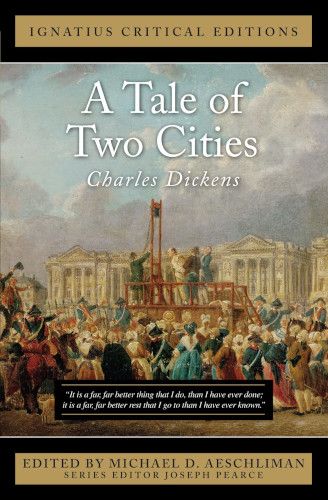
There are the two cities of the title: Paris and London. What becomes clear in the opening chapter, where Dickens is setting up all the polarities in these societies, is that Paris and London have a lot in common. There are many social, personal, economic, and religious problems in each. The two cities that he is most interested in, however, are spiritual and moral ones, even mystical. There is an allusion to the two cities of St. Augustine: the city of God and the earthly city. Ultimately, the novel is concerned with where your spiritual citizenship lies. As in Little Dorrit, everyone in this novel suffers much. The question is how will one respond to that suffering?
Another of the great themes of the novel is resurrection. The first section of the book is titled “Recalled to Life.”
Doctor Manette, one of the main characters, has been held in prison for many years in Paris. His daughter and a friend go and spring him from the cell in one of the early chapters. Having been dead in prison for years, he is recalled to life.
Later, his daughter marries a young man named Charles Darnay. He will get thrown in prison a few years later, also in Paris, and be released by the sacrificial offering of another character, Sydney Carton.
So, a number of characters are released from prison and given new life through the loving ministry of others.
The resurrection comes up in other places too, right up to the famous ending, where Sydney Carton encourages a young woman who is going to the guillotine with him by reciting the words from the Gospel: “I am the resurrection and the life, saith the Lord: he that believeth in me, though he were dead, yet shall he live: and whosoever liveth and believeth in me, shall never die” (John 11:25-26). The theme of resurrection through sacrificial love runs through the whole novel.
Like Little Dorrit, the novel deals with the suffering that stems from imprisonment.
Doctor Manette is held for many years in prison and is released, yet the past keeps on coming back to him. The traumas he has undergone for many years keep coming back, plague him, and draw him back into dark spells of depression. He falls back into his prison mindset from time to time. He cannot let go of it.
In that character, there is one way of orienting towards yourself towards your past sufferings. He holds on to them and wants to control them on his terms and ameliorate them himself. There is something inappropriate about that. Others in the novel suffer by realising they cannot do anything about it, let go of it, and give themselves in love in the midst of it. This is what the hero, Sydney Carton, does at the end.
A last thing about this novel that is profound and worthy of a Christian’s attention is the cross.
At the heart of the novel are the guillotine and the many murders carried out with it in the Paris of the French Revolution. In a famous passage, we are told that, for the revolutionaries, the guillotine has replaced the cross. Dickens means that vindictive justice has replaced forgiveness, mercy, and the sacrificial love that covers the sins of the past. There is a really disturbing shift away from the cross towards the guillotine in Paris. However, when Sydney Carton gives his life for his friend at the end, by going to the guillotine, he symbolically baptises the guillotine and makes of it another cross. He makes it a site where his self-gift overcomes the vindictive, unjust structure that has been set up there, thus turning it into a fresh terrain for creative love.
That is the novel’s beautiful ending.
"Chesterton needs to be our guide to Dickens because he brings out what is so Catholic about the man."
5.
You have included G.K. Chesterton’s writings on Dickens. Do you recommend Chesterton as the best guide to reading Dickens?
I really do.
In the volume that I recommended, there are two books. There is Chesterton’s 1906 biography: Charles Dickens: The Last of the Great Men. Then there is a series called Appreciations and Criticisms of Charles Dickens. Those were introductions that he wrote for a complete series of Dickens’ novels.
Chesterton needs to be our guide to Dickens because he brings out what is so Catholic about the man.
I don’t mean, however, that Chesterton uses a Catholic framework to explain this non-Catholic novelist. Rather, he sees Dickens as unwittingly opening up paths toward various Catholic realities. Indeed, it was partially because of Dickens’s influence on his mindset and moral imagination that Chesterton ended up moving toward Catholicism. His Dickensian qualities lay at the heart of Chesterton’s character.
The dynamics that I have been talking about—sacrificial love, self-emptying, divine childlikeness, and other such mysterious paradoxes—are at the heart of Chesterton's view of the world. He is the most paradoxical writer of the 20th century, and he especially loved the paradoxes of the Gospel.
Dickens was one of the main places where he first learned to love and think of those things. Dickens is where he came to a fully sacramental, lived-out Gospel: one that is not only taught, but is given in a life that you can touch, taste, hear, and feel.
Chesterton appreciates those aspects of Dickens and brings them out marvellously in these books.
Today, it is hard to find novelists comparable in stature to Dickens and his many nineteenth-century peers. Is this because novelists lost touch with their craft, the life of ordinary people, or a deeper understanding of man?
That is a very good question.
It is not as simple as novelists losing touch. It is partly that, and partly the fault of readers.
We are in much less of a reading culture now. Popular entertainment moves in the direction of various kinds of video: television shows, movies, and video games. People do not have the attention span to read Dickens. Some of the novels that I have been recommending are extremely long: about 800 pages.
On the other hand, novelists today generally fail to seek out the deepest things in our moral, interpersonal, and social lives: the deepest desires of the heart. There are some novelists who do this and do it successfully. Not everything is rubbish now. But Dickens could go deeper, partly because the common culture incentivized him to do so. It took the Gospel, and the truths of God and man seriously. That cultural framework is less available for novelists today. They must strike out on their own and do something that sticks out and feels countercultural.
6.
In Hard Times, Dickens offers a withering critique of utilitarianism and the unfettered capitalism of the English centres of the industrial revolution. Is this novel still as pertinent today as it was in 1854?
Yes, though putting it in those terms can make it sound like a very political book. That was the first thing I ever heard about it before I read it. It was framed as a critique of capitalism. And indeed, it is a critique of an industrial capitalism that is willing to instrumentalize people and see them all as cogs in the wheel.
Hard Times is the novel written directly after Bleak House and is very much of a piece with its critique of any cultural, political, social, or industrial organisation that leaves out individuals, alienates them, and ruins their lives because it is just too abstract and broad. It is all thought out and handed down from the top, without any concern for the way people live. Utilitarianism and other forms of empiricist thought about life, knowledge, and education are of a piece with that in the novel. These are all abstract, inhumane conditions.
The novel's worth lies in its strong, palpable, and humane response to what it is like to live in a culture that makes theoretical sense from a rationalist standpoint but does not meet the most heartfelt needs of the soul.
The title of the first chapter is “The One Thing Needful.” That is an allusion to Martha and Mary. Mary chooses the one thing needful, whereas Martha is worried about all the things she must do (Luke 10:41-42).
The novel is poised between two classes of people. On the one hand, some are always doing, planning, scheming, and arranging things to make their workers, systems, and everything whatsoever most productive. On the other hand, there is the contemplative, imaginative, affective life of the soul and the spirit, which wants something more. Ultimately it wants to find a way through this world to God. That is the one thing needful. Some characters are looking for it throughout the novel.
The full title is Hard Times, For These Times. Dickens is stressing that, no matter when people read this novel, the times are going to be hard. In a way, we always live in hard times. Everyone is labouring under some social problems. The question is whether, amid your hard times, you will find a way to bear witness to the true, the good, the beautiful, to “the desire of the nations” and “the one thing needful.”
7.
Michael Slater has written extensively on Dickens. His The Genius of Dickens focuses on the central ideas and intellectual debates that underlie his work and how the great novelist engages them. Do you recommend this book as a guide to the ideas embedded in Dickens’s fiction?
Yes, this a very affirmative book that treats some of the main aspects of Dickens's mode of seeing the world in his novels. It is written by one of Dickens’s great biographers.
I propose this volume in lieu of Slater’s much larger biography. It is grounded in historical research and has a fine-grained, appreciative, and positive sense of Dickens’s thought and writings.
Slater understands and tells the truth about Dickens's faith more clearly and affirmatively than most biographers. Most sources tend to write it off because the contemporary writer has no religious beliefs to speak of, and non-believers tend to write poorly about issues of faith. I do not know what Michael Slater's personal commitments are, however, he is very even-handed and comfortable with Dickens's faith.
This book also shines a light on Dickens's understanding of the imagination, which is so important to him across all his novels, especially in Hard Times.
Dickens thought that modern education, social organisation, and in general British empiricism had created a practical empiricist mindset. People wanted to explain everything in terms of measurables, data, and maths. For Dickens, the proper working of the imagination was critical for recovering true human elements and dimensions of life that are missing so often in the late modern world. Slater is very good at explaining how Dickens saw that.
"Dickens bears witness to ideals from which he nevertheless falls short."
8.
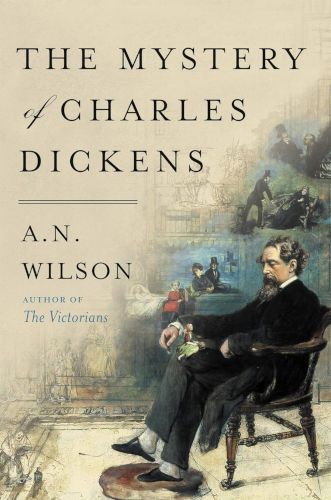
Finally, there is A.N. Wilson’s biographical study The Mystery of Charles Dickens. The title takes its cue from Dickens’s final, unfinished novel, The Mystery of Edwin Drood, but also expresses Wilson’s belief that “of all the great novelists, Dickens is the most mysterious.” Each chapter explores a separate mystery of Dicken’s life: his childhood, his marriage, his charity, his public readings, and his final novel. Why have you recommended this biography over others? Does Wilson solve the mystery of Charles Dickens?
Good question. This choice is the one that I waffled the most about, but I think I still stand behind my choice of Wilson's book.
I went back and forth about it because Wilson dips into some of the more unsavoury parts of Dickens's life and tells the hard truths about the failure of Dickens's marriage.
He left his wife, the mother of his ten children. He separated himself from her later in his life, and there is strong evidence that that he took up with a younger woman. Wilson does not shrink from these morally repugnant facts.
The mystery he is interested in—and which can help us think about our own lives—is that Dickens had such a profound sense of the importance of love, family, children, widows, orphans, and “the least of these,” and yet he mistreated his wife and children. Many of the Dickens children were adults by the time he abandoned his wife, but anytime you do a disservice to your wife, not to mention separating from her, it is a disservice and unloving to your children and family. How can the man who is committed to these ideals and dramatised them so profoundly in his novels, go against them in his life? These are deep waters.
Part of Wilson’s conclusion—and I think this is very accurate—is a truth about Dickens and life in general. Dickens bears witness to ideals from which he nevertheless falls short. We must admit that this is humanly possible in our own lives, and more normal than we assume. Here is a cause for hope and mercy. Even though Dickens struggled to follow the vocation which he dramatises in his novels, he continued to hold it up higher and higher. The divide between his imaginative vision and his personal life bears witness to the impossibility of letting go of these ideals, even as we feel the difficulty of their attainment. That is a hard truth to state, but A.N Wilson sets it out well, sometimes acerbically, but also with generosity.