
Truth is an attribute of God, whereas lying and deceit are characteristic of the wicked. Sacred Scripture stresses this continually. Accordingly, it prohibits lying time and again (e.g. Exodus 20:16 Leviticus 19:11, Proverbs 12:22, Colossians 3:9). The Church brings together all this together and teaches that:
“Lying is the most direct offense against the truth. To lie is to speak or act against the truth in order to lead into error. By injuring man's relation to truth and to his neighbour, a lie offends against the fundamental relation of man and of his word to the Lord.
The gravity of a lie is measured against the nature of the truth it deforms, the circumstances, the intentions of the one who lies, and the harm suffered by its victims. If a lie in itself only constitutes a venial sin, it becomes mortal when it does grave injury to the virtues of justice and charity.” (Catechism of the Catholic Church 2483-84)
Nevertheless, the Church’s teaching that lying is wrong by its very nature and can never be justified (Catechism of the Catholic Church 2485) has always been disputed. Virtually everyone acknowledges that lying is wrong in principle. Frequently, however, there have been debates over what counts as a lie. Moreover, many maintain that, under certain circumstances, lying may not be wrong at all but a morally necessary measure to protect the innocent.
In this interview, Christopher Tollefsen discusses some of the main theoretical and ethical disputes about lying and recommends five books on the subject.
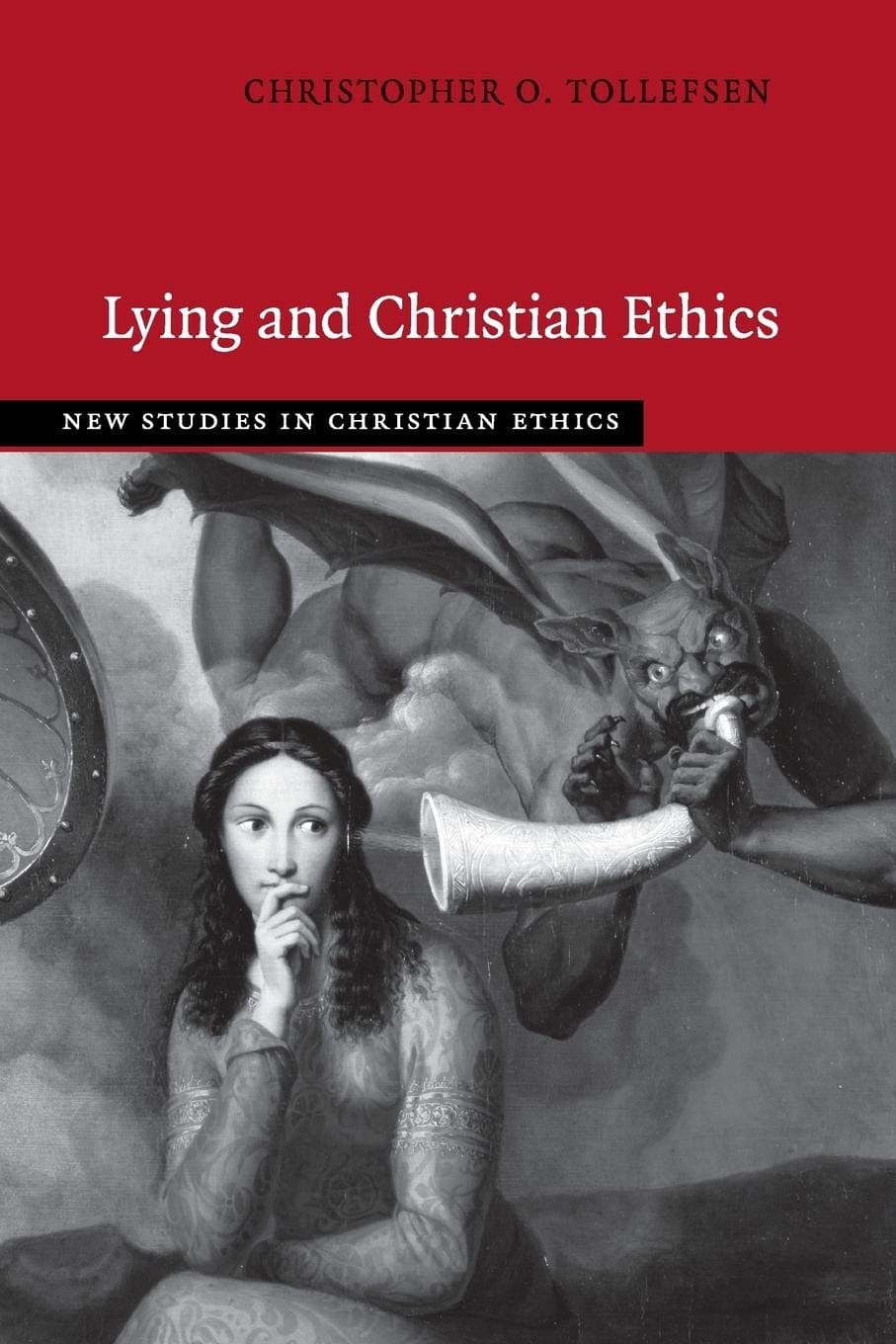
Christopher Tollefsen is Professor of Philosophy at the University of South Carolina. He works broadly in ethics, in an area of natural law philosophy popularly called the "new" natural law theory. He is the author of Lying and Christian Ethics (Cambridge University Press), co-author of The Way of Medicine: Ethics and the Healing Profession (University of Notre Dame Press), and co-editor of Natural Law Ethics in Theory and Practice: A Joseph Boyle Reader (Catholic University of America Press)
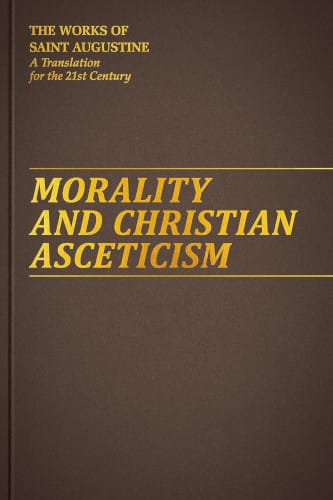
- On Lying & To Consentius, Against Lying
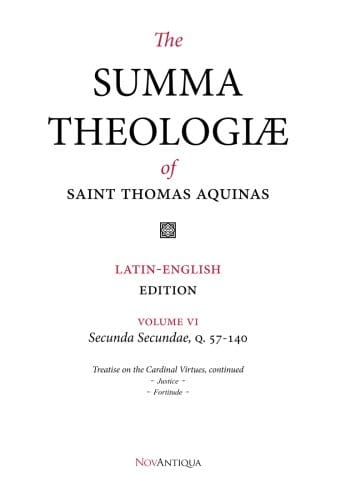
by St. Augustine - Summa theologiae II-II, qq. 57-120 (esp. 108-110)
by St. Thomas Aquinas - Catholic Teaching About The Morality Of Falsehood
by Rev. Julius A. Dorszynski - Moral Absolutes: Tradition, Revision, and Truth
by John Finnis - Truthfulness, Lies, and Moral Philosophers: What Can We Learn From Mill and Kant? (online pdf)
by Alasdair MacIntyre
Five Books for Catholics may receive a commission from qualifyng purchases made using the affliate links in this post.
You have written an excellent monograph, Lying and Christian Ethics. What motivated your extensive research on theoretical and ethical problems surrounding lying?
Two defining events in my intellectual formation led to this.
One was time that I spent as a graduate student reading through Aleksandr Solzhenitsyn’s Gulag Archipelago. There, as he did in various other of his writings, Solzhenitsyn talks a great deal about the extent to which lies pervaded Soviet life and the difficulty of being a person of integrity. That resonated with me as a graduate student at a secular philosophy program. I thought there was something to be learned there about the importance of speaking one's mind.
A second thing was of more proximate importance to the development of that book. I have always been involved in the pro-life movement and had written several essays in defence of the rights of unborn children. Around 2011, there was a lot of news about a prolife organization that had gone undercover to infiltrate various Planned Parenthood facilities in New Jersey. Members of the organization had pretended that an underage migrant needed an abortion. The workers at Planned Parenthood showed that they were willing to facilitate an abortion for the underaged. This was viewed as a great triumph for the prolife movement. However, I thought it was a disaster and that it was terrible for the prolife movement to be involved in offenses against truth. It seems to me that the strongest thing that we have going for us is that we speak the truth always, in season and out of season. Lying in the service of our mission would impair our ability to pursue it and witness.
That got me reading Augustine. He was faced with a very similar situation: the attempt of some Catholics to infiltrate a heretical sect by lying and pretending to be part of it. With many good arguments, he explained that this was a terrible idea.
That prompted me to write some articles on the topic for Public Discourse. Then, during a sabbatical at Princeton University in 2011-12, I worked on my book.
You have just mentioned the sting operation that some prolife activists carried out in Planned Parenthood clinics. However, the state also sponsors the sting operations of undercover intelligence agents and police officers. Is it licit for the state to do this?
Certainly not. In my book, I follow Augustine, Aquinas and several others (though there are not many others) in arguing that lying is always wrong. This, as I describe it, is an absolute view about lying: lying is the assertion of something contrary to one's mind and should never be done. That has far-reaching consequences, not just for church groups or the prolife movement, but for the government too.
Many think that just as government has the authority to use lethal force in ways that private citizens do not, so too does it have the authority to lie in ways that private citizens do not, and that this authority extends to the inclusion of undercover agents in criminal and terrorist operations.
If my view is correct—and it is the view of Aquinas and Augustine—then it is equally wrong for the state to perform such undercover operations.
Interestingly, Aquinas did believe that the state has a certain authority to perform acts of intentional killing in which private citizens may never engage. However, he never suggested anything of the sort when it came to lying. For instance, he believes that lying in warfare is always wrong, regardless of the circumstances. In that respect, his view on lying are even stricter and more absolute than those on state sponsored killing.
"The essence of the lie is the assertion contrary to what one believes."
A first question that needs to be addressed is, “What is a lie?” There is more to a lie than merely making statements that are untrue. Generally, we make false statements whenever we tell a story or a joke, as when Tolkien says, “In a hole in the ground there lived a hobbit.” However, we do not take such statements to be lies. So, what is a lie?
The question, “What is a lie?” is of intense interest right now among philosophers, especially philosophers of language. Their interest overlaps incredibly with the initial discussion of that question in Augustine's book On Lying.
Any lie is an assertion. When one asserts something, one affirms it to be the case. For example, it is the case that my wife and children are out of the house thrift shopping right now. When I assert something of that sort to you, I intend for you to understand that I am affirming it and affirming it as true.
Whenever we say something on a stage, recite our lines in a play, write a story that begins with “In a hole in the ground there lived a hobbit,” or perform various other speech acts, such as questions and commands, we are not engaged in that act of assertion. We are not affirming something to be the case. Whenever you lie, you affirm something contrary to what you really believe. If I thought that my wife was actually upstairs reading a book, but I told you that she was out at a thrift shop, then that would be a lie according to this account.
Augustine appears to add another requirement, although he qualifies it in certain respects. For something be a lie, it needs be asserted with intention to deceive.
Today, many philosophers consider this to be the so-called traditional definition of a lie: an assertion contrary to what one believes with the intention to deceive.
Aquinas disagrees. He believes that the essence of the lie is the assertion contrary to what one believes. Indeed, many philosophers today believe that the intention to deceive is not necessary for a lie. They are impressed with what they call bald-faced liars, people who will lie to you even though they are known to be liars and know that they are known to be liars. Nobody is taken in by them in any respect whatsoever and yet they seem to be lying. Over the last five years, a huge literature has developed on the bald-faced liar. This goes right back to Augustine and is a testament to how the incredible, enduring importance of his writings on this issue.
Recently, the morality of lying has also come to the fore in the anti-realist current of metaethics called fictionalism. Authors such as Richard Joyce and Mark Kalderon maintain that there is no such thing as actual moral goodness or badness but that those who are aware of this should continue to act as if there were objective moral values since it is socially useful to keep up the pretence, much as a parent pretends Santa Claus exists for the good of the children.
Right. Bernard Williams had a lovely expression to describe views of that sort. He said that they “were not stable under reflection.” You cannot grasp the alleged truth of such a view and continue to operate as usual under it. If we genuinely thought that there were no moral norms and that they were all fictions, then we would treat them the way we do fictions. We would not give them the same respect that we currently do.
Certainly, some people are inclined in that direction, but it seems unsustainable as an overall way to treat moral norms. There is an interesting intersection there, but I am unconvinced by it.
There is a lot at stake with how one defines lying. Barring consequentialists, certain definitions entail an absolutist position: that every false assertion contrary to one’s mind is a lie and so wrong under every circumstance whatsoever. Other definitions are non-absolutist: asserting a falsehood contrary to one’s mind to someone who does not have a right to know the relevant facts is not a lie and so may be justified under certain circumstances. The moral entailments of the former definition, unlike those of the latter definition, appear counterintuitive. This is because lying appears to be morally necessary, under certain extreme circumstances, to protect the innocent. This argument is centuries old. Currently, the standard case-study used to frame it is that of a person who is hiding Jews at their home from the Nazis but must answer the Gestapo official who is asking whether there are any Jews in their house. The first edition of the Catechism of the Catholic Church appeared to imply that it would not be a lie at all to tell the Gestapo that there were no Jews in one’s house. This is because the provisory 1992 edition of the Catechism defined lying in a non-absolutist manner as “to speak or act against the truth in order to lead into error someone who has the right to know the truth” (n. 2483). However, the 1997 editio typica appeared to rule this out by removing the final clause of this definition and specifying that the other’s alleged right to know the truth is not an essential constituent of a lie. Why this change to the more rigid, absolutist definition of lying?
The definition of a lie as speaking falsely to one who has a right to the truth is, relatively speaking, a recent addition to the literature. It was introduced by Grotius. In a certain way, it pays homage to the absolutist view. It preserves absolutism about lying, but in a very formal, almost tautological way. Any instance in which you are justified in speaking falsely to someone will turn out, on this definitional approach, not to be a lie.
According to the more traditional view—which goes back to Augustine, Aquinas, and virtually everyone in between—it is important to separate the definitional question from the moral question.
First, one identifies the speech act to which lying belongs: assertions. Then, one identifies the feature that makes it a lying assertion as opposed to a sincere one. Only then does one ask whether such speech act can be morally permissible.
Of course, different people have different answers to that question.
There was a long tradition of Thomists and Neo-Thomists who argued that lying is contrary to the nature of the faculty of speech. There are other interesting and important approaches. However, that is a separate question because the definition of lying does not introduce moral terms.
This way of approaching the question is important and helpful. Saying that lying is always wrong whenever it is done to somebody who has a right to the truth does not give us any guidance on when such a right exists. Rather, first we need to identify when it is that we are lying and then we ask whether lying is ever permissible.
The shift in the Catechism reflects the interventions of several people, who in one way or another, indicated to the authors that the definition of the preliminary edition does not reflect Catholic thought on the matter.
Grotius was not a Catholic. There is a long tradition of thinking about lying in the way that I have just described. It goes back to Augustine and mirrors the broader Catholic tradition of thinking about moral absolutes: to identify an action’s natural kind independently of any moral assessment, and then bring moral assessment to bear on it. This is the focus of the book by John Finnis that I have recommended.
"I make a goods-based argument, not an argument about the normal function of a capacity. It is the argument that the good of society or community is always at stake whenever one is asserting. Whenever one lies, one directly violates that good."
In Lying and Christian Ethics, you defend an absolutist position and maintain that lying is always wrong, under any circumstance and regardless of the agent’s noble intentions. How do you defend this controversial position which is counterintuitive for many?
It is counterintuitive. One of the things that emerged from the discussion about the sting operation on Planned Parenthood is that it is not just counterintuitive. It is repugnant to many.
Many think that it is morally repugnant to hold that one should never lie for a good cause.
I went back to Augustine to refresh my memory for this interview and was so impressed with his straightforwardness on this point.
Augustine set down an absolutist position that was then dominant within Catholicism for 1200 years. People may have disagreed with it in one respect or another, but they did not find it repugnant.
My view about the wrongness of lying owes more to Thomas Aquinas, who understands the speech act of assertion within the order of communication. When communicating something to you by way of an assertion, my affirmation points in two different directions. On the one hand, it points towards the things of the world that I am talking about. On the other hand, it points towards me and what I believe about those things in the world. Aquinas asks implicitly what goods are at stake in communication. At one point, he says that we owe it to the members of society to provide them in speech whatever is necessary for them to flourish as a society. That strikes some as an instrumental claim about what we need to feed ourselves and to protect ourselves against enemies. That is indeed an important part of the justice and injustice of lies. However, Aquinas is pointing to something deeper. To have a society or community at all, there needs to be a common will between the persons of the community. For there to be a common will, there needs to be a common mind. That common mind can exist only if minds are shared. The paradigmatic way in which we share our mind with one another is through assertion. Therefore, whenever I assert something to you, I am opening myself up to you. I am sharing an aspect of myself with you that you can either accept or reject. That initial sharing and acceptance are what I call the primordial moment of the formation of a community. You cannot have a community without that opening of the self to the other and the other’s acceptance of what is being shared. To assert something to you—to offer that aspect of myself and assertion—and then block its realization within a form of community by asserting something contrary to my mind, is a direct, intentional violation or assault on the good of the society, community, or friendship that can exist between us.
Even in the most ordinary encounters—as when somebody on the street asks me for directions or what time of day it is—I have an opportunity then and there to initiate a very minor, to be sure, but real form of community. However, I can also block and rupture that possibility of community between me and that person by lying to them.
I make a goods-based argument, not an argument about the normal function of a capacity. It is the argument that the good of society or community is always at stake whenever one is asserting. Whenever one lies, one directly violates that good.
The other good that is at stake is that of integrity. This was why Solzhenitsyn’s writings were of such interest to me as a graduate student. Both Augustine and Aquinas mention this. Augustine talks about the liar’s doublemindedness and lack of integrity. That is simply a recognition that whenever I present myself to you in speech, I can either do so in a way that is integral or disjointed with who I am and what I believe. By doing so in the latter way, lying is a deliberate, intentional rupture of my integrity.
Hence, the two goods that I believe are at stake are those of society and personal integrity. Both are intentionally violated in a lie.
That still leaves many other questions open. I am sure that we shall get around to talking about the Nazi at the door. This is obviously the most important objection to the absolutist view. However, just to make a quick comparison, this objection is similar in a certain way to a particular understanding of the wrong of contraception. In marital intercourse, one has the opportunity to bring a new life into existence. With contraception, one blocks that opportunity and takes steps to prevent a potential new life from coming into existence. That is why many find contraception repugnant. However, many who are immediately involved in the prolife movement do not think the same way about lying. There is a disjoint there. I would like those people to see lying in the same light as they do contraception: as a violation of certain important goods.
With the possible exception of the fifth entry, the books you have recommended are works of Catholic theology (which does not entail an absence of sophisticated philosophical analysis). Are there any significant differences between the Christian perspective on lying and a purely philosophical one, or does the Church merely state authoritatively a matter of natural moral law?
I do think that its position is one of natural moral law and defend this claim in my book, even though my writing is deeply influenced by the Catholic tradition and draws upon Augustine and Aquinas.
Though I am making an argument about natural law, it is one of those arguments that, as Aquinas says, is not necessarily easy for people to see.
He distinguished truths that can be deduced quite quickly from prior principles, such as the precepts of the Decalogue, and principles that are further down and whose discovery can be more difficult because it requires some experience and thought. Culturally, we are in a place where, for many centuries and in one way or another, we have rejected certain truths and the Catholic Church as a source of those truths. We have adopted an instrumentalist mentality about a wide variety of things and a consequentialist approach to morality.
These attitudes and approaches militate very strongly against the idea that lying is always wrong. They all settle on the thought that lying can be wrong in obvious ways— it can reduce one’s autonomy and have bad consequences—but also morally permissible whenever the bad consequences are sufficiently significant. This makes it very difficult for the natural law argument to gain much traction. It runs against a long tradition of secular, instrumentalist, and consequentialist thought.
Due to the influence of that secular strand of thought within Christianity, it is important and helpful to make use of traditional Christian sources to at least open the minds of Christians to the possibility that what they have taken for granted— the secularist traditions belief that lying can be right—might not be correct.
So, I do make a sort of naked appeal to authority. I do not claim that my view about lying is right because Augustine or Aquinas held it, but that it needs to be taken seriously because they held it.
It is fairly rare for a traditionally minded Catholic to think that that they can blithely disagree with something on which Augustine, Aquinas, and all the popes and theologians in between them agreed. That is why I make an appeal to the tradition, both in my book and in the books that I recommend here. I do so to move Catholics and other Christians of goodwill towards the traditional Christian view.
During catechesis, most are taught that lying is a sin against the eighth commandment. That is certainly the case, but what the eighth commandment prohibits directly is false witness or perjury. How is lying related to the eighth commandment?
I share Aquinas's view that, in one way or another, each of the Ten Commandments contains the other moral precepts of its domain. For example, the precepts against adultery and coveting your neighbour’s spouse contain implicitly the entirety of sexual ethics.
This plays out in Aquinas' treatment of lying. He does deal with lying within a court of law prior to his more general treatment of lying. He recognises that there is a special gravity to lying when the authority of the judge has told you that you are obliged to tell him the truth. The general wrong of lying is compounded when it takes place in a court and constitutes an instance of bearing false witness. That opens up for Aquinas a further discussion: whether it might be the case that lying is always wrong. He goes from the specific instance of bearing false witness to the more general, unrestricted instance of lying, and concludes that it is always wrong.
If one is successful in showing that, then one is successful in showing that the commandment against bearing false witness invites us implicitly to think about lying in general. The eighth commandment does not answer that question in every possible respect, but it does indicate that lying is a matter of sufficient seriousness that we need to inquire whether there is something wrong with it in general and not just in the court of law.
Several post-Reformation Catholic theologians, most notably some Jesuits, maintained that mental reservation (mentalis restrictio) is licit. Strict mental reservation is the making of an assertion that, in all likelihood, will be misunderstood because the speaker holds back in their mind an essential truthmaking component of the statement. Is mental reservation licit?
I don't think so. Strict mental reservation was condemned by Pope Innocent XI and, on the surface, is obviously a form of lying.
It is worth mentioning that many of these doctrines were developed under conditions that were extremely difficult for Catholic priests in Elizabethan and Jamesian England. They too pay homage to the traditional view that lying is always wrong.
Under these situations of persecution, the Jesuits especially were understandably interested in finding ways to protect their priests. However, some of the examples you read about are quite incredible.
One who was on trial for being a Catholic priest was asked if he was a Catholic priest. He denied it. Of course, he was a Catholic priest and when asked about his answer afterwards, said, “Well, I am not a priest of the temple of Apollo”. He was asked if he had come over to England by sea from France, where the Jesuits were being trained. He denied it, but when confronted with evidence that he had come over the channel, said, “Well, I had not come over the Indian Sea.” He was holding back within his mind the full sentence that would be true.
Of course, there was no way for his interlocutor to understand that this is what he was doing or to grasp the rest of the sentence. He was telling straight out lies. He was asserting something to his interlocutor that was contrary to what he believed. It is no surprise that this was condemned.
There are questions, however, about equivocal speech. This is where we say something that has more than one legitimate meaning.
There are various ways of speaking ambiguously. Perhaps the most famous case is Athanasius's answer to the Romans who were pursuing him. They asked if he had seen Athanasius. He replied, “He is not far away.” So, the Romans went off looking for him and he continued his journey. This was not a lie. It was true that Athanasius was not far away. Nor was he speaking contrary to his mind. However, he was speaking in a way that he expected to be deceptive.
In the essays by MacIntyre that I have recommended, there is the example of a Dutch housewife who hid Jewish children. She had promised her Jewish neighbours that she would do this and care for them. The Nazis approached her and asked if the children were hers. She said that they were. MacIntyre thinks that this was a lie. However, I think that it was neither strict equivocation, nor strict mental reservation, nor a lie. She believed that even if they were not her children in a biological sense, they were in a deep moral sense. That made that claim true.
There are many points of casuistry, questions, problems at the boundaries of equivocation that are important for thinking about the moral issues that an absolute view about lying raises. However, ambiguous speech that has multiple meanings is different from strict mental reservation.
"It is essential for people who predicate their mission on speaking truth that they always speak the truth."
1.
The first reading you have recommended comprises two short works on lying by St. Augustine: On Lying (395) and Against Lying (420-421). What makes Augustine’s treatment of the issue so important?
Three things, two of which I have already mentioned but are worth repeating.
The first is that Augustine begins the treatise with a very robust discussion of what constitutes a lie. His stated reason for this is an interesting and important moral one. He says that we need to know what a lie is before we start accusing people of lying. It would be an injustice to accuse somebody of a lie merely because they had spoken falsely. They might have done so accidentally. They might believe what they say even if it is false. Then Augustine raises interesting questions about what happens if you speak truly but deceptively; falsely to get somebody to believe the truth. He raises interesting questions about what a lie is. This is one of the abiding ways in which this book is important.
The second reason is his question about the infiltration of the Priscilianists, a heretical sect. This has a specific application to the question of sting operations. However, Augustine is concerned with a larger central question, one that comes up in both his treatises on lying. In his view, a religion that identifies itself as the religion of truth—whose business it is to speak the truth about God the Father, the Son, and the Holy Spirit—must always act in a complete spirit of truth-telling. His concern is that lying undermines that mission. This aspect is of immense and abiding importance but often overlooked. Augustine continually asks the following question. If we are found to have lied to promulgate the truth of the Catholic faith, on what ground will anybody believe us in the future? It is essential for people who predicate their mission on speaking truth that they always speak the truth.
The third way in which these books are very important is that Augustine recognizes and addresses repeatedly the arguments in favour of lying, ones that are still around.
One objection was that lying was the only way to defeat the Priscillianists or for Bishop Firmus to hide people from unjust persecution. Augustine says two things that are important to remember. One is that it's not our business to do every good deed that could ever possibly be done. Rather, our business is to be upright in all of what we do. The other is that there is a hope to be had in speaking truly. Augustine notes several times how Bishop Firmus refused both to tell the authorities the location of the people he was hiding and to lie to them. Eventually, this impressed the authorities so much that they relented. Time and again, Augustine says that we might think that lying is the only way to accomplish some great good whereas speaking truly is the only way to accomplish it.
Augustine also has arguments against consequentialist approaches. He points out the ways in which lies lead to other lies; the ways in which we are selective and self-serving in excusing lies but not other kinds of behaviour, such as unchastity, for some greater good. All arguments are of direct relevance to the moral questions we pose.
As you mentioned, Augustine wrote On Lying to counter an exegesis of Galatians that could undermine faith in the truthfulness of Scripture. Origen, St. John Chrysostom, and St. Jerome had maintained that Paul staged his falling-out with Peter to make it clear to the Judeo-Christians that the Mosaic law was no longer in vigour. Augustine is writing in response to Jerome’s rehearsal of this interpretation. Is he the only Church Father to deal with lying in such a systematic manner?
At that point he is. The topic comes up in various contexts among the Eastern Fathers, but not with the same sustained vigour of Augustine. Moreover, the Eastern Fathers are a little more permissive. They seem to think that there is something wrong with lying, but that it can be used as a bitter medicine in certain cases. Augustine is the first person in the West to address it systematically and sets the template. Dorszynski's dissertation shows the extent to which this was the case.
Although what Augustine said is repeated frequently, it is not until Aquinas that there is another sustained attempt to identify the principles on which one could assess the morality of lying. It is just taken for granted that Augustine is right.
2.
That brings us into St Thomas’s discussion of lying within the Summa theologiae’s immense treatise on justice (II-II, qq. 57-122). This is part of his discussion of the virtue of veracity or truthfulness and its opposing vices (qq. 109-113). Lying is the first of those opposing vices (q. 110). What makes his discussion of truthfulness and lying so important?
Again, this goes back to my own understanding of the wrong of lying. There is a passage in question 109 where Augustine says that there is a special virtue whenever there is a distinct good and that good pertains to a distinct order. This the heart of the question of what assertion and communication are all about, and the way in which lying and other forms of untruthfulness distort the order of communication.
This passage opens up many possibilities when thinking not just about truth-telling, assertion, and lying, but also about the order and goods in one's life and the ways in which certain virtues are necessary to the order of marriage, friendship, or study. For example, certain virtues are necessary to sustain the order of life of an academic, whereas various vices and acts are destructive of that order.
In this one passage, Aquinas is at his richest and yet briefest. This is characteristic of him. He says in a couple of sentences something that one can think about for years.
Moreover, he opens the discussion out not just into lying but various other ways in which you can conceal who you are. He makes important distinctions that are central to many misconceptions of the absolute view. He says that, through simulation, you can even be a liar in your actions. You can feign to be a kind of person that you are not. Hypocrisy is to do so in a religious context. However, there are various other forms of simulation that are tantamount to lying.
But Aquinas distinguishes this from the ways in which we can conceal the truth from those who do not have a right to the truth or when we have an obligation not to promulgate the truth. These distinctions are central to an adequate casuistry of lying and truth-telling. It would be impossible to be a moral absolutist and say not only that it is always wrong to lie but also that it is always obligatory for people to tell whatever truth they know. That would render the holding of secrets or privacy impossible. Furthermore, without privacy, the possibility for various forms of intimacy and friendship would be greatly reduced. Hence, Aquinas says that there is a real and important moral difference between lying, on the one hand, and not speaking or speaking in a way that is true but potentially deceptive, on the other. A relevant comparison can be drawn here. Lying resembles contraception whereas remaining silent is similar to natural family planning or abstaining from intercourse for a good reason. There can be good reasons to abstain from telling the truth, but that is very different from saying that there can be good reasons for lying.
"Even someone as late as Newman still suffered from the suspicion that the practice of strict mental reservation brought upon Catholics."
3.
Is the third book, Catholic Teaching About the Morality of Falsehood by Julius A. Dorszynski, a good précis of Catholic doctrine and theological debates about lying? You point out that holds the theological dubious view, which goes back to Hugo Grotius, that asserting something false to someone who does not have a right to know the truth (falsiloqium) is not a lie.
It is in the following respect. Dorszynski does a good job—the best in English that I am aware of—of presenting the remarkably uniform tradition of thought that runs from Augustine to the Jesuits of Elizabeth’s and James's era. It shows how the view within Catholicism, unbroken for about 1200 years, was that lying is always wrong and ever to be avoided.
However, it also the case that his position is very dubious. This is most clearly on display towards the end of the book, where he starts to give examples of the Grotian view: that it is not a lie to assert something false to someone who does not have a right to the truth.
He gives the case of Junior, whose teach asks him if he went to Mass. Bonhoeffer gives a similar example: of a schoolboy whose teacher asks him if his father came home drunk the evening before. In Dorszynki's view, it is unjust for the teacher to ask the student this in front of everybody else. This is probably an injustice. However, Junior says, “Yes, I did go to Mass”, when in fact he did not. Dorszynski concludes, “Verdict: no lie.” Nobody can think realistically that it was not a lie simply because the teacher initiated a wrongful form of communication. It is obviously a lie when you tell someone that you went to Mass, though you did not and know that you did not. If we do defend speaking falsely in certain circumstances to someone who does not have a right to the truth (falsiloqium), we should just be clear about what we are doing. We should say, “Yes, it's permissible to lie in these circumstances.” That at least clears the field for a discussion about whether, when, and why lying is ever permissible rather than concealing the issue under this dubious distinction between mendacium and falsiloquium.
You mentioned the post-Elizabethan trends or post-Reformation trends in moral theology. Does Pascal get into the question of lying in his Provincial Letters?
He does and is blistering about it. He is very unhappy with the practice of mental reservation. Arguably, he contributed to its downfall.
Even someone as late as Newman still suffered from the suspicion that the practice of strict mental reservation brought upon Catholics.
Catholics were considered untrustworthy because they engaged in these practices. Pascal was concerned about this too. Newman was accused of being evasive and equivocal.
Strikingly, he writes that it can be permissible to lie under certain very strict conditions, but never permissible to equivocate. He got things backwards there, but this shows how the social effect that the practice of equivocation and reservation by some Catholics lasted for hundreds of years. This is a succinct illustration of exactly the dangers that Augustine warned about.
4.
Fourth is Moral Absolutes by John Finnis. In these lectures Finnis defends against proportionalism, a current within Catholic moral theology, the existence of moral absolutes: “absolute and specific moral norms, that is, exceptionless moral norms.” Have you recommended this book for its occasional discussions of the moral absolute about lying or for its defence of moral absolutes in general.
More for the latter reason. Late in the book, there is a brief discussion of Augustine and lying is mentioned occasionally as an instance of moral absolutes. However, the book is important for the discussion of lying for two reasons.
One is its defence of moral absolutes. Even well-formed Catholics of goodwill think that, ultimately, there are not any moral absolutes: acts that, described in a non-moral manner, should never be done.
We are less than a month away from the anniversary of the atomic bombing of Hiroshima and Nagasaki. Gaudium et Spes issued an unqualified condemnation of the indiscriminate bombing of innocent civilians. Such bombing is utterly contrary to Catholic teaching about the morality of warfare. Nevertheless, many who would consider themselves to be traditional Catholics and defenders of the Church’s traditional moral teaching believe that the atomic bombing of Hiroshima and Nagasaki were necessary because the stakes were so high. Some will argue that it was both justified and necessary; others that it was not justified but nonetheless necessary. It is problematic that so many Catholics are willing to go down that road. It is completely at odds with the teaching of John Paul II’s Veritatis splendor.
Finnis's book recalls the long tradition of Catholic teaching on moral absolutes. The primary property of a moral absolute is that it identifies a form of action that, absolutely, is not to be done.
Another reason to read Finnis’s book is that it identifies the structure of the acts that is implicit within Catholic teaching about moral absolutes: that an act is to be identified in terms of its intention rather than any physical causality or behaviour and the way that intention bears upon certain goods, such as that of marriage, human life, or truth. As a result, by identifying an act’s kind, one can then determine whether it is always wrong in virtue of the object that the agent is thereby choosing. There is no room in the Catholic tradition, therefore, for absolute moral norms of the form, “Unjust killing is always wrong,” or “Speaking falsely to one who has a right to the truth.”. Such definitions build in moral qualifiers that make them tautologous rather than informative. The whole purpose of traditional teaching on moral absolutes tradition is to enable us to identify act that are not to be done. It is no help to identify such acts in virtue of tautologous moral qualifiers.
"The lesson of those Eastern European prophets of truth is simply that you need to speak the truth."
5.
Fifth is Alasdair MacIntyre’s Tanner Lectures: Truthfulness, Lies, and Moral Philosophers: What Can We Learn From Mill and Kant. In them MacIntyre pits Mill, one of the founders of utilitarianism, against Kant, an absolutist about lying. He compares them to one another because they are the main sources of post-Enlightenment ethics. MacIntyre reaches an apparently paradoxical conclusion: there has to be a moral absolute regarding lying, as St. Thomas and Kant maintain, but Mill is also right that under certain circumstances it is not just permissible but a duty to lie. This, he argues, is because “the evil of lying…consists in its capacity for corrupting and destroying the integrity of rational relationships.” Have you recommended MacIntyre because he makes a strong case for treating lying as a circumscribed moral absolute?
Yes. In preparing my book and teaching a couple of courses on the topic, I concluded that MacIntyre's Tanner Lectures make the best case possible for the permissibility of lying under some circumstances.
One reason is that MacIntyre recognizes that lying, whatever one’s justification for it, cannot be presented as an exception to a general rule. This is an important insight.
The other reason is that his account of the two traditions, the one in which there are moral absolutes and the other in which there are none, is correct on certain points.
He notes correctly that for the non-absolutist tradition only deception is wrong, not speaking falsely. Within that tradition, it does not make any difference whether you deceive through lying or in some other manner. Deceit, not lying, is the essential component. That tradition focuses, therefore, on the kinds of harms that the deception causes and the damage it might do to the social fabric.
Within the other tradition, the focus is on assertion. However, MacIntyre wrongly assumes that that the absolutist tradition’s primary argument—and this is certainly not the case in Aquinas—conflates the moral norm with the constitutive norm of assertion. In other words, you assert something if and only if you assert it to be true, in the same way that believe something if and only if you believe it to be true. Otherwise, you are not making an assertion. The problem with this view is that it is impossible to imagine what it would mean to believe something except as true, whereas it is certainly possible to imagine somebody who asserts something while not believing it and has reasons to do so. Simply saying that asserting the truth is the constitutive norm for assertion does not, unlike the Thomistic argument, make any reference to the goods of assertion.
Elsewhere, however, the essay does identify how the practices of assertion and truth-telling are related to the importance of truth within two kinds of community. This is a characteristically MacIntyrean theme.
In the essay on Mill he focusses on a community of moral inquiry. Such a community requires openness of debate and honesty in presenting one’s views, so that those views can be critiqued by others. On a Millian account, you can never claim that a view is so well-known others may not criticise it, or so false that others are no longer allowed to defend it. MacIntyre and Mill disagree with that on account of what it means to be part of a community of moral inquiry.
In the second of the two essays, MacIntyre situates the importance of being part of a community of moral inquiry within a larger kind of community, one that, among other things, is engaged in caring for the vulnerable and helping them attain independence.
As with his discussion of Mill, MacIntyre notes that truthfulness is important in this community too. If we are incapable of offering criticisms of one another and receiving them from one another in our familial, political, or ecclesial communities, we are incapable of engaging in truth-telling that resists fantasy or calls into question various aspects of our communities. That itself is detrimental to the good health and flourishing of our moral community.
MacIntyre makes all these deeply important points. They go directly to the importance of truth-telling.
However, when he gets to the question of the morality of lying, he defends lies that are told to preserve those very communities.
One case he gives is that of the Dutch woman who hides Jewish children. The other is that of a woman who shoots an abusive ex-lover who is threatening her and her daughter. Neither case does the work that he needs it to do. At some points he comes close to recognising this. Overall, however, he fails to recognize something that Augustine does. Even in situations where lying or intentional killing might seem to be the only ways to protect the community against an aggressor, making that judgment goes beyond what we can know for certain and rejects the hope truth-telling might accomplish more than we might otherwise expect. In a context of Christian hope, truth-telling might be the way to accomplish what we suppose can only be accomplished by lying.
MacIntyre, therefore, presents the strongest case for the justifiability of lying, one that does not view it as an ad hoc exception to the norm but as an entailment of certain truth-oriented considerations. At the end of the day, however, I am unconvinced by the cases he considers and the overall trend of the argument.
To conclude, let us go back to where we started. At the beginning, you mentioned how reading Solzhenitsyn triggered your interest in lying and its impact on society and our joint pursuit of the common good. Do you think that the sort of situation that Solzhenitsyn or Vaclav Havel described under communism is being mirrored nowadays in liberal democracies, where there is an advance of cancel culture and forms of social pressure to conform with certain dominant ideas rather than speak one's mind on certain issues?
I do. In my book, I mention a Polish dissident, Adam Michnik. He was part of the Solidarity Movement, which itself was part of a larger movement of Eastern European thinkers. They were committed to speaking the truth against social structures and institutions that were filled with falsehood and lying. Michnik says that if we want the truth, we need to start is by speaking the truth.
That is the most important lesson of these Eastern European prophets of truth. We are in a situation in which it is difficult to speak the truth. Moreover, attempts to do that are met in many cases with a variety of what Mill would have considered social sanctions. Although these social sanctions constitute a softer form of despotism than actual penal punishments, they are more effective. Many find it much easier, at least in theory, to resist the threat of a state sanction on account of their moral views than the possibility of being cancelled on Twitter, provoking their colleagues to despise them, or being incapable of moving up the ranks of a particular business. The lesson of those Eastern European prophets of truth is simply that you need to speak the truth. Yes, you need to be prudent, kind, and charitable in so doing. However, letting yourself be run over by the forces at work in institutional, societal, and political falsity is not the solution.
I take a lot of inspiration from what those thinkers but acknowledge that it is very difficult to live up to the model that they set for us.