Most people care about education, but those who are not committed Catholics are likely to take a very different view from the Church when it comes to defining the stages and setting of education. In this interview, R. Jared Staudt explain the books that he believes will help us understand the nature and situation of Catholic education.
Dr. R. Jared Staudt specializes in systematic theology, the evangelization of culture, catechesis, Catholic education, Church history, and Thomas Aquinas. He has taught at the Augustine Institute since 2009, teaching part-time since 2014. He has also served as the director of the Catholic Studies Program at the University of Mary, director of religious education in two parishes, co-founder of two high schools, as associate superintendent for Mission and Formation at the Archdiocese of Denver. He is currently Director of Content for Exodus 90, a ninety-day spiritual exercise for men.
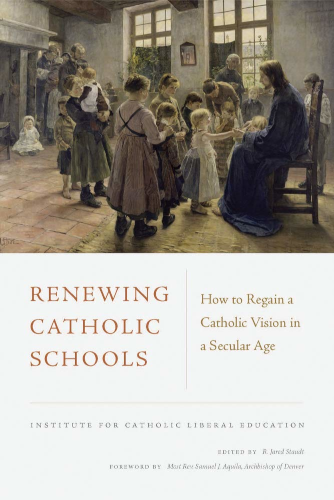
Dr. Staudt's books include The Priority of God: The Virtue of Religion in Catholic Theology (Emmaus Academic), Restoring Humanity: Essays on the Evangelization of Culture (Divine Providence, 2020), Renewing Catholic Schools: How to Regain a Catholic Vision in a Secular Age (editor, Catholic Education Press, 2020), The Beer Option: Brewing a Catholic Culture Yesterday & Today (Angelico, 2018), and How the Eucharist Can Save Civilization (TAN Books).
- A Reason Open to God: On Universities, Education, and Culture
by Pope Benedict XVI - The Crisis of Western Education
by Christopher Dawson - John Senior and the Restoration of Realism
by Francis Bethel OSB - Beauty for Truth's Sake: On the Re-enchantment of Education
by Stratford Caldecott - Renewing the Mind: A Reader in the Philosophy of Catholic Education
by Michael Gross
In its broadest sense, education is everything that a society does for the self-development of its members. However, we normally associate it with schools and university. Do the books that you have selected take the narrower or the broader focus?
Most of the books that I chose reflect a broader understanding of education: education as an entering into a whole way of life and thinking. Some of them do look at what we need to do within the school itself. Good books on education will hit at both aspects. There is initiation into a culture or group of people. But then, there is the question, “Okay! How do you do that effectively within formal education?”
How would you define Catholic education? Is it just conventional education plus catechesis or does it work with a radically different conception of education?
In the Early Church, there was a providential coming together of two ways of viewing education. The Church accepted the Greek ideal of paideia, the formation of the person through the liberal arts. It blended that with its own understanding of catechesis. So, in a way, Catholic education accepts the ideal of paideia, the formation of the person through humane learning, while also understanding education as an initiation into the life of God through the Church. There may have been tensions between the two through time. Tertullian is often quoted in this regard: “What has Athens to do with Jerusalem?” But in general, the Church has said, “Athens does have something to do with Jerusalem.” When we look at the formation of the human mind according to reason, according to the Logos, we see that it does relate to the soul. Right thinking and virtue are in accord with our nature. They, of course are the aim of paideia. They are related to Christian life.
Now, could you ever reduce catechesis to liberal arts learning? That would be a gross distortion. We know that Catholic education must be rooted in Christ. It is not simply about the education of the mind. But Christ is the Logos. Catholic education does extend to the formation of the mind.
"The overarching goal of Catholic education is to bring people into an encounter with Christ"
Who do you have in mind when recommending your top five books on Catholic education? Parents who are thinking about their children? Teachers? Catholics who want to improve their own education? All of the above?
All of the above. I have seen dedicated laypeople make a profound effect on Catholic education in many ways, even if they are not working in a Catholic school or do not have school-age children.
There was a retired woman, elderly and with health problems, who helped inspire the founding of a Chesterton Academy in the Denver Metro area, particularly by influencing me as part of that project. There was also of a bunch of dads. They had young kids who were not even in school yet. They formed a group in their parish called First Educators and began sponsoring talks. That was another factor that led to the founding of this high school. Catholics who are serious about formation and who care about education can certainly support the great work of Catholic education in different ways.
1.
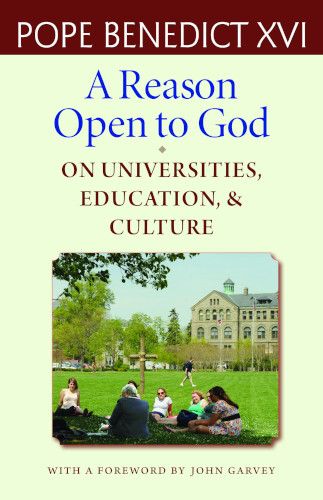
First on your list is A Reason Open to God, edited by J. Steven Brown. This is a collection of speeches, letters, and homilies that Pope Benedict XVI delivered on education and the university. A university professor by training and inclination, he speaks with first-hand knowledge. His main point is that we need to go abandon the reductively positivistic conception of reason that has become dominant in modernity and restore God to his rightful place at the centre of education and the sciences. What are Benedict XVI’s fundamental teachings on education and why have you chosen him as an authoritative guide on this subject rather than one of the other recent popes?
In my mind, Pope Benedict has articulated the Church's whole tradition of education: the recent magisterium both from the last one hundred years and even back to the Early Church. He has articulated that vision better than anyone else.
In particular, his talk at Catholic University of America and his meeting there with educators (it was with college presidents and superintendents from throughout the United States) has really been the magna carta of our work. He has a great gift of being able to synthesise and transmit so many principles in a succinct way. As a Microsoft Word document, that speech is about four pages long. However, it engages in all the major themes of education so quickly. I have used it in so many different settings with educators.
It states that the overarching goal of Catholic education is to bring people into an encounter with Christ. It deals with the topic of faith and reason and how that extends to human freedom. Freedom is one of the great themes of this short talk. Benedict XVI says that we have emphasised the formation of the mind but perhaps overlooked the importance of the will and, therefore, of the good. This draws on a whole reflection on education that goes back to Plato: that education should shape our desires. Then, he talks about hope. Right now, Catholic education can provide hope for young people because it grounds them in the truth. The truth is liberating for us, because it provides the right ground for the adventure of life. I love how he calls life an adventure. He is pointing to how Catholic education calls young people into a great discovery of the truth and then to the great adventure of living in communion with Christ in the Church.
Beyond that one lecture, his writings and talks on education are known for the integration of faith and reason through the Logos. The Word of God is the truth through which the entire universe was created and the one who comes to reveal the Father to us. This shows that there must be a profound harmony between faith and reason in the work of Catholic education. We can see the whole of reality more profoundly than anyone else. We need to help our young people to enter into the full breadth of this tradition. Of course, that does not mean that we simply add the knowledge that comes from faith onto the regular approach of a school. It is about freeing reason itself. Reason can do more when it is not locked into a positivistic view. It can consider the deepest truths of human. It has an important role to play in the life of faith. Our youth will come to know Jesus Christ more fully when they are able to think clearly, coherently, and deeply about reality.
2.
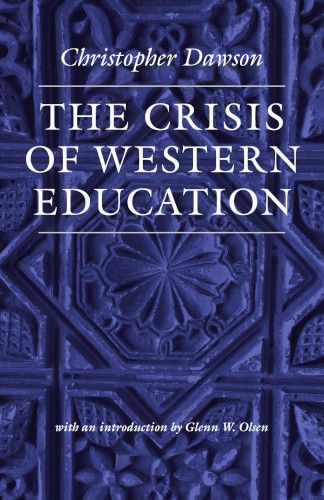
Your second pick is Christopher Dawson's, the crisis of Western education, which was published in 1961. Dawson was a convert to Catholicism and a prestigious historian who argued that religion is the foundation of any culture. In his view, education is enculturation the way in which a society inculcates its culture. He examines the history of Western education and assesses the prospects of a Catholic education in the United States. A lot has changed since then. What does Dawson get right and what can he teach us about the current challenges facing Catholic education?
Writing in 1961, when he was the Chair of Catholic Studies at Harvard, he was witnessing the highpoint of parochial education in the United States. At the time, there were five times as many students in our parochial schools as there are now, even though the Catholic population on the United States has grown significantly since 1961. So, Dawson was betting on the parochial system to resist the trend towards fragmentation and secularism then underway in the United States. He really thought that Catholic education would be a bastion.
In some ways, he was right. But since the late 1960s, there has been a profound decline in Catholic education. Every single year, we have lost schools and students. Funding becomes more difficult. COVID gave us a little boost. People were seeking out Catholic schools at that time because we stayed open. But beyond COVID, it has been a story of decline. So, Dawson was wrong about that, but no one could have predicted that decline in 1961.
This work has influenced me more than any other on education. Dawson looks at the tradition of classical education. To him, it was the tradition of humane learning that he experienced at Oxford: the whole tradition of the liberal arts; the study of Greek and Latin; the reading of the classics in the original languages. That is what he was thinking about. He was looking at that tradition and how, under John Dewey's influence especially, it was breaking down within the United Stated in the face of pragmatism. Looking at that breakdown, he asked what we could learn about enculturation from the previous classical tradition. It preserved a cultural ideal related to the paideia. Dawson asked why we had been focusing so much on the culture of classical civilization throughout the past centuries instead of the culture of Christendom? Moving forward in Catholic education, we could have a whole programme of studies that is based upon the cultural achievements of the Church. Dawson wanted to see a whole programme of Christian or Catholic studies That could enculturate students into the whole organic and living tradition of the Church herself. And so, he thought that Catholics should attend more to an initiation into the whole tradition of the Church, cultural, educational, or otherwise.
This book was very influential in the founding of the Catholic Studies program at the University of St. Thomas. I did my undergraduate and master's degree in that programme. Don Briel, the founder of that program, set it up as a way of soaking up the great cultural legacy of the Church in theology, philosophy, art, history, literature, along with study abroad in Rome. I have edited a collection of his essays on education: The University and the Church.
It was through Catholic studies, that I read Dawson's corpus. I had a research grant to study Dawson. At the end of my studies on him, I was asked which work stood out the most. It was this one. It has motivated me in my own work to share the great cultural legacy of the Church with others.
3.
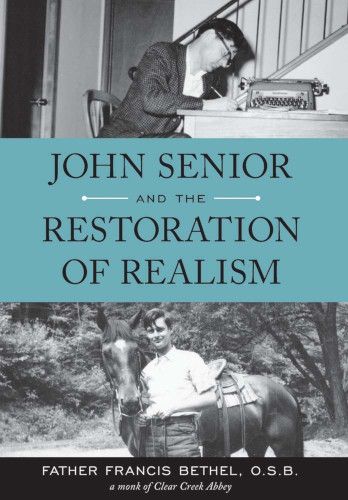
Next is Fr Francis Bethel’s biography of one of his professors in the Integrated Humanities Program at the University of Kansas: John Senior and the Restoration of Realism. Besides teaching his students the humanities, Senior inspired a significant number to convert, and even enter seminary or the religious life. His two main writings are The Death of Christian Cultureand The Restoration of Christian Culture. In shortlisting Fr Bethel’s biography instead, are you suggesting that we can learn more from Senior’s approach to teaching rather than his writings? If so, what should we learn from him?
I highly recommend The Restoration of Christian Culture but it only dedicates one chapter to Catholic education, though there are insights that you can glean from other chapters.
"Education begins with poetic knowledge: the engagement of the emotions and the senses."
Senior had a very compelling story. He grew up in Long Island and even ran away from home to be a cowboy in the American West. He flirted with communism. He was part of the first great books programme in the United States, at Columbia University. He started reading Plato. Interestingly, though, his studies there led him to the esoteric. He even got into Hindu spirituality and the symbolist movement, and wrote his dissertation on the occult in symbolist literature. But as he was studying Hinduism and the eastern tradition of occult knowledge, he started finding references to St Thomas Aquinas and to St Augustine. So, as a professor at Cornell University, he decided to read them in the original Latin. He read Augustine’s De Trinitate and the entire Summa theologiae. He came to a great insight. Reading the Summa brought him back to his days as a cowboy, sitting around the fire, drinking coffee with the other men on the plains. It was rooted in the earth: in the truth of creation. That is what he found in Thomas Aquinas: common sense and an encounter with reality. The Hindu approach and the esoteric approach was to say that reality was an illusion. Sitting around the fire with the cowboys was not an illusion. So, Thomas Aquinas opened this encounter with the real to him. That is why Fr Bethel's book is called John Senior and the Restoration of Realism.
"Senior criticised modern education for being Cartesian. It simply begins with ideas of things. These ideas are removed from things themselves."
One of the big takeaways, is that education begins with poetic knowledge: the engagement of the emotions and the senses. It progresses naturally from the poetic to the rhetorical: the ability to approach truth in communion with others through conversation, as occurs in the Socratic method. From there, it moves to the dialectic: the ability to make distinctions. Then, it comes to scientia: the true understanding of the nature of things.
Senior criticised modern education for being Cartesian. It simply begins with ideas of things. These ideas are removed from things themselves. Instead, his approach is very sacramental. It is the outward sign, the material reality of things, that draws us inward to spiritual realities. That is what Paul says at the beginning of Romans: God's creation bears witness to his truth and to his existence. It is very important in contemporary education to make sure that we are rooted in God's creation, the senses, and the bodily, before trying to jump into ideas about things or even into the spiritual.
4.
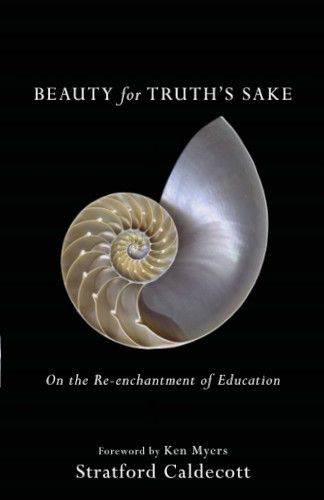
Fourth, is Stratford Caldecott’s Beauty for Truth's Sake. It aims at retrieving what Caldecott calls the Pythagorean spirit or, to put it another way, the retrieval of the liberal arts in their integrity: the mathematically grounded quadrivium and not just the language-centred trivium. Pythagoreanism sees mathematical order as the essence of beauty. This affects how we approach the contemplation of the universe, art, music, liturgy and prayer. Can you explain Caldecott’s proposal and why it is important?
Classical education has really caught on here. It began with Protestant schools and then moved to charter schools. Catholics are finally catching up.
It was inspired by Dorothy Sayers’s “The Lost Tools of Learning.” She encouraged people to enter into the trivium: the three ways of grammar, rhetoric, and logic. She even looked at them as stages in education. People have criticised the classical movement in the United States for focusing too heavily on the trivium to the exclusion of the quadrivium. It is too focused on words and not enough on numbers.
"Mathematics is the language of God. It is the language through which he has created the universe. Numbers have a deeper, symbolic, and even mystical meaning."
Stratford Caldecott has stimulated the classical movement among Catholics. This book can be paired with the one on the trivium: Beauty and the Word. The two of them were very influential, particularly fifteen years ago. A lot of people were reading them then and a lot of work has been done since then. However, for a time, these were the definitive books for Catholics on the classical approach to the paideia tradition and humane learning.
This book of Caldecott’s focuses on the quadrivium. It is important for Catholic educators to reclaim maths and science. Even here we should not have a secular approach. Mathematics is the language of God. It is the language through which he has created the universe. Numbers have a deeper, symbolic, and even mystical meaning. That does not mean that we need to get esoteric, to go back to John Senior. We do not have to go in that direction. It is simply to say that the order of numbers reflects the proportion, harmony, and truth of God's creation. So, this book has been very fertile for Catholic education.
5.
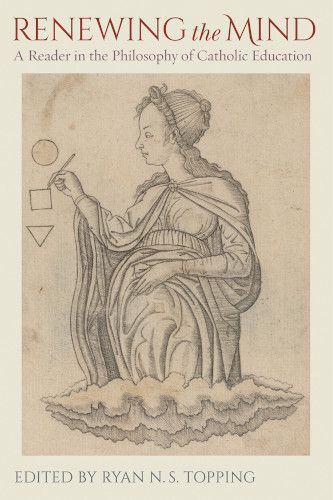
Your fifth pick is Ryan Topping’s Renewing the Mind: A Reader in the Philosophy of Catholic Education. This is a collection of some representative texts from the Catholic tradition on the principles of education, more specifically the principles regarding its end, curriculum, method, and renewal. Who should study this anthology and how can it be used?
A lot of principals ask me what they need to do to root their curriculum more deeply in the liberal arts or to take a classical approach. Often, they are looking for a curriculum, some concrete tools to work with, or policies to employ. My answer is always that the first thing they need to do is to think deeply about education with their teachers. If education is of interest to you, the book is worth reading.
Topping's collection offers excerpts from classical authors such as Plato and Aristotle and also more recent figures such as Newman, Dawson, and John Senior.
It is very important for teachers to break out of a purely pragmatic approach. I have found that they can be resistant to the intellectual life. They are not used to just thinking or taking time to read something worthwhile, to think about it, and discuss it. That is painful for many teachers. I have seen it in their faces. They look agonised at the prospect of taking time to think about something.
Many of these texts are difficult. Teachers have told me that as I have worked through some of these readings with them. That is good. Struggling with something worth reading enlarges your mind. We grow in our ability to think and contemplate by engaging complex ideas. So, this book can really help teachers if they are willing to commit the time and energy to go through the readings carefully, to think them through them, and discuss them. It will enrich their view of education itself.
What led to your own involvement in Catholic education?
I have been involved as a catechist, a professor, the founder of a high school, a diocesan administrator. My life has been about Catholic education as a whole.
When I was thirteen, I was expelled from the public schools for bringing my boy-scout knife to school. There was zero-tolerance. I was a non-practising Catholic at the time. My mom tried to get me into a whole bunch of other independent or private schools, but no one would take me in. Only the Catholic school would, and even then, the principal was hesitant. But the priest said, “No, we will give him another chance.” He invited me to come to daily Mass. I was not going to Sunday Mass, but he asked me to serve mass on the anniversary of his ordination one morning, and I really felt that the Lord called me to find my home within the Church. That is what I have done. So, when I was in eighth grade the next year, I read the whole Bible and then the Catechism. Since then, I have just been trying to understand God's Revelation, the teaching of the Church, and to share those truths with others. So, even in middle school and high school, I knew that I would dedicate my life to sharing the truth of Christ with others. That is educational by nature.
In the Catholic Studies program at the University of Saint Thomas, I saw that this would require a very broad approach. It is not just about theology but the broader tradition. It is a whole way of life. That is how you usually define culture. For me, then, Catholic education is initiation into the Church's way of life, into its way of thinking, and into the great beauty of that tradition. It is about integrating that into our lives and discovering a mission and vocation in the Church. I have tried to do this any way that I could. The first time, I was a director of religious education at a parish both times when I was still in graduate school. When I was hired by the Augustine Institute, it was as a professor of catechesis. I was teaching people how to share the faith. It is very natural for me to look for even new and innovative ways—now with Exodus 90— of sharing the truth of the faith and helping people to live that out in their own lives.
"If we think that we can educate children or evangelise children apart from their parents, our success will be very limited. "
You have first-hand experience in education at a school, university, and diocesan level. What led you work in education? What is the best strategy for responding to the current challenges to Catholic education?
It is working as closely as we can with parents. That is something that I have seen time and time again. The most successful schools are a community of families that is conscious about that mission and task. When you study catechesis in terms of what works, it is the influence of parents. If we think that we can educate children or evangelise children apart from their parents, our success will be very limited. I am a miraculous case. My parents were not trying to teach me the faith, yet through something that seemed tragic at the time, I was invited directly by the Lord, through the mediation of my pastor, to enter into the life of the Church. The Lord can take things into his own hands. Ordinarily, however, the influence of parents is by far the easiest and most successful path for young people to live out the faith. So, a Catholic school should think of itself as a missionary hub for families. A religious education programme at a parish should do the same.
When I was hired by the Archdiocese of Denver, the first task I received was to help implement a program for restoring the original order of the sacraments of initiation: baptism, confirmation, then the Eucharist. This is what the catechism teaches. We did that in second and third grade. Confirmation and first communion were in third grade. Everyone said, “Well, what happens to our catechetical programs after confirmation in third grade?” We replied that the number one thing to do was engage the parents in a family-based program of catechesis. The parishes that did, saw a lot of fruit.
You have edited the volume, Renewing Catholic Schools: How to Regain a Catholic Vision in a Secular Age? What are its main findings and recommendations?
This book was written in cooperation with the Institute for Catholic Liberal Education. I would encourage people, particularly those in the United States, to seek out their work. They do a lot of training for schools, workshops for teachers, and hold a wonderful national conference. In the book, our thesis is that the Church's two-thousand year tradition of education is a great treasury for us, as we look to the future. What should Catholic schools look like in the coming decades? Our approach to instruction and the general formation of students should be deeply rooted in this tradition. It should flow from our faith in Christ. There should be a unified vision within the curriculum. Everything fits together through this coherency of faith and reason. We should form our teachers and parents to build a strong community around this vision of faith and the unity of faith and reason.
Over the last ten years cultural or moral progressivism has become ever more dominant in institutions of education. There are still some distinctively Catholic institutions, but are there other ways of pursuing a Catholic education outside the school and the university?
Particularly, at the university level. My mentor, Don Briel, advocated for institutes and centres of Catholic learning at secular universities. There are some places where that is happening. The University of Mary, where I taught for a while, has a programme in conjunction with Arizona State University. The Newman Institute in Lincoln has a programme to support students at the University of Nebraska. There is a Catholic studies institute at the University of Pennsylvania. There is the Lumen Christi Institute at the University of Chicago. Those programs are a model. They are just a few examples.
When it comes to the K-12, I would advocate that every parent does whatever they can to get their children out of public education. It is detrimental to the spiritual and moral lives of our children at this point in time. In the past, it was more acceptable. At present, I do not think that, in good conscience, it is possible to have children in these schools. There are some good charter schools in the United States. The heart of education is missing even with a good charter school. However, a good one, especially when it is run by Christians, and even if cannot be explicitly Christian, can nonetheless be a great improvement from the public schools. People can probably send their kids to such a school in good conscience. Nonetheless, I think that it is worth the sacrifice and the investment to get them into a Catholic school. If there is not a good Catholic school in your area—something that occurs in the United States, but even more so in other countries, where the Catholic schools may be progressive—it is possible to start independent schools. I have done this twice on the high school level. It is possible. Many may be daunted by that, but if you get a group of motivated parents together, you can do more than you think. That may be more difficult to do in other countries. In the United States we have more freedom in the realm of education. But it is worth the sacrifice and the effort to ensure that our kids truly have the best Catholic education possible.